Black-tailed godwits, Leighton Moss
Showing posts with label Colwyn Bay. Show all posts

Tuesday, 10 February 2026

Colwyn Bay

Cormorants
There wasn't any shortage of perches, the original sitter was evicted just out of spite.

The train services are going to be bedlam next week, Manchester Piccadilly is closed for something or other again. I thought I'd best get one or two of the long-distance jaunts done and dusted this week, trains and weather permitting.

February's a good time for checking out the rafts of common scoters in Colwyn Bay. There are reports of a surf scoter this week (is it the same one every year?), it would be good to get them both on the year list and it's a very nice walk from the station to Old Colwyn.

Colwyn Bay Pier

Arriving at Colwyn Bay it's literally just a matter of walking out of the station, taking the footpath under the line and hey presto! there's the pier. The tide was lowish but on the turn. It doesn't go out very far here compared Liverpool Bay so seawatching was a practicable option.

Looking over towards Old Colwyn 

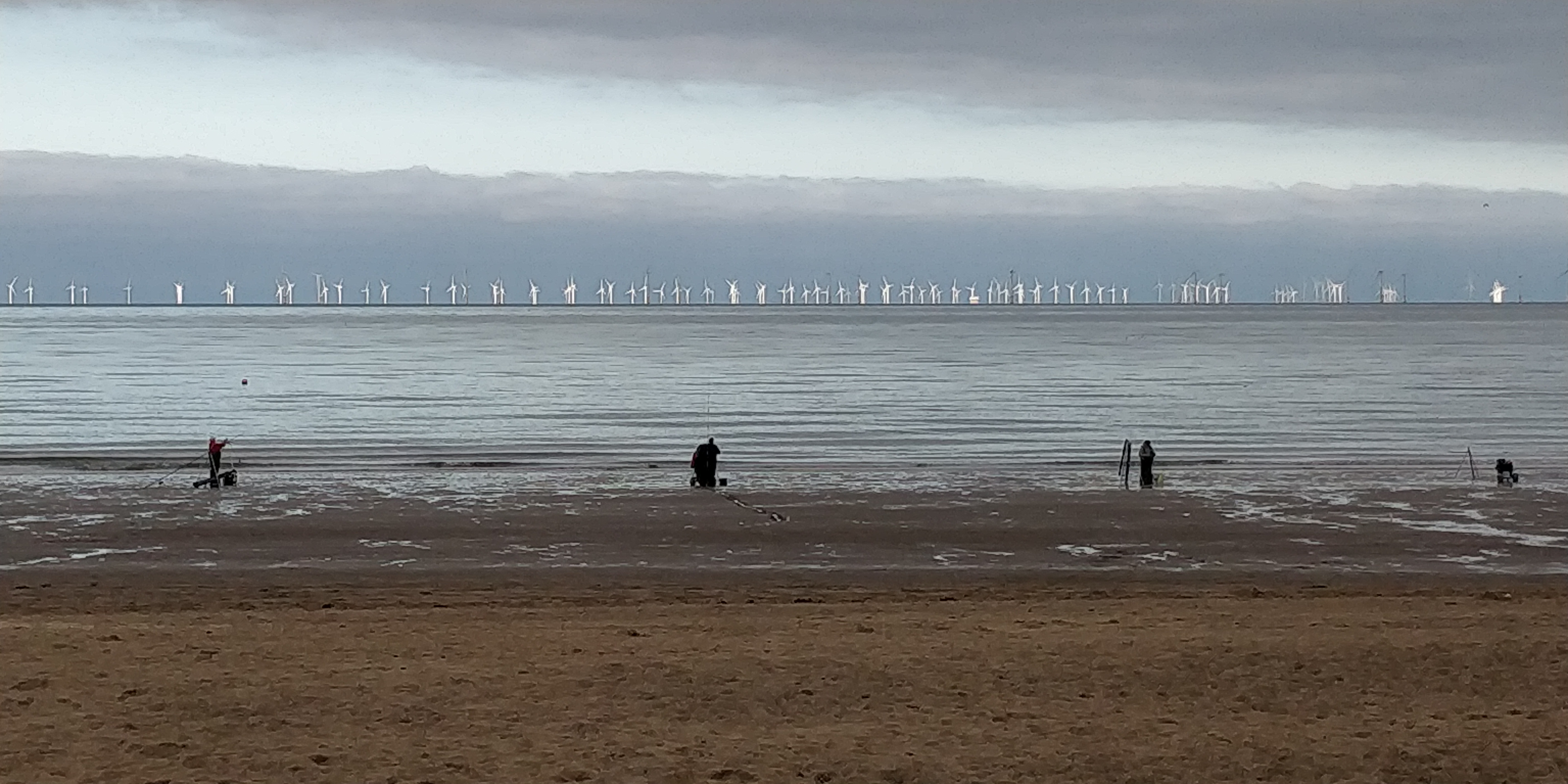
Seawatching's an odd business. You arrive, you look at the sea through your binoculars, not a sausage save a few waves. Then half a minute in you start seeing objects on the waves and half a minute after that you start recognising them. The weather was on my side today, dull but with good visibility up to about five miles, though the wind farm on the horizon was misty. Bright, sunny weather can bring out so much glare and contrast on the water you can't see anything properly. I had a fighting chance today and was soon seeing distant black blobs which eventually resolved themselves into scores of drake common scoters. I couldn't work out if I couldn't see any female scoters because they were too far away for me to pick up or if they just weren't there.

Herring gulls

I walked along a bit. Robins and a coal tit sang from the railway embankment. Herring gulls and black-headed gulls flew about making a racket, perched on lampposts and made a racket or bathed in the sea and made a racket. Cormorants perched on marker cones. Great crested grebes dived in the surf after dabs. I'm always surprised there aren't more waders here, I suppose it's because it's such a short beach and the promenade is always busy with people. Turnstones never seem unduly fussed by people, a dozen of them were busy throwing seaweed about by the car park.

Turnstones

The further I walked the more scoters I was seeing, there were hundreds of them out there with hints of plenty more beyond as every so often a stocky black speck would fly across the waves. Some of the rafts drifted closer inland but still well beyond my camera's capabilities (don't think I didn't try and don't think I didn't bin the results). I started to be able to pick out a few female scoters but they were still very heavily outnumbered by the drakes. A couple of paler objects had me baffled. Luckily they were drifting forward slower than I was walking and after a good five minutes' worth of head-scratching and bad language I finally recognised them as a pair of red-breasted mergansers. It was worth the effort, though, as the raft of scoters they were shadowing included a drake velvet scoter. I very much doubt if I could have picked it out with binoculars had it not raised itself up and given its wings a good stretch, letting me see the big which patch on each of them.

The sea was drifting in as I walked into Old Colwyn

A lady stopped me and asked me what was out there. She'd seen a group of people with telescopes on the fisherman's pier in Old Colwyn and here was me with a pair of bins. She was surprised to hear there were thousands of ducks out there every Winter and even more so when I lent her the bins and she could see a lot of them.

Looking back to Colwyn Bay

I walked down into Old Colwyn and stared out to sea from the fisherman's pier. If the surf scoter was about I wasn't seeing it, or was seeing it but not being able to identify it at that distance. I wasn't terribly disappointed, I'd got two out of the three species of scoter on offer onto my year list and had an exceedingly pleasant walk.

Old Colwyn 

I checked the train times and found that if I put a shift on I could get the next train back. I got it with four minutes to spare. I was ever so glad there was a trolley service and I could have a cup of tea.

Tuesday, 4 March 2025

North Wales

Herring gull, Rhyl Harbour

Woolston Eyes is having a purple patch with the penduline tit still playing hide and seek, the arrival of bittern and black-necked grebes and first thing a report of a ferruginous duck. I decided to head the other way so's not to spoil anyone's birdwatching. I've been having dreams about seawatching and felt the need for an excursion after a week's feeling ropey so I headed out to Colwyn Bay.

Colwyn Bay Pier 

It was a splendid, sunny Spring day. The wind had an edge but not unpleasantly so. Arriving at Colwyn Bay I ducked through the underpass and straight onto the pier. I have to say, whoever chose the colour scheme for the pier is a genius, the contrast between the ice cream buff and pink against the blues and greys of the Irish Sea is spot on. It was high tide, just right for seawatching.

Cormorant

Herring gulls and handfuls of black-headed gulls wheeled about. Cormorants sat on buoys. I quickly got my eye in on the seawatching. The high tide had done its work, hundreds of common scoters were small black shapes on the water instead of tiny black shapes on the water. There was a lot of preening and bathing going on out there and every so often a bird would rise on the water and flap its wings. It was too much to hope that one would conveniently have the white wing patch of a velvet scorer but it didn't stop me looking. A few groups drifted slightly closer, just close enough to be able to pick out the pale cheeks and brown plumage of the ducks, always outnumbered by black drakes. Every so often there'd be the white of a black-headed gull or a great crested grebe, one of which was in full breeding regalia.

The common scoters were small black shapes on the water instead of tiny black shapes on the water.

There was a huge congregation of rafts of scoters, a thousand or more birds, out opposite Old Colwyn so I walked along the beachfront thataway, scanning the rafts as I went. Most were very distant but I was getting good views of the birds about a quarter mile out. The distances involved in seawatching always amazes me. There was a bit of a kerfuffle with birds scuttling off the water and flying in slightly inshore as a couple of great black-backs passed by half a mile out. 

The further I walked the more I came to realise there were thousands of scoters out there.  I was very puzzled by a white and grey shape amongst the closest group of scoters until I'd taken a few steps further along and changed the angle of view and the bird became very obviously a black-headed gull. The occasional white flash was the wing panel on a great crested grebe as it flew low over the waves. A red-throated diver stood out as it flew by because of its pale underparts and plain wings.

I was about halfway between piers when a touch of white in a raft of scoters caught my eye. I expected it would turn out to be another grebe or gull, or the splash of a scoter coming in to land. The raft was pretty far out and was riding a swell in the wave so I wasn't getting a steady clear view of the birds. The white caught the corner of my eye again, it wasn't a whole bird it was part of a bird and I knew whereabouts to look now. The raft dipped out of view then rose again and I spotted the coot-like white splash on the forehead and the impression of something reddish orange about the beak of a surf scooter. At that distance with binoculars that's as much detail I was getting but it was enough to identify it.

Common scoters

I'd walked perhaps a hundred yards when most of the scoters took flight, heading East and leaving hundreds of birds behind in relatively small rafts of a score or so birds each.

I'd already seen a couple of pied wagtails along the promenade and assumed there was another with the pair of rock pipits flying by the Arches Viaduct until it flew back and I saw it was a grey wagtail. Robins sang under the viaduct as I had one last scan of the sea then headed inland for the bus to Rhyl.

Horton's Nose 

I caught the 12 to Rhyl, got off in Kimmel Bay and walked along the harbour onto Horton's Nose. The tide was still high but was showing hints of the ebb and the turnstones on the jetties were starting to fidget. I was hoping for a sighting of the black redstart that's been here for a while so I had a slow meander about. The only small birds I could find were three stonechats, a pair and a male that wasn't for being chased off far. Every so often they'd fly up onto a fence post, the males would tussle then they'd disappear into the grass. By my second circuit round the interloper had finally taken the hint and was feeding in the open ground away from the fence.

The tide began to ebb, I had to duck as a flock of turnstones flew out to shore and redshanks and curlews started feeding on the exposed mud on the river. I took this as a hint to head for my train home past the marine lake with the black swan amongst the herd of mute swans and the noisy flock of oystercatchers on the island.

Rhyl Harbour 

I didn't have long to wait for the train and struck lucky with the bus home. The cat assumed I'd been to Pennington Flash.

Rhyl Marine Lake

Thursday, 31 October 2024

Denbighshire

Herring gulls, Colwyn Bay 

It was another mild and mizzly day in Manchester with the tops of the vainglorious tower blocks of the city centre lost in the clouds so the obvious thing to do was to go to the seaside to look for distant ducks.

I had an envelope full of rail travel vouchers to use up so I put half of them towards a return ticket to Colwyn Bay. A surf scoter's been reported all week as being in the rafts of common scoters in the bay, I thought I'd have a go at finding it. And if no joy it's a nice place for a bit of seawatching anyway. There's a surf scoter on the North Wales coast most Winters, I don't know if it's the same bird each time. Last year I struck lucky and saw a couple of them off Llandulas.

It became a clear, bright, cloudy day. The line along the North Wales coast has plenty to recommend it for the sedentary birdwatcher though I could have done with the train finding some signals to stop at so I could have a proper look at some of the waders. Carrion crows, woodpigeons, jackdaws and herring gulls were the staple fare. Here or there there'd be a crowd of black-headed gulls, little egrets or redshanks. A flock of pink-feet grazing in a field near Llanerch-y-Môr viaduct was unexpected .A herd of mute swans seemed to have Rhyl Marine Lake to themselves. Half a dozen drake goosanders were showing off to a couple of redheads as the train passed over the Clwyd.

Colwyn Bay 

I got off at Colwyn Bay and walked round to the beach. The path under the expressway comes out at the pier, it would have been rude not to walk to the end to do a bit of seawatching. 

Mackerel fishermen 

It was a couple of hours after high tide but unlike the Wirral there's a steep shelf just offshore so the sea doesn't go far out. Close by there was a steady passage of herring gulls and there was almost as many black-headed gulls and cormorants as mackerel fishermen setting up their gear on the tideline. Carrion crows and jackdaws fussed about on the beach.

At first sight the sea at Colwyn Bay was empty

It wasn't.
You'll need to click on this picture to enlarge it enough to see the common scoters. There are a few pale cheeked females at the front.

About half a mile out the sea was littered with hundreds of common scoter. It took about ten minutes to get my eye in so I was seeing duck shapes rather than than indistinct dots. I was helped a lot by a few groups drifting in ever so slightly, once I had them in focus the further groups became less difficult. A great crested grebe swimming past about a hundred yards out helped me establish a sense of scale. Hundreds of common scoters. With just my bins to play with I wrote off my chances of seeing any other type of scoter out there without the aid of Providence.

Walking to Old Colwyn

It's a nice walk down the prom towards Old Colwyn. A crowd of herring gulls bathed in the outflow by the Port Eirias Centre in the company of a few black-headed gulls and jackdaws, a gang of carrion crows and a great black-back. A little further on a couple of oystercatchers probed the mud by the seawall.

Herring gulls and carrion crow, Colwyn Bay 

Herring gulls and carrion crow, Colwyn Bay 

Herring gulls, great black-back and carrion crow, Colwyn Bay 

Colwyn Bay 

I kept stopping and scanning the distant scoters. A couple of odd-looking birds turned out to be the back ends of fishing cormorants. Then I saw a flash of white where there shouldn't be one. The surf scoter must have been three-quarters of a mile out but it was facing me and reared up to stretch its wings. A flash of white on the front of the head then it settled down on the water and I lost it in the crowd. I saw it again a few hundred yards down the prom, it had turned its back to the shore, making it very much harder to pick out the white markings on the head. I owe Providence a cup of tea.

Heron and little egret, Colwyn Bay 

Aside from the two oystercatchers I hadn't seen any waders on the beach, it was far too busy with people and dogs. I passed a couple of small stone groynes and had no luck finding turnstones. The third one I passed was different: there were a dozen of them fossicking about on that one. And only that one, I didn't see any more further along. A couple of rock pipits flitted about the sea wall but didn't settle. A bit further along a heron and a little egret shared the fishing on a pool. And out at sea there were more distant scoters.

Old Colwyn

River Clwyd 

I didn't have the legs in me for the walk to Llandulas so I went into Old Colwyn and got the bus to Kimmel Bay for a potter about Horton's Nose and the harbour. The tide was well out here, the tideline marked by a distant line of cormorants. The best part of a hundred gulls loafed on the beach, a large flock of herring gulls and a few smaller flocks of black-headed gulls, there were plenty of both flying about with an eye on the half-term main chance. A pair of goosanders fished the river by the harbour, redshanks and black-tailed godwits rummaged about in the mud, and a large flock of pigeons had congregated on the mud under the road bridge for I know not what reason.

Horton's Nose 

River Clwyd 

The sun finally made an appearance as I walked over to Rhyl Station for the train home, walking by the marine lake on my way. The herd of mute swans shared the lake with a lone goosander and a small flock of black-headed gulls, a few herons and cormorants loafing and dozing on the island.

Rhyl Marine Lake 

The North Wales coast in the golden hour was my reward for good timing for the journey back. Shelducks dabbled in the mud as the train passed close by the Flintshire coast. I often mock myself for staring out of train windows in the forlorn hope of seeing an owl in the twilight. As we passed Hawarden Airport there was still enough light to watch a short-eared owl as it floated low over the trackside field.

Thursday, 27 June 2024

North Wales

Herring gull, Llandudno

A long-intended trip out to North Wales almost fell at the first hurdle: my train into Oxford Road arrived late enough for me to wave goodbye to the Holyhead train. As it happened, the next train to Manchester Airport was to become the next train to Holyhead so I got that, got to the end and came back on the strength of my monthly travel card and stayed on courtesy of a return ticket heavily subsidised by rail vouchers. Which was a much better way of passing the fifty-nine minutes than sitting at Oxford Road stewing about late trains.

I'd been debating whether to go to Anglesey or Llandudno, the lost hour decided it for me so I'd got a return to Colwyn Bay and would bus it from there — the buses from Llandudno Junction to Llandudno are scheduled to leave a few minutes before the train arrives there. It was a lovely ride, I'd been careful to sit on the right-hand side of the train so I'd be facing North most of the way and have a view of the North Wales coast. The tide was out so most of the birds were fairly distant and none of them waders. The only little egret was a flyover near Talacre. The lesser black-backs of inland England gave way to the herring gulls of the Welsh coast, a couple of dozen lesser black-backs loafing on the roof of an industrial unit in Saltney being a last hurrah.

Arriving at Colwyn Bay I decided I'd go straight to Llandudno and have a nosy round here on the way back, the trains back are once an hour. Five minutes walk and I found a gap in the traffic on the main road so I could run across and catch the number 12 bus that had just arrived at the stop. (There was no need to panic, mind, they're every twelve minutes or so.) This route goes through Rhos-on-Sea then along Llandudno Road through Penrhyn Bay and passes the Little Orme before going into Llandudno. The Little Orme has a substantial seabird colony, I haven't visited it, I thought I should. So I got off the bus just after Craigside and walked back along the promenade.

Little Orme and Craigside
That's gravel beach, not sea, in front of us.

Rook, Craigside

The promenade soon gave way to a grassed bank liberally supplied with park benches. There was a large flock of rooks in one of the fields across the road, a few of them flew over to feed on the grass here, entirely unconcerned about people though they got fidgety whenever a dog walked past. There were a few herring gulls about, a glance over with my binoculars confirmed the crowds were with the crowds at Llandudno.

Herring gull, Craigside

It was a mild, cloudy day with a strong wind pushing behind me as I walked. I stopped to scan the sea every so often. More herring gulls passed close by, as did a lesser black-back, a greater black-back and a few cormorants. Further out were more large gulls, probably herring gulls, and a handful of gannets. As I approached the houses of Craigside the first shag of the day was loafing on the choppy sea a few hundred yards out.

Little Orme

I looked at the state of the tide and decided that the pile of limestone boulders marking the end of the seaside houses would be a prudent stopping point if I was going to be spending any amount of time watching the seabird colony. I'd been seeing guillemots flitting to and fro between the cliffs and the open sea as I walked up. I found a boulder with a good view, sat down and had a look round.

Little Orme
The black shapes on the grass are mostly cormorants (there are a couple of great black-backs in there, too), the ones on the sheer cliffs ate shags.

I was getting distant views of the birds, which would still have been the case if I'd been able to walk to the bottom of the cliffs, but they were good views. Cormorants littered the grassy slopes, shags were peppered about the sheer cliffs or traced in black lines along ledges. And there were hundreds of them. A few herring gulls and great black-backs hovered around. It took me a while to find any kittiwakes and fulmars, and there weren't many of them on this side of the cliffs. It took me even longer to find any nesting auks, the first were a pair of razorbills on a ledge near some shags. There was a constant, heavy traffic of hundreds of guillemots commuting between the sea and a big cleft in the cliffs closest to me.

Little Orme

I kept an eye out for black guillemots, they're resident round here unlike the other auks that disappear after the breeding season. Every so often I'd get my hopes up with a black shape on the sea then the wave would swell and show me a razorbill. Some of the guillemots were surprisingly dark underneath and made me look twice as they landed on the water. Luckily auks are easy to identify (least ways, the ones that breed in Britain are): guillemots taper at both ends and the upperparts look brown; razorbills have blunt ends and are black and white; puffins, which I haven't seen on the Welsh mainland, are black and white stocky torpedoes. Black guillemots are the easiest of the lot: in Winter they're mostly white, in Summer they're jet black except for a big white patch which covers most of the base of the wing. It was that big white patch I was looking out for. And, in the end, wasn't seeing. But there was plenty enough else to keep me interested.

Shags, Little Orme

The tide engulfed the stone I'd selected as a warning sign and I made tracks back. Stopping every few yards for another quick scan of the sea just in case, as you do.

Little Orme

I walked back along the gravel beach, house sparrows fossicking about the garden walls of Craigside and a dunnock singing from one of the gardens. It seemed strange to only see the one linnet and no pipits, I suspect it would be a different story if I'd been walking through the fields across the way. Sea beets were doing their best to make sure there'd be something for the beachcombing flocks of Winter.

Sea beet

Sea holly

I got the 12 into Llandudno and had a walk along the promenade which was, predictably, very busy despite the strong wind. Herring gulls and jackdaws lurked about waiting for easy pickings. The herring gull pictured at the top was minding its own business as it stood on a railing. A bloke, keen to show off to his missus and toddler, approached it and jabbed a finger at it. "Come on and bite me then," he said, repeatedly. The fourth time the gull flew off. It should have gone for his throat.

Little Orme and Craigside from Llandudno

Out at sea there were more herring gulls, a few cormorants and shags and a couple of very distant gannets.

Llandudno Pier

I had a bit of a wander, decided I didn't have the time or energy to do the Great Orme any justice so got the 12 back to Colwyn Bay.

Colwyn Bay 

There was the best part of an hour for a walk along the promenade before getting my train home. It was one of those languid Summer teatimes where herring gulls and black-headed gulls pass by with an utter lack of urgency, an occasional cormorant can be seen in the middle distance out to sea and every tide pole has a Sandwich tern sitting on it.

The journey back was pleasantly uneventful. I added rock pipit to the year list as we slowly passed by Old Colwyn.