Black-tailed godwits, Leighton Moss
Showing posts with label Hodbarrow. Show all posts

Monday, 29 June 2026

Hodbarrow

Panic! I couldn't see what had spooked these black-headed gulls and Sandwich terns

With the passing of the heatwave I thought I'd best make an effort at picking up last week's itinerary. So I used up one of my Delay Repay compo tickets and got the trains to Millom for a visit to Hodbarrow. 

I had to get the busiest train of the day into Manchester so I could catch the Windermere train that connects with the Corkicle train at Lancaster, this being the train that stops at Millom. (It's still rail replacement buses from Corkicle to Whitehaven.) After this one the next connection less than an hour is late afternoon, which is one reason why I've been putting it off. The over reason is that the busiest train of the day into Manchester is also the one that only has half the number of carriages of the trains running the rest of the day. It must have been like one of Dante's circles last week.

Grange-over-sands Station 

Anyway… I got the Windermere train, got the Corkicle train and got to Millom. Along the way I noticed three spoonbills fast asleep opposite the Eric Morecambe Hide at Leighton Moss (they'd moved on on the way back); very little on the salt marshes of Morecambe Bay that wasn't a jackdaw, a carrion crow or a little egret; a few eiders by the viaduct over the Leven; and an osprey back at the nest by the track on Arnaby Moss (possibly the same one was sat on the nest on the way back). And the scenery, as always, was quite a bit better than pretty good.

At Kirkby-in-Furness Station

It felt like next to no time between getting off the train and arriving at Hodbarrow. Herring gulls, lesser black-backs and jackdaws sat on chimneys and rooftops and the presence of a pint-sized herring gull chick loudly begging on a house's pitched roof led me to wonder how it didn't roll down into the gutter when it was an egg.

Little egrets and cormorants 

Approaching the entrance to Hodbarrow I became aware of a peculiar creaking noise in the distance, like fairground machinery badly in need of lubrication. I wondered if there was a Summertime Seaside Spectacular happening at the holiday home haven but it became apparent it was coming from the nature reserve. In fact, it was the noise of the colony of little egrets at the landward side of the lagoon. The cormorants nesting beside them had their own repertoire of croaks and grunts but they were drowned out by the creaks and groans of the egrets.

A small raft of herring gulls loafed on this corner of the lagoon and mute swans cruised over on the other side. The colony of terns and black-headed gulls is hidden from view here, just hinted at by small white figures flying about in the distance.

Common blue damselfly 

The path from the entrance through the trees was fairly quiet. Blackbirds sang, chiffchaffs squeaked and goldfinches twittered about. A blackcap singing by the entrance on Maingate Road was the only one I heard. A way in, perhaps a hundred yards after the car park, a garden warbler in deep cover was in a hurry to get its song finished. The wayside sparked with common blue damselflies, red admirals sunned themselves on the path and a confusion of bees and hoverflies busied themselves among the vetches and brambles.

Black Combe from Hodbarrow 

A stiff, cool breeze asserted itself as I reached the more open country. The heathland was thick with bracken, bedstraw and rosebay, the areas of thinner soil carpeted with thymes, horseshoe vetch and restharrow. Sand martins flashed by at knee height, rising only to turn and swoop back for a fresh run over the ground. A couple of house martins flew higher, tending to skim over the trees and bushes rather than fly between them. Meadow browns and ringlets fluttered through the grasses and some vividly fresh painted ladies continued what has been an excellent year for them. Whitethroats churred and sang from hawthorn bushes and a couple of willow warblers sang from patches of scrub. And I started to hear Sandwich terns.

Duddon Estuary 

Hodbarrow Lagoon

I had come late to the party. Not many terns were commuting from the Duddon Estuary to the colony, and most of they common terns. The Sandwich terns passing over the sea wall were carrying their loads of sand eels at a leisurely pace, the common terns a bit more hurried. High overhead a few juvenile terns noisily chased after their parents out into the estuary.

The seabird colony on the gravel banks

A raft of Canada geese cruised about this corner of the lagoon. Eiders drifted over to join the dozens loafing on the edges of the gravel banks. A couple of bar-headed geese floated just offshore. There was a lazy high Summer feeling to the whole scene despite the cool wind.

Sandwich terns 

I joined the hide and had a look round. There seemed to be a lot fewer Sandwich terns than last year and they were further away than usual, to the right, from the hide. The youngsters I could see were nearly full-grown, it could be that I'd missed a lot that have moved on. 

The black-headed gulls, as always, were very vocal and were spread across the gravel banks. There weren't many common terns but they made almost as much noise as the gulls. Both were running the full gamut of stages of breeding: some sat on nests, some had chicks begging for food at the nest, some had juvenile birds running after them begging, and a few of the juveniles were capable of flight. Woe betide the wandering juvenile Sandwich terns that got too close to the gulls, they were soon bundled over and sent running back to their flock. Similarly, a couple of young black-headed gulls got a good going over from the common terns and their parents had to intervene and escort them to safety.

Red-breasted mergansers

A raft of red-breasted mergansers, mostly young redheads, bobbed about just offshore, socialising with the eiders, lapwings and shelducks keeping out of the way of the gulls and terns. A ringed plover dashed about between the flocks. Family parties of oystercatchers marched through like they had a free pass.

The nesting common terns kept their distance from each other, and they joined forces to make sure nothing else filled the gaps.

A couple of times a panic ran through the flocks and a cloud of gulls, terns, lapwings and starlings took to the air. Which is how I spotted there were any starlings about. I couldn't see what had caused the commotion and the birds settled back down within a couple of minutes. 

Sandwich terns, a young bird is on the left

All the time I was looking for, and failing to find, any little terns. Looking at the numbers posted on the observations board it looks like not many arrived here and for the second year running they didn't stay to breed, which is a pity. Has it been the weather? Has the habitat of the gravel bank changed? Is it competition from the other gulls and terns? I've no idea, I just hope their fortunes pick up.

Ringlet

I walked back. A small heath fussing about in the grasses on the seaward side of the path wouldn't sit still for the camera, the ringlets on the landward side were more obliging. Chiffchaffs sang in the trees, goldfinches and linnets bounced about the heathland and a handful of swallows had joined the martins.

Common darter
I had to look three times at this one, he's a very flushed shade of red for so early in the season

There were more dragonflies about. Black-tailed skimmers and common darters sunned themselves on the paths and an unidentifiable hawker shot past me and off over the lagoon.

Common darter

I walked back to the station and checked the train times. Even though the train back to Barrow was running late it would connect with the train back to Lancaster. I had a choice: I could hang about for an hour at Barrow or Lancaster waiting for the next train to Manchester or I could spend the best part of an hour at Leighton Moss.

Shoveler

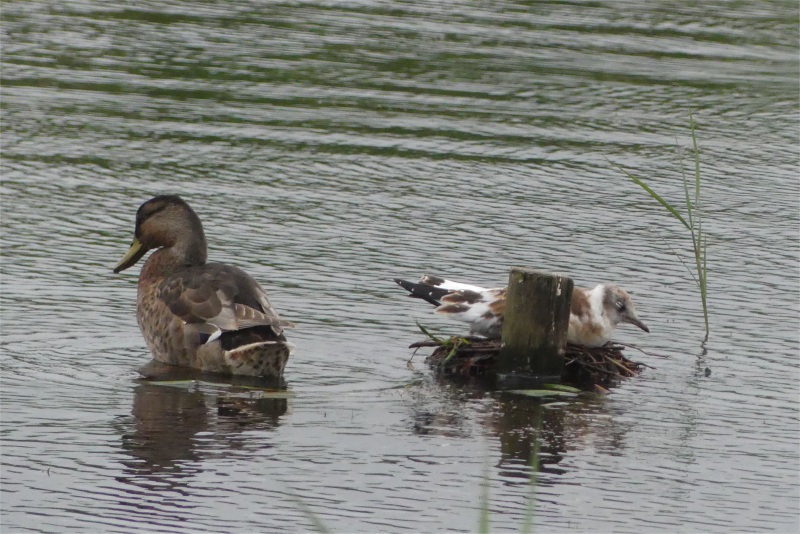
I spent nearly all that time in Lilian's Hide, a Cetti's warbler providing the backing track to the experience. The black-headed gulls had nearly all moved on, just the one pair was sitting on a very late nest. The male's badgering any passing great black-back just seemed to be drawing attention to the nest for future pillage. A crowd of gadwalls had gathered in one corner of the pool, a few mallards and shovelers were scattered about. The drakes were all already well into the moult into eclipse plumage.

Shoveler 

Out over the reedbeds a female marsh harrier rose out of the reeds, flew a lazy circle and settled back whence she came. The great black-backs had a large youngster in the nest. The only things big enough and daft enough to try and rob a great black-back's nest would be a sea eagle or a couple of great black-backs and sure enough the parent at the nest kept a close eye on the couple of great black-backs circling nearby.

It was time to be getting back. I didn't have long to wait for the train and got home without fuss or incident after quite a full day's birdwatching.

Saturday, 28 June 2025

Hodbarrow

Black-headed gulls and Sandwich terns

I had a pile of Go Anywhere On Northern return tickets burning a hole in my pocket with more on the way so I thought I'd best get one used up. I've been "going to Hodbarrow" since the end of March and have either been distracted or put off by the lousy train services between Lancaster and Preston, I thought I'd best get out there, have a nosy round, get it off my worry list. So off I went.

I set off early for me, the rush hour hell to be avoided of the weekday is a leisurely journey on a Saturday. I got the Windermere train to Lancaster and the Carlisle train from there. Swings and roundabouts, on a weekday this would be a lot less busy than it was today.

The birdwatching had been quiet on the way up. Even the coastal pools at Leighton Moss were quiet, a handful of avocets lingered with some black-headed gulls, little egrets and a great egret. A carrion crow chased a marsh harrier over the fields just beyond as a red deer hind and her two half-grown fawns watched on.

A grey and cloudy day got greyer and cloudier and distant hills became faded pedestals for rolling mists. The tide was coming in as the train went over the Kent at Arnside, the last redshank beating a retreat as we passed. A couple of dozen eiders bobbed about on the Leven by the viaduct in the company of a handful of mute swans and a couple of mallards.

We passed the gangs of herring gulls and lesser black-backs at Ulverston and Barrow and the great mass of large gulls at the waste management site just outside Barrow. As the train traveled up the Duddon Estuary dozens of black-headed gulls and oystercatchers shuffled closer together on the mudbanks as the tide rolled in with the brisk wind. I looked over to the old osprey nest on Arnaby Moss but saw no sign of its being in use.

I got off at Millom and walked the mile or so to Hodbarrow. It would have been a heavy and uncomfortable walk but the wind was so brisk it felt like Spring. House martins and swifts swooped about at rooftop height, beyond the houses swallows skimmed low over the fields and shot across the road at knee height.

Little egrets and cormorants 

The distant sounds of heavy machinery in need of a regiment of grease monkeys resolved itself into the grunts and croaks of nesting little egrets and cormorants. The cormorants had young in their nests, I think there were one or two juvenile little egrets but at the distance from the path across the lagoon to the trees it was impossible to be sure of it. A handful of herons lurked about the bank under the trees with a bunch of mallards and mute swans.

Walking towards the old lighthouse 

The wind was keeping all the small birds undercover but, mercifully, they weren't all for keeping quiet. Chiffchaffs and willow warblers sang in the trees, blackcaps, dunnocks and greenfinches in the bushes and blackbirds sang from both. The robins crept about silently and I was surprised to neither see nor hear any wrens.

Hodbarrow 

Out in the open whitethroats sang from the depths of gorse bushes, reed buntings from brambles and a lesser whitethroat claimed the biggest hawthorn bush as its own.

Common thyme

I remembered seeing bee orchid along this path in the past and I kept a look out just in case. There were no orchids that I could see but there was plenty else in bloom.

Kidney vetch

Centuary

At last I reached the corner of the lagoon and the start of the sea wall, I always trick myself by thinking the end of that North bay is the start of the sea wall when it's actually the three-quarter mark. A small group of Canada geese steamed out of this corner and headed for the crowds on the shingle beach. The tide was nearly in on the Duddon with just a tiny patch of beach yet to be invaded.

Duddon Estuary 

The tern and gull colony in the lagoon

It was late in the season and there wasn't the frenetic feeding activity on the tern colony. Earlier in the year I'd have been ducking my head as terns flew low over the seawall between estuary and nests. A few black-headed gulls flew over, a few lesser black-backs flew by. I was wondering if I'd missed the boat but every so often the wind dropped slightly and I could hear terns calling.

Sandwich terns and black-headed gulls 

As it happened I hadn't missed the boat. There were still lots of Sandwich terns and common terns out on the shingle beach, together with crowds of black-headed gulls. A lady in the hide said that the little terns had gone, they'd been crowded out by the black-headed gulls and hadn't had a good season. The black-headed gulls had had a good season by the looks of it, some nests having half-grown youngsters, many of the older juveniles being capable of flight. Whatever their stage of development, God help them should they stray into another bird's territory. Some of them got a serious pecking until their parents intervened. The Sandwich terns seemed more sedate but they were at least as noisy. Many of the juveniles were flying with their parents, begging as they went. The common terns were more thinly spread and it took me a while to start picking up the juveniles in the crowds of Sandwich terns and black-headed gulls. A few pairs of oystercatchers with chicks were dotted about in the grass, a ringed plover with a near full grown youngster lurked near cover at the front of the shingle beach. A great crested grebe sat on its nest in the middle of a crowd of juvenile gulls and terns bathing in a tiny inlet by the beach.

Common tern

Sandwich terns and black-headed gulls 
A juvenile Sandwich tern just scuttled into the grass on the left.

Canada geese, oystercatchers, black-headed gulls and Sandwich terns

Common tern

Juvenile black-headed gull and ringed plover
Two different plumage strategies for merging with a gravel beach.

Black-headed gull and Sandwich tern 

Sandwich terns and black-headed gulls
Juvenile Sandwich tern limbering up at the front.

Millom from Hodbarrow on a grey and gloomy day

Black-headed gulls 

Crowds of Canada geese were everywhere. Eiders, all the drakes in eclipse plumage, loafed on the water's edge while a couple of dozen red-breasted mergansers sat offshore with a few greylags and mute swans cruised about aimlessly. A cloud of black-headed gulls shot in the air as a great black-back passed over ominously low and settled back down the moment it had gone on its way. All in all it was a lazy June day on the colony more befitting a sunnier sort of day. A flock of sand martins flew in to join the swifts hawking low over the lagoon to make the picture complete.

Mute swans, Canada geese, greylags and red-breasted mergansers

Duddon Estuary 

I walked back and watched the breakers hitting the rocks on the estuary. It had been good walking weather so I decided to take the path that loops round away from the lagoon before returning to the car park. Most of this path runs through the trees and I thought I might hear and see more birds with a bit of cover from the wind. I was rewarded with more blackcaps, blackbirds, willow warblers and chiffchaffs and a family of long-tailed tits bouncing through the willows.

There was about ten minutes to wait for the train back to Lancaster. We passed Green Road and I kept an eye out for the abandoned osprey nest and was astonished to see an osprey standing on it. The eiders had been pushed upstream of the viaduct on the Leven with the tide. Redhead goosanders dozed with the mallards and black-headed gulls on the last remaining mudflat at Arnside.

I got off at Silverdale. I had the choice of mooching around for an hour at Lancaster for the Manchester train or mooching around for an hour at Leighton Moss for the same train and it was an easy decision. And the birds were a lot closer to hand.

Robin

Robins and blue tits rummaged about the hideout while more blue tits jostled with the great tits, chaffinches, greenfinches and goldfinches on the feeders. The jostling about was providing easy pickings for half a dozen mallards and a pair of crows.

Carrion crow

As I walked through the trees to Lilian's Hide blackcaps, chiffchaffs, wrens and a Cetti's warbler sang in the undergrowth.

Chaffinch 

I had Lilian's Hide to myself, a pleasant novelty. The black-headed gulls were noisy and fidgety and will soon be taking their kids further afield. The coots crowded in their corner, the mallards and gadwalls skulked by the reeds. Greylag geese, a great crested grebe and a shelduck cruised about. In the distance I could see the great black-backs have two youngsters in their platform nest.

Mallard and juvenile black-headed gull 

Did I have time to go and have a nosy at the Causeway Hide? I checked the trains as I left Lilian's Hide. I had time enough to walk to the causeway (but not the hide) and back then on to the station without having to rush. If I missed that train I'd be stuck here for two hours after closing time and it was looking like rain. So I walked down to the causeway and back. I was rather hoping to bump into the marsh tits having had no luck on the previous couple of visits. I had no luck today, either. I did hear a booming bittern and watched a marsh harrier floating over the reedbeds.

I got back to the station with seven minutes to spare for the train back as it was running four minutes late. A Cetti's warbler sang in the rain from the reserve car park as the train pulled in.


Tuesday, 30 April 2024

Hodbarrow

Little tern

I've had Hodbarrow in my sights for a few weeks and now the trains to Barrow are back in action and the weather okay there was no excuse not to go for a visit and, hopefully, add common tern and Sandwich tern to the year list. A very ropey night's sleep had me wondering if I really wanted to bother but I got myself an old man's explorer ticket and set out. The weather was gloomy and although I was overdressed for sitting in the train I was equal to the strong, cool wind that was blowing. I took my raincoat to make sure it wouldn't rain.

The trip up was without incident. Jackdaws, carrion crows and woodpigeons abounded. A couple of swifts flew low over Carnforth Station. The lesser black-backs of Manchester gave way to the black-headed gulls of Bolton and Chorley which gave way to the herring gulls and lesser black-backs of Preston. Herring gulls nested on Ulverston Station, the heronry at Meathop was busy, the black-headed gull colony on the coastal pools at Leighton Moss was packed. There was something on the old osprey's nest on Arnaby Moss but the black tail feather tips on show could have been a crow, rook, raven or even an osprey. 

The herring gulls at Ulverston Station were already nesting, these lesser black-backs were still billing and cooing.

I'd been doing so well with the train-bound birdwatching and the weather was looking so unpromising I wondered if I should just stay on the train and leave Hodbarrow for another day. I dragged myself off the train at Millom and headed for Hodbarrow and I would have good reason for being glad that I did.

The chiffchaff singing at the station was the last warbler I'd hear for the next mile. Blackbirds, chaffinches and collared doves sang, the rookery was noisy and busy and every other rooftop had its crowd of herring gulls or pair of lesser black-backs. Spadgers fussed in garden hedges, greenfinches and goldfinches in treetops. A handful of swallows hawked at chimney pot height above the road.

Walking into Hodbarrow 

Walking into Hodbarrow I was greeted by singing chiffchaffs and willow warblers, which came as a bit of a relief after a warbler-free walk by the hedgerows. I needn't have worried; the reserve was heaving with warblers. The singing at the entrance was accompanied by absurd bubblings and croaks which told me that the mixed colony of cormorants and little egrets was in full swing. I walked through to the edge of the lagoon and looked over: a couple of dozen cormorants were on nests, there were a similar number of little egrets in the trees but I could only find a couple of nests. A raft of herring gulls and lesser black-backs loafed in this relatively quiet corner of the lagoon.

Cormorants and little egrets 

Walking along chaffinches and blackcaps joined the songscape in the trees, blackbirds, whitethroats and a song thrush sang from the gorse bushes. Every so often a dunnock or linnet would strike a pose in a gorse bush and sing. Greenfinches and goldfinches twittered between trees, robins staked out the path margins, sand martins flew round the old iron mines. And all the time there was a constant traffic of rather noisy black-headed gulls.

Walking towards the old iron mines

Red-breasted mergansers
Mergansers nearly always strike me as having untidy crests but when you see them in display like this they make sense.

The terns I heard a long time before they came into view. The corner of the lagoon by the iron mines was dotted with eiders, tufted ducks and Canada geese. Two drake red-breasted mergansers were putting a lot of work into impressing a duck, their slow motion head bobbing accentuated by the symmetry of their long bills and crests. A few terns flew in and wheeled round before disappearing over to the noisy colony on the shingle over by the sea wall, they were all common terns. Odd ones and twos flew by as I watched the mergansers. Then one that didn't quite look right. The grey belly looking slightly darker than the wings might have been a trick of the light but the plain pale wings were those of an arctic tern and the black cap not stretching down the nape made the head look different to the common terns. I was quite chuffed to get two additions to the year list so quickly.

Old iron mines from the sea wall

Eider on the lagoon

Eiders on the Duddon Estuary 

I joined the path on the sea wall. Over on the Duddon Estuary a few pairs of eiders bobbed in the sea, on the lagoon there were hundreds of them. A flock of swallows twittered madly as they flew over the sea wall at knee height. Herring gulls flew out to sea, black-headed gulls flew hither and thither but the noise of the gulls was equalled by the calls of terns. Most were common terns, many dozens of them rather than the hundreds of gulls but making up for numbers in noise. A few Sandwich terns and common terns flew over the sea wall to fish in the estuary. Most of the little terns stayed in the lagoon. Every year I'm surprised by how small little terns are.

Ringed plover making sure I stay on the path

I walked over to the hide. Linnets chipped from clumps of mustard and ringed plovers tried to distract me from patches of bare ground so I was careful to stick to the path. I was scanning the lagoon as I walked along and got a surprise when I noticed a whimbrel standing on the rubble that serves as a screen between the path and the shingle.

Whimbrel 

Eiders

Eiders, oystercatchers and herring gulls 

Black-headed gulls 

Little terns

I sat in the hide and scanned the shingle banks. Hundreds of black-headed gulls sat on nests, hundreds of eiders loafed, many dozens of common terns fussed about. There weren't many Sandwich terns but they were busy making babies. The little terns kept to a couple of shingle islands. A distant black-tailed godwit in rust red breeding plumage dazzled amongst all this monochrome. A couple of dunlins and a few more ringed plovers skittered about, a redshank flew in, a couple of lapwings lost themselves in the crowds. A very dapper common gull preened at the edge of a pool.

The view from the hide

I was about to leave when the lady sitting nearby said: "Roseate tern!" It took me a while to see where she was looking but there, fast asleep by a pair of black-headed gulls, was a bright pink tern. My fears that it was a common tern that had done well on a shrimp diet were allayed when it woke up and had a look round, displaying a great black dagger of a beak. It promptly went back to sleep again before I could get my camera on it. I really wasn't expecting a life tick today!

Black-headed gulls, common tern (centre left), roseate tern (centre, in front of the pair of gulls) and Sandwich tern (right)

Male wheatear 

Female wheatear 

I tried and failed to not disturb the ringed plovers on the way out and bumped into a pair of wheatears. Walking back a sedge warbler riffing a rapid series of squeaks, churrs and rattles was a nice bonus for the year list.

It's a very substantial sea wall

If I didn't dawdle I'd be okay for the quarter past four train back to Barrow. I checked the times and found it was running three-quarters of an hour late. So I sat down for a bit and listened to the songs of linnets, chiffchaffs, blackcaps and a song thrush as sand martins flew overhead.

Walking back from the sea wall 

I got the late-running train and even though it didn't stop at any of the stations before Barrow I still missed the Manchester train by ten minutes. I got the next train to Lancaster, enjoying the little egrets and shelducks on the fields and marshes and the marsh harrier cruising the pools at Leighton Moss, then had an hour's wait for the next train to Manchester from Lancaster. Which, surprisingly, didn't take the gloss off an excellent day's birdwatching.