Black-tailed godwits, Leighton Moss
Showing posts with label Frodsham. Show all posts

Monday, 15 July 2024

Frodsham Marsh

Yellow wagtail 

It was a lovely sunny morning and I thought I'd best get a visit to Frodsham in before the end of the singing season. It was going to be cloudy later and there was a yellow warning for rain overnight so if I was going to get a walk out in the open on uncertain paths done this week today was the best bet. I slathered on the sunblock and smeared vaseline round my nostrils and toddled off to the station.

Moorditch Road 

I got off the train at Frodsham, walked down the main road then over the motorway on Moorditch Road and onto the marsh. The weather brought out the butterflies, including at long last my first comma of the year, and I had to hang about for a few minutes while the spadgers finished their dust bathing before I could go over the motorway bridge. Blackbirds, blackcaps and chiffchaffs sang in the hedgerows, goldfinches twittered between fields and whitethroats sang from hawthorn bushes in the fields. A flock of rooks accompanied the horses in one of the fields.

No.6 Lagoon and Frodsham Wood Hill 

Mallards

I climbed up to No.6 Lagoon. Most of the usual precarious footways up to the top of the bank of the lagoon were an impenetrable mass of nettles, thistles and ragwort or were screened by dense hawthorns so I didn't get a good look at it until halfway down. The water was high and there was no exposed mud for waders to be found on. A few coots fussed about in one corner, a raft of a couple of dozen tufted ducks dozed at the deep end and sixty-odd mallards drifted about at the shallow end. I looked in vain for gadwall, shovelers or teal. A couple of dabchicks hinneyed by the near bank and a buzzard soared overhead unheeded by the ducks.

It was the odd time of year where you see sedge warblers and reed warblers long before you hear them and most of the time they only sing when they've seen you. There were plenty of both as well as chiffchaffs and whitethroats. For once I didn't hear or see a single Cetti's warbler all day here. The most persistent singers were reed buntings and blackbirds. There wasn't a lot doing out on the marsh that was visible from the path. Four carrion crows mobbed a passing raven. Crows tend to harass buzzards and harriers just because they're there, there's real intent when they mob sparrowhawks and ravens.

Walking beside No.6 Lagoon

It is a rule of life that you'll be passing between a high bank and a tall, thick hedge of hawthorns and elderflowers when a male marsh harrier passes ten feet over the path just ahead of where you're walking and that it will have disappeared over the marsh when you finally get to a gap in the hedge with your camera at the ready. It just is and you have to learn to accept it. About twenty minutes later I saw a female hunting over the marsh out by the river.

Another passing raven put up a small flock of lapwings and black-headed gulls that been hidden by a bank in one of the fields. They settled back down and disappeared beneath the bank. The handful of teal that could be seen dozing by the little pool there didn't move a muscle. I recalled that this was where I couldn't see a green-winged teal a while back so I gave them all a good stare before moving on.

Small tortoiseshell

Red admiral

Gatekeeper 

The clouds rolled in quickly and the weather was getting muggy. The ragworts were busy with butterflies, the first time this Summer I've seen crowds of small tortoiseshells and red admirals and I was reminded that small heaths are very small indeed. The meadow browns and gatekeepers were abundant and very fidgety and very distracting when you're trying to work out what the small birds are hopping about in the bases of bushes. Most turned out to be wrens, dunnocks and blue tits, some were reed warblers or linnets. There weren't any swifts about which was odd because they were swarming over the houses in Frodsham.

The cattle on the rough grazing were all lying down, as were half the sheep which is never a good sign. Any time I see cattle in rough grazing West of Runcorn I check for egrets of one kind or another. There were none to be seen today. A flock of starlings meandered through the bodies and here and there a greylag or a Canada goose poked its head above the grass. Somewhere far out a skylark was singing.

Lapwings and mallards

There were a dozen mallards and half a dozen teal with the coots and moorhens on the phalarope pool. One of the mallards had tiny ducklings with her and she seemed intent that the half-grown lapwings on the bank were some sort of threat to them. They scuttled out of the way sharpish. The deeper pool next to it was littered with tufted ducks.

Frodsham Wood Hill 

Lordship Lane 

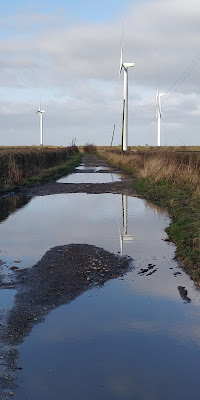
I followed the path round and down onto Lordship Lane where chaffinches and chiffchaffs sang in the trees, goldfinches twittered and sang well nigh everywhere and the road was a crazy paving patchwork of deep puddles. I'd be disappointed if it were otherwise. The weather got warmer and muggier and very uncomfortable indeed. I was wondering what was turning the wind turbines because the air was dead still along the road. The answer came when I got to a field opening and spent half a minute enjoying a very welcome breeze. I decided I wasn't going over Holpool Gutter and through the chemical works to see if I could have a nosy at Insch Marshes.

I was halfway down Rake Lane on my way to Helsby when it started raining. Random big blobs of rain, nothing steady but a hint of things to come. Luckily I had my cap on and wouldn't get wet. Swallows skimmed low over the fields of barley and young swallows begged noisily from the telephone wires. A yellow wagtail wheezed noisily from a wire as I passed, and well he might given the beakful of insects he was carrying.

Swallows and yellow wagtail

Juvenile swallow begging and male yellow wagtail 

The house martins flitted about Helsby Station when I arrived and I was extremely grateful for a sit down. I'd only been walking about three hours but for the past hour the weather had been draining. I had ten minutes to wait for the train. "It's still only mid-afternoon, we can move on to another site," said a voice in the back of my head. The rest of me told it not to be so bloody silly.

I really don't know why I neglect Frodsham like I do. It felt like a very quiet, nothing doing walk but I still chalked up forty-odd species of birds along the way.

Tuesday, 25 April 2023

Frodsham

No.6 Tank: black-tailed godwits, bar-tailed godwits, ruffs, shelducks, shovelers, teal and gadwall

I was tempted by the green-winged teal's third day at Frodsham Marsh. I seem to be going through a patch of catching up with birds I've not seen since before the pandemic so off I toddled in the hopes of carrying on with the lucky streak.

Female orange tip butterfly on dandelion

As I crossed the motorway and joined Moorditch Lane the air was full of the sound of birds trying to sing over the traffic noise. A song thrush and a wren were, predictably, the most nearly successful. Between them and the traffic I was lucky to hear the jangling keys songs of the dunnock in the hawthorn hedge and a corn bunting in a hawthorn bush in the opposite corner of the field.

Walking down Moorditch Lane there were a lot of small birds about, and a lot of willow leaves and hawthorn leaves to provide cover for small birds. In one stretch of the lane I bumped into six species of warbler. Blackcaps and chiffchaffs sang in the trees while whitethroats sang in the bushes on the rise behind them. My first sedge warbler of the year sang from a bit of rough reeds and nettles and a Cetti's warbler sang from the nettles in the ditch. I was to lose count of the number of Cetti's warblers I heard today. A garden warbler sang from a hawthorn bush, not sure if it was being a blackcap or a sedge warbler and being reassuringly different from the blackcap singing two bushes to my right.

No.6 Tank

The fields on No.5 tank were busy with jackdaws and rooks. A pair of ring ousels had been reported earlier but I couldn't see any sign of them. I bobbed up onto the bank of No.6 tank for a quick look round. Plenty of shelducks, mallards and tufted ducks, not as many shovelers as last time, and a pair of dabchicks. I hoped the green-winged teal hadn't skipped over onto this tank, all the teal I could see were distant silhouettes identifiable only by size and shape.

I exchanged pleasantries with the chap I last bumped into last year at Ince Blundell, each convinced they were the last birdwatcher on public transport. He'd been looking for the green-winged teal for a couple of hours and was about to go home but decided sod it, he'd give it another go. I last saw him half an hour later scanning the mitigation pool from a high bank. I note that the teal was reported there about the same time, I hope it was him he put in the work to deserve it.

No.6 Tank is on the other side of the high bank on the right

I had another look at No.6 Tank from further down the lane. There were about a dozen bar-tailed godwits amongst the crowds of black-tailed loafing and feeding by the shore. A few ruffs skittered about on the shore and a couple of pairs of gadwall dabbled with the shovelers.

I reached the mitigation pool — the tiny pool about halfway along the lane on the opposite side to No.6. There wasn't anything on that I could see. Four teal flew in and I got my hopes up but the drakes were all common teal. I walked along a little, scanning the pool all the while, and another teal popped its head up. Another drake common teal. I couldn't in all conscience turn any of the teal on the pool into a green-winged teal no matter how much I wished for it.

Moorditch Lane 

There were plenty of butterflies about, mostly orange tips with a few large whites, peacocks and small tortoiseshells, brought out as the cold, cloudy morning turned into a warm, bright lunchtime. I found myself acting as sheepdog to half a dozen sheep on the lane. Try as I might to pass by them they'd scamper on ahead a few paces. In the end they havered between me and a chap who was scanning the phalarope pool so they ducked under the fence back onto the marsh.

Garganey

A drake garganey was showing well on the phalarope pool in the company of a dozen teal and a couple of pairs of gadwall. A female teal joined it for a few minutes, I didn't think anything of it until I noticed it had a distinct eyestripe and a pale loral spot just in front of its beak. A female garganey hiding in plain sight!

Common teal

Whinchat

There were a couple of whitethroat skittering about in the vegetation at the front of the pool. I was looking at them when something small and colourful flitted by. I was lucky: it found a couple of sticks it liked and spent a few minutes fly-catching from them. I was struck by how different a whinchat looks side-on, where it is a small brown bird with a white eyestripe, and head-on, where it is a fiery orange bird with a black-and-white striped face.

Whinchat

I carried on walking to a backdrop of singing whitethroats and Cetti's warblers. A male marsh harrier floated over the marsh, stopping only to mob a buzzard that had floated too low and too near for its liking.

Marsh harrier

Lordship Lane was almost bone dry. In fact it was entirely unnecessary to step in any mud, which is remarkable so early in the year. Linnets, which had been a bit thin on the ground on Moorditch Lane, were plentiful and noisy, as were the goldfinches, chiffchaffs and whitethroats. Yet another Cetti's warbler sang a duet with a sedge warbler in the nettles in the ditch.

I seriously contemplated trying the walk into Elton and catching the bus back to Frodsham but after due consideration I had to concede that I had the mile and a half to Helsby in my legs but not the three and a half to Elton. 

There were more linnets and goldfinches in the hedgerows along Rake Line together with a lot of chaffinches and house sparrows. A raven gave a passing buzzard a very hard time. I got to Helsby in time to have missed the train by ten minutes then missed the bus to Frodsham because it was five minutes early(!!!) So I got the bus to Chester to get a feel for the Ellesmere Port/North Chester area and found out that the Ince Marshes aren't quite as inaccessible as I thought given a bit of planning.

The phalarope pool 

Back home for a much-needed pot of tea and then another after another good day.

Monday, 3 April 2023

Frodsham

Marsh harrier

I decided to go over to Frodsham today. It was a bright Spring day, I've not been there yet this year and I was feeling lazy so an easy trip out with a simple connection at Oxford Road appealed to me.

I saw my first butterfly of the year, a peacock, as the train passed through Winwick into Warrington. There were more butterflies, all small tortoiseshells, along the paths on Frodsham Marsh. Walking along Moorditch Lane every fifty yards there was a singing chiffchaff, robin or wren and goldfinches flitted between trees.

Frodsham Marsh, walking up to No.6 Lagoon

I took the path up past No.6 Lagoon. The sheep shared the fields with flocks of jackdaws and woodpigeons and half a dozen carrion crows swaggered about. 

Black-tailed godwits

Black-tailed godwits

Over on the lagoon there were a couple of hundred shovelers, mostly asleep on the far bank, dozens of mallards, teal, tufted ducks, coots and shelducks and about a hundred black-tailed godwits, mostly clustered together in the shallows by the reeds by the near bank. There were a few black-headed gulls loafing and bathing on the open water and a pair of dabchicks over at the deep end. A couple of redshanks and a lapwing were the only other waders I could find and they took some finding amongst the crowd of shovelers. A couple of Cetti's warblers sang, one from the bank of the lagoon and one from some brambles in the drain at the side of the path.

No.6 Lagoon

Marsh harrier

Marsh harriers

A couple of marsh harriers had been hunting at either end of the lagoon. They flew over and started skydancing together high above the wind turbines.

The clean-up crew attends to a dead sheep.
The small black birds are carrion crows, the others are ravens.

Ravens

I'd seen a couple of ravens flying about as I walked down the path. There was a crowd of them in one of the fields feeding on a dead sheep with a few carrion crows. At first I thought it was crows and jackdaws then some of the ravens flew over to the reedbeds on the lagoon and I realised I'd entirely misjudged the scale.

Walking further I was very aware that there was raven ribaldry going on over the other side of the high bank and they seemed very pleased with themselves about it. Eventually they flew up and flew acrobatic circles round each other, cronking their delight all the while. Ravens I am sure love flying for the fun of it, any bird flying upside down for no reason whatsoever must be enjoying themselves. A soaring buzzard drifted over and I thought the ravens might break off to give it a hard time but they were too busy with each other to be bothered. The buzzard made sure to climb sharply so that it was always soaring above the ravens, just in case.

Ravens

Lordship Lane 

I dropped down onto Lordship Lane which in parts was as muddy as hell, which by its standards is hardly at all. Flocks of linnets and goldfinches twittered between fields and hedgerows, more chiffchaffs, robins and wrens sang and a Cetti's warbler sang from a tangle of nettles and water hemlock in the drain by the lane.

Lordship Lane, a dry bit

I walked down Rake Lane into Helsby, chaffinches and great tits joining the linnets in the hedges and flocks of stock doves and woodpigeons feeding in the stubble fields. Another marsh harrier put up a flock of linnets over by the gutter.

I just missed the train back to Manchester from Helsby so I got the bus into Frodsham and was just in time for the next train from there (the Chester to Leeds train that skips Helsby). I'd had a very pleasant afternoon's walk and while the birdwatching hadn't felt busy it had still offered plenty to enjoy.

As I was walking home from Humphrey Park Station there was a commotion amongst the jackdaws, woodpigeons and starlings on Lostock School's playing field. I looked around for the usual sparrowhawk and found a male peregrine instead. Having scattered the birds he did a handbrake turn around one of the rooftops and steamed off towards the Trafford Centre.

Saturday, 22 October 2022

Frodsham

Stonechat

I looked at today's train cancellations and decided to have a day out at Frodsham while the sun shines.

I got off the train at Frodsham and walked straight up Marsh Lane and over the motorway onto the marsh. The signs of Autumn were everywhere, whether it be the skeins of pink-footed geese overhead, the sloes in the hedgerows — it seems to be a bumper year for them — or the riotous colours of the spindle trees and their berties along the paths.

Sloes

Spindle tree 

Spindle berries 

Spindle berries 

I walked down Moorditch Lane to No.6 Lagoon. The fields were surprisingly quiet, just a couple of carrion crows about. Robins, wrens, great tits and a chiffchaff muttered in the hedgerows.

Mallards

No.6 Lagoon was busy with ducks. Shovelers and mallards dabbled at the deep end with the tufted ducks and dabchicks, more shovelers loafed on the bank at the shallow end with upwards of a hundred each of wigeon and black-tailed godwits while pintails and teal dabbled at the margins. I scanned round for any oddments but the only other birds I could find were coots, moorhens and a great crested grebe. Large whites and red admirals fluttered by the bank by the path and a pair of brown hawkers were busy making baby brown hawkers.

Black-tailed godwits and wigeons

It wasn't busy out on the marsh. Carrion crows and magpies foraged and squabbled and ravens, black-headed gulls and linnets passed to and fro.  A sparrowhawk rose from the reedbeds on the lagoon and flew over towards the river. Not long after the godwits on the lagoon rose and headed over the same way. Other than that it was greylags, Canada geese, cows, sheep and a couple of fishermen. (I found out later than about half a mile beyond the fishermen, some lucky observer was watching a passing black-winged pratincole on some private land on Ince Marshes.)

The path by No.6 Lagoon
The lagoon is on the other side of the bank to the left 

The hedges along the path were considerably busier. Loose mixed tit flocks bounced around in the willows and poplars with robins and wrens while mixed finch flocks worked the bushes on the bank.  There was one flock of about forty finches working a patch of elder bushes on the bank. Even though they were very close I had trouble picking out what was what, had I not seen them go into the bushes I'd have thought there were just a couple of linnets and a chaffinch. As it was, the flock was roughly equal numbers of linnets and chaffinches with a handful of goldfinches, a couple of greenfinches and a blackbird. While I was trying to sort all this out a female stonechat flew into the bush next to me. There were a couple of juvenile stonechats in the reeds in the drain on the other side of the path.

Pink-footed geese

I was composing a note for this blog along the lines of how pleasing and appropriate it was to have six Cetti's warblers singing by No.6 Lagoon when the seventh piped up. There were eight in all once I'd finished.

Pheasant

A few shovelers and teal dabbled in the "phalarope pool" and pairs of gadwall and tufted ducks loafed on the deeper pool next to it. A brown hawker whizzed by; there was another dragonfly patrolling the bushes but I couldn't get a good enough sighting of it to know what it was except that it wasn't another brown hawker.

A few herring gulls and lesser black-backs passed overhead as I got to the far end of the lagoon. There'd been some fresh sludge dumping from the dredgings of the canal. I had a fruitless scan for any waders, there was just a couple of carrion crows. A couple of common gulls circled but didn't settle. I think they were curious to find out what was so important that the crows tried to chase them off. I think the crows were just being crows.

Frodsham Hill from Frodsham Marsh
Fresh sludge dumpings in the foreground 

I looked at the state of Lordship Lane and headed for Holpool Gutter. The going wasn't much better in that direction but at least it was a shorter walk to a more reputable lane. The potholes and puddles were navigable, it was the surface that made it tough going. I got the distinct impression that the sludge lorries had shed their loads pretty liberally on their way to the lagoon. There were more linnets, goldfinches and great tits; a couple of Cetti's warblers assayed a bit of song and a couple of fieldfares flew overhead. The stubble fields by the lane were noisy with ravens, carrion crows and magpies.

Ruffs and black-headed gulls

It was a relief to get onto the dryish rutted track that is Rake Lane. A buzzard lurched out of the hedgerow on the other side of the field as I passed the bridge over the drain. Near the end of the lane, in the field by the motorway, a couple of hundred black-headed gulls danced for worms in the company of a few dozen black-tailed godwits, a redshank and a handful of ruffs.

Alexandra Park, Whalley Range 

I got to Helsby with five minutes to spare for the train back to Manchester. I got in at tea time so decided to take a diversion on the way home, getting the bus into Moss Side and walking across Alexandra Park for the 150 bus to the Trafford Centre. The park was noisy with ring-necked parakeets, the pond was busy with mallards and tufted ducks. I'd either overestimated my stamina or underestimated the effort walking that half-mile stretch of Lordship Lane, I was very happy when the bus turned up.


Monday, 3 January 2022

Frodsham

Reed bunting

It looked like being a decent day so I decided on Frodsham Marsh for the first proper walk of the year. For a change I thought I'd start at Helsby and walk through to Frodsham.

There was a crowd of black-headed gulls on the school playing field as I set out, nearly ninety birds, together with common gulls, a lesser black-back and a couple of first-Winter herring gulls.

Waiting for the train at Oxford Road one of the city centre peregrines circled over for a couple of minutes before flying on over towards the Town Hall. It's been a while since I've seen one, I took it as a good omen.

Rake Lane

I got off the train at Helsby and walked down Rake Lane towards Holpool Gutter. The potholes in the path were ankle-deep with water, a recurring feature of today's walk.

The Spring-like weather was affecting some of the birds: a blue tit sang from the top of the hawthorn hedgerow and dunnocks were chasing each other round the hedge bottoms. There were carrion crows and woodpigeons in the stubble fields, a few pigeons and a pair of stock doves flew overhead and there were lots of small brown birds which weren't for sitting about waiting to be identified. It took quarter of an hour to be sure of the flock of linnets and the skylarks feeding on the ground, the flock of meadow pipits that flew in were rather easier, the one corn bunting I could reliably identify was a bit of a challenge. A small flock of reed buntings took pity on me and posed for the camera.

There'd been odd black-headed gulls and lesser black-backs flying overhead. A great black-back flew over Holpool Gutter while I was trying to see what had brought up flocks of curlews and starlings up off the marsh. I couldn't see the culprit, the great black-back was an innocent bystander. Five mute swans, including a particularly grubby first-Winter bird, flew in to join the sheep in one of the fields.

Buzzard

I'd had a bad night's sleep and the hypnotic swoosh and hiss of the wind turbines down Lordship Lane almost had me sleepwalking through the puddles. Which is how I almost missed a big charm of goldfinches in the dead thistles on the embankment and the flock of redwings in the hawthorns. Half a dozen ravens cronking overhead were difficult to miss, as was the buzzard sitting in a tree by the lane.

Along Lordship Lane

I walked up to No.6 Lagoon. At the top of the initial incline I looked back and had a scan over the fields I couldn't see from Lordship Lane. Three fields away a small flock of pink-footed geese were sharing a stubble field with crows and woodpigeons. Next door, difficult to see through the gaps in the hedge and more often than not hidden by passing sheep, was a small herd of whooper swans and at least one Bewick's swan. I climbed up onto the embankment for a better view but couldn't be sure there was more than just the one Bewick's. I was bounced out of muttering dark thoughts of frustration by a Cetti's warbler that started singing from the nettles by my side.

No.6 Lagoon

There was a small mixed flock of shovelers and teal on the "Phalarope pool," with a couple of mallards and a moorhen. A kestrel hovered over the marsh and a few herring gulls and black-headed gulls flew over the Ship Canal. There were lots more shovelers, teal and mallards on the pools further along the marsh. A dozen common gulls passed overhead including a first-Winter bird and what I think was a second-Winter bird with unusually pale marginal coverts that made me look twice.

Perching mallards

There were a couple of hundred shovelers on No.6 Lagoon, together with dozens of teal, mallards and pintails. A dozen shelducks dabbled by the reedbed on the Western side and half a dozen in the deep waters at the Eastern end. The water was high and there weren't any waders to be seen.

I carried on walking round and over into Frodsham without adding anything to the day's tally.

Frodsham Marsh

A nice walk on a mild, sunny day and a good start to the birdwatching year.