Black-tailed godwits, Leighton Moss
Showing posts with label snow bunting. Show all posts

Friday, 17 January 2025

Southport

Snow bunting, Southport 

It was a surprisingly mild and cloudy morning after a clear and cold night. I headed to Southport for a day's wander. For balance's sake let's have it on the record that the trains and buses behaved themselves.

The journey out from Oxford Road as the clouds slowly parted was interesting. The usual trackside corvids and woodpigeons were punctuated quite regularly by buzzards and blackbirds. The lakeside path at Pemberton Park had emerged from the waters but still looked very damp, the lake had small rafts of coots and tufted ducks lurking by the reeds. The usual large flock of black-headed gulls between Parbold and Hoscar was a few fields down from its usual haunt. The rooks were nest building at Burscough Bridge. And the mass of hunched backs in a stubble field near Bescar Lane seemed to be equal numbers woodpigeons and red-legged partridges.

Southport Marine Lake 

Common gull dancing for worms, Southport 

At Southport I walked down to the lake where the usual assemblage of mute swans, Canada geese, herring gulls and black-headed gulls jostled with the pigeons as they mugged for bird food. The crowds put off the few mallards and tufted ducks, the gadwalls were fast asleep and the greylags looked at the whole brouhaha with something like suspicious contempt. The few black-headed gulls and common gulls that didn't join the fray danced for worms in the wet grass.

Greylags, Southport Marine Lake 

Oystercatchers and black-headed gulls 

The tide was out when I got to the beach though it was coming in at a rate of knots, it doesn't mess about as it races across this flat expanse of mud. Cormorants and oystercatchers shuffled from the tideline. More oystercatchers, with shelducks, black-headed gulls, redshanks and dunlins got one last forage in before being moved on and small flocks of ringed plovers headed for the salt marsh at the Birkdale end of the beach. Most of the redshanks headed for the salt marsh North of the pier.

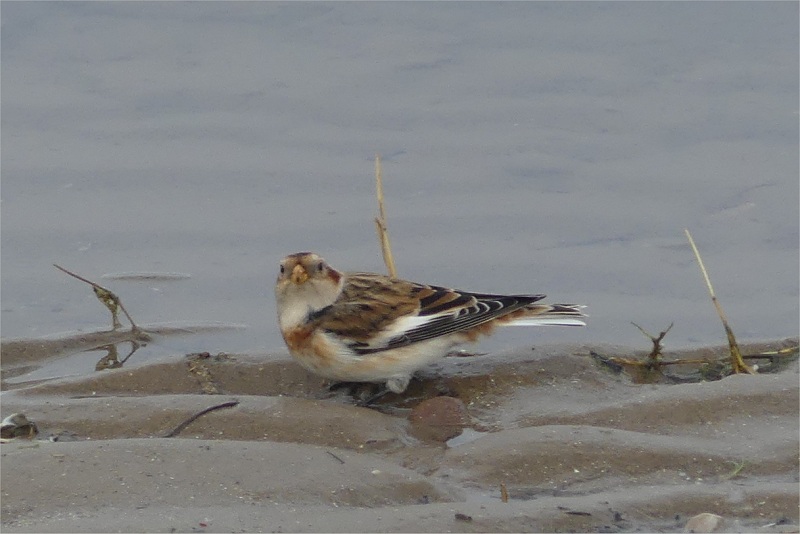
It took me a while to find the snow bunting, she was tucked into the rubbish stacked at the base of the revetment so I couldn't see her from above. She didn't mind my standing and watching her about her business but despite my efforts to keep my distance as I passed by she hopped up onto the revetment just to be on the safe side. I remain surprised she's finding plenty to eat here, it just shows how many seeds and small animals get washed in by the tide.

Snow bunting
This angle emphasises just how short the tail is compared to other buntings.

Snow bunting 

Snow bunting

Snow bunting 

Snow bunting stretch

Snow bunting 

Snow bunting 

Snow bunting 

Snow bunting 

The tide was rushing in as I passed under the pier and the redshanks, dunlins and curlews were retreating into the salt marsh. The only reason I saw the flock of twites at all was that they don't like getting their feet wet so had to keep skipping between tussocks ahead of the tide. It was nice to be close enough to see their pink rumps clearly for a change, from a distance these merge into the brown upperparts. Once they were back down they were just occasional shuffling shadows in the grass.

I crossed over the road to have a nosy at this end of the lake. A crowd of mute swans, gulls and pigeons were being fed over by the roadside jetty. Dabchicks bobbed about by the near bank, a goldeneye and a great crested grebe tagged along with a raft of tufted ducks.

Hesketh Park 

There were more tufted ducks on the lake with a crowd of mallards at Hesketh Park.

Golden plovers, lapwings and black-tailed godwits, Marshside 

I got the bus into Marshside and walked down to the end of Marshside Road. The flooded side of the road was chock-a-block with wigeons and teals, hundreds of golden plovers loafed on mud banks with larger flocks of lapwings and black-tailed godwits beyond them and crowds of gulls further yet. Where the flood became the Junction Pool groups of pintails, shovelers and tufted ducks drifted about and mallards dozed in quiet corners.

Golden plovers

The dry side of the road was quite deserted save a dozen curlews and a small group of wigeons.

The pool by Sandgrounders was a lot quieter than usual, handfuls of gadwall and tufted ducks with a couple of dozen wigeon. A few little egrets fossicked about in the marsh beyond.

Wigeon

It wasn't much busier at Sandgrounders where the wigeon were accompanied by a dozen teal.

Wigeon

I decided to walk round to Crossens Marsh. Well, trudge really, I've not got my legs back properly after a lazy couple of weeks. There wasn't much cover about after extensive scrub clearance so any wildfowl in the drains and gulleys in the inner marsh made themselves scarce as I walked along. A drift of snowdrops had survived the clearing.

Snowdrops 

Pink-footed geese and juvenile spoonbill

At first it didn't look like there was much on the outer marsh aside from the mallards, black-headed gulls and little egrets in the near pools. I soon started to see the tops of heads of the pink-footed geese on sentry go in the distant tall grass and a great white egret raised its neck in the near distance. The further along I walked the closer the geese came in towards the road but none came particularly close. I was very surprised to see a young spoonbill, a first-Winter bird, feeding out there with the geese.

Pink-footed geese 

I wondered what had brought up a flock of skylarks and eventually found the merlin that had settled on a fence post. The skylarks were soon up again as a marsh harrier drifted by, most of the skylarks flew over the road and disappeared into the inner marsh.

Crossens Inner Marsh was busy with teal and wigeons and the usual crowd of black-headed gulls lurked over by the water treatment works. Over the road a few dozen pink-footed geese grazed near the road while further out there were ranks of Canada geese and more pink-feet. Some of the group of Canada geese in the middle distance had dark backs that weren't just a trick of the string, low sunlight, but we're all just variations on a theme of Canada goose, except the barnacle goose with the dark grey back.

Canada geese, Crossens Outer Marsh

About half a mile out another merlin was harassing the small birds in the long grass by the fence, stooping and rising to try and flush them out of cover before diving in and disappearing out of sight.

Something caused a panic out on the outer marsh. Waves of lapwings and golden plovers passed overhead and this spooked the geese which rose and wheeled around, taking a good five minutes to begin settling down, nearly all heading for the long grass. Not much that is airborne is going to put geese up, except low-flying aircraft, so I looked around in vain for the harrier or peregrine that had been the culprit. I saw later that a hen harrier had been seen on the marsh a little earlier so it might have been that. I don't often see Canada geese spooked by marsh harriers though there's nothing to say they didn't just join in a general panic.

Canada geese, pink-footed geese and lapwings

I didn't have the legs for the walk down the bund back into Marshside so I got the bus back into Southport and just managed to catch the train back to Manchester and have plenty of time for the connection back home. It had been a productive day and rather to my surprise I found the year list had hit the hundred mark. I was ready for my tea.

Crossens Inner Marsh 

Friday, 15 November 2024

Southport

Snow bunting

I'd been ignoring the shouting in my ear and the paw in my face for what seemed like many lifetimes and when I finally properly woke up I was convinced I'd slept through to lunchtime. I hadn't, so I got the early train into town to get a new monthly travel card and the train to Southport. 

The snow bunting was back on the pleasure beach at Southport. I don't know whether it, or its counterpart at Wallasey, is the same bird every Winter but I like to think so. I dipped repeatedly last Winter so I thought I'd renew my acquaintance. I could also have a look for twites on the nearby salt marsh while I was at it. After that, depending on the visibility on a grey and misty day, I'd either bob on to Crossens or head back for a nosey at Martin Mere.

A grey wagtail flitting about the roof of Deansgate Station I took to be a good omen. Similarly the field near Hoscar that was blanketed with a couple of hundred pink-footed geese, a hundred or so woodpigeons, scores of rooks and jackdaws but still had a bit of room left for a dozen black-headed gulls. There were another hundred or so pink-footed geese in a field near Woodmoss Lane just after Bescar Lane Station. All good omens.

Black-headed gull
Some birds travel thousands of miles. This gull was ringed at Southport Marine Lake six years ago and has only ever been seen here.

Arriving at Southport I walked down to the marine lake which, by its lights, was rather quiet: a herd of mute swans cruised by the Venetian Bridge; a few coots, mallards and black-headed gulls; a handful of herring gulls and a crowd of pigeons. Carrion crows and a couple of oystercatchers fed on the grass just beyond.

Herring gull

Southport pier 

As I walked down onto the Pleasure Beach the sun poked through the clouds a couple of times, more to tease than anything much else. The tide was lowish and the wet beach was dotted with redshanks, shelducks dabbled with the little egrets at the salt marsh edges and a small group of dunlins scrabbled about between redshanks.

Redshank 

I'd dropped down to the beach but decided to get back on the revetment. I could see all the beach from there and it would have been just my luck for the snow bunting to be fossicking about in the storm debris littering the tops. As it happens, the bunting was on the beach, almost perfectly camouflaged against the shell debris. A few people spotted that I'd spotted it; luckily by the time they came over it had moved into a patch of open sand by a square puddle so I could give coherent directions for seeing it. I do like snow buntings, they're bonny birds.

Snow bunting
First sight of it.

Snow bunting 

Snow bunting 

Snow bunting 

Passing under the pier I thought I'd try to find any twites in the salt marsh by Marine Drive. Plenty of redshanks, shelducks and starlings, a couple of skylarks… Technically I suppose I didn't see any twites in the salt marsh. A couple flew up and briefly  joined the starlings perched on the telephone lines by The Guelder Rose. Another one flew by a hundred yards further down.

Carrion crow 

I crossed the road and tried my luck by the sailing club. When the twites disappear into the salt marsh they do a proper vanishing act, if any are about the sailing club they show very well. But not today. There were plenty of pied wagtails and black-headed gulls but no twites. Out on the lake there were more mute swans and coots, a dozen dabchicks bobbed about and half a dozen gadwall were getting very amorous. 

I had a walk round the lake. Small charms of goldfinches posed picturesquely as they fed on the seedheads, right up to the moment the camera got them in focus. A young male stonechat followed their example. For a change, and in the light of the recent visit to Hoylake, I took the path going through the stand of sea buckthorn bushes. It provided plenty of cover for the passage migrant (and also felt significantly warmer than the open country) but all I could find were goldfinches, wrens, greenfinches and chaffinches, which I really shouldn't sniff at, I miss them when they're not around.

Goldfinch 

Goldfinch 

Goldfinches

It was apparent that I wasn't up for a visit to either Crossens or Martin Mere. The steep hill climb and descent followed by a long and cramped train journey home the other day wasn't enjoyed by my knee. Yesterday's walk got a lot of the movement back and took a lot of the ache out but today I seemed to be walking more ache in, it might be the change in the weather. 

Hesketh Park 

I contented myself with a walk down to Hesketh Park where the scaup that was on the pool earlier in the week hadn't made a reappearance. There was no shortage of tufted ducks, though, including a couple of females with white blazes about their beaks which made me look twice. They were undeniably tufted ducks once they stuck their heads in their back feathers for a doze. 

Tufted ducks 

Tufted ducks 

Tufted ducks and black-headed gulls
Tufties are not big ducks.

Tufted ducks 

There was a wide variety in the first-Winter drakes ranging from almost indistinguishable from the females save for the greater contrast between the dark back and wings and the underside, through various shades of dark browns and sandy greys to individuals that looked like adult drakes but with grey sides. I wasn't finding myself a scaup so I thought I'd better double-check all the tufties just in case there was a ring-necked duck in the crowd. There wasn't but if you don't look you don't find. A grey wagtail feeding by the path was a nice consolation prize.

Grey wagtail 

Calling it a day I walked back to the station. I didn't feel so bad about being so lazy when I realised I'd done four and a half miles' worth of dawdling about and somehow clocked up fifty-two species of birds for the day. On the way home I added a grey heron, a pair of teal and a flock of stock doves to the tally.

Tuesday, 28 November 2023

Wirral

Black redstart, Red Rocks

A bright sunny day was promised so I decided on a day at the seaside. Hoylake was boasting both black redstart and snow buntings yesterday so I headed thataway to see if I could find one or other of them, then see where else I end up.

I left home earlier than usual, hoping to get into Liverpool half an hour earlier. What I hadn't figured on was the train I was getting to Warrington not connecting with anything heading towards Liverpool — it's another of those cases where Northern chops a service into two smaller chunks then making sure there's no through connection. 

From Birchwood Station 

I didn't fancy spending the best part of half an hour sitting at Warrington Station so I got off at Birchwood and watched the fields by the station. Which turned out to be very rewarding: about fifty black-headed gulls came in to feed on the closest fields with a couple of stock doves, a flock of rooks feeding further out. Woodpigeons and carrion crows flew hither and thither and the hedgerows by the platforms were busy with dunnocks, blackbirds and a mixed tit flock. Robins and a mistle thrush sang in the bright sunshine and it was a very agreeable way to wait for a train.

Herring gull, Hoylake

Knots, Hoylake

I arrived at Hoylake and walked straight down The Kings Gap to the beach. The tide was on the ebb and dark lines of roosting waders still marked the high points on the mud banks. Redshanks dunlins and knots were the most numerous, small groups of ringed plovers skittered around the mud, grey plovers lurked at the edges of the crowds, oystercatchers and curlews were already moving out. Small groups of herring gulls loafed near the esplanade, more were flying out to the timeline with a few lesser black-backs. One group of half a dozen herring gulls were dwarfed by three great black-backs. As the herring gulls flew out from the beach black-headed gulls started flying in.

Walking from Hoylake to Red Rocks 

As I started walking across the top of the beach towards Red Rocks linnets, goldfinches and meadow pipits started flying down to the beach from the seaside gardens. The starlings were for staying on the rooftops for a bit longer. I let on to a couple of birdwatchers who were after the black redstart and let them walk ahead so as not to put the jinx on them. 

Snow bunting, Hoylake

Snow bunting, Hoylake

Snow bunting, Hoylake

I hadn't gone far when a cheep from the wall by my shoulder made me stop and look round. Two snow buntings were sat on top of the wall looking at me. They were very close and the sun was directly behind them so I had to walk down the beach a bit to try and photograph them, all the while gesticulating at the other two guys to let them know the buntings were there. Snow buntings are fearless so you can get away with this sort of nonsense with them. Anyway, we all three got a good look at them and once the buntings had decided we'd had our fill they jumped down into the garden to feed on the lawn.

Cormorants, herring gulls and brent geese

The crowds on the offshore rocks off Red Rocks were starting to disperse, flocks of dunlin, knots, redshanks and ringed plovers flying up the estuary, oystercatchers and curlews following the tide out to join the shelducks already dabbling out there, leaving loafing cormorants and grazing brent geese behind.

Hoylake from Red Rocks 

I wasn't sure if I wanted to walk as far as Red Rocks or just get as far as the big muddy patch and retrace my steps with the sun behind me as I walked. I was approaching the muddy bit when I noticed a robin-like bird on the fence by the nursing home. "It'll be a robin," I told myself, not unreasonably. There was something about it that wasn't quite so I tiptoed a bit closer. 

Black redstart, Red Rocks

Black redstart, Red Rocks

Black redstart, Red Rocks

The something that wasn't quite right was that its underparts were the same colour as its upperparts and the tail was stick-thin and a bit long for a robin. I got close enough for a better look and it dived out of sight onto the lawn. It quickly bobbed back up onto the seawall where I identified it properly as a "female type" black redstart (young male black redstarts look like females and some of them never gain the black face and breast of the textbook male). It kept bobbing up and down onto the wall as I walked along trying to get the sunlight to the side of it rather than directly behind. I looked back for the pair of birders but they were already halfway back to Hoylake.

Stonechats, Red Rocks

I didn't fancy walking back to Hoylake — I'd either have to go back through the mud or traipse down Stanley Road — so I headed through the nature reserve and on to West Kirby. The boardwalk seemed to have a pair of stonechats every hundred yards, which was a bit distracting as I was having to keep a close eye on where I was walking as I'd forgotten how dodgy the boardwalk's become. Pairs of water rails squealing in the reedbeds were even more distracting.

Hilbre from Red Rocks Nature Reserve 

Looking out into the estuary small flocks of dunlin and ringed plovers flew upstream, a little egret flew into the long grass in the marsh and redshanks foraged on the mud in the marsh. Further out the brent geese were spreading out across the estuary as they grazed upon the sea grass.

Great Egret, Red Rocks

A sense of relief passed over me as I reached Terra Firma and another pair of stonechats. Looking back out of the estuary I was surprised to see a great white egret at the edge of the marsh. (There's no good reason why one wouldn't be here, they breed a few miles upriver.)

Dee Estuary 

Black-headed gulls and turnstones, West Kirby

I decided on a late lunch by the marine lake at West Kirby. The tide was well out now and there were loads of waders on the estuary upstream but the pontoon was still standing room only with black-headed gulls, turnstones, redshanks and knots. I was feeling greedy so I double-checked to make sure there weren't any purple sandpipers in there. There weren't.

Black-headed gulls and turnstones, West Kirby

Redshanks and turnstones, West Kirby

Knots, turnstones and redshank, West Kirby

There were a few gulls and a pair of mute swans out on the lake. I looked for the juvenile great Northern diver and found it very easily: the lake was like a mill pond and the diver was dead in the middle of it. 

I looked at the time, remembered it was late November and decided against moving on to another site. It had been a good walk in excellent weather and some excellent birdwatching. A seaside walk with snow buntings in it is always special and the black redstart was a cherry on the cake.

West Kirby Marine Lake