|
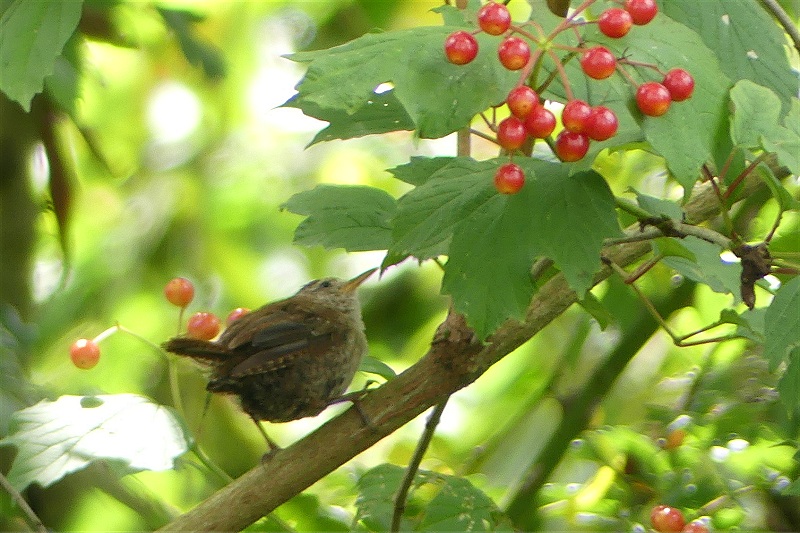
| Wren, Treeton Dyke |
I thought I'd have an adventure and explore a bit of Yorkshire new to me. I had a look to see what was about, saw a red-crested pochard has been on Catcliffe Flash for a couple of weeks, saw that it was dead easy to get to and within walking distance of a couple of other sites, decided to go and have a look.
I got the train to Sheffield and the X54 to the top of Treeton Lane, got off and lo and behold there was the start of the path to Catcliffe Flash right across the road. It looked harder on Google Maps. I went through the gate and walked down a grassy path in between two lines of trees, one lining the river Rother, the other lining the flash and both doing a good job of hiding the water most of the way.
 |
| Catcliffe Flash |
Chiffchaffs squeaked in the trees, woodpigeons and wrens sang. The path was fizzing with common blue damselflies and every so often a brown hawker would zip past my cap. Even less often a blackbird, great tits or goldfinch would break cover to fly from one line of trees to the other. A couple of banded demoiselles fluttered by, always a delight, and as the path passed an open stretch of the river an emperor dragonfly powered its way over the waterside vegetation.
 |
| Common blue damselfly, Catcliffe Flash |
 |
| Banded demoiselle, Catcliffe Flash |
The first glimpses of the flash through the trees were tantalising. Pochards, mallards and tufted ducks bobbed about. A couple of pochards sat in a drowned dead tree to preen. Black-headed gulls noisily skittered about, cormorants hung out to dry and a mute swan cruised along the far bank. No sign of a red-crested pochard but it was early days yet.
 |
| Catcliffe Flash |
I walked round to Trenton Lane and found a bus stop back to Sheffield by the exit, which is handy. I ignored it because I had places to go yet. I walked up the road to the layby where it turned out I got a full view of the flash. It's a relatively small lake perhaps a couple of hundred yards long and about half that wide. The bank opposite was thickly lined in reeds.
 |
| Mallards, black-headed gulls and gadwalls, Catcliffe Flash |
 |
| Female pochard, Catcliffe Flash |
At one side by the reeds there was a tiered arrangement of planks. Ducks and black-headed gulls were arranged on this like dolls in a toy shop window. Most of the ducks were mallards and gadwall, there were a few tufted ducks but most of them were drifting about in groups of three or four out on the flash. Coots fussed in the reeds, moorhens and dabchicks picked their way through the ducks. More pochards passed by. A heron walked behind the ducks and gulls on the showcase. No red-crested pochard. The reports hadn't said if it was a duck or a drake though this time of year with the drakes being in eclipse plumage it's not easy to be sure if you're just seeing the one bird. I wasn't seeing anything either way and was about to give up in despair when I caught a flash of bright candy pink out of the corner of my eye. An eclipse drake red-crested pochard got added to the year list.
 |
| Red-crested pochard (centre left), moorhen, mallards and coots, Catcliffe Flash |
The plan had been to walk through Treeton and go on to Waverley Lakes for a nosy round but a dog walker suggested I take a diversion along the way to look at Treeton Dyke. The path was dead easy to find, it ran alongside the railway just before the bridge that takes you over into Waverley and the lakes. Yet more common blue damselflies, speckled woods and large whites fluttered about the hedgerows and chiffchaffs squeaked in the trees. It took me a while to identify the migrant hawker patrolling the nettles by the path.
 |
| Treeton Dyke |
 |
| Great crested grebe, Treeton Dyke |
People were waterskiing on Trenton Dyke which turned out to work in my favour because all the waterbirds were congregating by the bank near the path. It's not often I get to see great crested grebes and mallards side by side, the grebes looked tiny and skinny in comparison. A family of wrens were bouncing about in the willows by a small pond across the way. Any piece of reasonably healthy water larger than a pocket handkerchief will have its moorhens and so it did. It also had a Southern hawker zipping about the waterside.
 |
| Moorhen, Treeton Dyke |
I walked back, turned, apologised to my knees for the steps up to the railway bridge and crossed over into Waverley where chaffinches, great tits and chiffchaffs called in the trees. The Rother looked very picturesque as it burbled its way through the rocks just downstream of the bridge, elsewhere it was a fairly sleepy river.
 |
| River Rother |
 |
| Waverley Lakes |
The lakes are out in open parkland. I picked my way through the damselflies towards the nearest and largest lake. Immediately to the North a new housing estate was being build. This didn't seem to bother any of the birds. Nearby there were dozens of coots, mallards, black-headed gulls and tufted ducks, one of the tufties having four tiny ducklings in tow that were already impressive divers. There were also a few pochards and mute swans and the far bank was lined with Canada geese. Further out was a raft of forty or fifty lesser black-backs. I expect there's some serious gullwatching done here in Winter. The swallows and martins that had been conspicuously absent so far hawked over the lake, albeit only being two swallows and a house martin.
 |
| Waverley Lakes |
I checked the bus times. If I walked back into Treeton or Catcliffe I'd have to wait three-quarters of an hour for a bus back to Sheffield. If I carried on walking along the river to Woodhouse Mill the buses were roughly every quarter of an hour. I headed thataway.
 |
| Walking by the River Rother |
It was a pleasant walk. Wrens chaffed in the undergrowth. Goldfinches, greenfinches and a couple of little egrets flew overhead. There was a stand-off between me and a Southern hawker as it hovered in front of my face for what felt was hours but was actually half a minute. In the end it moved around me and headed off up the path whence I came. I passed an open patch by the river and a robin ran through a few practice notes of song.
 |
| Orgreave Rise |
I followed the path down to Retford Road and got the 52 back into Sheffield. Next time I'm this way I'll follow the river South from here through the Woodhouse Washlands and see if I can get down to Rother Valley Country Park. It had been a good day's birdwatching today, it'll be interesting to see how they compare.