|
| Sketch map of Martin Mere, New Lane and Red Cat Lane |
Martin Mere is a very popular nature reserve surrounded by farmed moss lands. Getting there involves a decent walk but the effort's always worthwhile. Trains from Burscough Bridge are usually every half hour, those from New Lane are more irregular: every one, two or three hours and subject to radical change with each new timetable. There's a network of footpaths between Burscough and Martin Mere, these notes are limited to a few of the more direct routes between the stations and Martin Mere. So far my tally for the area covered in this post is 147 species.
 |
| Whooper swans, Martin Mere |
Winter is the best time for seeing spectacular numbers of wildfowl but a visit at any time of the year will provide a wide selection of birds. The
Martin Mere website includes very regular updates on bird sightings.
Starting from Burscough Bridge Station, go up the steps or walk round through the car park and turn left onto the main road (Moss Road). The next left turn takes you onto Red Cat Lane. This takes you straight to Martin Mere. Once you leave town there's a footpath on one or other side of the road for the full length. If you're a brisk walker it's half an hour's stroll. If you're like me and spend half your time trying to identify distant bodies across the fields you can stretch it out to an hour.
 |
| Fieldfare, Red Cat Lane |
This can be a very rewarding walk for traditional farmland birds: there's a mixture of horse paddocks, arable fields and farmyards along the way. This is the most reliable place I know for corn buntings, sometimes you'll find one singing from the telegraph lines. Strangely enough I only see grey or red-legged partridges: if I see the one I don't see the other this time. No idea why that should be, it's a rule God came up with.
 |
| Red-legged partridges, Tarlscough Lane |
About two-thirds of the way a road — Curlew Lane — branches off to the right and goes on to the nature reserve at Mere Sands Wood. This is also the point where Red Cat Lane becomes Tarlscough Lane. Curlew Lane is a good place to look for yellow wagtails.
 |
| Tarlscough Lane, opposite Martin Mere |
Carrying on down Tarlscough Lane it's a short walk to Martin Mere. The road on the left is Marsh Moss Road which goes down to New Lane Station. Just after this on the same side of the road there are a couple of houses, immediately after the last there's a footpath running parallel to the road which leads to Martin Mere.
Martin Mere
In Winter there are huge numbers of wildfowl with a supporting cast including ruffs and black-tailed godwits, in Summer nesting black-headed gulls and shelducks with common terns and avocets. Buzzards, kestrels and marsh harriers can usually be seen and it's always worth checking out the fence posts on distant fields to see if any peregrines or barn owls are perched on them. You may strike lucky and see a merlin or a hen harrier on a Winter visit. The usual woodland species, together with a good population of tree sparrows, can be found along the paths and on the feeders by the Janet Kear Hide. The Reedbed Walk is a relatively new addition to the reserve and has already attracted bearded tits and even the occasional bittern.
(The bird gardens can be useful for familiarising yourself with exotic wildfowl that you might bump into in future.)
Leaving the visitor centre follow the path bearing right to get to the first set of hides. It's a good idea to check the board outside the smaller In Focus hide to see if anything interesting's been reported today. The Discovery Hide is the best place to start: it overlooks the main mere and lets you get your eye in as many of the birds will come very close to the hide.
 |
| Ruff, Martin Mere |
The most obvious wildfowl in Winter are the whooper swans, greylags and pink-footed geese; the ducks include large numbers of mallard, teal, wigeon and pintail.
 |
| Pintail, Martin Mere |
You have a choice now: follow the path to the right down towards the Ron Barker Hide or go left and follow the path towards the United Utilities Hide and the Reedbed Walk.
Towards the Ron Barker Hide
This is a lightly wooded path with a few hides along the left-hand side. The first is the Raines Observatory, a small glazed hide which used to be the best place for getting your eye in on the mere in a warm place (the enclosed half of the Discovery Hide.has taken over this rôle). Look out for tree sparrows, they use the nest boxes in this area.
The next hide is the Hale Hide. This overlooks a small pool by the mere. This can be a good place for getting close views of passage waders, particularly green sandpipers.
 |
| Green sandpiper, Martin Mere |
Past the duckling nursery the path branches: the path to the left loops round to the Kingfisher Hide and rejoins the main path further down. The Kingfisher Hide overlooks a couple of small pools and is on slightly higher ground, giving a good overview of this part of the reserve.
 |
| Kingfisher Hide, Martin Mere |
In Winter it's a good idea to check the ivy-covered trees in the corner of the reserve as the lower path loops round. Most days there'll be a tawny owl roosting deep under cover.
Finally, we get to the Ron Barker Hide which overlooks two fairly large, shallow pools and a sluice channel. This is probably the best hide for passage waders such as wood sandpiper. In late Spring you can get good comparison views of both little ringed and ringed plover. The large numbers of wintering teal sometimes include a green-winged teal. The sluice is a favourite hunting ground for kingfishers. In Winter and early Spring barn owls hunt over the fields to the right of the hide, sometimes coming quite close. A few years back a pair of black-winged stilts lingered in the field by the hide and teased us with the hopes that they might breed before moving on to parts unknown.
 |
| Kingfisher, Martin Mere |
Towards the United Utilities Hide
The bank to the right of the path here is fairly new, this is where the old Swan Link Hide used to be. This was a very long hide giving an excellent view of the whole length of the mere and is sadly missed, even though it was getting a lot ramshackle towards the end of its life. A couple of viewing points are all that remain but they give decent views of this side of the mere.
 |
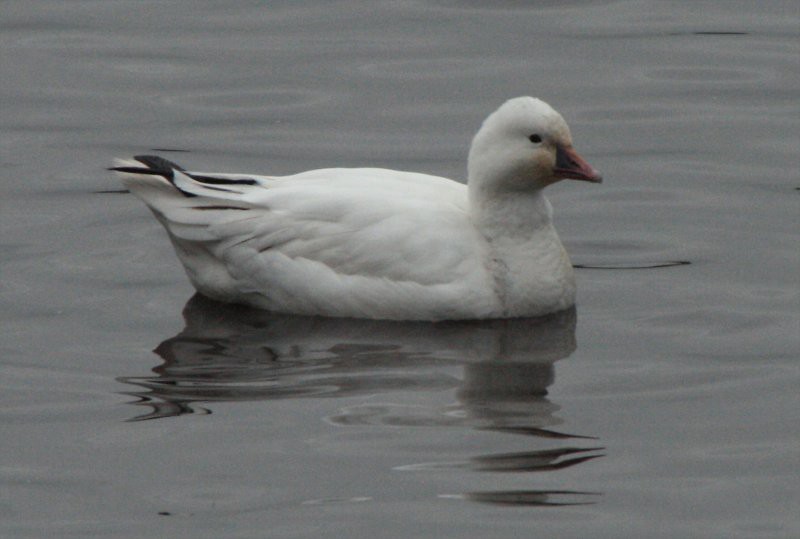
Ross' goose, Martin Mere
All Ross' geese are treated as escapes but who knows, records like this may get reassessed by the Rarities Committee some time in the future. |
I tend to skip the Gladstone Hide and go straight down to the Janet Kear Hide. This might be doing it a disservice but it's been a long while since I found it productive. The feeding station at the Janet Kear Hide attracts good numbers of tits and finches, including bramblings in Winter, and great spotted woodpeckers are regular visitors. The small pool here usually has a pair of nesting moorhens.
 |
| Great spotted woodpecker, Martin Mere |
The Janet Kear Hide is at the corner of a path running by the Harrier Hide, looping around the Reedbed Walk, past the United Utilities Hide and back to this corner.
The United Utilities Hide is on a slight rise that gives you a panoramic view of the reserve. As you go in the main mere is to the right of you, the Ron Barker Hide is a quarter of a mile dead ahead of you, the Harrier Hide and Reedbed Walk are behind you and to your left. The fields to the left of the hide host hundreds of pink-footed geese in Winter and sometimes you may find barnacle geese or white-fronted geese amongst the crowd.
The path next to the United Utilities Hide takes you anti-clockwise around the Reedbed Walk. You can get a better view of most of the pools from the hides as they have elevated views but the walk's worth it, especially in Summer when you've a very good chance of hearing eight or nine species of warbler as well as cuckoos. The reedbeds also host a variety of damselflies and dragonflies.
 |
| Reedbed walk, Martin Mere |
The path eventually leads to the Harrier Hide. This hide looks good but is hard work to use. It overlooks a large, reed-lined pool that is quieter than the main mere but still worth checking out. Pochards and great-crested grebes seem to prefer this pool to the main mere.
 |
| Sunset, Martin Mere |
Leaving Martin Mere you can go down Tarslcough Lane back to Burscough Bridge or you can take one of the paths that lead to New Lane. Check the train times before aiming for New Lane; I generally allow forty minutes for the shorter walk (it invariably takes less than that but better safe than sorry given the frequency of trains here) and add another good half hour if I'm taking the long walk. If you miss the train there are footpaths to Burscough Bridge or you may strike lucky and be able to catch a train going the other way and change further down to come back up again.
Martin Mere to New Lane
Going back along the footpath by Martin Mere, when you reach the houses turn left and follow the path along the field boundary (this gets quite muddy at times). There are usually a few geese or shelducks in the field, possibly a little egret and if you're dead lucky in Winter you may disturb a woodcock (or it might disturb you as it flies off unexpectedly from under your feet). At the end of the field you have a choice: go through the gate and do the long walk skirting Martin Mere's reedbed or turn left for Marsh Moss Road.
The long walk skirts round the southern boundary of Martin Mere then heads West. You then go round three borders of a field before crossing the railway line and joining the path running by the line that goes down to New Lane Station. It won't be long before you realise you've reached a point where you're about ten yards away from the start of the walk around that field! That frustration aside this is a pleasant enough walk on a Summer's day.
The short walk takes you through a small patch of woodland through to a gate onto Marsh Moss Road. Be careful here: it's a small road but a busy one with lorries and tractors using it and no footpath beside it. On the opposite side of the road to the gate is the start of a path over the fields that eventually gets to Burscough Bridge Station. This is another nice walk on a Summer's day. Turning right from the gate and following the road down we get to New Lane Station. There are a couple of corners that you need to be careful about because of limited visibility but once you get to the houses it's pretty plain sailing to the station.
 |
| Along Marsh Moss Lane |