Black-tailed godwits, Leighton Moss
Showing posts with label reedbeds. Show all posts

Monday, 4 November 2019

Leighton Moss

Female shoveler
Thought I'd take advantage of the cool, rainy weather to do a quick repeat visit to Leighton Moss. It turned out to be a good idea, a good day's birdwatching, a lot less irritating than last week and all the trains ran on time (a Monday miracle!).

More Winter ducks had come in, including a handful of goldeneye on the Lilian's Hide pool. The majority of the rest were shovelers and teal but there were also plenty of mallards and wigeon, a few tufted ducks and half a dozen pintail.

Away from the marsh hides waders were in short supply except for the dozen or more snipe around the Griesdale Hide. Water rails were making a racket in the reeds and a couple of them came out into plain sight for a moment before skittling back where they came from. Three reedbeds held mixed tit flocks, including treecreepers, nuthatches and goldcrests, and there were the usual raiding parties on the feeders by the "Hideout." Just the one marsh tit, though, and that only fleetingly.

Three marsh harriers showed well and I could hear but not see a soaring buzzard.

A mixed flock of goldfinches and siskins were feeding high in the alders by the path between the "Hideout" and Lilian's Hide. No redpolls yet but they must be due soon.

Leighton Moss

Male marsh harrier
Common snipe
Common teal
The recent bad weather has knocked the reedbeds about a lot
Taking advantage of my Old Man's Day Ranger ticket I took the train to Barrow to do a bit of Morecambe Bay coast watching while there was still some daylight. Low tide so it was mostly black-headed gulls, little egrets and pied wagtails on the salt marshes and distant specks that may have been ducks of some sort but it's a nice ride when the trains are running.

Thursday, 27 June 2019

Sunny day at Leighton Moss

A stroll round Leighton Moss today in blazing sunshine.

A couple of years ago a few nesting rafts were put on the pool by Lilian's Hide, with the hope that they might attract terns (they even have some tern decoys to tempt them in). Typically, they've been taken over by black-headed gulls. It's interesting to watch the interplay between nesting pairs: lots of noise and display aggression but no actual fighting.

Black headed gulls, Leighton Moss
The marsh harriers were showing well, with one of the males coming very close to the Griesdale Hide at one point.

Male hen harrier, Leighton Moss
A bittern was the highlight at the Causeway Hide. Their camouflage doesn't always work this time of year: side-on a bittern presents quite a lot of straw yellow against a background of green reeds. It's a different matter when it turns round, the combination of lateral compression and the strong streaking on the neck completely disrupt its shape and it looks anything but birdlike.

Bittern, Leighton Moss

Also good to see a family of pochards on this pool today.

Pochards, Leighton Moss

Sunday, 9 June 2019

Martin Mere

Sketch map of Martin Mere, New Lane and Red Cat Lane
Martin Mere is a very popular nature reserve surrounded by farmed moss lands. Getting there involves a decent walk but the effort's always worthwhile. Trains from Burscough Bridge are usually every half hour, those from New Lane are more irregular: every one, two or three hours and subject to radical change with each new timetable. There's a network of footpaths between Burscough and Martin Mere, these notes are limited to a few of the more direct routes between the stations and Martin Mere. So far my tally for the area covered in this post is 147 species.

Whooper swans, Martin Mere
Winter is the best time for seeing spectacular numbers of wildfowl but a visit at any time of the year will provide a wide selection of birds. The Martin Mere website includes very regular updates on bird sightings.

Starting from Burscough Bridge Station, go up the steps or walk round through the car park and turn left onto the main road (Moss Road). The next left turn takes you onto Red Cat Lane. This takes you straight to Martin Mere. Once you leave town there's a footpath on one or other side of the road for the full length. If you're a brisk walker it's half an hour's stroll. If you're like me and spend half your time trying to identify distant bodies across the fields you can stretch it out to an hour.

Fieldfare, Red Cat Lane
This can be a very rewarding walk for traditional farmland birds: there's a mixture of horse paddocks, arable fields and farmyards along the way. This is the most reliable place I know for corn buntings, sometimes you'll find one singing from the telegraph lines. Strangely enough I only see grey or red-legged partridges: if I see the one I don't see the other this time. No idea why that should be, it's a rule God came up with.

Red-legged partridges, Tarlscough Lane
About two-thirds of the way a road — Curlew Lane — branches off to the right and goes on to the nature reserve at Mere Sands Wood. This is also the point where Red Cat Lane becomes Tarlscough Lane. Curlew Lane is a good place to look for yellow wagtails.

Tarlscough Lane, opposite Martin Mere
Carrying on down Tarlscough Lane it's a short walk to Martin Mere. The road on the left is Marsh Moss Road which goes down to New Lane Station. Just after this on the same side of the road there are a couple of houses, immediately after the last there's a footpath running parallel to the road which leads to Martin Mere.

Martin Mere

In Winter there are huge numbers of wildfowl with a supporting cast including ruffs and black-tailed godwits, in Summer nesting black-headed gulls and shelducks with common terns and avocets. Buzzards, kestrels and marsh harriers can usually be seen and it's always worth checking out the fence posts on distant fields to see if any peregrines or barn owls are perched on them. You may strike lucky and see a merlin or a hen harrier on a Winter visit. The usual woodland species, together with a good population of tree sparrows, can be found along the paths and on the feeders by the Janet Kear Hide. The Reedbed Walk is a relatively new addition to the reserve and has already attracted bearded tits and even the occasional bittern.

(The bird gardens can be useful for familiarising yourself with exotic wildfowl that you might bump into in future.)

Leaving the visitor centre follow the path bearing right to get to the first set of hides. It's a good idea to check the board outside the smaller In Focus hide to see if anything interesting's been reported today. The Discovery Hide is the best place to start: it overlooks the main mere and lets you get your eye in as many of the birds will come very close to the hide.

Ruff, Martin Mere
The most obvious wildfowl in Winter are the whooper swans, greylags and pink-footed geese; the ducks include large numbers of mallard, teal, wigeon and pintail.

Pintail, Martin Mere
You have a choice now: follow the path to the right down towards the Ron Barker Hide or go left and follow the path towards the United Utilities Hide and the Reedbed Walk.

Towards the Ron Barker Hide

This is a lightly wooded path with a few hides along the left-hand side. The first is the Raines Observatory, a small glazed hide which used to be the best place for getting your eye in on the mere in a warm place (the enclosed half of the Discovery Hide.has taken over this rĂ´le). Look out for tree sparrows, they use the nest boxes in this area.

The next hide is the Hale Hide. This overlooks a small pool  by the mere. This can be a good place for getting close views of passage waders, particularly green sandpipers.

Green sandpiper, Martin Mere
Past the duckling nursery the path branches: the path to the left loops round to the Kingfisher Hide and rejoins the main path further down.  The Kingfisher Hide overlooks a couple of small pools and is on slightly higher ground, giving a good overview of this part of the reserve.

Kingfisher Hide, Martin Mere
In Winter it's a good idea to check the ivy-covered trees in the corner of the reserve as the lower path loops round. Most days there'll be a tawny owl roosting deep under cover.

Finally, we get to the Ron Barker Hide which overlooks two fairly large, shallow pools and a sluice channel. This is probably the best hide for passage waders such as wood sandpiper. In late Spring you can get good comparison views of both little ringed and ringed plover. The large numbers of wintering teal sometimes include a green-winged teal. The sluice is a favourite hunting ground for kingfishers. In Winter and early Spring barn owls hunt over the fields to the right of the hide, sometimes coming quite close. A few years back a pair of black-winged stilts lingered in the field by the hide and teased us with the hopes that they might breed before moving on to parts unknown.

Kingfisher, Martin Mere


Towards the United Utilities Hide

The bank to the right of the path here is fairly new, this is where the old Swan Link Hide used to be. This was a very long hide giving an excellent view of the whole length of the mere and is sadly missed, even though it was getting a lot ramshackle towards the end of its life. A couple of viewing points are all that remain but they give decent views of this side of the mere.

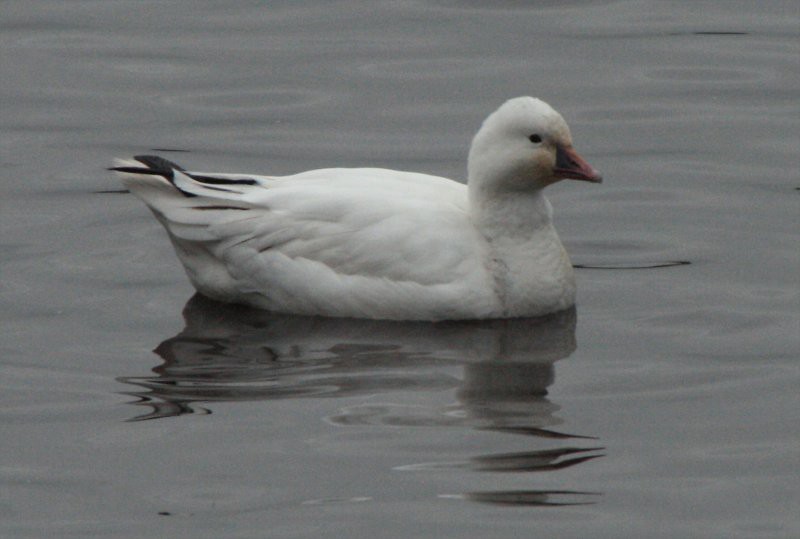
Ross' goose, Martin Mere
All Ross' geese are treated as escapes but who knows, records like this may get reassessed by the Rarities Committee some time in the future.
I tend to skip the Gladstone Hide and go straight down to the Janet Kear Hide. This might be doing it a disservice but it's been a long while since I found it productive. The feeding station at the Janet Kear Hide attracts good numbers of tits and finches, including bramblings in Winter, and great spotted woodpeckers are regular visitors. The small pool here usually has a pair of nesting moorhens.

Great spotted woodpecker, Martin Mere
The Janet Kear Hide is at the corner of a path running by the Harrier Hide, looping around the Reedbed Walk, past the United Utilities Hide and back to this corner.

The United Utilities Hide is on a slight rise that gives you a panoramic view of the reserve. As you go in the main mere is to the right of you, the Ron Barker Hide is a quarter of a mile dead ahead of you,  the Harrier Hide and Reedbed Walk are behind you and to your left. The fields to the left of the hide host hundreds of pink-footed geese in Winter and sometimes you may find barnacle geese or white-fronted geese amongst the crowd.

The path next to the United Utilities Hide takes you anti-clockwise around the Reedbed Walk. You can get a better view of most of the pools from the hides as they have elevated views but the walk's worth it, especially in Summer when you've a very good chance of hearing eight or nine species of warbler as well as cuckoos. The reedbeds also host a variety of damselflies and dragonflies.

Reedbed walk, Martin Mere
The path eventually leads to the Harrier Hide. This hide looks good but is hard work to use. It overlooks a large, reed-lined pool that is quieter than the main mere but still worth checking out. Pochards and great-crested grebes seem to prefer this pool to the main mere.

Sunset, Martin Mere
Leaving Martin Mere you can go down Tarslcough Lane back to Burscough Bridge or you can take one of the paths that lead to New Lane. Check the train times before aiming for New Lane; I generally allow forty minutes for the shorter walk (it invariably takes less than that but better safe than sorry given the frequency of trains here) and add another good half hour if I'm taking the long walk. If you miss the train there are footpaths to Burscough Bridge or you may strike lucky and be able to catch a train going the other way and change further down to come back up again.

Martin Mere to New Lane

Going back along the footpath by Martin Mere, when you reach the houses turn left and follow the path along the field boundary (this gets quite muddy at times). There are usually a few geese or shelducks in the field, possibly a little egret and if you're dead lucky in Winter you may disturb a woodcock (or it might disturb you as it flies off unexpectedly from under your feet). At the end of the field you have a choice: go through the gate and do the long walk skirting Martin Mere's reedbed or turn left for Marsh Moss Road. 

The long walk skirts round the southern boundary of Martin Mere then heads West. You then go round three borders of a field before crossing the railway line and joining the path running by the line that goes down to New Lane Station. It won't be long before you realise you've reached a point where you're about ten yards away from the start of the walk around that field! That frustration aside this is a pleasant enough walk on a Summer's day.

The short walk takes you through a small patch of woodland through to a gate onto Marsh Moss Road. Be careful here: it's a small road but a busy one with lorries and tractors using it and no footpath beside it. On the opposite side of the road to the gate is the start of a path over the fields that eventually gets to Burscough Bridge Station. This is another nice walk on a Summer's day. Turning right from the gate and following the road down we get to New Lane Station. There are a couple of corners that you need to be careful about because of limited visibility but once you get to the houses it's pretty plain sailing to the station.

Along Marsh Moss Lane

Monday, 4 February 2019

Hope Carr teaser

I've only recently started visiting Hope Carr Nature Reserve just outside Leigh. It's quite compact but also quite productive. Birds seen on today's visit included buzzard, peregrine and sparrowhawk, quite a few shovelers and bullfinches and a couple of willow tits. And, on the second attempt, I managed to see the Blyth's reed warbler that's been hanging round the brambles for the past week or so.
Blyth's reed warbler, Hope Carr NR

Blyth's reed warbler, Hope Carr NR

Blyth's reed warbler, Hope Carr NR
I'll provide a map and directions in a future post.

Wednesday, 9 January 2019

Leighton Moss

Sketch map: Silverdale and Leighton Moss

Leighton Moss is a dead easy day out by public transport (so long as the trains are behaving themselves) as the main entrance to the reserve is literally just round the corner from Silverdale Station, on Storrs Lane. The only reason for it ever to be much more than a minute's walk is the bird life in the brambles and trees by the station. The reserve is famous for its reed beds; marsh harriers and bearded tits breed here, bitterns used to breed here regularly, less frequently these days.

Silverdale Station is on the Lancaster to Barrow-in-Furness line with a few through trains from Manchester and Carlisle.Not every train that goes through stops here; it's sometimes possible to make a connection to a quick train via Arnside. If you're lucky you'll get ten minutes to wait for your connection, which gives you the chance of a look over the very picturesque stretch of the river by the station.

Leighton Moss

There are two parts to the reserve: the complex of reed beds and pools by the visitor centre and the salt marsh about a mile down the road to the south. The paths are mostly very good; the only one that's a bit rustic is the path through the damp woods between the Lower Hide and the road to the north-east of the reserve. In Winter, with one eye on the train timetables, it can be a bit of a push to fit everything in, especially if you feel the need to stop for a pot of tea and a sausage bap at half time.

The only downside to Leighton Moss is its popularity: some of the hides (particularly the Causeway Hide) can get very busy.

Marsh tit
From the visitor centre the first port of call should be the feeding station by the little bit of garden. This will give you the chance to get your eye in and you might strike lucky and see one of the reserve's marsh tits. (Don't give up if you don't see one here, there are plenty more chances.)

From here you've got three options:

  • Follow the path to the right on to Lilian's Hide and then through the reed beds to the Tim Jackson and Griesdale hides.
  • Follow the path to the left on to the public causeway and then through to the Causeway Hide and further on to the Lower Hide.
  • Go back through the visitor centre, turn left on the road, over the bridge and turn left and follow the road down to the Allen and Eric Morecambe hides.

Take your time walking through the reed bed areas. Most of the birds in the reeds will be blue tits, robins and wrens; in Summer they're joined by reed warblers and sedge warblers, with chiffchaffs and willow warblers in the trees. And there's always a chance of striking dead lucky and bumping into some bearded tits! Inevitably, water rails are more often seen than heard. The pools hold mallard, teal, gadwall and shoveler, with wigeon and pintail in Winter. In Summer hirundines and swifts hawk over the pools and these — and the huge numbers of dragonflies on the reserve — attract hobbies. On a very good day you may see four species of heron: grey heron, little egret, bittern and great white egret. And once in a blue moon…

Juvenile purple heron, August 2017
Near the visitor centre the trees attract all the usual woodland species. The fields by the reserve attract green woodpeckers but they're usually heard rather than seen. And wherever you are keep looking up once in a while: marsh harriers can fly in quite low, buzzards soar above the wooded hillside to the east of the reserve and in Summer you may see one of the ospreys commuting between Morecambe Bay and Foulshaw Moss. In Winter, particularly after Christmas, there can be some spectacular starling murmurations.

Marsh harrier
A lot of the small birds are so used to visitors they're almost tame to the point of impertinence. If you're like me and feel guilty when you're faced with a robin begging for food it's as well to have a bag of dried mealworms in your pocket. Many of the robins and great tits will feed from the hand; I once saw a nuthatch surprise somebody by doing it. I sort of expect robins and great tits to come a-begging, I'm still surprised when coal tits and marsh tits join in. All you have to do is stand still in some places and they'll come to you whether you're feeding them or not.

From Lilian's to the Griesdale Hide

Lilian's Hide overlooks a large pool surrounded by reeds. Lapwings and black-tailed godwits roost here when the water's low. You can often see snipe at the water's edge and in freezing weather you've a good chance of seeing water rail.

Right by Lilian's Hide is the Skytower. At first sight it's a bit of a gimmick but it provides an excellent panoramic overview of the reserve and lets you get your bearings in the scheme of things. In Winter and Spring this treetop view is a good way of finding siskins.

Moving on the path along the edge of the reserve is fringed by willows. On your left there is a big reed bed, on your right are some fields and the railway line. Take your time and check both sides, it's usually worth it. At the bottom of the path it turns sharply left and into the reed bed. You'll hear more than you see and most of what you'll see will be flying over. It's a very pleasant walk.

Reeds

The path forks at a large willow tree. The Tim Jackson Hide is to your right and the slightly larger Griesdale Hide to the left. It's a toss-up as to which to go to first. They both overlook small reed bed pools fringed with willows. Sometimes they're both dead quiet, sometimes one's busy and every so often both are busy. The only thing you can predict is that in freezing conditions they'll be quiet of bird life. Red deer can often be seen from these hides though they're often tricky to spot. Wood sandpipers seem to favour the Griesdale Hide, very often giving excellent views.

Wood sandpiper

Along the causeway to the Lower Hide

The path from the visitor centre to the public causeway mostly runs closely parallel to the road and gives a nice view over this part of the reserve. It then turns into a short stretch of boardwalk through a corner of the reed bed . The point at which this path meets the causeway is currently the territory of a particularly vocal Cetti's warbler.

Be careful walking along the causeway as cars do use it to get from the road to the other side of the reserve. There are a couple of open areas with grit trays that are used by bearded tits in Autumn; your best chance is early in the morning, by eleven o'clock you've probably missed them. If you don't like crowds you'd best wait for the bad weather.

Female bearded tit
The Causeway Hide overlooks a large pool fringed by reeds. There's a tiny island in the middle which is used by resting waders — lapwings, redshanks and greenshanks — and cormorants. Black-headed gulls often nest here though last year they were put off by a pair of great black-backed gulls that raised a couple of young. This tends to be the best place to see otters or, if you're lucky, a bittern.

Carrying on down the causeway there's a little bridge over one of the channels. On your right the channel leads on to a complex of small shallow pools. Water rails are often heard in the reeds at this corner and in the height of the chasing-each-other-round-like-clockwork-mice season they can be so busy chasing each other they forget they're supposed to be masters of hiding in the reeds. Past this point there's a stretch of wet woodland, mostly alders, on your left stretching down to the Lower Hide and beyond. In Winter check the treetops for lesser redpolls.

At the bottom of the causeway, on the left, there's a gate to the path leading to the Lower Hide. This tree-lined path runs along the edge of the reserve with the wet woodland on your left and farmland on your right. The farmland attracts curlews and cattle egrets have visited here.

On the path back from the Lower Hide to the Causeway..
The Lower Hide is smaller than the Causeway hide and sits on the opposite corner of the pool. The margins of the pool are shallower here so waders come closer to the hide at this side.

Beyond the Lower Hide the path to the road deteriorates and can be very wet in places. It can be worth exploring, though, as this end is quieter and wilder than the rest of this part of the reserve and can throw up the occasional surprise. Once you get to the end I'd retrace my steps, it can be a bit of a hairy walk back down that road.

The salt marsh hides

The Allen and Eric Morecambe hides are about a mile's walk away from the visitor centre. The hides overlook pools at the edge of the salt marsh and attract good numbers of wildfowl and waders, always with the chance that something unusual has come along with the migrating flocks.

Follow the road away from Silverdale Station till you come to the junction with the road to Warton. Turn left here, carry on over the level crossing then over the narrow (one vehicle wide) road bridge. Just after this bridge there's a turning on your right that goes under the railway line. Follow this down to the car park. The gate at the far end is the start of the path to the hide. The fields and trees in this part of the reserve are particularly worth checking out for passage migrants.

The first hide is the Allen Hide. This overlooks a small, shallow pool that is very popular with waders. In Summer you'll see avocets and black-headed gulls, in Winter greenshank, redshank and one or two spotted redshanks.

Redshanks and greenshanks

Further along is the slightly bigger Eric Morecambe Hide. One side of this overlooks the Allen Pool, the other looks out over a bigger pool and then out into the salt marsh. High tide is best as that brings birds in towards the hide. On a sunny Winter's day it can be as frustrating as rewarding as the bird that most looks like something special will invariably be the one sat on top of a bank with the sun right behind it. Don't forget to check the muddy corner to the left for waders!

On the walk back to the visitor centre, or Silverdale Station, there are a couple of lay-bys where you can stop and have a look at the southern end of the reed beds. Be careful on the way back: the junction with the road to the station is a bit of a blind bend and there's an unhelpful bend on the approach to the junction with Storrs Lane. Alternatively, if you've the time and the bus timetable allows it, you could turn left at the junction and spend some time in Silverdale village before getting the bus back to the station.
Dusk at Leighton Moss