Black-tailed godwits, Leighton Moss
Showing posts with label Iceland gull. Show all posts

Friday, 13 March 2026

Roundhay Park

Iceland gull

Yesterday was a busy morning, then the gale force winds hit so it was today I went over to Leeds to see if I couldn't get a photo of the Iceland gull at Roundhay Park. In the event it would have been more remarkable if I couldn't, there were people taking selfies with it. It was a nice-looking subadult bird, the eye looked dark so I think it's a first-Winter bird but I may be mistaken.

I used one of my Delay Repay compensatory returns for the trip out to Leeds and the X98 bus to the gates of Roundhay Park. As the bus passed the junction with Easterly Road I took the two red kites circling Roundhay Road as a good omen. 

The path from the gate leads directly to the lake in next to no time. The trees were noisy with the songs of robins, great tits and woodpigeons and I could hear the black-headed gulls before I could see the lake.

We'd passed through umpteen bands of wind, rain, sun and overcast cloud on the train, if anything the bands of weather passed by more quickly as I walked around the park. Two passing showers of derisory drizzle passed by the time I got to the lake.

Roundhay Park 

I had a quick scan round to get my bearings. I'd seen a lot of photos of the Iceland gull perched on a wooden pile next to the café in the corner. I wouldn't be lucky enough to have it sat there waiting for me would I? I bloody would.

Iceland gull

By the time I'd wandered over to that corner the Iceland gull had decided to have a swim round with the other gulls and waterfowl. Most of the gulls were black-headed, there were a handful of herring gulls and a second-calendar-year common gull had me scratching my head for an embarrassing few minutes. Mind you, the more I learn about gulls the less confident I am in their identification and I'm starting to second-guess myself when I see black-headed gulls. Luckily for me the Iceland gull was both unmistakeable and very obliging.

Iceland gull

A herd of a couple of dozen mute swans was mugging for scraps by the café. A small raft of half a dozen tufted ducks drifted about in this corner and handful of goosanders dozed nearby. There were only a couple of coots, it's that time of year when the hordes of noisy, squabbling hooligans that have spent most of the year carpeting municipal ponds and lakes suddenly go quiet and invisible.

Iceland gull, goosanders and black-headed gull

The Iceland gull decided it was going to steam through the gap between a drake goosander and two ducks. A sharp peck from the drake goosander persuaded it otherwise.

Iceland gull, goosanders and black-headed gull

The wooden piles hadn't been completely deserted, cormorants dried their wings, a couple of herring gulls and a black-headed gull perched and loafed.

Herring gull and mute swans

Mute swans

Cormorant

Mute cygnet

I turned the corner around the café and when the piles were back in view there was the Iceland gull perched stop one of them. The bright, pale pink legs and feet were very conspicuous.

Iceland gull

Iceland gull

Iceland gull, herring gull, pigeons, mute swan and black-headed gull

Job done I carried on with a walk round the lake, which was very agreeable and the changeable weather added extra visual interest though I was extremely grateful the rain was only light and occasional. 

Roundhay Park 

The path by the lake

Roundhay Park 

Noisy groups of Canada geese cruised the open water and mallards skulked by the banks. Pairs of mute swans barked, grunted, squeaked and creaked as they picked fights with small rafts of mute swans apparently minding their own business and small rafts of mute swans picked fights with passing singletons and then with each other. Goosanders and tufted ducks cruised about steering clear of any mute swans and who can blame them.

Goosander

Great tits, robins, song thrushes and wrens sang in the surrounding trees and bushes and I noticed the ring-necked parakeets had made their way up here. Blue tits, long-tailed tits, siskins and goldfinches quietly foraged in the tops of the trees by the lake while moorhens and mallards fossicked about their roots.

Roundhay Castle 

The top end of the lake from Roundhay Castle 

I had a nosy at Roundhay Castle, a folly built in 1811, then took a path swinging through woodland back to the lake. My reaction time was too slow to catch the red kite flying low over the castle and out of sight over the woodlands. Singing chaffinches and calling nuthatches added to the songscape.

Greats Head Beck

I'd been disappointed not to find any grey wagtails on the becks running through the woods. As the path turned and met the lake there was a pair of them on the bankside.

Grey wagtail

Grey wagtail
This is the male.

Cormorants

A little further on a line of piles jutting out into the water was ornamented by loafing cormorants.

Roundhay Park 

Roundhay Park 

Now that I was walking into the sun it was staying out from behind the clouds more often than not, which made the scenery even more picturesque but made taking photos of the birds on the water that bit more tricky. I'd noticed a distinct lack of grebes on the walk up to Roundhay Castle, my faith in the scheme of things was restored by a pair of great crested grebes fishing on this side of the lake. A large perch, spiny fins all erect, took some careful manoeuvring before swallowing.

Great crested grebe and perch

Mute swans

The sunshine triggered even more punch-ups amongst the mute swans and the pairs indulging in slow, silent and stately courtship dances were insufficient to convince bystanders of the placidity of the mute swan. The pairs of Canada geese brawling by the dam had the grace not to pretend they weren't noisy hooligans. That incident was worth watching if only for the demonstration that a Canada goose can dive underwater as quickly and with as little disturbance to the water as any dabchick.

Walking over to Wetherby Road for the bus back to Leeds

I didn't have long to wait for the bus back to Leeds. While I was waiting I checked the options for the route home. As my ticket restricted me to Northern's train it turned out, paradoxically, that I'd get home quicker by going back to Manchester via Sheffield as that would make the necessary connection with my local train. And so I did. The red kites flying overhead just after the bus passed Roundhay Clock reassured me they hadn't been an hallucination on the way in.

The rookeries of the Derbyshire Peak District were in full swing as the sun set on a nicely successful day.


Friday, 23 February 2024

Wild gull chase

Herring gull, Widnes

A morning which has promised so much showed its true colours and carried on until lunchtime so I ran a few errands in the hail and hoped for the best. Late lunchtime the sun came out and, much to my surprise, so did nearly two dozen spadgers that had evidently got fed up skulking in the wings. I'm trying to work out how many coal tits there are; the pair fly in from the station but there's a male singing a few doors down, it would be nice to have a couple of pairs about.

The weather looked like behaving itself but I really didn't want to go slutching about knee deep in mud so I decided to go over to Widnes to see if I could have any luck seeing the Kumlien's gull that's been in the crowds on the recycling centre by Ditton Road. I got the train into Warrington and it was just late enough for me trot briskly over to the bus station to wave the 110 goodbye. So I got the 62 into Murdishaw and got the 110 to Widnes, arriving at Ashley Way about quarter of an hour after I would have had I caught the planned bus.

It would surprise the reader not one bit that by the time I arrived at Warrington it was raining. It stopped as we passed the mallards on the canal at Moore and it was sunny at Murdishaw. On the approach to Runcorn the sky went black and it sheeted down. I debated staying on the bus and going back to Warrington but a burst of bloody-mindedness had me getting off the bus and walking down to Ditton Road just as the rain stopped.

There were plenty of gulls flying about and sitting on rooftops along Ashley Way and I checked them all out. It would be just my luck to walk past my quarry because it was sitting on a roof on the wrong side of the motorway. Walking down I aimed for the cloud of gulls just over on the other side.

Once I passed under the motorway I was a bit spoilt for choice. There was a huge cloud of large gulls over the recycling centre on my side of the road and a couple of hundred gulls, mostly black-headed gulls, on the vacant lot on the other side of the road. I had a quick sken through the black-headed gulls and found handfuls of herring gulls and lesser black-backs. Having got my eye in I then turned my attention to the confusing swirling mass on my side of the road.

There were buildings and trees between the road and the centre of the gulls' attention so there weren't many extended clear views of any of the birds. Standing at the corner where the slip road meets Ditton Road I had a view through a gap that let me see a fair part of the flock as it flailed around. I couldn't reliably say how many birds there were, it was three figures certainly but how many more than that would be a wild guess. I think there were roughly equal numbers of lesser black-backs and herring gulls with a few black-headed gulls. Every so often half the black-headed gulls from across the road would come over, swirl around with the rest then float back over the road.

There was a confusion of herring gulls of all ages. The adults and near-adults ranging from big, dark, beefy argentatus males to relatively pale and dinky argenteus females. A couple of pale herring gulls turned out to be pale herring gulls. A sandy looking first-Winter bird got my hopes up for a glaucous gull but the dark bill and primaries were those of a very faded herring gull. Ten minutes in I had a bit of luck: a pale "herring gull" flew up over the buildings and wheeled round before dipping back below. In the process of doing that wheel and dip I could see that its wing-tips were silvery grey, not black. I had me a Kumlien's! I tried in vain to find it again in the crowd. Eventually I began to suspect a case of wishful thinking.

There were a couple of blokes with bins at a pull-in a bit further down on the other side of the road, perhaps they were getting better views down there. I wandered down, found another gap to look through and found I'd been getting better views where I had been. I gave it ten minutes, just in case the change of angle might work in my favour, but I wasn't having any luck. I took a few photos of herring gulls so I'd have something to illustrate this blog post and prove I had actually been out, honestly.

Herring gull, Widnes

Back at the corner I found a couple of common gulls I'd missed in the crowd. Then I got another glimpse of a pale herring gull, and yes! grey primaries. It eventually made a third, very brief appearance, just to confirm I hadn't been making it up. The chances of my getting a photo were pretty remote, I decided to call it a day before I pushed my luck too far with the weather.

I took the footpath to Victoria Road for the 110 back to Warrington. The very skittish pair of stonechats on the motorway embankment were a nice bonus.


Saturday, 8 April 2023

Widnes

Mute swan, Spike Island

Another bright Spring day so I decided to head over to Widnes which seems to be going through one of its golden patches for gulls and ruddy shelducks. The plan was to see if I could find the Kumlein's gull that's been reported the past couple of days on the river and then have a wander round Spike Island to see what was about. Kumlein's gull isn't a taxon I've ever seen and it hasn't been on my radar at all, it's one of those that I associate with hardcore Irish gullwatchers.

I got the train to Warrington and thence the 110 to Widnes, getting off at the stop before the Silver Jubilee Bridge and walked down to the river. I passed under the bridge and almost immediately bumped into half a dozen birdwatchers who were scanning the river.

Herring gulls and lesser black-backs, River Mersey, Widnes

I had hopes that the Kumlein's gull would be in one of the rafts of large gulls loafing above the sandbanks that had been flooded by the tide. Of course I couldn't be that lucky, it was in the crowd of gulls on a distant sandbank on the other side of the river. Luckily it was a bunch of very nice birdwatchers who insisted on my having a look at the bird through their telescopes. There was no chance I could have picked it up with my binoculars but it jumped out of the crowd on the 'scope. 

Had I not been primed beforehand I'm not convinced I would have identified it as a Kumlein's had I just bumped into it. It was definitely an Iceland-type white-winged gull and at a guess a second-Winter bird, it wasn't an adult and it looked too patchy for a first-Winter. Structurally it wasn't quite like the Iceland gulls I've seen, it didn't have the same gently rounded head and the wings didn't look so long. The outer primary wing feathers were darker than the inner ones, a cold mid-brown sort of colour. It would have been nice to have seen the wings spread out and be able to see the tail pattern but it wasn't to be. Once I'd pinpointed its position by the telescope I tried to pick it out through my binoculars and failed dismally. It works sometimes, not this time.

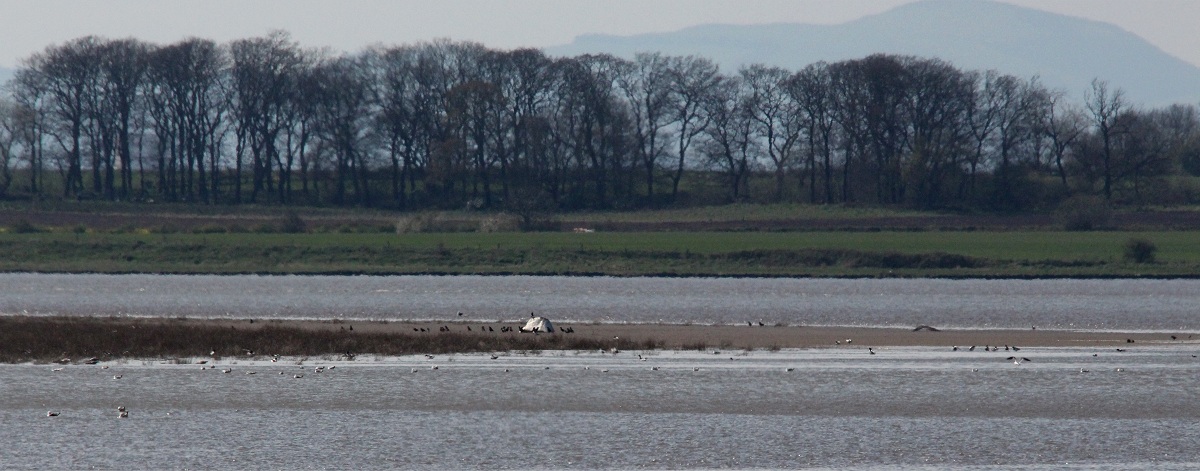
There's a Kumlein's gull out there somewhere near the big white blob, River Mersey, Widnes

Carrion crows, herring gulls, lesser black-backs and shelducks, River Mersey, Widnes.
This photo's very heavily cropped and you'll probably still need to zoom in on the picture to see very much.
I think the Kumlein's gull is the pale bird directly below the big white blob. 

I wandered down the path into the West Bank Docklands Park to have a look round. There were more gulls and blackcaps and chiffchaffs sang in the trees. I added green-veined white and large white to the year's butterfly list and enjoyed the scenery looking out over the Mersey. One of the birds in a distant raft of large gulls caught my eye, a rangy looking gull with a small head. I walked a little further ahead and got a better view of it, definitely a Caspian gull, probably the first-Winter bird that's been reported hereabouts a few times recently. I've got my eye in for the structure of Caspian gulls for identification purposes but I'm still not remotely confident about ageing them.

Silver Jubilee Bridge 

I headed back to go and have a wander round Spike Island and as I approached the birdwatchers they shouted over to me: "Peregrines!" And sure enough, there was a pair of peregrines on the railway bridge. There was a lot of calling between the two as they courted amongst the iron spars, the female doing a lot of come-hither tail fanning and crouching.

Peacock butterfly, Spike Island

Thanking them again I eventually made my way over to Spike Island. On a whim I ignored Google Maps and turned onto the river and a good job I did, too. The Victoria Promenade is a very nice walk around the head of West Bank and leads almost directly onto Spike Island (there's a housing development in the way just before Spike Island so you have to walk down the road for about a hundred yards). I could hear Canada geese but it took me ages to find where they were loafing on the far bank. There was an egret with them that didn't look like a little egret but I wasn't convinced I was getting a correct sense of scale. Luckily there was a heron a little further along the bank so I could confirm it was a great white egret.

Spike Island 

The canal was busy with mute swans, Canada geese, mallards and coots with a few tufted ducks and moorhens to break the monotony. The whooper swan that was resident here for a couple of years has either moved on or passed over. Blackcaps, chiffchaffs and goldfinches sang in the trees and black-headed gulls peppered this stretch of the river. Over near the Gateway Bridge a crowd of Canada geese, herring gulls, oystercatchers and redshanks sat on the bank to wait out the tide while a pair of teal flew out and settled on the river. There were plenty of common shelducks and a little egret further upstream but no sign of any ruddy shelducks. Serves me right for being greedy. 

I added a speckled wood to the butterfly list, had a bit of a sit down to record my notes and set off for the bus back to Warrington, arriving with plenty of time for the train back to my doorstep. One of those days when everything works just so, they don't happen very often and they're to be savoured when they do.

I was today years old when I discovered that alexanders has a light, pleasant scent

Monday, 7 February 2022

Barrow

Red-necked grebe

The plan was to have a bit of a dawdly sort of a day at Leighton Moss. The plan was. On the way I noticed a report of a red-necked grebe at Cavendish Dock in Barrow and seeing as I was already on the Barrow train and red-necked grebe is the only grebe on the British List I've not seen this century and seeing as my old man's explorer ticket was good for any Northern Rail train between Carlisle and Stoke, I thought: why not?

The little egrets of Morecambe Bay were out in full force today with scarcely a stretch of salt marsh without a few amongst the carrion crows and shelducks.

I got off at Roose and walked down Rampside Road. Google Maps told me there was a road between Rampside Road and Cavendish Dock. Not for the first time Google Maps wanted me to climb the gates into a sewage works. Luckily there was a not unduly muddy path from the end of Old Rampside Road that went over the hill and joined the greenway that runs by the side of the dock and joins the causeway.

The walk along the greenway was nice, even in today's moody weather. I'll have to find out where it starts. A song thrush was doing its best to drown out robins, dunnocks and goldfinches. Furtive movements in the bushes involved coal tits, bullfinches and goldcrests.

Cavendish Dock

It was a first time visit to Cavendish Dock, I usually only see it as the train goes past into Barrow, so I didn't know what to expect. Turns out that the lake is as big and open as it looks on the map, there's an excellent path with some sheltered seating along the causeway and there's an expanse of saltmarsh on the seaward side. The tide was rolling in when I arrived, which gave excellent opportunities for wader watching.

Salt marsh by Cavendish Dock

The most obvious birds on the dock were the rafts of black-headed gulls and herring gulls loafing on the water and the dozen cormorants drying their wings on a jetty. Once I got my eye in I could find a few mute swans and a male goosander by the corner nearest Roose and a couple of pairs of red-breasted mergansers out beyond the jetty. No sign of any grebes of any sort but nil desp, there was a long length of causeway to walk yet.

Redshank

Out on the salt marsh the curlews and redshanks being noisily herded together onto mudbanks by the tide were very conspicuous. Forty-odd lapwings were very self-effacing until they were forced to take flight and abandon their mud. I almost missed the couple of dozen dunlins, a few dozen knots and half a dozen ringed plovers that hung on to a stretch of samphire-covered mud till grim death.

Red-breasted merganser

I was two thirds of the way across the causeway and still hadn't seen any grebes so I sat down on one of the seats and scanned round. I added a great black-back, a couple of lesser black-backs and some common gulls to the tally, together with another couple of mergansers. Small flocks of redshanks and lapwings flew over the causeway as they retreated inland from the tide. A flock of a couple of dozen grey plovers flew in low from the sea and headed for the other side of Barrow. 

After a chat with a chap taking his dog for a walk on his mobile scooter and wishing him luck with his allotment and his Alzheimer's (I have a "Tell me your life" sort of face) I decided to move on.

I hadn't gone ten yards when a paler than usual first-Winter herring gull flew low over the incoming tide. Except it wasn't a paler than usual first-Winter herring gull. I've never seen an Iceland gull that close before, they're nearly always distantly hiding in a crowd. The best way for me to describe it is as looking like a small female herring gull with sandy brown and white plumage and with all the wing feathers the same colours as its body and back. Very neat. So if I wasn't going to get to see a red-necked grebe today the day wasn't a disappointment.

I was nearly at the end of the causeway when a chap walked up and asked: "Are you here to see that bird?" "The red-necked grebe?" I asked, "Yes, but I've had no luck." "It's just there, it was the first thing I saw," he answered.

And bugger me, so it was.

Red-necked grebe

It was feeding close to the causeway, I couldn't see it from the seat because it was hidden by the curve of the bank and I was looking too far out while I was walking along. I thanked the chap profusely and as he asked why it was a red-necked grebe I talked him through the identification: the more stocky build and thicker, darker neck; the thick yellowish bill; and the shorter, more rounded crest. A very nice looking bird and I hope I don't have to wait so long for my next one!

Red-necked grebe

Red-necked grebe

I walked down the road between Ramsden Dock and Cavendish Dock. Oystercatchers and lapwings loafed on the sides of Ramsden Dock and a couple of pairs of eiders swam by a little island. A male stonechat flew down from the fence into some dead thistles. 

Eiders and herring gull

I walked into Barrow and seeing as we were in that peculiar period where all trains head North I got the Carlisle train as far as Seascale and the next train back from Barrow from there. A raven being escorted out of a pine grove was the only addition to the day list but the journey's worth it for the scenery alone, even on a dreich day.
Ravensglass

Barrow train to Lancaster for the train to Manchester (the first time this connection's possible after mid-afternoon). A very productive day's birdwatching even if it wasn't the one I left home to have.

Monday, 4 January 2021

Icy

Shovelers and coot

I wanted to go a bit further afield today before the inevitable full lockdown comes into play. I had a lie-in so I would miss the trains that might tempt me to go roving outside Greater Manchester and decided to go over to Pennington Flash to check out the gull roost — there's been a passage of Iceland gulls into Greater Manchester and there's always the chance of a Mediterranean gull or a yellow-legged gull. You have to hope.

The path into Pennington Flash from St Helens Road was horrible: the usual muddy puddles had spread and frozen over into a mosaic of mud, water, crunchy ice and black ice. It was so bad that on the way back I walked down the road instead.

A couple of dozen mallard fussed about in the brook by the bridge in the company of a few coot, a tufted duck and a mute swan. I wobbled over the bridge into the car park which was fairly busy but not silly so. 

Black-headed gulls

The flash was mostly clear of ice, what ice there was was generally littered with gulls. There were a couple of hundred black-headed gulls, with more coming in, a couple of dozen common gulls and a lot of large gulls, mostly settled in rafts out in the water. It was a bit early for the full gull roost so there were only fifty-odd herring gulls, slightly fewer lesser black-backs and about thirty great black-backs. I spent a while checking the largest raft which was over towards the sailing club, mostly black-backs of both flavours on the left, mostly herring gulls on the right. There was a lot of variation in the greys of the herring gulls, though none of them came close to being dark enough for the common gull grey of a yellow-legged gull. My eye was caught by a couple with a lot of white in their tertials but both birds proved to be good herring gulls with black primaries when they drifted round into full side view. I was puzzled for a while by one bird with a slightly darker mantle and a distinct hood which I concluded in the end was just an odd-looking herring gull (it was too big to be an odd-looking common gull though the shape of its head and bill was quite a lot that way) (I was wrong: it *was* a common gull).

Common gull with a distinct hood

Then my eye drifted to one bird loafing near the halfway point of the raft just in front of a couple of great black-backs. The grey on its back looked a bit pale but was that just the contrast with the great black-backs? Possibly, but overall the bird didn't quite look right. Then again, herring gulls that don't quite look right are ten a penny and nearly all turn out to be herring gulls. Then the bird drifted round and there it was: an adult Iceland gull with white primaries. Nice, it's an age since I've seen an adult.

Gulls weren't the only birds on the flash. Mallard, mute swans and Canada geese hung around the shoreline in smaller numbers than usual. There were fair numbers of coots and tufties and about a dozen goldeneyes. Half a dozen drake goosanders flew in and landed in mid-water, an outrageous flash of bright salmon orange on a grey day. There were more ducks on the spit by the Horrocks Hide, mostly mallards and shovelers with a dozen each of teal and gadwall. Half a dozen great crested grebes swam out into the open water and a dozen cormorants hung their wings out to dry at the end of the spit. Further beyond there was another raft of gulls in the bight by the Ramsdales pool, this time mostly herring and black-headed gulls.

Pennington Flash

The small pools by the sides of the path were nearly entirely frozen over though there was just enough open water in front of the Tom Edmondson Hide for a group of shovelers to take turns to bathe in.

I looked at the bobsleigh run that was the path down to the Ramsdales Hide and decided to give it a miss this time.

Walking back I bumped into the first and only tit flock of the afternoon and a small flock of redwings.

Pennington Flash