Black-tailed godwits, Leighton Moss
Showing posts with label ring ousel. Show all posts

Monday, 20 May 2024

Horwich moors

Stonechat, Burnt Edge 

After last week's wanders on the fringes of the Peak District I thought I'd treat my knees to a bit of a walk on level ground around Martin Mere.

Well I got that wrong.

I wanted a lazy morning and had to drag myself kicking and screaming to the station in time for the train. We got held up outside Deansgate because the Southport train was running late (the Southport train and the Warrington train both terminate on platform five; nothing uses platform one) so I missed the Blackpool train. No matter, I could get the Barrow train and still get to Bolton in time to catch the Southport stopper from Victoria and get to New Lane before lunchtime. The Barrow train was packed standing solid (the Edinburgh train had been cancelled and its passengers told to change at Preston) and I was damned glad I wasn't travelling further. Until the Southport train was cancelled. Still, I could wait ten minutes longer and get the next Southport train and walk up to Martin Mere from Burscough Bridge rather than New Lane. Except I couldn't because that was cancelled, too. I took the hint and got a refund on my tickets.

Pied wagtail, Georges Lane

I was in Bolton so I decided it was high time I went for a stroll on the Horwich moors. I got the 125 to Bottom o'th' Moor and started walking up Georges Lane. The day had started a bit chilly but it was warming up in the sunshine and a breeze was keeping everything fresh. Blackbirds, willow warblers and chaffinches sang in the trees, woodpigeons, jackdaws and a pied wagtail fossicked about in the fields, a few carrion crows flew by.

Georges Lane by Wilderswood 

As I walked by Wilderswood dunnocks, robins and whitethroats joined the songscape, spadgers and yet more chaffinches and goldfinches bounced about in the hedgerows, swallows swooped across the road and greenfinches and linnets called from the trees.

Rivington Pike from Georges Lane

Passing Wilderswood and heading for Rivington Pike Café a few meadow pipits flitted about in the fields and skylarks sang above them. I scanned the dry stone walls looking for stonechats and found myself a female wheatear sitting on a stone before she dived into the bracken. A kestrel hovered over the slopes before drifting downhill and two pairs of ravens convened to do aerial acrobatics before going their separate ways.

At the Rivington Pike Café 

Starlings, Rivington Pike Café 

I had a cup of tea by the café, trying to see if any of the lapwings had babies and watching the baby starlings begging from their parents as they ran amongst the sheep with the jackdaws. Swallows swooped around the café, a chaffinch sang in the back garden, God knows where the mallard came from. Down the slope a few black-headed gulls drifted across the fields. It was all rather pleasant.

Swallows, Rivington Pike Café 

Looking down into Horwich 

I walked up the road into Lancashire, scouring the fields below me for stonechats. Great tits and robins joined the willow warblers singing in the plantations and a pair of swifts skimmed the treetops. I was pretty sure I didn't want to walk into Rivington today, I had a yen to walk up towards Winter Hill. Any doubts I had were dispelled by the arrival of a group of young women orienteers with a strong Sing As You Go ethic. I turned and walked back to the café, along the way I discovered that the stonechats were nesting uphill of the road this year.

Rivington Reservoir and Rivington Pike 

Rivington Pike 

I walked up to Two Lads, stepping aside for a large group of young lady orienteers to descend. I bumped into some last week in Glossop, too. Evidently I've missed a trend. The weather was fine, there was a cool breeze to help the climb and the moor was chock full of singing skylarks and meadow pipits. Every so often a black-headed gull would pass by and there were jackdaws and carrion crows by the cairns.

Skylark, Two Lads 

Winter Hill from Two Lads

I walked down to the road, had a potter up towards Winter Hill just so I could say I did then walked down to Bottom Hole to join the path to Burnt Edge. Stonechats, linnets and goldfinches bobbed about in the bushes by the path and willow warblers sang in the mature trees in the hollows. A familiar unfamiliar "kyack!" made me look up as I was negotiating a steep climb and I spotted a female ring ousel flying low up the other side of the gully.

Walking between Bottom Hole and Burnt Edge 
The steps down and up this gulley are hard on the knees, not least because they end three feet above the bank of the stream.

See?

Walking between Bottom Hole and Burnt Edge

Walking between Bottom Hole and Burnt Edge

Approaching Burnt Edge 

Kestrel, Burnt Edge 

Kestrel, Burnt Edge 

The walk over to Burnt Edge was splendid. Willow warblers, skylarks, mipits and chaffinches sang. Swallows twittered by. Blackcaps joined the songscapes in the plantations, whitethroats in the open scrub and curlews over the open moor. It made a change looking down on a kestrel as it preened and surveyed the ground from a telephone pole. A tree pipit singing by the plantation at Burnt Edge was a nice find.

Burnt Edge 

Burnt Edge

Walking from Burnt Edge to Walkers Fold 

Approaching Walkers Fold

The walk between Burnt Edge and Walkers Fold provided more of the same, with a lot more singing goldfinches about in the trees. There was a passage of black-headed gulls flying up to moorland roosts. Swifts and swallows hawked overhead, and a buzzard soared over the farmland below.

The path to High Shore Clough

I arrived at Walkers Fold with every intention of walking down Walkers Fold Road to get the 125 back to Bolton from Chorley Old Road so imagine my surprise when I found myself walking along the rough footpath to Barrow Bridge with the sun on my back and the breeze in my face. Blackbirds, blackcaps and robins sang in the trees, wrens, goldfinches and whitethroats in the bushes, starlings and greenfinches muttered their disapproval anytime I got too close as I passed by.

Marsh thistle, High Shore Clough 

Willow warblers dominated the songscape as I walked across the meadow towards Higher Shore Clough, they were singing from the trees along the clough. There was a huge drift of meadow horsetail, something I don't see often enough to recognise instinctively (I'm all too familiar with field horsetail!). It provided a lacy backdrop to the pillars of marsh thistle dotted throughout. I would have expected a lot of butterflies but I saw none, and not that many bees, either.

Steps down to Dean Brook 

I thought I'd been clever and taken the path avoiding the staircase leading down to Dean Brook and I thought wrong. I considered sliding down the bannister until I remembered the dirty big stone wall at the bottom. 

Grey wagtail, Dean Brook

The brook was running fast and clear, I had a scan round for dippers or grey wagtails, just in case. I checked the buses and found I was fine for catching the 526 back into Bolton. I was just approaching Barrow Bridge Road, thinking to myself that the brook really ought to have dippers and grey wagtails when a dipper flew past me downstream. I hurried to the bridge to see if I could see it and found a grey wagtail fossicking about on the rocks by the bridge.

I walked down to the bus stop feeling pleased with myself. The first chiffchaff of the day sang in the trees with a coal tit and another grey wagtail flew up the brook by the road. Sometimes Northern's inability to provide a train service is a blessing in disguise.

Walking between Bottom Hole and Burnt Edge

Saturday, 18 May 2024

One that got away

Binn Green 

Yesterday afternoon when I was fossicking about by Binn Green car park I kept hearing a bit of song that I wasn't sure about. There wasn't much of it, and what there was was intermittent and interrupted, much in the way that a mistle thrush song never quite seems to get going. The song was coming from somewhere in a bit of birch scrub further along the road but I couldn't pin down the singer. A couple of blackbirds chased each other across the trees and a dark shape, probably another blackbird, flitted between some bilberry bushes but I couldn't find the mystery singer.

At the time I concluded that it was probably a song thrush warming up then getting distracted before getting into full song. The warm up practice notes of some birds can be puzzling, one of our local robins will do a few blackcap calls before starting singing in the afternoon and there have been a couple of times at Barton Clough where it's taken half a minute before I could be sure which of the singing thrushes was cranking up the engine. And I had a head full of wood warbler so wasn't paying all that much attention anyway. So I concluded it was probably a song thrush.

Sometimes these things nag at me. When I was writing up the last post last night I was reviewing the songscape in my head and something didn't quite fit. And there was something about that dark shape flitting between bilberry bushes that wasn't quite. The song sounded like a bit like a fragment of song thrush song, sung slow and sad. Two loud call notes repeated then a pause then a slow few seconds of something more complex like somebody learning and practicing an unfamiliar bit of music concentrating on the notes not the tempo. Sometimes it would just be the call notes.

I'd given up on the puzzle and was idly browsing bird reports later on when I noticed somebody mention seeing ring ousels further up Holmfirth Road. I hadn't been hearing and not recognising a ring ousel song had I? I had no idea what they sounded like. I went onto the Xeno-Canto web site and looked up some ring ousel songs. The first one I heard wasn't like the song I'd been fretting about. The second one was, though. And the third. And the fourth.

In all probability I'd been hearing a ring ousel singing, hadn't paid enough attention to the unconscious observation that this was something different and didn't put enough effort into finding the singer. It happens, it's part of the game. Usually it'll be a fairly common bird and I'll realise what I hadn't been registering when I hear another one singing or calling a couple of hundred yards down the path.

So I dipped on a ring ousel. Ah well. Next time I'm up that way I almost certainly won't remember what its song sounds like but if I hear something unfamiliar I will remember to check that it isn't a ring ousel.


Saturday, 20 April 2024

Carrington Moss

Carrington Moss 

It was a bright sunny day after a clear, cool night and I thought it was high time I took a look at Carrington Moss, I've not been there yet this year. I got the 255 to Carrington and the walk down Isherwood Road didn't seem so very long as it used to, I'm not sure if that's because I'm doing so much walking or because the new housing estate makes the industrial stretch seem shorter. Robins, song thrushes, coal tits and woodpigeons singing in the trees were a good omen.

Carrington Moss 

The fields were still wet and unploughed, the field drains freshly re-excavated. Skylarks sang and carrion crows fossicked about in the wet stubble. Orange tips and brimstones fluttered about the path margins and my first damselfly of the year — a large red — zipped past and vanished almost as quickly as I saw it.

The black-headed gulls colony on the Shell Pool was making a racket. Looking through the fence I could see at least a hundred gulls. How many of them had nests on the go I couldn't say, except that it was more than the dozen sitting birds I could actually see through the trees. A few Canada geese and mallards were trying to sleep despite the noise. Somebody in the hide by the pool was watching a dabchick subdue and swallow a fair-sized minnow. 

Carrington Moss 

I turned onto the wooded lane between the fields. I noticed another birdwatcher spending a long time at the crossing of the lanes further down then walking slowly across towards the road. I'd be meeting him later. The path had more than its fair  share of deep puddles to avoid but rarely was it bad to walk on. Blackcaps and song thrushes sang in the trees, wrens and robins bounced about in the undergrowth. A raven flew overhead towards the electricity substation with a substantial something in its beak and flew back empty-handed. 

Grey partridges 

Scanning the field on the right I found a couple of carrion crows scratching about. Then something caught my eye, a greyish patch in the stubble was blowing oddly in the wind. It turned out to be the feathers on the back of the neck of one of a pair of grey partridges hunkered down in the stubble. I walked down a bit and scanned over to have another look at them and really struggled to see them even though I knew where they were. It was their orange faces gave them away in the end.

The birdwatcher was still at the crossroads and we let on to each other. He'd found a male ring ousel having a drink on the path to the road and got a couple of photos before it disappeared into the hawthorn hedge. He was sitting tight waiting to see if it would reappear either on the path or on the field by the hedge. I wished him luck and had a quick look at the hawthorn hedge hoping to find some yellowhammers and finding a couple of pairs of goldfinches. And the male ring ousel which poked its head out at the end of the hedge. I took a quick snap and retreated. Had there been nobody else about I would have wandered down and hoped for a better view but I'd seen the bird and didn't want to put the mockers on it for anyone else. I walked back to the crossroads and told the other chap what I'd seen, wished him luck again and headed down the path towards Sinderland Brook. 

Spot the ring ousel

Carrington Moss 

I hadn't gone far when a small flock of finches twittered through the birch trees. At first I thought it was a flock of siskins because a pair of they were the first ones I got a good look at but they were just passing by and heading in a different direction to the rest of the flock which turned out to be a dozen lesser redpolls. They made sure to keep the sun right behind them most of the time before flying off in a panic when a particularly noisy track back rattled past.

Any time you're looking for wheatears passing through on passage check out the corners of the fields where the ploughed up rubbish and excavations from land drains are dumped.

I kept scouring the fields as I walked along, hoping for something yellow flitting about. I'm seeing so few yellowhammers these days that I'm sure it's not my fieldcraft at fault, there's something wrong with the local population. A flash of orange and silver bouncing round a rough corner of field could only be a wheatear. A few more minutes' looking round found two or three more, all rather distant and all rather active.

Helmeted guineafowl, not being added to the year list

At the bottom of the path I turned left by the farm and headed for the old railway line that ran between Cadishead and Altrincham. This takes you alongside Sinderland Brook, past Altrincham Water Treatment Works into Stamford Brook Community Woodland and into Broad Heath. It's a dead straight walk largely overgrown by mature birch scrub and ash trees. 

Walking to Sinderland Brook 

The singing blackbirds, blackcaps, chiffchaffs and willow warblers kept a constant chorus. Most of the small birds flitting between hedgerow and undergrowth were robins or great tits with a few chaffinches and goldfinches to stop it getting predictable. A small, pale object flew across into some birch saplings and I stopped to try and find it. Two partridges that had been hiding in the brambles by the path decided this would be a good time to give me and the long-tailed tit a fright by heaving up and flying into the adjoining field. A male pheasant tried the same trick but much more clumsily a couple of hundred yards further down.

Sinderland Brook 

I checked out the horse paddocks by the water treatment works. A cattle egret had been seen there at the beginning of the week. It hadn't been seen since but I'd have been cross with myself had it turned out I'd walked past it without looking.

Wood anemones, Stamford Brook Community Woodland 

There were yet more chiffchaffs, robins, blackbirds and blackcaps singing in Stamford Brook Community Woodland and plenty of great tits, blue tits and dunnocks rummaging about. I took the path by the edge of the housing estate and was just in time to catch the 247 to Altrincham and thence home after a very good afternoon stroll. A pair of ravens mobbing a buzzard over Altrincham Retail Park was just the icing on the cake.

A bit of the old Cadishead to Altrincham line 

Monday, 17 April 2023

Wirral

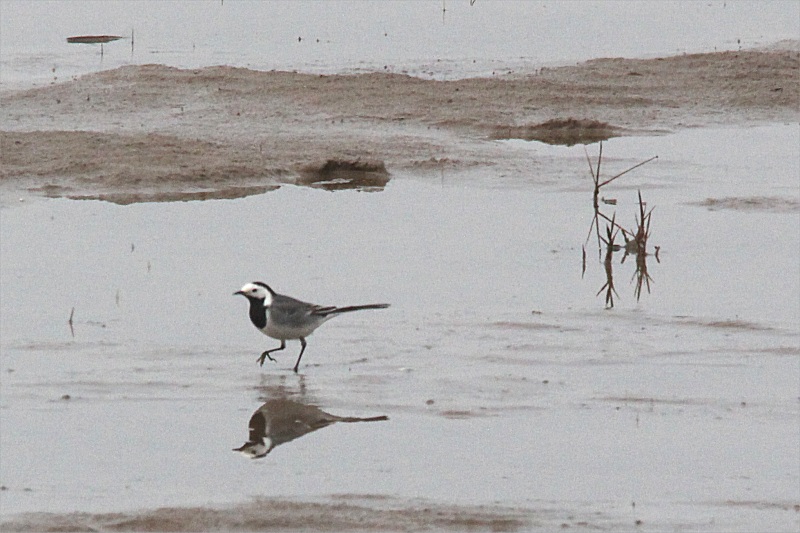
White wagtail, Hoylake

I've been getting fidgety about Spring migrants and although the visit to Leighton Moss last week relieved some of the worry it still feels like a lean Spring. The weather over the past few weeks hasn't helped any. A redstart was reported over at Turn Moss yesterday, made inaccessible by the marathon, and that got me the more fidgety. So I headed over to the Wirral coast to see what was about.

Getting off the train at Moreton I headed down to Kerr's Field. The weather forecast promised a grey but dry day and that's what was delivered, albeit with a definite chill in the air. Goldfinches and greenfinches sang and twittered about and herring gulls flew about the industrial estate with lumps of seaweed in their beaks. There were twice as many lesser black-backs about but it was the herring gulls that were nest-building.

Wheatear, Kerr's Field

The hedges at Kerr's Field was busy with house sparrows, blackbirds and finches and woodpigeons fed in the paddocks. Chiffchaffs and goldfinches sang from the trees. The big field at the end is usually reliable for wheatears. At first I thought I was out of luck, there were herring gulls and oystercatchers, Canada geese and mallards, a pair of mistle thrushes and a pied wagtail… then a male wheatear, bright grey and orange, bobbed up from behind a pile of horse manure. I quickly found a pair of wheatears further along the field. Not a bumper crop but very nice to see them.

A redstart had been reported to be in the bushes in the field behind the lighthouse so I kept a beady eye on the hedgerows just in case. A chap was watching the gap in the hedge behind the lighthouse. "Have you seen it?" he asked. He'd seen it a few times flitting between a large hawthorn and the fence about fifty yards down so I joined him and hoped for the best. There were plenty of distractions with goldfinches and great tits bouncing around, blackbirds and robins hunting from the fence and swallows darting about but I had no luck with the redstart. I put my bins down for a moment and had a look round. A particularly noisy goldfinch drew my eye to a dark shape in the tree to my right. The dark shape caught my eye, cried: "Chak!" and took flight, flying across in front of us. My closest view yet of a male ring ouzel.

Bidding good luck to the birder I decided on another approach and wandered up Lingham Road for a side view of the field. There were lots of birds providing a lot of distractions, which sounds like a complaint but isn't, but no joy adding redstart to the year list. A small flock of stock doves was good to see. After half an hour I admitted defeat.

Bluebells, Leasowe Common 

I wandered through Leasowe Common, taking the path by the fence so I could scan the paddocks as well as the thin woodland. There were carrion crows, robins and blackbirds in the paddocks and woodpigeons rummaging about by the stables. The trees were full of chiffchaffs and blackcaps and a Cetti's warbler sang in the reeds by the pool.

The groyne at low tide

I joined the revetment just before the groyne. It was a very low tide and most of the gulls and waders were distant dots. Nearby half a dozen lesser black-backs stood in a group displaying to each other noisily as they settled into pairs. A few redshanks dabbled in puddles, curlews stalked the mud and a couple of turnstones fossicked in the seaweed at the base of the revetment. There were more turnstones on the groyne as well as a mudlark collecting seaweed for his allotment.

Redshank, Meols

Black-tailed godwits, Meols

It had become a very heavy, muggy afternoon. The grey mud beyond the groyne reflected the grey sky and was dotted with gulls, redshanks, curlews and shelducks. There were a couple of groups of black-tailed godwits, the largest just a dozen birds, mostly in their Summer gingers.

Meols

I had a sit down on the promenade at Meols and had my lunch and took an immediate dislike to a couple who were loudly bullying two inoffensive little dogs into walking to heel. I let dog walkers pass me and go on ahead as a rule, it was difficult in this case as each time they got ahead they stopped to tell off the dogs. My sympathies were entirely with Wilf and Olivia.

A dark white wagtail, Hoylake

White wagtail, Hoylake

Pied wagtail, Hoylake

I finally steamed past them and left them behind. Approaching the lifeboat station there were more waders closer to the promenade, mostly redshanks with dunlins further out in the mud. I'd already seen a couple of pied wagtails, there were a few more along here together with a few dozen white wagtails and a similar number of meadow pipits. I had a sit down to watch them. There was a fair bit of variation in the white wagtails, a couple of the males had bright, silvery backs even in this light and pale grey flanks, most of the wagtails had mid-grey backs and flanks, a couple were quite dark and at a glance might be assumed to be pied wagtails but lacked any sooty markings and still had a contrast between the grey of the back and the black of the nape.

White wagtail, Hoylake

White wagtail, Hoylake

I decided to get the train from Manor Road to West Kirby, have a sit down at the marine lake to get my second wind and have a wander round the lake. Which was a sound plan except there's nowhere to sit at the marine lake at the moment as the promenade's fenced off for work on ribbon seating for its whole length. The beach was building site scoured. I had ten minutes' sit down on a rock, just to show I could, then found myself drifting over to the path to Red Rocks.

Stonechat, West Kirby

Wheatears, West Kirby

The salt marsh was lively with linnets and pipits. A pair of stonechats flitted between the golf course fence and the gorse bushes by the path. I followed the high path along the fence so I could see what was about on both the marsh and the golf course. I hadn't gone far when I bumped into a dozen wheatears. They, the linnets, pipits and another pair of stonechats, flitted to and fro from the fence. A couple of times they were all on the fence at the same time but wouldn't sit still for a group photo. It was tricky work trying to get past without disturbing them too much though they quickly returned once I'd passed. I hadn't gone a lot further when I bumped into a grasshopper warbler singing in the rough on the golf course.

Walking to Red Rocks 

I suspect I'm getting too old and heavy for the boardwalk through the reed marsh. It was a relief to reach terra relatively firma at the other end. A reed warbler was in full song as I passed through.

Looking over to Hilbre

It was still a very low tide and I didn't expect to see much as I looked over the estuary. I was dead right, the only two waders out there were a couple of grey plovers of all things. It wasn't until I got to Red Rocks that I started seeing curlews and shelducks.

Red Rocks

I walked through Hoylake to the station for the train home, passing a couple of white wagtails calling from the stacks of scaffolding on the golf course waiting erection for the stands and screens for The Open.

Looking over to Hilbre