Black-tailed godwits, Leighton Moss
Showing posts with label Lunt Meadows. Show all posts

Tuesday, 2 December 2025

Merseyside bumper bundle

Preening redshanks, New Brighton

It was a bright, sunny day after a very wet night so I headed for the seaside. The problem with December is that you've no sooner arrived somewhere than the light begins to fade so I'm going to try and "front-load" this month's birdwatching before the short days cramp my style.

I got the Liverpool train, noting the return of woodpigeons along the way and that they were all feeding or loafing in trees and none on the ground. The wariness of newcomers? I'm becoming persuaded that "our" woodpigeons don't come back for the Winter.

New Brighton sea front, Liverpool Docks in the background

At Liverpool I got myself an all areas Saveaway and went to New Brighton, hoping to get purple sandpiper onto the year list. The tide was on the ebb when I arrived at the sea front and there was already plenty of beach for gulls, waders and dog walkers to use.

Herring gull

Herring gulls and black-headed gulls were much in evidence, common gulls and lesser black-backs needed looking for though there were a few about. I just saw the one great black-back. I browsed through the gulls, just in case. My first Bonaparte's gull, Mediterranean gull and my only Laughing gull were at New Brighton and a lad can dream.

Most of the oystercatchers had moved on. Redshanks bathed and preened in pools before flying out to the retreating tideline.

Redshanks

Herring gulls

Dozens of cormorants and herring gulls loafed on the sea defences by the lighthouse. Starlings bustled about on the tops, turnstones and oystercatchers about the bottom. As the tide ebbed the gulls started to drift away, all the quicker when an elderly couple of dog walkers thought it would be a fine idea to climb over the sea defence until they discovered it wasn't.

Cormorants, herring gulls, oystercatchers and great black-back

New Brighton Lighthouse 

A wander round found more gulls, redshanks, turnstones and starlings and crowds of pigeons on the car park. A dozen black-headed gulls dozed on the pontoons. I was disappointed but not surprised not to find any purple sandpipers, the mild Autumn has postponed a lot of Winter visitors.

Next stop was Lunt Meadows, long due a proper visit by me this year. I had twenty minutes to wait for the 133 at Waterloo so I said a quick hello to Crosby Marine Lake where the herring gulls and coots carpeted the grass by the boating pond. A quick look over the pond found coots, mute swans and tufted ducks but I didn't notice any mallards. An equally quick look over the lake found a dabchick fishing on its own out in midwater.

Roughley's Wood 

I got off the 133 at Lunt and had a brief nosy in Roughley's Wood. At first I didn't think the mixed tit flocks were including long-tailed tits then the flock bouncing across the main path included more than two dozen of them. The blue tits were staying in the treetops with goldfinches and chaffinches, the great tits at the bottom of the canopy and the long-tailed tits tended to move between the lower canopy and the undergrowth, which was busy with robins and wrens.

A kestrel was hovering over near the car park to Lunt Meadows. Greenfinches passed low overhead, higher up there was a steady traffic of black-headed gulls and herring gulls heading for the coast.

Lapwings

Lapwings, teals, wigeons and mallards were settling down on the main pool. Shovelers dabbled midwater and a couple of dozen Canada geese cruised about. Moorhens and pied wagtails fussed about the water margins while the coots squabbled in that half-hearted way I associate with sleepy toddlers in a grump.

Lunt Meadows 

I'd walked round for a look over the pool from the screen on the East side, finding myself a goosander hiding in plain sight on the open water. I stepped away from the screen, turned onto the path and came face to face with a short-eared owl sitting on a fencepost almost within arm's reach. The owl slipped sideways from the fence — I don't know any other bird that can fly sideways effortlessly like a short-eared owl can — then slowly circled round and flew over to the open meadow. By this time I'd retrieved my camera and took what is unequivocally the worst photo I have ever taken of an owl. Which I'll be keeping for the memory.

Lunt Meadows 

I got another, more prolonged though distant, view of the owl on the way back as it drifted over the meadow and round the edge of the wood.

Short-eared owl
Not a great picture but substantially better than my first one today.

The chaffinches were going to bed as I walked past Roughley's Wood and the blackbirds were having one last go at the hawthorn berries. As I waited for the bus back to Waterloo the hedgerow fizzed with house sparrows and the big trees on the corner of the road were becoming black with jackdaws. The journey home was nicely uneventful and I was ready for a pot of tea when I got there.

Roughley's Wood 


Thursday, 11 January 2024

Lunt Meadows

Smew

I had a yen to go on a twitch, saw that a smew had joined the green-winged teal and the Richardson's cackling goose at Lunt Meadows and got the trains over to Waterloo in Merseyside. 

Crosby Marine Lake 

I had half an hour to wait for the 133 to Lunt so I had quick nosy at Crosby Marine Lake. The black-throated diver played hard to get over on the far side of the lake, most of the diving was being done by cormorants and goldeneyes. A dozen oystercatchers joined the herring gulls and starlings on the boating pond roost; the usual mallards, coots and mute swans mugged for scraps and half a dozen turnstones skittered to and fro at the lakeside.

Crosby Marine Lake 

I got the 133 to Lunt, took the footpath down Lunt Lane and had a quick look in Roughley's Wood. A mixed tit flock flitted about the riding, jackdaws called from the tall trees and a Cetti's warbler called from some hawthorn scrub. I'd usually expect it to be singing from the reeds in the brook that crosses the lane but they'd been absolutely flattened by last week's floods.

Lunt Lane 

Walking into Lunt Meadows I was surprised that the paths were in such good nick. Even at their worst they were no worse shape than the ones I've been walking on this past week. The effects of the flooding were evident by the flattened vegetation and tide marks on the sides of trees and posts but the tidy-up has been impressive.

Lunt Meadows 

The greylags loafing in the field by the entrance were noisy as usual. Looking out on the main pool from the screen next to them I could see plenty of mallards, Canada geese and teal and a handful of wigeon.

Smew

Walking down the path a chap walking by told me that the smew was hugging the near bank but could be seen from the screen on the next corner. And so it could, a very nice white nun showing very well.

Mallard and smew

Mallard and smew

Mallard and smew

I'd been wondering what kept bringing up the couple of hundred lapwings from the fields by the Alt. I got the answer when a marsh harrier floated over and provoked a lot of panicky whistlings from the teal on the main pool. It carried on floating by towards Lunt Road.

Lunt Meadows 

I checked out the pools to the North of the path. Mallards, teal and herons hugged the banks. One pool was covered with gadwalls, the other with tufted ducks and pochards. A skein of pink-footed geese flew overhead towards the local mosses.

The green-winged teal and cackling goose had been reported on the Great White Pool first thing. I couldn't see any geese at all on the pool but there were plenty of teal about. I spent a good half hour scanning them looking for a vertical white stripe to no avail. Drake upon drake with a horizontal white stripe and rather too many fluffing up their body feathers to show no stripe at all.

Green-winged teal and common teal
(Heavily cropped photo)

I walked round the pool getting increasingly eye-boggled staring at teal. The supporting cast included shovelers, gadwalls and rather a lot of lapwings. At one point I was struggling to concentrate on the teal dozing on an island because a pair of stonechats kept bobbing up and down in my line of view. I gave up and retraced my steps and found a group of people staring in a corner. I was offered a look through a telescope and really should have apologised more profusely for my exclamation. I'd spent ten minutes staring at that group of teal and hadn't seen the green-winged teal sitting in the middle of them. Once it had been pointed out to me it was obvious, if distant.

Richardson's cackling goose (left) and Canada geese

I walked over to the screen overlooking this corner of the main pool and spotted the cackling goose amongst the Canada geese almost immediately. A duck-sized "Canada goose" with a short neck was reassuringly obvious after making such a botch of the teal.

Richardson's cackling goose (left) and Canada geese

I completed a circle of the reserve, bumping into a kestrel, a handful of fieldfares and another Cetti's warbler in the process then headed off back down Lunt Lane for the 133 back to Waterloo and thence back home after an excellent afternoon's birdwatching.

Friday, 5 May 2023

Lunt Meadows

Common sandpiper

A Temminck's stint lingering for its third day promoted my first visit to Lunt Meadows this year. My preferred route would have been getting the train to Kirkby via Wigan then getting the 133 bus to Lunt but the trains were only going as far as Rainford, making an ordinarily tricky connection definitely dodgy. Then I read that Lunt Road was closed and the 133 redirected so there was no point in picking it up at the Waterloo end. No matter, I could get the X2 or 47 buses running between Liverpool and Southport, get off at Long Lane and walk up, it's only a mile or so. It's cheaper to get to Southport and I'd be avoiding the start of the Eurovision celebrations so off I went.

Boding dodgy on Southport Road 

The weather forecast was for a grey day with a light wind and occasional showers with the risk of thunder. There had been odd spots on rain along the way and as I got off the bus I noticed a nasty black cloud over Crosby. What wind there was seemed likely to be pushing it out to sea so I didn't worry about it.

A heron was crashing about on the pond at the corner of Long Lane and a reed warbler reeled in the reeds. Goldfinches, robins and wrens sang in the hedgerows and blackcaps, chaffinches and chiffchaffs sang in the trees by the farm buildings. Mallards and magpies fossicked about in the fields and a kestrel flew low over.

"Occasional showers"

I hadn't gone fifty yards when the sky suddenly went black and the heavens opened. In less than a minute the road was awash and I was soaked. There was no point in turning back — there was no cover on Southport Road and half an hour's wait for the next bus — so I carried on in the rain. Most of the birds took cover, a lot started singing for want of anything else to do. I added reed buntings, whitethroats, greenfinches and great tits to the tally. A grey partridge ran across the road just in front of me to take shelter in a field of barley.

Lunt Meadows 

Just as suddenly as the rain started it stopped when I got to the crossroads with Lunt Road and it was a bright sunny day, warm enough for me to start drying out. Despite reports to the contrary neither Lunt Road nor the car park were closed so I went into the reserve that way.

Greylags and goslings

There were more blackcaps and chiffchaffs in the trees and they were joined by willow warblers. Every patch of brambles by the drains had a sedge warbler, whitethroats or a Cetti's warbler — or any combination thereof — all singing like Billy-o. Canada geese and greylags grazed in the fields with the lapwings and a family of greylags occupied the path. I tried given them space to move on by scanning the pools but they weren't for budging.

There were more geese on the pools together with mallards, gadwalls and tufted ducks. The nesting black-headed gulls were made nervous by a few dozen herring gulls and lesser black-backs loafing on the pools and wheeling overhead.

Avocet

I negotiated passage past the pair of hissing greylags and went over to the far pool where the stint had been reported. A couple of pairs of avocets were nesting, ditto a pair of coots and some more black-headed gulls. A lone common sandpiper was busy catching midges on the water margins.

Avocet

I spotted a small sandpiper feeding behind a distant lump of mud but when it came out into the open it was a very smart dunlin in its black-bellied Summer togs. A scan of the mud on the other bank quickly found me a little ringed plover. It took me a while to find the stint despite its being in plain view, it was smaller than the little ringed plover, mud-coloured and fast asleep. 

Temminck's stint

Temminck's stint and little ringed plover

Little ringed plover and Temminck's stint

Little ringed plover and Temminck's stint

In the time I watched it it woke up a couple of times, had a quick preen of its chest feathers and fell asleep again. This is pretty much my experience of Temminck's stints.

Lunt Meadows 

As I walked around I bumped into yet more warblers and there were shovelers in some of the back pools.

Lunt Meadows 

I had a quick explore of Roughley's Wood which was noisy with blackbirds, blackcaps and song thrushes. Chiffchaffs sang in the depths, willow warblers sang along the rides and sedge warblers, whitethroats and Cetti's warblers sang in the margins and drains. A cuckoo sang from a clearing on the other side of the wood but I had no luck seeing it.

As Lunt Road was open I checked the MerseyTravel web site to see if the 133 was back on its usual route. Apparently it was and I only had ten minutes to wait for the bus to Kirkby or fifteen for the bus to Waterloo. The notices on the bus stops said they were suspended from the 19th of April for about twelve days so that was alright then. The hedgerows were busy with spadgers and goldfinches while swallows and swifts wheeled overhead. There was a bit of a panic when a pair of kestrels turned up but it calmed down when they settled to rest in a tree.

Twenty-five minutes later with no bus in either direction I set off for the walk down Lunt Road then Long Lane for the bus back to Southport. Luckily the weather was a lot kinder this time. I was surprised when a ring-necked parakeet flew overhead at the crossroads and headed for one of the coverts.

I had only ten minutes to wait for the next bus. Forty-five minutes later one arrived and I just managed to get the train home. It had been a peculiar sort of day and I ached all over but I'd managed to get decent views of a Temminck's stint for a change, even if it wasn't particularly active, and it and the cuckoo kept the year list ticking over.

Saturday, 30 April 2022

Merseyside bumper bundle

Greylag geese and goslings, Lunt Meadows

Northern had a mare of a day with its trains today, which sort of turned to my advantage at the start of my day out. The intention had been to get the twenty-past ten train into Manchester, get an old man's explorer ticket then go over to Merseyside for a wander round Crosby Marina and Seaforth Nature Reserve to look for passing wagtails and perhaps then go over to Lunt Meadows for a nosy round before coming home. As it was, the train to Liverpool from Humphrey Park was running fifty-five minutes late so I got that and arrived at Waterloo about forty minutes earlier than planned, which I took as a good omen.

A medley of herring gulls of different ages, Crosby Marine Lake

The bank holiday fun fair had been set up by the boating lake by Crosby Marine Lake. Aside from pinching a lot of space it didn't seem to bother the birds much, I expect they're so used to this area being busy with people a tent with a band playing a medley of Marty Wilde hits doesn't faze them any. It being a bank holiday weekend the weather was grey and cool, with the wind having an edge to it.

Nearly all the gulls on the boating lake were subadult herring gulls, the adults being busy elsewhere. A handful of lesser black-backs and black-headed gulls flew over. Most of the ducks and geese were elsewhere, too, with just a dozen mallards and a few Canada geese and tufted ducks. The usual herd of mute swans were all down at the shallow end by the dunes demanding food with menaces from passersby, leaving plenty of space for the pair of black swans to swan about looking elegant.

Out on the lake most of the buoys and rafts had herring gulls sat on them. A couple of common terns sat on one of the buoys in mid-water with a reassuringly dark arctic tern which made the identification pretty straightforward. More common terns flew overhead with a few maybe arctic terns ("commic terns") and pairs of Sandwich terns.

Small flocks of house sparrows and linnets commuted to and fro between clumps of sea buckthorn while skylarks tried, and mostly failed, to make themselves heard over the band.

It was high tide and the sand largely populated by children and dogs so there were only a few carrion crows and pigeons on the beach. Sandwich terns and common terns went out on fishing sorties and a couple of swallows flew in from Birkenhead.

Linnet, Seaforth Nature Reserve

Looking through the fence at Seaforth Nature Reserve there were more spadgers and linnets in the sea buckthorns here, accompanied by greenfinches and reed buntings. A hundred or more common terns were making a racket accompanied by rather a lot of black-headed gulls while a couple of hundred oystercatchers roosted on the banks and islands of the main pool.

I scanned the rabbit-trimmed grass for wagtails with not a lot of luck, just the one male pied wagtail. I've already got yellow wagtails on my year list but can always stand to see more of them; I'll have to try my luck elsewhere for white wagtails. Fifty or so shelducks were roosting on the grass so I had to take care not to upset them as I walked along the fence.

There were a few wheatears on the grass, nearly all of them females. A large wheatear on the dune by the marine lake had the long-legged, long-winged and very upright look of a Greenland wheatear, with the broad black tail band of that subspecies.
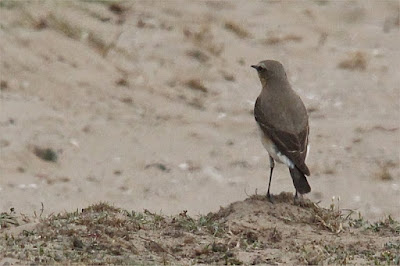
Greenland wheatear, Crosby Marine Lake

Greenland wheatear, Crosby Marine Lake

Sandwich terns, Crosby Marine Lake

A quick wander round the tiny bit of wet woodland by the sailing club added two surprises to the day's tally: a singing Cetti's warbler and a great spotted woodpecker. Chiffchaffs, willow warblers and whitethroats were expected treats.

I checked the bus timetables. I'd just missed the 133 that would take me to Lunt and the 47 that would take me to the bottom of Long Lane for a walk up to Lunt so I got a 53 to Great Crosby and picked up the 133 there.

Getting off the bus at Lunt I walked through Roughley's Wood which was full of the songs of blackcaps, chiffchaffs, willow warblers and song thrushes. A Cetti's warbler sang from the rank vegetation in one of the ditches. Coming out into the open by Lunt Meadows there were more whitethroats and something else coming from the tall grasses in one of the fields. It took five minutes before its song coincided with a lull in the songs of the other warblers and a song thrush. As usual I tried in vain to see the bird but at least I'd heard my first grasshopper warbler of the year.

Lunt Meadows

It's not often I want to heave a brick at small children in nature reserves, they're usually better-behaved than some of the grown-ups, if a bit enthusiastic. Today was an exception with a family that had obviously been taught to self-actualise as they may accompanied by a group of adults who would have been drawn by Posy Simmonds on a day when she had a particularly vicious headache. It took a long while before I'd managed to hang back enough for them to be a good distance ahead of me on the path.

Despite them the greylags, black-headed gulls and mallards by the hides and screens kept their cool and carried on with their business and even the feeding lapwings didn't go off on one. Many of the black-headed gulls were nesting and some of the greylags had goslings with them.

A typical view of a singing reed warbler, Lunt Meadows

A sedge warbler singing in a ditch was easy to identify by song alone even before it showed itself and I could easily tell it apart from the reed warblers I started to hear singing further along the path. It's an odd thing: if I hear a sedge warbler first I can tell the songs apart easily, if I hear a reed warbler first I struggle to do so. It's not something I can explain, it may be an infirmity of age.

A dozen or so avocets were setting out their stalls for nesting on the smaller pool away from the main body of nesting black-headed gulls.

I'd just missed the 133 buses heading either way to Kirkby or Waterloo so I walked down Long Lane to get the 47 to Crossens. I'd had a couple of good short walks with very productive birdwatching but it was still barely teatime and I needed a bit of exercise so a stroll along the bund behind Crossens Inner Marsh to Marshside Road was an attractive proposition.

As I started down Marine Drive it started raining. Luckily it was only light and fitful but it added to the gloom of the day and I wondered if I was doing the right thing. Stubbornness prevailed and I joined the path onto the bund, apologising to a couple of pairs of mallard I disturbed in the process.

Crossens Inner Marsh looked very quiet without the Winter crowds of wigeon, teal and waders. There were still a few pairs of teal about and half a dozen black-tailed godwits squabbled by one of the pools but the marsh was largely given over to pairs of Canada geese and lapwings and a group of a couple of dozen black-headed gulls loafing by the pool near the water treatment works. A few avocets and redshanks fed on the small pools and half a dozen ruffs rummaged about in the mud. Three pink-footed geese grazed on a patch of grass, a flock of a couple of hundred flew over the Outer Marsh.

Avocet, Crossens Inner Marsh

Although there weren't many ruffs they were all males and no two looked alike. The first one I encountered was a very striking white bird.

Ruff, Crossens Inner Marsh
A high-status white male

Ruff, Crossens Inner Marsh
A ginger and black male well into getting his ruff

Ruff with black-headed gull, Crossens Inner Marsh
A black male still waiting for his ruff.

Both ringed plovers and little ringed plovers were on the marsh but nowhere near each other to make for snap identification. It's hard to get a sense of scale in an open landscape like this so I couldn't rely on the size difference alone. The ringed plover's having a white wing bar in flight is a comfort when you're still not sure of a distant bird.

Greylags and Canada geese littered the grass on Marshside with oystercatchers and lapwings being remarkably inconspicuous in comparison. There were a few redshanks about, with black-tailed godwits and avocets feeding in the pools. Starlings, spadgers and linnets fed on the marsh near the bund and a steady flow of swallows and house martins fed overhead.

It being teatime I had a long wait ahead of me for the next bus from the bottom of Marshside Road so I wandered down to Sandgrounders to try my luck. The black-winged stilt, broad-billed sandpiper and curlew sandpiper of last week had been and gone but you never know what might have come in. The answer seemed to be: not much new. The black-headed gulls were on their nests and the usual gadwall, teal and shovelers were dabbling about. A few sand martins fed low over the water. I was just reminding myself that I'd have felt this was actually a pretty good haul if I'd come here first when I noticed my first common sandpiper of the year bobbing its way along the bank.

I got the 44 back into Southport and didn't have long to wait for the Manchester train. We startled a roe deer just outside Bescar Lane and it skipped across the field in an ungainly fashion. A couple of hares glowered at the train from the field by the water treatment works at Parbold. The train was cancelled at Wigan Wallgate. Luckily, I noticed there was a train to Victoria in ten minutes' time from Wigan Northwestern so I rushed over for that, the alternative being to wait half an hour at Wallgate for one to Victoria. I'd hoped that one going straight to Oxford Road from Northwestern might be available but it was cancelled. As it was, I struck dead lucky as the train to Victoria before the one I'd noticed was running late so I caught that. But couldn't change at Salford Crescent for the train to Deansgate because that was cancelled and the next one forty minutes later would have me waiting fifty minutes for my train home. So I got to Victoria and eventually got the bus home, arriving to find a cat sitting on the hall mat in full What Time Do You Call This.

But I didn't care: it had been a damned good day's birdwatching.