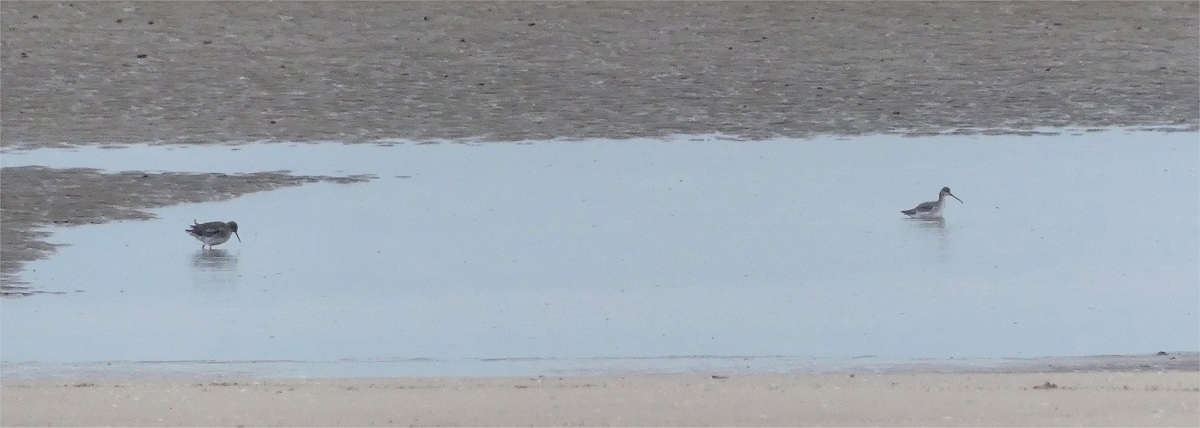
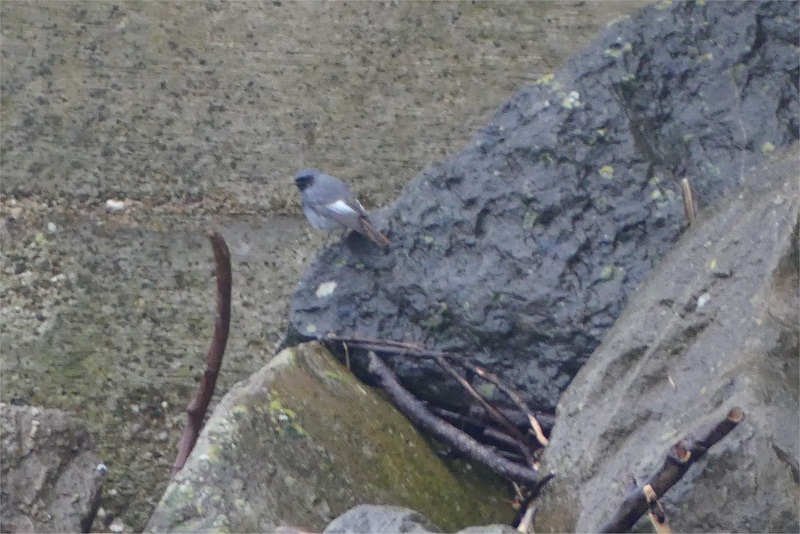
Black-tailed godwits, Leighton Moss
Showing posts with label black redstart. Show all posts

Friday, 21 November 2025

Knott End

Sparrowhawk, Pilling Lane 

If the frost and frozen bird bath were not enough confirmation of the cold weather the first black ap of the Winter, a nice female with a caramel brown cap, arrived in the back garden and had a peck at the few remaining rowan berries. I'll have to get some suet blocks, the blackcaps seem to prefer them to the suet pellets, similarly the long-tailed tits and goldcrests.

I've pretty much avoided rail travel this week. Today reminded me why I've done that. The connection between my train into Manchester and the Blackpool train is straightforward on paper but is a bit tight for comfort in reality. Even more so when the train into Manchester is stuck at Castlefield Junction for an age. I wrote off making that connection and started to worry whether I'd be able to make the connection with the next one half an hour later. I needn't have worried, my train was running twenty-eight minutes late. The departures board was carnage, what wasn't late was cancelled. 

The train arrived at my destination, Poulton-le-Fylde, twelve minutes late by the simple expedient of not stopping at the stations between Bolton and Preston. (Passengers were told to get off at Bolton and wait for the next one which was right behind. I could see on the departures board it was twenty minutes late.) Any road, I'd arrived and I had ten minutes to wait for the 5c to Knott End. The plan was to have a look to see if the twites were back at the ferry jetty then have a mosey along the esplanade and then move on. And it's a nice, winding bus route through picturesque little towns on a cool, sunny day.

Fleetwood from Knott End 

The high tide was just starting to ebb at Knott End. There were no twites about on the slipway but I kept my fingers crossed that there might be some on the salt marsh along the esplanade. The house sparrows in the gardens tried to provide a suitable alternative. Herring gulls and black-headed gulls made plenty of noise as they flew about. Redshanks waded in the shallow waters by the jetty, I could hear more on the salt marsh. I could also hear pink-footed geese but could see no sign of them (I found out later that they were on the fields behind the local library, I worked with libraries for a quarter of a century, I should have guessed).

By the esplanade 

When I started walking along the salt marsh by the esplanade I wasn't intending to have a walk down to Pillings Lane but that's what I did.

Scores of waders roosted on the wet mud just beyond the salt marsh, a hundred yards or so from the esplanade. Most were curlews and oystercatchers, there were a few redshanks and a few dozen clockwork sanderlings raced along the surf. Closer to hand, half a dozen mallards dabbled in a pool by the pub and every fifty yards or so there'd be a little egret rummaging about in the marsh grass and shelducks dabbled in the mud.

Shelducks

The salt marsh beyond Knott End 

Sea defences at the top of the salt marsh

It was notable that there weren't many small birds in the salt marsh, I wasn't surprised not to see any twites but an absence of linnets and goldfinches was a bit unexpected and I had to go a long way before I bumped into the first meadow pipit. I can't blame the dogs being walked on the path because the few that weren't on leads were sticking strictly to the path. I know not how or why but they seemed to make a point of it.

Dunlins and ringed plovers

Mostly curlews and knots

The tide ebbed as I walked along and I was seeing more waders, mostly curlews and knots with sanderlings, redshanks, dunlins and unidentifiable godwits, and they were becoming more active. Redshanks fossicked about the margins of the marsh or foraged on the mud with dunlins and ringed plovers. Single lapwings were stationed at regular intervals along the edge of the marsh until I started seeing small groups of them on the mud opposite the caravan park and beyond. A flock of knots rose and fell in the distance then whatever it was causing the commotion came closer and a billowing cloud of peeps and plovers rose from the shore line. I looked for whatever raptor was responsible and couldn't find it. I reckoned it wasn't a peregrine as the curlews and oystercatchers stayed put.

Curlew

Meadow pipit

Just beyond the caravan park I had a stroke of luck. I'd watched a meadow pipit fly in and land on the fence by the path. Just ahead of it a robin bobbed up out of the newly mown grass, sat on a fence post and used that as a launch pad for a couple of pounce-hunting forays. Then another bird bobbed up just beyond the robin and took up the same hunting activity. A black redstart. I don't see enough black redstarts to be able identify females from first-Winter males, this was one of the other. And very nice to see, too. 

Black redstart

A birdwatching couple following behind joined me in watching it as it progressed down the fence posts then it disappeared into the marsh. They walked on and stopped almost immediately, signalling me to look ahead where a male sparrowhawk was sitting on the rocks by the path. 

Sparrowhawk, exit stage left

It sat there for a few minutes before flying off on the approach of some walkers. It didn't go far: about five minutes later I was watching it chase a meadow pipit which got away by doing a very tight wingtip turn then flying up when the sparrowhawk flew across.

Looking towards Barrow

Greenfinches

Beyond the houses on Beach Road the fields were busy with goldfinches, greenfinches, rooks and lapwings. Out on the bay the tideline was a memory and the waders were widely dispersed in the distance. 

Looking across Morecambe Bay

There was snow on the Lake District hilltops on the horizon, the wind had picked up and had blown in a lot of cloud to cover the sun and it felt a lot cooler, but it was still decent walking weather. I checked the public transport options beyond Pilling Lane and headed back for Knott End and the bus back. I didn't get to see the black redstart again but there were plenty of meadow pipits and they were joined by a couple of linnets.

Walking back to Knott End 

The bus got me back just in time for the train to York. I'd bought an old man's explorer ticket so my options were to get this train and change at Preston or Blackburn for a Manchester train or wait for the Liverpool train and change at Preston, Wigan, St Helens or Liverpool. I decided to head for Blackburn. All was going stunningly well until the train stopped at signals just after Salford Crescent. And stayed there for twenty minutes before stopping at signals at Castlefield Junction for another ten minutes or so. I'd missed my train home and was starting to fret about making the next train half an hour later but that was stuck at signals at Castlefield, too, so I had ten minutes' wait for it at Oxford Road. Which it left after sitting at the platform for half an hour for no apparent reason.  (I had more bad luck later on, I thought I'd take advantage of the explorer ticket to run an errand, the train was cancelled and the next one was two hours later.) It's good of the train operators to keep that doughty spirit of adventure kindling to stop us all getting blasé about the wonders of travel.

It's not like I wasn't warned 


Tuesday, 21 January 2025

Merseyside damp bundle

Black redstart, New Brighton

I've mentioned before that I often go out birdwatching in the hopes of seeing the one thing and see quite another again. And so it was today.

I headed out to Crosby Marine Lake to see about adding the drake smew there onto the year list. It was a listless, grey, drizzly sort of day and the visibility wasn't clever. As I got off the train at Waterloo and walked down to the marine lake the clouds darkened and the drizzle became persistent.

Common gull, Crosby Marine Park 

The grass by the lake was carpeted with gulls. Black-headed gulls and common gulls danced for worms by the lake while a crowd of herring gulls loafed with coots and oystercatchers by the boating pond. A dozen turnstones running in and out among them was unexpected.

Red-breasted merganser, Crosby Marine Lake 

There were a few more black-headed gulls loafing on the lake by the sailing club. At first sight the rest of the lake was empty save the little egrets dotted about it's bankside. I picked up a handful of goldeneyes in the distance and not far from them a couple of dabchicks. A pair of great black-backs landed on the water near them, the dabchicks dived and reappeared forty yards away, the goldeneyes slowly put a bit of distance between themselves and the gulls. A great black-back could easily take a dabchick on the water, it might struggle with a goldeneye, I don't think they were keen to assay the experiment. A drake Goldeneye drifting about on his own in the middle of the lake was joined by a female red-breasted merganser that flew in from the sea. For the life of me I couldn't see a smew.

Crosby Marine Lake 

I checked out the boating pond, just in case the smew had drifted over there. There was the usual mass of coots, Canada geese, mallards and tufted ducks but no smew. I had one last scan of the lake, just in case, then headed for the beach. I might have better luck on the way back.

Redshank (left) and spotted redshank, Crosby Beach 

I'd thought that the crowds of oystercatchers by the pond meant I'd got the tide times wrong and it was high tide. It wasn't, it was still quite low but on the turn. The beach was peppered with redshanks, carrion crows and black-headed gulls with a few herring gulls loafing at the tideline. I also found a couple of grey plovers amongst the redshanks feeding in the surf. A wader flew in from Seaforth Nature Reserve, a dark-winged Tringa that looked too dark to be a greenshank and proved to be a spotted redshank. It fed beside a redshank for a few minutes giving me the opportunity to compare the differences in shape, build and bill. Had I not watched it fly in there's every chance I'd have glanced at it and thought it a redshank.

Crosby Coastguard Station 

I walked by the fence by Seaforth Nature Reserve. The pool was crowded with waders, most of them unidentifiable in the poor light with their beaks tucked into their back feathers. A few dozen black-tailed godwits fed around the margins of the crowd with a few bar-tailed godwits and a small flock of dunlins which had conveniently flown in as I arrived. There weren't as many shelducks as usual and I couldn't see any lapwings.

Kingfisher, Crosby Marine Lake 

I dropped down onto the marine lake and had a scan round. I could find the dabchicks, goldeneyes and great black-backs but still had no luck finding a smew. I did find a kingfisher lurking in the rocks on the bank and got a couple of "A kingfisher was just here" photos. It was raining in earnest now so I started to set off back to the station. I thought I'd check to see what else was about and decided to head over to New Brighton where a black redstart had been showing well. Then I noticed someone had reported seeing the smew twenty minutes earlier from roughly where I'd been standing when I found the kingfisher so I went back for another look. No joy with the smew but I got some photos of the kingfisher in the God-awful light.

Kingfisher, Crosby Marine Lake 

I squelched my way back to the station and asked myself if I really shouldn't be going home where I'd be a little warmer and drier. The train passed Bidston Junction on the way to New Brighton and a beautifully bright chestnut buzzard sat in a tree by the line. I had to look twice to make sure it wasn't a Harris' hawk, a common escapee, there wasn't time for a third look to confirm the confirmation.

Redshanks, turnstones and dunlins, New Brighton 

It was still raining, though not as heavily, when I arrived in New Brighton so I headed straight for the marine lake. The tide had come in and a small flock of waders had come to roost on the jetty. A board had been put down across one part of the jetty, it looked warmer underfoot than the worn planks which would explain why all the waders preferred it. A dozen turnstones fidgeted around while a couple of dozen redshanks and a handful of dunlins tried to get some sleep. No purple sandpiper today, alas.

Redshanks, turnstones and dunlins, New Brighton

Cormorants, New Brighton 

Starlings, New Brighton 

The black redstart had been reported at Fort Perch Rock so I wandered over there. I checked out the rocky breakwater for rock pipits as much as a black redstart but found neither. There was plenty enough in the debris on the sand around the entrance of Fort Perch Rock to keep crowds of carrion crows, turnstones and starlings interested but no redstart. A couple of pied wagtails followed me around as I spent a while wandering by the two sides of the fort above the tideline, then I concluded it wasn't my day and started back. 

I'd gone a hundred yards when I looked back and saw an object on top of one of the castellations. It was the right size and shape to be a black redstart but I couldn't be sure at this distance in this light. I walked back to the fort and could see that it was the black redstart. It was sat on the corner of the block preening so I was getting occasional flashes of white from the wings. It was the least convenient spot it could be in, as I got closer I lost sight of that side of the castellation. I moved back a bit, got the redstart back in sight and immediately lost it as it ducked out of the way of a gang of starlings. Ah well, I'd seen it.

Black redstart, New Brighton 

Walking back something flew past me onto the rocks ahead. Something black and white with red in it. The redstart sat on the sea wall, suddenly realised there was a dog walker standing there and flew onto the rocks by the path, which was a lucky break for me.

Black redstart, New Brighton 

There was a bit of a delay getting home because of a broken track in Birkenhead but it didn't make that much difference with the connections and I was very glad of a pot of tea when I got home. I'd dipped the smew but found a spotted redshank and had lovely views of a kingfisher and a black redstart so it had been worth getting wet for.

New Brighton Lighthouse 


Wednesday, 18 September 2024

Winter Hill

Winter Hill 

I had a yen to go hillwalking and for once I had enough sense to not set off on the ascent in the heat of the day. Thus it was mid-afternoon when I got off the 125 bus at Bottom o'th'Moor and had a nosy at the pool in the old quarry by the road. Just the two Muscovy ducks and a migrant hawker today.

The old quarry on Chorley Old Road 

It was a cloudless day and there was a nice breeze blowing as I walked up George's Road. Carrion crows, magpies and woodpigeons fossicked about in the fields, chiffchaffs squeaked, robins sang and great tits called from the trees. A couple of swallows skimmed the tops of the fields but weren't for stopping and were quickly on their way.

Georges Road and Wilderswood 

The road skirts Wilderswood, the robins and great tits in there being joined by dunnocks and a pheasant. A couple of ravens flew in and out of the trees before flying low over the houses at Montcliffe and disappearing into the quarry behind.

The path up the moor

I took the first path going up onto the moor. This one eventually leads to the Winter Hill access road just to the South of Two Lads. At first sight there was nothing about, I soon found the moor was fizzing with meadow pipits. Any time I accidentally flushed one mipit a dozen would take to the air, fly about for a minute then vanish into the grass and heather. The ravens emerged from the quarry and were shadowed from a distance by a rival family of ravens, four in all, and they all drifted over the rise and headed towards Burnt Edge. After that I'd hear their cronking but not see them.

As a little stream crossed the path I accidentally flushed a stonechat and a party of mipits that had been having a drink. I was trying to find where the nearest one had disappeared into the grass when something orange fluttered across my line of view. I managed to find it again and was surprised to see it was a large heath butterfly, I didn't know they could be found this high up.

The Winter Hill access road 

I walked up the access road to Winter Hill. There were lots more mipits about and a couple of carrion crows patrolled the moor, one of them returning each time to the same fencepost by Hole Bottom. I was hoping for sign or sound of red grouse but it wasn't my day for them today. The scenery was wonderful, the tops golden in the sunlight and the Lancashire and Cheshire plains shades of blue. A shimmer of light in the distance was the sun glistening on the sea by the Burbo Bank wind farm. Back before the Trafford Centre was built I could see Winter Hill from my house, I can still see my house from Winter Hill.

Looking over towards Bolton and Manchester 

You only appreciate how high the Winter Hill transmitter is when you realise that for the past half mile you've been telling yourself the compound is over the next rise. They were locking up and going home when I arrived. I scanned around, this time of year black redstarts pass by and sometimes hang about a bit here. There had been reports of a couple but all I was seeing were some mipits and a carrion crow. I spent a while admiring the scenery and checking for anything flying about on the moors. Looking back over the compound I thought I saw a couple of meadow pipits flying over the wire fence on the other side. Then I realised they didn't have a speck of white on their tails — the white tail margins on a meadow pipit are very conspicuous even at a distance. These birds were a hundred yards away and had uniformly dark tails. You've got to get fairly close or be lucky with the light to see the red properly on a black redstart, flying low in bright light against the sky they were almost in silhouette. They disappeared into the compound and all I could find after that were mipits and the carrion crow.

Looking over to Burnt Edge and beyond 

Rivington Pike 

I started the wander back down. At Hole Bottom I decided, reluctantly,  that I didn't have the legs for walking over Burnt Edge and on to Walker Fold. I've never walked down the access road to Georges Road so I decided I'd do that for a change. The sun was approaching the golden hour and the scenery was magnificent though I was glad when I'd dropped down enough to no longer be able to see the Manchester developers' follies glowing in the sunlight. Lots more mipits zipped about, carrion crows called, there was the distant cronking of ravens and a couple of kestrels hunted over tracts of heather moorland.

Kestrel, Hole Bottom
The only bird I managed to photograph up tops.

Rivington Pike (right) and Wilderswood 

Dropping down into Montcliffe the horses in the fields tiptoed round jackdaws and a charm of a few dozen goldfinches fed on the ragworts on the margins.

A charm of goldfinches, Montcliffe

I joined Georges Road and walked down, resisting the temptation to go for a wander in Wilderswood. A raven flew low overhead daring me to try to take its photo and dipping behind treetops whenever I tried. Down the hill I saw the bus back to Bolton pass by but I wasn't too perturbed, they're about every twenty minutes this time of day, it just meant the connection between the train from Bolton and my train home was a bit tighter than I'd like. As it was, for once it worked like a charm and I got home to the tail end of a fiery sunset.

Chorley and beyond

Tuesday, 28 November 2023

Wirral

Black redstart, Red Rocks

A bright sunny day was promised so I decided on a day at the seaside. Hoylake was boasting both black redstart and snow buntings yesterday so I headed thataway to see if I could find one or other of them, then see where else I end up.

I left home earlier than usual, hoping to get into Liverpool half an hour earlier. What I hadn't figured on was the train I was getting to Warrington not connecting with anything heading towards Liverpool — it's another of those cases where Northern chops a service into two smaller chunks then making sure there's no through connection. 

From Birchwood Station 

I didn't fancy spending the best part of half an hour sitting at Warrington Station so I got off at Birchwood and watched the fields by the station. Which turned out to be very rewarding: about fifty black-headed gulls came in to feed on the closest fields with a couple of stock doves, a flock of rooks feeding further out. Woodpigeons and carrion crows flew hither and thither and the hedgerows by the platforms were busy with dunnocks, blackbirds and a mixed tit flock. Robins and a mistle thrush sang in the bright sunshine and it was a very agreeable way to wait for a train.

Herring gull, Hoylake

Knots, Hoylake

I arrived at Hoylake and walked straight down The Kings Gap to the beach. The tide was on the ebb and dark lines of roosting waders still marked the high points on the mud banks. Redshanks dunlins and knots were the most numerous, small groups of ringed plovers skittered around the mud, grey plovers lurked at the edges of the crowds, oystercatchers and curlews were already moving out. Small groups of herring gulls loafed near the esplanade, more were flying out to the timeline with a few lesser black-backs. One group of half a dozen herring gulls were dwarfed by three great black-backs. As the herring gulls flew out from the beach black-headed gulls started flying in.

Walking from Hoylake to Red Rocks 

As I started walking across the top of the beach towards Red Rocks linnets, goldfinches and meadow pipits started flying down to the beach from the seaside gardens. The starlings were for staying on the rooftops for a bit longer. I let on to a couple of birdwatchers who were after the black redstart and let them walk ahead so as not to put the jinx on them. 

Snow bunting, Hoylake

Snow bunting, Hoylake

Snow bunting, Hoylake

I hadn't gone far when a cheep from the wall by my shoulder made me stop and look round. Two snow buntings were sat on top of the wall looking at me. They were very close and the sun was directly behind them so I had to walk down the beach a bit to try and photograph them, all the while gesticulating at the other two guys to let them know the buntings were there. Snow buntings are fearless so you can get away with this sort of nonsense with them. Anyway, we all three got a good look at them and once the buntings had decided we'd had our fill they jumped down into the garden to feed on the lawn.

Cormorants, herring gulls and brent geese

The crowds on the offshore rocks off Red Rocks were starting to disperse, flocks of dunlin, knots, redshanks and ringed plovers flying up the estuary, oystercatchers and curlews following the tide out to join the shelducks already dabbling out there, leaving loafing cormorants and grazing brent geese behind.

Hoylake from Red Rocks 

I wasn't sure if I wanted to walk as far as Red Rocks or just get as far as the big muddy patch and retrace my steps with the sun behind me as I walked. I was approaching the muddy bit when I noticed a robin-like bird on the fence by the nursing home. "It'll be a robin," I told myself, not unreasonably. There was something about it that wasn't quite so I tiptoed a bit closer. 

Black redstart, Red Rocks

Black redstart, Red Rocks

Black redstart, Red Rocks

The something that wasn't quite right was that its underparts were the same colour as its upperparts and the tail was stick-thin and a bit long for a robin. I got close enough for a better look and it dived out of sight onto the lawn. It quickly bobbed back up onto the seawall where I identified it properly as a "female type" black redstart (young male black redstarts look like females and some of them never gain the black face and breast of the textbook male). It kept bobbing up and down onto the wall as I walked along trying to get the sunlight to the side of it rather than directly behind. I looked back for the pair of birders but they were already halfway back to Hoylake.

Stonechats, Red Rocks

I didn't fancy walking back to Hoylake — I'd either have to go back through the mud or traipse down Stanley Road — so I headed through the nature reserve and on to West Kirby. The boardwalk seemed to have a pair of stonechats every hundred yards, which was a bit distracting as I was having to keep a close eye on where I was walking as I'd forgotten how dodgy the boardwalk's become. Pairs of water rails squealing in the reedbeds were even more distracting.

Hilbre from Red Rocks Nature Reserve 

Looking out into the estuary small flocks of dunlin and ringed plovers flew upstream, a little egret flew into the long grass in the marsh and redshanks foraged on the mud in the marsh. Further out the brent geese were spreading out across the estuary as they grazed upon the sea grass.

Great Egret, Red Rocks

A sense of relief passed over me as I reached Terra Firma and another pair of stonechats. Looking back out of the estuary I was surprised to see a great white egret at the edge of the marsh. (There's no good reason why one wouldn't be here, they breed a few miles upriver.)

Dee Estuary 

Black-headed gulls and turnstones, West Kirby

I decided on a late lunch by the marine lake at West Kirby. The tide was well out now and there were loads of waders on the estuary upstream but the pontoon was still standing room only with black-headed gulls, turnstones, redshanks and knots. I was feeling greedy so I double-checked to make sure there weren't any purple sandpipers in there. There weren't.

Black-headed gulls and turnstones, West Kirby

Redshanks and turnstones, West Kirby

Knots, turnstones and redshank, West Kirby

There were a few gulls and a pair of mute swans out on the lake. I looked for the juvenile great Northern diver and found it very easily: the lake was like a mill pond and the diver was dead in the middle of it. 

I looked at the time, remembered it was late November and decided against moving on to another site. It had been a good walk in excellent weather and some excellent birdwatching. A seaside walk with snow buntings in it is always special and the black redstart was a cherry on the cake.

West Kirby Marine Lake