Black-tailed godwits, Leighton Moss
Showing posts with label marshes. Show all posts

Tuesday, 7 July 2020

Marshside and Crossens

Juvenile avocet
The weather forecast was decidedly gloomy for today so I decided to go over to Marshside, the idea being that there wouldn't be a crowd and I needed to break the hoodoo before there was any chance of new lockdowns. Sure enough, the weather was a bit grim so off I toddled.

The only travel problem of the day was the wait between connections because of the emergency timetables. It was reassuring to see everyone wearing masks and respecting the distance between each other.

Walking down Marshside Road it seemed strange to see a green field where last time there was a lake. The difference a long, hot Spring makes! A family of whitethroats had me puzzled until I finally got a proper look at them: they were uncharacteristically quiet, not even chakking when they spotted me. A large flock of house martins, including a few obvious youngsters, spent their time hawking high over the housing estate and low over the marsh. Half a dozen swifts fed at head height, including one that very near knocked my cap off, the closest encounter I've had since visiting an Arctic skua colony up in Orkney a couple of decades ago.

It was high tide so there was a few hundred black-tailed godwits scattered about the marshes, a mixture of adults in all stages of moult from full breeding to Winter plumage and a peppering of juveniles. There were also a couple of dozen curlews about, most of them on the school playing field on Marshside Road. Half a dozen little egrets were dotted around, none of them particularly close. A couple of avocets flew over the road. There were large flocks of Canada geese and a few big family groups of greylags, all a bit quiet and nothing like the clamour of Winter.

Black-tailed godwits
The Sandgrounders Hide was closed but the view from the screens by the hide was more than adequate. A flurry of small waders passed by a group of godwits and disappeared behind a large tussock of grass. It took a while for them to emerge the other side and join a redshank on a large puddle: four dunlins, two of them in full breeding plumage.

Avocet
I decided to walk over to Crossens as the rain wasn't awful and the wind was behind me. There were more avocets in the creeks on Marshside inner marsh, including a couple of well-grown youngsters. On days like this with flat, gloomy lighting it's amazing how easily avocets disappear against a backdrop of wind blown water. A couple of reed warblers sang from the overgrown ditches, one very near to the road had an astonishing song that included elements of blackbird calls.

Viper's bugloss
The viper's bugloss growing in the cracks in the path by the Marine Drive are doing well this year. I've missed the best of the poppies, roses and everlasting peas.

Crossens Marsh was a lot quieter than Marshside, though the black-headed gulls were easier to see because the grass is a lot shorter. A great black-back steamed over and was driven off by the combined efforts of a pair of oystercatchers and a lapwing. I could see no evidence of youngsters about so I suppose they chase off the danger as a matter of principle.

A sedge warbler sang from a bank of great willowherb. Aside from my visit to Frodsham I've been finding sedge warblers a lot thin on the ground this year so it was nice to get this tick for the day. A little further along there was another reed warbler in one of the overgrown gutters.

On the way back home it was good to see a couple of fields with pairs of hares in them. One pair in a field near Hoscar were accompanied by a family of red-legged partridges.

Strange how I'd missed having muddy boots.

Monday, 29 June 2020

Frodsham

A damp sedge warbler
Had my first proper birdwatching jaunt since mid-March, getting one on before all hell breaks loose. A carriage to myself on the Frodsham train coming and going and mostly next to nobody around in the rain. The exception was part of the bank next to Tank No.6 on the marsh where the red-necked phalarope that arrived over the weekend was showing quite well. No chance of a decent photo, it was too far away, as this picture shows.

No.6 Tank
Black-tailed godwits, lapwings, shelduck and black-headed gulls.
The red-necked phalarope is a small distant smudge by a shelduck.
Just over the motorway bridge on the way into the marsh chiffchaffs, blackcaps and blackbirds were singing from the trees and bushes.

The walk along the path to No.6 Tank was amazing. The heavy weather had brought hirundines and swifts down to feed. The prelude was a small flock of sand martins and swallows feeding at waist height. Further along there was a large flock of swifts — a hundred or more — feeding just over head height, with a good few whizzing disconcertingly over my shoulder. They were joined by half a dozen house martins.


Standing on the bank overlooking the Western end of the water I saw a small flock of lapwings fly in, accompanied by the red-necked phalarope. I immediately lost it once it landed, instead of swimming on the water it wandered about on the mud and mingled with the lapwings and teal at the water margins. A chap with a telescope joined me and between us we found it again. A peep through the 'scope showed me that it was a very nice, brightly plumaged female. (Thank you, sir). A few more birders turned up so I quit the bank to let them take their turn, I'd seen what I could of it from there. I had another look from further along the path and could just see the bird but I wouldn't have been able to identify it from there.

Other birds on the tank included a hundred or so black-tailed godwits, a dozen or so each of shoveler, gadwall and mallard, a raft of a couple of dozen tufted ducks and a few dozen teal. A couple of dozen black-headed gulls loafing by the water's edge were joined by a common gull.

Frodsham Marsh
Out on the marsh a few shelduck accompanied the sheep and a small family party of carrion crows followed the cattle about. A constant stream of odd ones and twos of lesser black-backs and black-headed gulls flew overhead. Further out there was a party of twenty-odd Canada geese and four uncharacteristically quiet ravens.

The bushes along the path were busy with wrens, whitethroats and reed buntings. Reed warblers singing in the reeds by the path showed well but weren't for being photographed.

The little pool in the field at the corner of the path held a family of shelduck, the youngsters being pretty much full grown, and a couple of pied wagtails. The larger pool had a couple of mallard and two dozen tufted ducks.

My first grasshopper warbler of the year was singing by the gate to Tank No.5.  A little way down a Cetti's warbler sang from an overgrown ditch.

At this point a light mizzle became a heavy downpour.

The fields alongside Lordship Lane were mostly quiet aside from a small flock of lapwings that fussed from field to field and a hare running about in a field of corn. I was watching this when another Cetti's warbler started singing from the ditch on the tank side.

Along that stretch of the lane were three singing sedge warblers and a family of reed warblers, together with a couple more whitethroats. As I got to the model flying club's field I was surprised to see a yellowhammer, I can't remember seeing one here before.

A train home, getting back to Oxford Road to see my train home off and away.

A black redstart singing from a rooftop as I waited for the bus on Chepstow Street brings the year list to 150.

Monday, 15 June 2020

Thundery mosses

Cotton grass, Little Woolden Moss
They've been promising thunderstorms for the past few days and nothing's happened, so I decided to have that walk across Chat Moss. And you'll never guess what happened. Luckily, although the thunder rolled in when I arrived at Little Woolden Moss the rain held off until I was two hundred yards from the bus stop on Warrington Road. Mind you, when it did come it was a deluge!

I got off the 100 bus from the Trafford Centre at the bottom of Cutnook Lane. A pair of buzzards were being harassed by a carrion crow. Once it had chased them over the motorway it decided its job was done and it went back to the football pitch.

It was one of those heavy, humid days which seem to encourage birds to sing. The most numerous warblers along Cutnook Lane were willow warblers. Blackcaps and chiffchaffs made up the weight and there was a single whitethroat in the horse paddock. I heard a willow tit-like chirring but couldn't find the source; a few yards down I bumped into a family of great tits and I concluded it was probably one of them. A pheasant was calling from one of the open fields and I was surprised to hear a peacock (I think it must be kept by the farm halfway along Twelve Yards Road). I wouldn't have noticed the nest of kestrels if the youngsters had kept quiet, they shut up when the female came back to them.

There were plenty of whitethroats along Twelve Yards Road. A family of blue tits foraged in the hawthorns. The kestrel reappeared and a few minutes later a flock of 50+ lapwings rose up a couple of fields down. My first common darters of the Summer patrolled the ditches and field margins. Another pair of buzzards, another harassing carrion crow.

Lapwing, Chat Moss
Lapwings, Chat Moss
Halfway down the road I finally added yellowhammer to the year list. A nice singing male at a farm entrance. There were a few more further along, together with a pair of reed buntings in a ditch. A small grey bird foraging in a clump of cow parsley and faded poppies turned out to be a lesser whitethroat. There hadn't been many skylarks until I got to Four Lanes End, plenty thereafter. A couple of dozen swifts swooped high overhead as the wind picked up and the skies to the West darkened.

Little Woolden Moss had half a dozen willow warblers singing from the birches and alders, together with a couple of blackcaps. I kept hearing curlews but couldn't spot them. Meadow pipits soared and sang and my first yellow wagtail of the year flew over. It started to thunder and that seemed to encourage all the skylarks in the adjoining field to start singing.

A big, bottle green dragonfly caught my eye: a downy emerald and a lifer for me. There were a couple more common darters, too.

Walking down the path on the North side of the moss I could hear a quail singing in the margins of the field of Winter barley on the other side of the ditch. We seemed to keep in step with each other until we got to the end of that field. I've only ever heard quail from this field.

A hobby rose up from the far end of the moss and flew along the path opposite, rising every so often to chase a dragonfly and spooking a small group of lapwings in the process. They in turn spooked the pair of curlews I couldn't see before.

Hobby, Little Woolden Moss
Walking across the field towards the farm poly tunnels I accidentally flushed a pair of yellow wagtails. They settled back down again a few yards down so I had a proper look at them. I was surprised to see that one of them was a "Channel" wagtail with a lavender blue head and white throat. I tried to get a few record shots but it was very skittish so all I managed was a collection of blurs.

Awful record shot of the "Channel" wagtail

We seemed to be getting away with the weather, though it looked like Glazebury was copping for some filthy stuff. Swifts and house martins fed fairly high overhead while swallows skimmed low over the fields. I'd just got as far as the farmhouses when it started raining and it got progressively worse. It was pelting down by the time I got to the bridge over Glaze Brook but by then I was as wet as I was going to get and spent some time watching a female goosander and her five small ducklings.

Fifteen minutes' wait for the bus, by which time it had brightened up again and the house martins were buzzing the field by the waterworks.

Not a bad bit of a walk and four added to the year list.


Monday, 28 October 2019

Banks

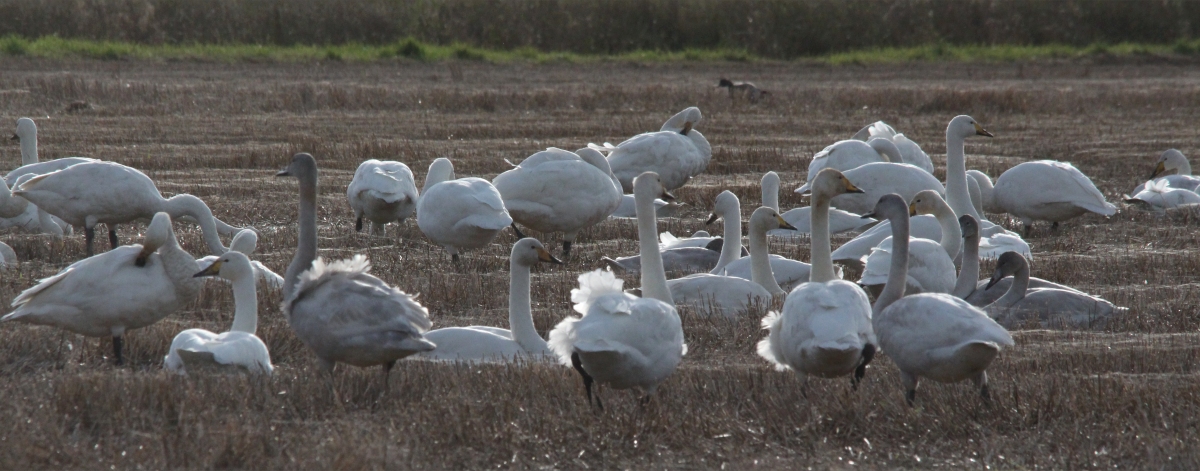
Greenland white-tronted geese, pink-footed geese and whooper swans
A whole bunch of American vagrants, and a few UK regulars I still don't have on the year list, had been reported from Banks over the past few days so I decided it was more than high time I spent the best part of a day there and get to grips with it properly rather than fitting in a quick shufti on a visit to Crossens.

It was Monday so of course Northern Rail had a meltdown. Anyway, I got to Southport and went to get the bus. My mistake here was to get the X2, not the 2. The X2 goes into Banks then turns and heads off towards Mere Brow and Tarleton, whereas the 2 carries on past Banks Marsh thence to Hundred End and Hesketh Bank. Not to worry: it was a nice walk from Mere Brow, I bumped into my first fieldfares of this Winter, four buzzards soared overhead and the bus I should have waited for only passed me a few minutes before I arrived at Banks Marsh.

Ribble Marshes from Banks
The most obvious thing walking down Marsh Lane was a field full of whooper swans. It was only as I got closer that I could see the pink-footed geese further back in the field. Working my way across the field with my binoculars I noticed two dark shapes in the middle of the swans which turned out to be a pair of white-fronted geese. I got a better view of them further down the road and managed to identify them as Greenland white-fronts.

Whooper swans
Whooper swans
Whooper swans
Something was spooking the jackdaws, woodpigeons and starlings feeding in the next field but I couldn't see anything flying about that might account for it.

From the embankment overlooking the Ribble the most obvious birds were the pied wagtails chasing each other about the mud immediately in front. Further out there were plenty of shelduck, wigeon, teal and mallard and little egrets were scattered about the creeks. Waders included lapwings, redshanks and dunlin and a modest flock of golden plover wheeled about the far bank. An Egyptian goose was a surprise. Three birdwatchers with big telescopes were trying to identify a bird which might have been the weekend's white-rumped sandpiper but with no success. It was too far away for me not to have been kidding myself at any identification. After a bit I decided I was jinxing it for the others and left them to it.

There was a lovely bit of cloud iridescence above the field of swans on the way back.

Cloud iridescence
The journey back was horrendous: I should have walked back to Crossens and picked up a bus there. The number 2 bus from Preston to Southport turns out to be horribly unreliable.

On the plus side, Greenland white-fronted goose brings the year list to 200.

Saturday, 14 September 2019

Lunt Meadows

Sketch map: Lunt Meadows and Roundley's Wood
Lunt Meadows is a Lancashire Wildlife Trust site roughly halfway between Maghull and Crosby in Merseyside. It's a stretch of flood meadow next to the River Alt and is particularly noted for its waders, waterfowl and owls. This is another of those places that look like a beggar to get to by public transport but turn out to be straightforward once you know how.

Lunt Meadows
The 133 bus runs between Kirkby Station and the bus stop across the road from Waterloo Station once an hour Mondays to Saturdays. It goes round the houses a bit and takes about forty minutes from Kirkby and twenty-five minutes from Waterloo. The bus stops at Lunt Village are across the road from each other. From Waterloo the bus eventually turns onto the A565 for a short stretch then goes down a long straight road (Long Lane) before taking a right turn onto Lunt Road and past the sign for the car park then into Lunt Village (which is tiny). From Kirkby the bus eventually goes through Sefton Village, then along a long straight road then takes a sharp right then a sharp left into Lunt.

Lunt Meadows, Roughley's Wood to the right
Don't walk down to the car park entrance. Take the little lane on the North side of the road. This takes you past Roughley's Wood (a small Forestry Commission woodland and worth a look round) and then onto Lunt Meadows.

Greylag goose
The paths around the reserve are pretty good. There are a few screen hides with seats dotted about and enough cover to let you see what's on the pools and in the reedbeds without spooking all the birds.

Wren
In Summer black-headed gulls and avocets breed, though large gulls tend to take most of the young avocets. The reedbeds, scrub and woodland attract a good variety of warblers, including Cetti's warblers in the brambles by the reeds. Buzzards, sparrowhawks and kestrels can be seen and marsh harriers seem to be fairly regular visitors. The large numbers of dragonflies and damselflies around the pools give you a chance of striking lucky with a hobby. Ducks include shovelers, gadwall and teal.

Outside the breeding season there are nearly always a few black-tailed godwits, ruff and snipe. Passage migrants include garganeys and wood sandpipers and sometimes something special may turn up.
Fairly poor, heavily-cropped record shot of the stilt sandpiper that visited in July 2019

Garganey
 In Winter Lunt Meadows is famous for the short-eared owls that hunt over the area in daylight.

Lunt Meadows

Monday, 9 September 2019

Crossens and Marshside

A visit to Crossens and Marshside in the pouring rain. It seemed to have eased when I arrived at Southport but once I got off the bus at Crossens roundabout the Heavens opened.

Crossens Inner Marsh in the rain
Mostly Canada geese with a few greylags and a domestic white goose
Definitely Autumn, and not just the weather. Crossens Inner Marsh was covered in Canada geese and greylags and the first few golden plovers were included in the flock of black-tailed godwits, starlings and lapwings put up by a kestrel. There were a few dozen pink-footed geese in Crossens Outer Marsh and a few hundred more in Suttons Marsh in Marshside. No sign of the red-breasted goose reported yesterday; I hadn't held out much hope for it, at this time of year the pink-footed geese see the Ribble Estuary as a transport café rather than a destination. Still, you live in hope.

Pink-footed geese, Marshside
At least two ruddy shelducks were still on at Marshside and there were five cattle egrets over at Nels Hide. Two of the egrets were juveniles, they must be breeding somewhere local, surely?

Ruddy shelduck, Marshside
Cattle egrets, Marshside
Cattle egret doing like it says on the tin, Marshside
Huge numbers of swallows passed through and there was a nice male wheatear at the Sandgrounders Hide.

Wheatear, Marshside
Teal and a shoveler, Marshside


Wednesday, 4 September 2019

Railway journeys: the Exe Estuary from Exeter to Dawlish

Sketch map: Exe Estuary
This is probably my favourite stretch of railway in this country, and certainly the best for birdwatching from the train.

The view from Exton Station
The service runs from Exmouth to Paignton, working its way along the coast from Exmouth to Lympstone then along the seawall to the River Clyst just past Exton, along the back of Bowling Green Marsh then, turning inland through Topsham then via the Exeter stations, south alongside the Exminster marshes then along the seawall past Starcross, through Dawlish Warren and Dawlish then bobbing back inland through Teignmouth and onward to Torbay. The insane thing is that thanks to Dr. Beeching that stretch of sea wall is the only rail connection to England West of Dartmoor.

Railway and seawall going from Langstone Rock to Dawlish
After the train leaves Exeter St. Thomas the line runs roughly parallel to the Exeter Canal and the River Exe and out into open marshy countryside. Back in the old days the pools and creeks along this stretch were the first hints that you might strike lucky and see your first little egret of the year. They still have their fair share of little egrets, and herons and Canada geese. Pretty soon the marsh land thins and the river widens and the railway line becomes the Western edge of the estuary.

Exe Estuary at Starcross
This journey's particularly rewarding in Autumn, Winter and early Spring when huge flocks of waders and wildfowl settle in the estuary. You'll need to sit by a window on the left-hand side to get the best of it.

At low tide the mud is peppered by distant dark shapes that usually turn out to be redshanks, oystercatchers and curlews and you may also see a few flocks of brent geese. At high tide the waders huddle by the railway line, the geese tend to stay out in the main channels of the river. Past Starcross you start to see more black-tailed godwits, dunlins and wigeon. If you're lucky you may get a close view of the regular wintering Slavonian grebe. As the train approaches Dawlish Warren the line runs by the side of the bight, then through a bit of salt marsh, alongside the golf club and into the station.

Oystercatchers, Dawlish Warren bight
Note the white-headed individual at the back
Brent geese, Dawlish Warren bight
Dawlish Warren is worth a few hours' (or even a few days') wandering round. It's a spit jutting about a mile into the mouth of the estuary. A large part of the northern side is a golf course, the rest of the Warren is a mixture of open heath and dunes with some small patches of light woodland at the landward end. The bight on the northern side is great for wintering geese, waders and ducks. The beach on the southern side is great for waders and seawatching. And every shrub or patch of brambles could hold an interesting passage migrant. My list for Dawlish Warren is 114 species with highlights including Bonaparte's gull, Richard's pipit, Dartford warbler and Siberian chiffchaff.

Sanderlings, Dawlish Warren beach
Pulling out of the station the train turns away from the estuary, joins the seawall and goes past Langstone Rock on to Dawlish.

Langstone Rock
Langstone Rock
It's definitely worth keeping a close watch on the sea here at high tide: the gently sloping sand attracts flatfish which then attract shags, great-crested grebes and, if you're lucky a diver may come close. The mussel beds at the end of the rock attract eiders and scoters, with the occasional nice surprise. If the weather's not awful it's a nice walk from Dawlish Warren station along the seawall to Dawlish Warren and worth it for the seawatching. If the weather is awful, it's worth trying to find a bit of shelter (there's not a lot of it, all at the Dawlish Warren end) and dig in to see what gets blown by.

Red-throated diver, Dawlish Warren
Velvet scoter, Dawlish
From Dawlish the line goes on to Teignmouth and on to Torbay, terminating at Paignton.

Wednesday, 28 August 2019

Marshside and Crossens

Marshside
One of those days when the sky's a painted backdrop
Keen to take advantage of the cool, wet weather and get away from the news of the day I went for an afternoon wander round Marshside and Crossens.

Aside from a couple of dozen low flying house martins the approach along Marshside Road was very quiet, picking up only near the end with ten mallard and a heron. Junction Pool was even quieter but that may be because there's been work going on recently to improve the ditches here.

Junction Pool, as quiet as I've ever seen it
Things changed dramatically at the Sandgrounders Hide. A flock of black-tailed godwits were busy feeding in the company of a few teal. Tucked away in a far corner were a couple of snipe and a curlew sandpiper. While I was trying — and failing — to identify a couple of small brown birds that were being chased by a pied wagtail a very bright female wheatear flitted across my eye line. Just as I was about to leave a common sandpiper flew in.

Black-tailed godwits, Marshside

Black-tailed godwit, Marshside
Black-tailed godwits, teal, a curlew sandpiper and a snipe, Marshside
Black-tailed godwits, teal, and a curlew sandpiper, Marshside
A ruddy shelduck could just be seen from the hide. It obligingly swam close by as I was walking down the path towards Crossens.

Ruddy shelduck, Marshside
Crossens Inner Marsh was very quiet, a combination of the time of year and work being done on the ditches now that this area's been added to the nature reserve.

Information board for Crossens Inner Marsh
Thirty or so curlew feeding amongst the greylag geese gave a hint of the Autumn to come.

Crossens Outer Marsh was similarly quiet, save for a large flock of swallows around the wildfowlers' pull-in and a couple of kestrels hunting over the rough sedge. A dark shape quickly skimming low over the salt marsh turned out to be a very fine adult hobby.

A merlin quartering a potato field alongside the railway line a couple of minutes outside Meols Cop was the icing on the cake. I've seen a report that I missed out on a peregrine about half an hour after I left Sandgrounders, a shame as it's always nice to get a full set of falcons in one day.