Black-tailed godwits, Leighton Moss

Monday, 12 July 2021

Pennington Flash

Great crested grebes collecting nest material

I was all set for another indolent day at home so I dragged myself out for a late afternoon walk round Pennington Flash in the rain.

I've never known the place so quiet: just me, a man with a sad-looking dog and a bloke pushing a three year old on a swing. Even the ice cream vans weren't there. Luckily, possibly consequently, plenty of birds were about. It was one of those afternoons where you wish the pandemic was over so the hides could be opened.

Walking towards Pennington Brook

Walking in from St Helens Road the rain dampened the spirits of most of the birds in the trees. A couple of song thrushes and a blackcap sang, the rest quietly got on with their business. There was neither sight nor sound of the jays this time. Great tits, blue tits, wrens and robins were around but very hard to get to see.

There wasn't a single bird on Pennington Brook, which is very unusual.

Black-headed gull

The usual suspects were on the car park, doing strangely natural things in the absence of people armed with duck food. A herd of thirty-odd Canada geese grazed on the grass between the trees, the goslings being in that peculiar stage where they look like three-quarter sized versions of the adults. The mallards loafed and dabbled by the banks of the flash while the herd of mute swans grazed further out in the water. 

A hundred and something coots were scattered in rafts across the open water accompanied by a handful of tufted ducks. A few black-headed gulls were about, most seemed to be on the other side of the flash by the sailing club. There were also the first big rafts of large gulls, perhaps fifty-odd blesser black-backs in total. There were dozens of swifts hawking low both over the water and the car park but, strangely, no hirundines. 

An Egyptian goose came to see what I was, didn't much like the look of me and strolled quickly away. I couldn't see if the other two that are usually with it were about.

Juvenile mistle thrush

There were a dozen mistle thrushes on the golf course by the car park, nearly all juveniles in their mildew-and-rust plumage. A few more chased each other round the kiddies' playground. While I was watching a couple skittering round in a willow tree I noticed a couple of tree creepers quietly working their way up the branches.

The vegetation made it almost impossible to see anything on the spit in front of the Horrocks Hide save a few mallards and black-headed gulls. Looking out over the flash I was trying to work out what a dark shape was on the water when I noticed a dark tern on one of the buoys. It turned out to be a common tern, the dark being down to a combination of murky light and the bird sitting low against the buoy. Coming back to the dark shape it eventually drifted in a bit closer and gave side-on views enough for me to identify it as a common scoter. It definitely wasn't an adult male but I couldn't see it well enough to be sure if it was a female or a young male (if pressed I'd be inclined to the latter). There seems to be another passage of scoters on the go, every other reservoir seems to have reported some today.

The pool in front of the Tom Edmondson Hide was full of loafing mallards. Across the path a pair of coots were feeding their second brood and a pair of great crested grebes were collecting nest materials. A sedge warbler and a reed warbler sang briefly and the usual Cetti's warbler gave a burst of song from its bramble patch.

There were forty-odd lapwings at Ramsdales in the company of a dozen or so mallards. A single drake teal in its spotted dick eclipse plumage was barged by a caravanserai of noisy mallard ducklings while it tried to doze on the bank nearest the hide.

Pennington Brook

I made my way back to St Helens Road. Plenty of more of the same along the way. I felt better for the walk even with damp feet where the stitching to my boots had finally given up the game.


Thursday, 8 July 2021

Mosses

Little Woolden Moss

After a rather indolent few days I thought I'd best get some exercise with a walk across the mosses from Irlam.

July is generally a quiet and difficult month for seeing and hearing small birds but the blackbirds, goldfinches and greenfinches in the hedges along Astley Road were having none of that and made themselves noisily conspicuous. The whitethroats and blackcaps were quieter than usual, having hungry mouths to feed is a full-time job. The adult robins tended to skulk while the young robins fed out in the open. There are more young robins in production given the beakfuls of insects the adults were carting about.

Irlam Moss

A buzzard flew over towards New Moss Wood. A male kestrel flew into the trees by the first field of turf. I looked around for the usual female and instead found two youngsters — a male and a female judging by their size — sitting with the woodpigeons on the phone lines over the other end of the field. (I bumped into the female a little further on at Annabel's Farm).

There wasn't much on the turf fields besides a couple of magpies on one of the field margins. Turf fields can seem a bit like a green desert landscape but they must have something happening in them otherwise there wouldn't be flocks of swallows hawking over them at knee height.

It wasn't until I saw the first one at Hephzibah Farm that I realised I hadn't been seeing any carrion crows. It turned out they were attending turf lifting operations on the other side of the motorway. (No sign of the Jack Russell that makes sure you're passing by and not stopping, either. I hope he's OK.) On the other hand there were quite a few yellowhammers, including three or four males singing from the foliage at the tops of the trees by the road.

The hedgerows were mostly quieter the other side of the motorway, at least up to the stables near Four Lanes End where a couple of chiffchaffs and a family of moorhens added themselves to the day's tick list. Flocks of crows, black-headed gulls and lesser black-backs busied themselves around the turf-lifting operations.

I'd seen a report of a wood sandpiper in a field a couple of hundred yards further up Astley Road this lunchtime so instead of turning go to Little Woolden Moss I carried on down the road. I spent a while looking in that field and a couple of damp fields across the road from it but all I managed to achieve was to unsettle the lapwings and draw the attention of horseflies. Still, well worth a go and nothing lost in the process.

Cotton grass, Little Woolden Moss

Little Woolden Moss was surprisingly quiet, and quietly surprising. It was a warm afternoon so I wasn't expecting a frenzy of bird activity on the pools but a complete absence of gulls or waders was a surprise. A family of pied wagtails skittered around the bunds, barging into a couple of yellow wagtails as they bounced about. All the willow warblers had too much in their beaks for singing. The meadow pipits seem to have had a good year judging by the numbers shuffling between the pools and the potato field on the other side of the reserve.

A kestrel flew low over and a buzzard soared by. I didn't think I'd have much chance of seeing a hobby as there weren't many dragonflies about, just a few four spotted chasers. I started heading for the path to Glazebury when I spotted a large, dark falcon high overhead. At first I thought it might be a small peregrine as it dwarfed the swifts flying nearby, then I realised the swifts were putting on a effort to keep well above it. It flew a bit closer, saw the kestrel coming its way and met it in aerial combat. Luckily, this time it was all for show: a male kestrel is no match for a female hobby and neither party wants to risk unnecessary injury so after a minute's banking and diving they went their separate ways. The hobby flew down lower and passed over the pools, giving me a chance to confirm her ID.

Mosslands Farm

I joined the path to Glazebury in the company of a family of reed buntings and some more meadow pipits. There'd been reports of a singing quail in the usual place yesterday so I spent a lot of time stopping and listening hopefully. No luck, just yet more meadow pipits with their parachute song and a couple of skylarks. I walked down between the field of ripe barley and the potato field, both of which were full of even more meadow pipits. A male emperor dragonfly patrolled the tops of the barley, the bright green and blue of its body dazzling against the old golds of the barley.

Everything went quiet for a moment and a large, dark bird floated over the polytunnels and off towards Astley Road. It took a while for me to realise it was an immature marsh harrier, possibly a second calendar year bird as it looked too big for one of this year's birds. It had moulted a few of its primary feathers, making its wings look a bit tatty. My reactions were too slow for getting my camera out of the bag for a photo.

I walked a little further then glanced after the harrier and thought I saw it floating about a few fields away near the railway. Then I realised it was a different bird, its wings were whole. Not the harrier then. A buzzard probably. A buzzard with a pale head. A buzzard with a pale head and grey shoulders. A male marsh harrier. Seeing one marsh harrier round here in Summer is a nice surprise, two is red-letter day stuff. 
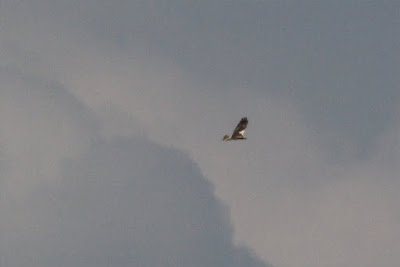
Male marsh harrier, Mosslands Farm

I was so intent on watching the harrier floating off towards the horizon that I didn't notice that the bush I was standing by had the Channel wagtail in it until the bird broke my concentration by calling loudly and flying across my eyeline before darting off towards the polytunnels. I didn't catch sight of it again, nor of any other yellow wagtails though I could hear a couple calling from the potato field with the meadow pipits.

Odd bird noises caught my ear as I walked down the path towards the farm buildings. I couldn't place them, though I found where the kestrel had retreated to after it was buzzed by the hobby. The mystery was solved when I turned the corner and found an odd assortment of chickens fussing about under a tractor. A rooster, a cheerful looking ginger hen and a young cock that looked more like a wild red jungle fowl than a farmyard bird. They had five chicks with them: one buttercup yellow, one black, one creamy yellow, one dark brown and one nearer white than beige. A very odd assortment.

Along Moss Lane

Walking down Moss Lane there were more pied wagtails and whitethroats amongst the spadgers and goldfinches. The swallows on the fields were joined by sand martins as I approached the Glaze Brook. The water was high on the brook and there were a couple of family parties of well-grown mallard ducklings dabbling by the banks.

I'd just missed the bus to Leigh from Glazebury. No matter, I could wait ten minutes for the bus to Warrington and get the train home. Fifty minutes later I got the next bus after the one that didn't turn up. No matter, it had been a good outing.


Wednesday, 7 July 2021

Cumbria

Pied wagtails, male (left) and juvenile, St Bees
That black and white pattern that makes them so obvious in the supermarket car park becomes disruptive camouflage amongst pebbles and seaweed. Or would if they didn't leap around so much and kept quiet.

I've had a feeling that I've been undercounting the spadgers in the garden. This morning as I opened the curtains I guessed from the sound there were half a dozen of them. In fact there were thirty-one. No wonder the sunflower feeders are getting hammered.

I had a few plans for a day out today, none of which really worked after consulting rail timetables, tide times and the pollen count. I got myself an old man's explorer ticket and headed North, looking for inspiration and train connections along the way. In the end I decided to stay on the train, change at Barrow for the Carlisle train and go up to St. Bees. The idea being to see how far along the Cumbrian coastal line I could get, spend an hour exploring then get home at a reasonable time. (I didn't especially want to explore Whitehaven or Workington.) It also gave me the chance of a bit of reconnaissance, I've passed through St. Bees a few times on the train but had no sense of how the station relates to St. Bees Head.

We left Manchester in the pouring rain but by the time we'd arrived at Preston it was bright and sunny. I was tempted to get off at Silverdale for Leighton Moss or Millom for Hodbarrow but I'd changed my mind three times before coming out so I decided to stick to the plan. I'm glad I did, the Barrow to Carlisle line is ridiculously picturesque this time of year, like one long Kerrygold Butter advert.

Just outside Drigg, from the Carlisle train

As the train approached Silverdale I could see that the black-headed gulls and lapwings had dispersed across the pools beyond the Eric Morecambe Hide. I could also see a few avocets keeping well away from the gulls. There weren't many ducks and geese of any kind were notable by their absence.

At Arnside the tide was still high on the Kent Estuary and most of the gulls were upriver. Leaving Carnforth earlier on I'd noticed how dry the marsh was, it was the same as we approached Grange over Sands and even more so between Cark and the River Leven where there were no pools of water whatsoever on the marsh. A couple of dozen eiders loafed on the River Leven in the company of black-headed gulls and lesser black-backs. Working our way through Furness the most obvious bird life were the small parties of swallows hawking over nearly every other field. Going through towns their place would be taken by swifts.

Kirkby in Furness

The stopping train to Carlisle meanders along the Duddon Estuary to Millom then flirts with the Irish Sea coast until it becomes a proper seaside railway from Seascale. I've no idea how (or if) the houses on the seaward side of the line at Braystones and Nethertown get insurance against flooding. The landward view is of distant Lake District peaks and rolling green hills.

Windscale was a surprise as the River Ehen runs beside the track for a good half mile either side of the station, providing a long, sheltered space for loafing gulls and mute swans. A common sandpiper was a good train ride tick.

St Bees Head

I got off at St Bees and had a wander towards the seashore. The start of the path up to St Bees Head turned out to be just a quarter of an hour's walk from the station. Realistically I couldn't walk up to the Head and get back for the train but it looks doable with a bit of planning ahead with the train timetables.

St Bees seashore

I sat by the beach, which was fairly busy, and did a bit of seawatching. The conditions were calm and flat and sunny so I wasn't altogether surprised only to be seeing herring gulls and cormorants. 

A large family of pied wagtails — five youngsters and their parents — foraged in the stranded seaweed by the breakwaters. The youngsters were more than capable of finding food themselves but spent most of their time begging from their parents. A young rock pipit joined them, looking very tatty after not doing a good job of drying itself after bathing in a puddle.

Just outside Drigg

The ride back was just as pleasant. The scenery was magnificent. As the train crossed the River Mite coming into Ravensglass I spotted a great white egret feeding in the company of a little egret.

Surprise of the day was seeing the osprey again in the dead trees just after Green Road Station. It wasn't in the same tree as last time, otherwise I'd have concluded it was a model, like those plastic owls people put on rooftops to attract the pigeons.

All in all, a very agreeable day.

Tuesday, 6 July 2021

Stretford

One of the "silver team" cock spadgers

I decided to have a lazy day today. I had to fill the feeders again after the spadgers brought in a third wave of spadglings. Just three or four of them but I'm happy to see the production line's still rolling. One of the young great tits has latched onto the silver family group. It often seems the first move a juvenile blue tit or great tit makes to assert its independence from the family group is to join a family of house sparrows.

Stretford Meadows

Had a wander over to Stretford Meadows as the rain eased over and the clouds parted for an hour or so. 

Goldfinches, blackcaps and chiffchaffs sang from the trees at the Newcroft Road end of the meadows. Out in the open magpies and blackbirds fed in the grass and goldfinches and whitethroats bustled about in the bushes. 

Buzzard, Stetford Meadows

A couple of buzzards flew overhead, the wind was strong enough to allow them to hover over the meadows. They didn't linger, it occurs to me that I've never seen any evidence of rabbits on here. There was a steady stream of carrion crows, wood pigeons and jackdaws overhead. The heavy conditions, and the past few days' rain, suited the flock of swifts hawking low over the open scrub. Luckily for me the midges weren't biting.

Stretford Meadows

I spent a while enjoying the flowers, I don't pay them as much attention as I should. A dizzying selection of vetches, clovers and medicks were in flower, the purples of tufted vetch and the bright mustard yellow of horseshoe vetch making the biggest flashes of colour with splashes of white clover along the paths. There were also plenty of butterflies about including a pleasing number of ringlets, I spent a while trying — and failing — to get a decent photo of any of them.

Marsh thistles, Stretford Meadows

White clover, Stretford Meadows

I walked along Kickety Brook to Stretford Ees. A sparrowhawk launched itself out of the trees near the canal and the woodpigeons clattered for cover.

Aside from the magpies feeding in the open and the reed buntings making noises in the sedges by the brook, the only birds on Stretford Ees were the few dozen house martins hawking overhead. A moorhen and her two small youngsters fed in the duckweeds on the pool at the end of the brook.

Stretford Ees

The clouds were looking interesting so I decided not to push my luck any further so I walked into Stretford to get my dad a new pair of slippers.


Monday, 5 July 2021

Southport

Little egret (left) and great white egret.
That's a barnacle goose behind them. I didn't spot it at the time.

After yet another poor night's sleep I dragged myself over to Southport for a wander round Crossens and Marshside. It was cool and raining when I set off at lunchtime, it was bright and sunny with a cool breeze by the time I got into Southport and I was distinctly overdressed for the walk. I'd just missed the 44 bus to Marshside so I got the bus to Crossens and started walking down Marine Drive from there, having slung my raincoat over my arm and jammed the waistcoat into my shoulder bag under the camera.

Crossens Inner Marsh

Crossens Outer Marsh was quiet save for swifts and the distant herd of cattle. Crossens Inner Marsh wasn't a lot livelier, both were almost bone dry so there wasn't much doing for wildfowl or gulls. The lapwings have had a few youngsters, most nearly full grown but there were a couple of families of quite young birds. The Canada geese grazed over by the bund with a handful of greylags. There were a few avocets feeding in the remaining pools and half a dozen black-tailed godwits flew in to fuss and preen in the grass.

Lapwing, Crossens Inner Marsh

There was more action along the path than on the marsh. The local greenfinches and goldfinches have obviously had a good breeding year, though there were only a couple of pairs of linnets. Meadow pipits and skylarks rose up and sang while sedge warblers and whitethroats sang from the cover of hawthorns and roses. A couple of little egrets flew over between the marshes and a great white egret flew out and over towards Banks.

Greenfinches, Marine Drive by Crossens Inner Marsh

Marshside was wetter and busier. Tufted ducks, mallards and a few shovelers loafed and dabbled in the drains and pools. Both mallards and tufties had very young ducklings with them. There were a few more greylags with the Canada geese but not as many as I'd expect normally. 

Black-tailed godwit, Marshside

Black-tailed godwits, lapwings and avocets fed in and around the shallow pools, with plenty more flying in and out. There were enough black-headed gulls to make a racket but not so many to make you think the breeding season was still in full swing. The dozens of young gulls in their gravy-stained plumage suggested it hadn't been a bad season. Nearly all the small black shapes in the tall grass turned out to be starlings. Overhead the swifts were joined by a hundred or so house martins.

Black-tailed godwits, black-headed gulls and Canada geese, Marshside

I got to Sandgrounders and had a scan across the large pool by the path. Plenty more tufties, Canada geese, godwits and black-headed gulls on the pool with more geese on the bank, together with a little egret and another great white egret. It was good to see the egrets together just to get a sense of the huge size difference. Strangely, the little egret was easier to keep in sight: once the GWE had finished preening it went hunting in the ditches, disappearing from view entirely except for odd moments when it raised its head like a periscope for a look round. Much to my shame, I only noticed there was a pair of barnacle geese with the Canada geese when I was looking at my photos of the egrets at home.

Juvenile little ringed plover, Marshside

Looking out from the hide the first thing that struck me, besides another group of godwits, was a juvenile little ringed plover walking along a muddy bank. I soon found another and both their parents. A few redshanks fed alongside the godwits and yet more black shapes in the sedges turned out to be starlings. Except the one that was a male ruff in almost entirely black plumage.

Ruff, Marshside

I was about to leave the hide when a common sandpiper flew in and waggled its way along the bank of the spit. A couple of grey herons visible from the path brought the heron tally to three and I carefully scanned the cattle feeding at the back of the field in an unsuccessful bid to bring it up to four. I still find it a bit mad that it's now possible to feel disappointed not to have cattle egret on the year list by July. (And it's not that long ago that great white egret was a lifer for me.)

Spot the great white egret

Juvenile (left) and adult avocets, Marshside

I had a look at the Junction Pool. The young avocets were well grown, though still slightly fluffy. They were with some young shelduck ducklings, between them the shelducks and adult avocets made sure no other ducks came close. Another ruff, this one in non-breeding plumage (unless it's one of those ones that stay in non-breeding plumage and nips in amongst the ladies while the flash boys are posing about in their leks) was feeding with a small bunch of black-tailed godwits.

House martins filled the air as I walked up Marshside Road to the bus stop and a couple of curlews called from the school football field. It had been a very productive walk, though between my impedimenta and the weather it felt like more hard would than it should have been. Perhaps I'm just getting old.

Viper's bugloss, Marshside


Saturday, 3 July 2021

Stretford

Wet spadger

A morning's rainfall freshened the air considerably. It also brought in a crowd of spadgers. I was looking at some of the youngsters sheltering in the rowan tree while they waited for their turn at the feeders when I noticed a paler body amongst them. I assumed it was one of the goldfinches but it seemed odd for them to be so close together (there's no active antipathy between the spadgers and the goldfinches, it's just that the goldfinches get a bit wearing with all that twittering about). I got the bins for a closer look and the bird turned round to give me a full profile. It was a young spadger, but a bright creamy yellow one, the usual dark makings being a sandy brown. I'm not sure if this is properly flavistic colouration or some type of dilution. Any rate, it'll be nice to be sure of identifying one of the youngsters; they do vary in their shades of brown, with some being paler, some darker, some greyer and some warm brown but the differences are subtle and I can only be sure they're there when the spadgers are lined up on the garden fence in full light. The next challenge is getting a photo.

This hooligan can taste the strawberry it cached there yesterday (which was stolen by spadgers when its back was turned.)
  • Blackbird 1
  • Carrion Crow 1
  • Collared Dove 2
  • Dunnock 1
  • Goldfinch 3
  • Great Tit 1
  • House Sparrow 25
  • Jackdaw 1
  • Magpie 1
  • Starling 13
  • Woodpigeon 5
Juvenile magpie, Barton Clough

I had an hour's wander round my local patch. There was plenty about though most of the birds were hard work to find. The adult robins are in post-breeding hiding and the tits and warblers were occupied in quietly collecting food for hungry mouths. Even the song thrush only did the occasional two minute burst. At the other extreme a juvenile jay made sure everyone within a hundred yards' radius knew it was bouncing round two thirds of the way up one of the Lombardy poplars.

The greenfinches and woodpigeons have evidently had a very successful breeding season. Family parties of greenfinches skittled about between the hawthorn bushes while the males sang from the high branches. Fewer goldfinches than last time, though judging by the twitterings I suspect I was missing a lot in the brambles at the base of the hawthorns on the other side of the fence. Half a dozen goldfinches sat in the dead trees in the copse by the school, together with twenty woodpigeons, three blackbirds and a couple of song thrushes. I've no idea what particular attraction there is in the dead trees but it's rarely I don't see a bunch of stuff in them.

Similarly the apple tree, though it's harder to see through the foliage. Today's highlights were a couple of blackcaps and a blue tit rummaging through the lower canopy.

I was surprised to see that the bramble patch near the flyover was busy. The usual whitethroat was preening in the company of a song thrush in the top branches. When the song thrush stiffened and the whitethroat moved down into the brambles I looked out for a sparrowhawk. Instead a juvenile robin flew in, landed where the whitethroat had been, fussed around a bit then flew down to the floor, whereupon a dunnock flew in to the space vacated by the robin. I can only assume this is a prime preening spot but I have no idea why.

Song thrush and dunnock, Barton Clough

  • Blackbird 12
  • Blackcap 3
  • Blue Tit 3
  • Chiffchaff 1
  • Dunnock 2
  • Feral Pigeon 23
  • Goldfinch 9
  • Greenfinch 12
  • House Sparrow 6
  • Jay 2
  • Lesser Black-backed Gull 6 overhead
  • Magpie 7
  • Ring-necked Parakeet 1 overhead
  • Robin 1
  • Song Thrush 3
  • Swift 3 overhead
  • Whitethroat 3
  • Woodpigeon 32
  • Wren 4
Having successfully managed an hour's birdwatching without being rained on I called it quits and ran a few errands. Which is why the sun came out.

Friday, 2 July 2021

Lazy day

Spadgers making inroads on the sunflower seeds

A combination of a couple of nights' poor sleep, high pollen count and a general can't be botheredness have pretty much kept me at home the past few days, venturing out to go to the shops or else getting some fruit picked before the blackbirds and squirrels get the lot.

The spadgers are keeping busy rummaging round the roses and fruit bushes for greenfly, though completely ignoring the blackfly that have descended on the broad beans by the bird bath. They, and the squirrels, are going through a couple of kilos of sunflower seeds a week. They'd go through more but I'm limiting top-ups of the feeders to twice a week. 

The usual pair of goldfinches and a pair of young great tits are regulars, though more often heard than seen, and the first of the adult blue tits reappeared from hiding for the post-breeding moult the other day and looked very spruce indeed. Still no sign of the robins or adult great tits though one of the robins holding territory by the station has started singing again and I'm seeing or hearing one of the coal tits most times I'm waiting for a train. The warblers, which were hard work to see at the best of times, have gone quiet so I'm left to hoping they're still out there somewhere in the foliage on the embankments.

I'm seeing the piebald woodpigeon only every so often, and then only when it joins the crowd on the school playing field. I think it favours the small field on the other side of the railway line, I'm generally passing by there at the wrong time of day to catch that flock on the ground. I know at least two pairs of woodpigeons are occupying the sycamores on the embankment and my conifer but the foliage is so dense I only see them if I happen to look out when they're to-ing and fro-ing.

The swifts look a bit thinner on the ground this year, perhaps two pairs overhead. Things look a bit better a few streets away near my dad's, eight birds were flying low overhead as the weather front came in this evening; As I was coming home three swallows passed by, seems a bit late (or early) for them to be moving through.

It was nice to see one of the local foxes on its dawn patrol of the garden this morning. I've forgiven them for flattening the irises at the bottom of the garden (and I've learned that lion dung is very good for keeping the neighbourhood cats out of the garden but the foxes love it). I don't recall seeing this individual before, a very fine beast with a sleek ginger coat and dark, iron grey hind quarters. 

  • Blackbird 1
  • Carrion Crow 1
  • Collared Dove 1
  • Dunnock 1
  • Goldfinch 1
  • House Sparrow 22
  • Jackdaw 1
  • Lesser Black-backed Gull 2
  • Magpie 2
  • Rook 1
  • Starling 6
  • Woodpigeon 2
  • Wren 1

    I read that Spike Island's whooper swan was an injured bird that was looked after by the RSPCA and released there when it had recovered. You fairly often see individual geese or swans over summering in their Winter quarters because they'd been injured and couldn't join their flock on migration. There's nearly always at least one whooper to be found at Martin Mere in the Summer waiting for the flock to return.