Black-tailed godwits, Leighton Moss

Monday, 14 June 2021

Etherow Country Park

Mandarin drake moulting into eclipse plumage

I had a bout of couldn't be bothered so I dragged myself out for a late afternoon stroll round Etherow Country Park and Keg Wood.

It was a grey day, cooler than it has been lately and with a light breeze so a good day for getting round the rollercoaster paths of Keg Wood. Etherow Country Park wasn't very busy, except with ducks and geese. One family of new mallard ducklings aside, the ducklings were nearly full grown. Some of the young drake mandarins were already showing hints of rusty orange about the ear coverts. Some of the drake mallards were starting to moult into their duller eclipse plumage, a lot of the mandarins were well into moult.

Grey wagtail

A family of grey wagtails flitted around on the river by the weir. Judging by the beakfuls of caddis flies the male was collecting they've got a second brood on.

Juvenile carrion crow

Keg Wood was noisy but hard work to see anything. Nearly all the noise came from singing blackbirds and song thrushes. Here and there they'd be joined by a wren or a chiffchaff. Otherwise it was mostly the contact calls of families of small birds hiding behind leaf cover.

Keg Wood

Just by the house by the orchard I heard a couple of juvenile great spotted woodpeckers and eventually found them as they flitted about the trees by the telephone pole. They flew over into the orchard then down towards Keg Pool.

I had a sit down and a drink at Sunny Corner accompanied by serenading blackbirds and a carrion crow with two particularly noisy youngsters. A jay flew in, silently checked me out to see what I was doing then silently flew off.

Mute swan cygnets

I continued down the path, wheeling round and down to Keg Pool. The family of mute swans there are obviously used to being fed, they steamed over sharpish when I got to the bank of the pool.

Mandarin duck preening

As I walked back the mandarin ducks were settling down to preen and a had to pick my way through the crowds of Canada geese and mallards blocking the paths. A sparrowhawk flew low over, evidently didn't fancy its chances here and carried on into Compstall.

There are worse ways of spending a Summer teatime.


Sunday, 13 June 2021

Home thoughts

Good job I went to see the rose coloured starling yesterday morning, it had gone by teatime. Apparently the lady whose garden it was visiting got fed up of people who couldn't respect her privacy and stopped putting food out. It wasn't so much the birdwatchers standing where I was, well away and not staring at the houses, which I'm glad to say was nearly all of us when I was there, but those who kept walking up and putting food on her garden wall so they could get good photos. In the first place this was massively intrusive, in the second place it was entirely unnecessary, it just needed patience (as does all good bird photography, which is why I churn out so many dud photos). I often wonder how/if I'd report a rarity turning up in my garden.

I was feeling fragile after a particularly bad night's sleep due to a combination of heat and hay fever, so stayed at home most of the day except for a quick nip to the shop for bread and circuses. 

The sparrows are steaming through the sunflower seeds and fatballs, largely unseen as they commute through next door's ivy and my rambling rose. There are a few youngsters about, most of the time the adults keep them well undercover but they come out to visit the bird bath once in a while. 

The great tits have brought up two well-grown youngsters and they've been enthusiastically giving the fatballs some hammer. Nice to hear the coal tit visiting yesterday, too. I think they've been nesting under the railway platform but I've not seen any youngsters. The blue tits are still noticeable by their absence.

I'm within the territories of a blackcap and a garden warbler but I don't think either is nesting close to my garden. I think the blackcap's nesting a few doors down. I hear it singing from there most mornings and evenings. The garden warbler tends to come in to sing late morning and mid-afternoon, its dawn chorus singing is coming from somewhere on the other side of the railway.

  • Blackbird 2
  • Blackcap 1
  • Collared Dove 1
  • Dunnock 1
  • Garden Warbler 1
  • Goldfinch 2
  • Great Tit 3
  • House Sparrow 10
  • Jackdaw 1
  • Magpie 1
  • Robin 1
  • Rook 1
  • Woodpigeon 1
  • Wren 1

Saturday, 12 June 2021

Horwich

Juvenile common starling (left) and adult rose-coloured startling (right), Horwich
The only record shot I managed to get of this bird

I decided I should have a go at seeing the adult rose-coloured starling over in Horwich, despite its being Saturday and likely to be a warm one at that. If I waited until Monday it would be gone. An early start to beat the crowds on the trains and buses, sunblock on and Vaseline round my nostrils to catch the pollen before it gets up my nose saw me getting the 575 bus from Bolton that stops by Pickup's Field in Horwich (not the 575 that goes straight through Horwich and off to Wigan).

I got off the bus and walked across the field, over the brook and past the football pitch to the far end of the field where a dozen people with binoculars and telescopes were staring at people's back gardens. I felt immensely uncomfortable; to my mind binoculars and big lenses are like shotguns: you don't point them at people or houses. Just as I arrived the bird had flew down into one of the gardens. I found a position where I could look down the length of the back fences without being able to see into any windows. Half a dozen starlings flew down into the gardens, a few juveniles jostled on the top of a feeder that was just visible over the fence. All of a sudden the starlings flew up onto the back fence, bringing the rose-coloured startling with them. I got good views and managed to get a record shot before they all rose and flew off over the houses. They wouldn't have gone far (I notice that the bird was reported as being back a couple of hours later). I'd seen the bird, my first adult, and nice it was but I was glad to pack up and move on.

Old Rake

I walked over to Brownlow Road then up to the path that crosses over to Factory Hill. I walked through into Winderswood and through to Georges Lane. There was enough cloud cover and a nice cooling breeze to make a nice walk of it. All the singing warblers were chiffchaffs or willow warblers, as I forked off onto an old pack road up the hill I had chiffchaffs singing to my right where the trees descended into Wilderswood and willow warblers singing to my left where the trees thinned out on the margins of the fields of sheep. A buzzard soared over Factory Hill, a couple of kestrels hovered over Georges Lane. Song thrushes sang in Wilderswood while mistle thrushes joined the blackbirds and lapwings in the fields. Textbook stuff, it's nice when it actually happens as clearly as this.

Wilderswood

I considered carrying on up to Rivington Pike but the clouds had faded away and the sun — and the pollen count — was getting high so I called it quits for the morning. As I descended a small flock of swallows arrived and fed low over the fields, disturbing pied wagtails, skylarks and meadow pipits in the process. 

Approaching Georges Lane

Further down there were huge log piles where the diseased pines and larches had been felled from Wilderswood. Strangely, it didn't look as if this had made much of an impression on the woods though it might have been a different story had I stayed the length of Old Rake instead of taking a detour up the hill. I'll find out next time I'm up that way.

Log piles, Georges Lane


Thursday, 10 June 2021

Pennington Flash

Juvenile black-headed gull

For once my knee and the Met Office were in agreement. So, with a significant risk of a rainy afternoon I decided not to give my hay fever a run for its money over the Salford mosses and went over to Pennington Flash where at least there's some cover. (In the event both were wrong, despite doom-laden clouds there were a few desultory raindrops at teatime and that was it).

I missed out on Cetti's warbler last time I visited and was hoping to rectify matters but it still came as a surprise to hear one singing at the edge of the flash in the car park. It kept itself well out of sight in some sense nettles at the base of a couple of willows. The usual Cetti's was back in its usual place by Ramsdales Hide.

By its own standards the Flash itself was quiet, which is to say dozens each of Canada geese, mute swans, mallards, black-headed gulls, lesser black-backs and coots, a handful of great created grebes and the odd herring gull. A handful of swifts hawked overhead and they were joined by a couple of sand martins.

The hides are still closed, which in current circumstances is fair enough. Blackcaps, chiffchaffs and willow warblers sang in the trees together with at least one garden warbler. Just the one reed warbler in song, by the Tom Edmondson Hide. Mallard families were keeping a wide berth of two young herons on the pool opposite the hide.

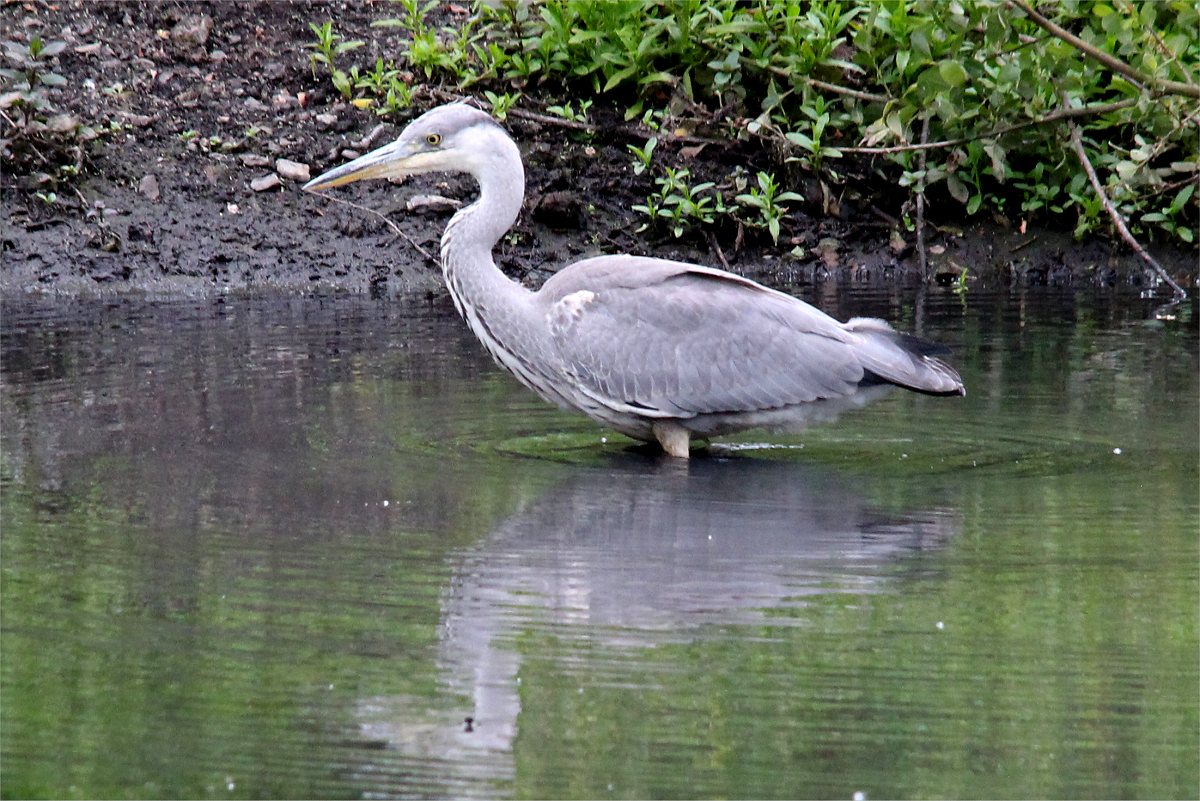
Juvenile heron

Ramsdales was busy with Canada geese, mallards, gadwall and shovelers. A couple of pairs of lapwings had youngsters feeding on the grass on the islands, the herons were given their marching orders pretty smartly when they flew in.

Seeing how dry it's been lately I took the usually boggy path past Bunting Hide through the woods to Teal Hide to see what was about. Mostly more warblers, blue tits, wrens and robins. It's impossible to see the Teal scrape from the paths so aside from the black-headed gulls that were bobbing up and down and a couple of very noisy dabchicks I've no idea what was on there.

I nipped through to the canal, taking a path that's infinitely easier to climb up than climb down. A four spotted chaser hawked over a patch of clover by the canal. For all the warm weather it doesn't feel like the dragonfly season's kicked in yet. This and a common blue damselfly by Ramsdales was my haul for today.


Tuesday, 8 June 2021

Merseyside

Willow warbler, Roughley's Wood

I thought I'd take advantage of the good weather to do a bit of catching up with places, using a combination of an old man's explorer ticket and an all areas Saveaway.

It was a morning for seeing sparrowhawks being harassed by swifts. A male soared over Humphrey Park while I was waiting for my train into Manchester, much to the displeasure of the pair of swifts that had been feeding overhead. It had something sparrow-sized in its talons but didn't seem in any kind of hurry to take it anywhere. As the Liverpool train approached Irlam another sparrowhawk was being chased by swifts over Liverpool Road.

Herring gulls, Crosby Marine Lake

I started off a Crosby Marine Lake, which was predictably busy but not silly so, though both I and the gulls could have done without the charmless nerk buzzing the boating pond with a drone. Nearly all the gulls were herring gulls, showing a bewildering array of moults and plumages. The few lesser black-backs were either adults or third-Summer birds. There were more tufted ducks than usual on the pond, which was nice. The pair of black swans I've seen on Seaforth Nature Reserve had moved over here today. House martins buzzed overhead, a pied wagtail had a hungry youngster in tow, and skylarks and reed buntings were singing.

Black swans, Crosby Marine Lake

I had a wander along the fence line of Seaforth Nature Reserve. There were plenty of linnets and goldfinches in the bushes while shelducks, Canada geese and a pair of baby rabbits grazed on the grass. The nesting common terns were noisily conspicuous, a few Sandwich terns with them were a lot quieter.

Just a couple each of whitethroats and chiffchaffs in the little nature reserve by the yachting club. 

I got the 133 bus over to Lunt Meadows. We were a few minutes early as we got onto Long Lane so the driver pulled into the side of the road to mark time. Which gave us both the opportunity to catch sight of my first hobby of the day as it flew low overhead towards Homer Green.

I got off the bus at Lunt and walked down into Roughley's Wood where I was greeted by a singing willow warbler. Further in there were singing chiffchaffs and blackcaps, and a very boisterous family of great tits.

I walked down the path to Lunt Meadows to the accompaniment of whitethroats and wrens singing in the hawthorns. The path is closed further than the corner hide, presumably because they're still sorting out the damage after the Winter flooding.

Lesser black-backs, herring gulls, black-headed gulls, mallard and lapwing, Lunt Meadows

The field by the hide was full of greylag and Canada geese goslings being shepherded by a handful of adults. Out on the water there were more geese together with loafing herring gulls, lesser black-backs and black-headed gulls.

I was watching a buzzard being mobbed by black-headed gulls and lapwings when a couple stopped by for a chat. As we were watching the buzzard a smaller bird pulled away and came our way. It turned out to be a hobby, possibly the same bird I saw earlier. As we were watching the hobby another falcon approached and was chased off. At first I thought it might be another, smaller, hobby but as it took evasive action the light caught the bright brown of its tail and identified it as a kestrel.

Walking back to the bus stop a Cetti's warbler burst into song from the scrubby reeds by the little brook.

From there the plan was to get the bus into Kirkby then get the Wigan train, possibly stopping off for a nosy round Orrell Water Park. As it was, we got bogged down by traffic in Maghull and when it became inevitable I'd miss the Wigan train I jumped ship at Maghull North Station. I went home via Preston, Todmorden and Manchester, just to get the full value of the ticket.

Monday, 7 June 2021

Alexandra Park

Coot family

A busy sort of a day, what with one thing or another, so I took the opportunity for a quick stroll round Alexandra Park on the way back home from getting my Covid jab. 

As bald as a (baby) coot

The ring-necked duck is a distant memory, with just half a dozen each of mallard and tufted duck to remind us it was ever there. The coots and moorhens have youngsters to keep them busy. 

Grey heron

The herons' nests are deserted but there's plenty of evidence of some degree of occupation. A young heron was perched at the top of one of the heronry trees but it was a second calendar year bird, possibly one of last year's batch from here.

And there was a reminder that the craze for Mutant Teenage Ninja Turtles didn't end well for the pond life of Britain.

Red-eared terrapin


Saturday, 5 June 2021

Southport

Little egret, Marshside

I thought I'd go out for a wander round Marshside and Crossens to get some sea air so I set out mid-morning to avoid the crowds. I'd forgotten the train timetable changes which mean there's now a fifty minute wait at Oxford Road and no connection that lets you catch the Manchester Victoria to Southport train at Salford Crescent. Usually there's a workaround involving getting the Barrow train and changing at Wigan but that was cancelled today. Ah well, part of the game.

Canada goose gosling starting to get the head pattern, Marshside

Walking down Marshside Road I noticed that the Canada goslings were getting big and many were starting to get their head patterns. One of these stuck out like a sore thumb because the rest of the family it was with were about a week younger.

The lapwings, and a couple of pairs of redshanks, had young hiding in the wet grass. Most of the redshanks were spending their time making noisy territorial flights over the road. A couple of sedge warblers sang from the ditch on the right-hand side of the road.

Lapwing and redshanks, Marshside

I had a look over the Junction Pool for the garganey which had been reported yesterday. No joy but I did find a male wigeon that had decided to linger.

I walked down to Nel's Hide. More redshanks, all too low and fast to photograph. Only a couple of skylarks, and just the one meadow pipit, singing which suggests the rest had busy mouths to feed.

Mallard duckling, Marshside

The pools in front of Nel's Hide were busy with mallard ducklings of various sizes, ranging from tiny to nearly full grown. A couple of shovelers dabbled over on the far side and a pair of gadwall passed by close to the hide. Two buzzards were sitting on fence posts by the road over towards Hesketh Road.

A very typical view of a glossy ibis, Marshside

A glossy ibis had been reported over the past few days but hadn't been seen today. Still, it was worth keeping an eye out just in case. I was about to leave when I had one last scan round. A dark shape emerged from behind a distant bush. At that distance it could have been anything though it looked a bit too brown to be a crow. After a few minutes it finally raised its head from the grass and promptly tucked its beak into its back feathers for a quick snooze.

Lapwing bullying a dunlin, Marshside

I wandered back and had a look round from the Sandgrounders Hide. The black-headed gull colony seems a lot smaller this year and there weren't many still on nests. There were a few avocet chicks about, largely unattended as their parents were spending all their time attacking greylag geese (avocets seem to have a particular aversion to greylags). A lone dunlin was having a miserable time of it: every time it settled down for a sleep it would be harassed by one of the lapwings.

Marshside

There were a few little egrets peppered around the marsh, nothing like the Winter congregations or post-breeding dispersal. It's a bit early in the year yet for cattle egrets but I still looked twice at every white shape near a cow.

I walked down towards Crossens. There seemed to be more avocets on the small pools on Marshside Outer Marsh than there had been on the Inner Marsh. The pools on the Inner Marsh had pairs of shelduck, mallard and tufted duck with a few gadwall and shovelers and a male pintail. A couple of whitethroats sang from the hawthorn bushes and a reed warbler sang from somewhere in a stand of great willow herbs and reeds.

Crossens Inner Marsh

Crossens Outer Marsh was very quiet, the cattle accompanied by a few shelduck and a couple of little egrets. Inner Marsh was busier, mostly with families of Canada geese and greylags. Lapwings and redshanks noisily patrolled their territories, adult avocets mainly fed in groups leaving little silver grey youngsters to fend for themselves as best could by small pools. There were a lot more black-headed gulls here than on Marshside but they were loafing rather than nesting. A male stonechat flitted about amongst the gorse bushes by the roadside.

Thence back home via a cancelled train at Southport and a jam-packed half a train home from Oxford Road.