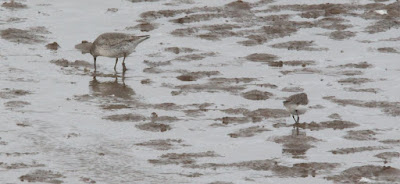
Black-tailed godwits, Leighton Moss

Wednesday, 16 February 2022

Windy day 1

Spadgers again

I'm not fond of windy weather, it makes me more nervous than the cat. I don't know why; when I nipped to the shop this afternoon the wind that had been getting on my nerves wasn't any worse than the one I was happily walking into the other day on the Wirral. We're promised something nastier on Friday.

The morning was quiet enough, weak sun and hardly a whiff of wind. Last night's wind had rattled the last of yesterday's mealworms and seeds out of the feeders and onto the floor, which kept the woodpigeons, blackbirds and robin happy. As I went out to do the refills a crowd of starlings lurked in the top of the sycamores on the railway embankment waiting for me to finish. They're still wary of me, which gave a couple of spadgers the chance at first dibs. I need to get more sunflower seeds, the goldfinches are making me feel guilty. It was late morning before the spadgers arrived in numbers and they tended to keep undercover as the wind started to pick up.

The female sparrowhawk made her second appearance of the week, swooping in at lunchtime and going away empty handed. The sparrows, safely in the deep cover of the rambling rose and next door's ivy, spent the next ten minutes noisily doing roll calls until all were established as being present and correct.

The jackdaws and crows seemed to know when the big wind was going to kick in. They flew up into the trees along the railway line and cawed for half an hour, skedaddling just before the weather got nasty.

The titmice kept a low profile until mid-afternoon when they came in as a mixed flock with the goldcrest in tow. The titmice pretty much ignored the mealworms, preferring instead to get the last of the sunflower hearts, the goldcrest confined itself to gleaning from the buds on the fruit bushes, it's been a mild Winter so I'd imagine there's plenty to go at. The sparrows and starlings made themselves scarce in the high winds but the titmice carried on until it started pouring down.

Oddly enough neither of the squirrels showed themselves today. I expect they've been teasing the cats under the station platform again.

  • Black-headed Gull 2 overhead
  • Blackbird 2
  • Blue Tit 3
  • Carrion Crow 2
  • Coal Tit 1
  • Collared Dove 1
  • Feral Pigeon 1
  • Goldcrest 1
  • Goldfinch 2
  • Great Tit 2
  • Herring Gull 1 overhead
  • House Sparrow 18
  • Jackdaw 4
  • Magpie 1
  • Robin 1
  • Rook 1
  • Sparrowhawk 1
  • Starling 27
  • Woodpigeon 5

The gulls on the school playing field were a bit understrength and they all disappeared mid-afternoon. It'll be interesting to see what blows in tomorrow.

  • Black-headed Gull 29
  • Common Gull 5
  • Herring Gull 1
  • Jackdaw 9
  • Magpie 1
  • Rook 3
  • Woodpigeon 5


Tuesday, 15 February 2022

Mosses

Fieldfares, Chat Moss

According to the Met Office today's the last day before all Hell breaks loose so I thought I'd best get a walk across the Salford mosses under my feet.

I made sure to refill the feeders in the back garden before I went out, the crowd scenes are taking their toll of supplies. When the spadgers and starlings aren't hogging the feeders a bunch of goldfinches are slipping in and staying awhile until the crowds return.

I got the 100 from the Trafford Centre and got off at the corner of Cutnook Lane by the motorway.  The mixed tit flock by the lane on the Irlam side included a very noisy coal tit. Over on the Chat Moss side it was all great tits.

By Cutnook Lane

Cutnook Lane was busier with cars than usual, I must have timed it ride for kicking-out time at the stables and the fishery. The roadside vegetation's been pretty much flattened, I think there's been work done to clear out the drainage ditches. A couple of trees look to be missing, too. All in all the landscape along the first half of the lane looks a lot more open. A dozen magpies feeding on one of the scalped turf fields were being watched by a tabby cat until a couple of crows flew in and scared them away (the cat wasn't much fussed). The hedge by the fishery has been ruthlessly trimmed so for once I could see the mallards, Canada geese and moorhens instead of just hearing them. A heron flew in and flew back out without landing.

By Twelve Yards Road

The fields along Twelve Yards Road were very wet. Here and there the field banks were cut through to drain into the ditches, the remaining pools testament to the recent heavy rains. There wasn't much about: a crow disturbed a charm of a couple of dozen goldfinches in the bushes over by the fishery; a couple of skylarks made heavy weather of flying over the road in the wind and a flock of black-headed gulls flew over and headed down to the flooded fields by the railway line.

The farm with the barn owl boxes was having some work done, I think one of the barns is being demolished. This meant there weren't any small birds in the nearby hedges. A little further along a pair of buzzards called and chased each other in the corner of a field of sheep.

Starlings and lapwings, Chat Moss

I was nearly at Four Lanes End when I saw a flock of starlings and lapwings rise up in the air, form a cloud and, after a couple of minutes' wheeling round, settle back on the ground. From where I was standing I couldn't tell if the cause was a predator or somebody walking along one of the turf fields.

At Four Lanes End the first small birds finally broke cover. A mixed tit flock — great, blue and long-tailed tits broke from the shelter of the hedgerow to visit a bird feeder hanging by a window on the farmhouse.

Redwing and fieldfare, Chat Moss

Lavender Lane, the little stretch from Four Lanes End to Little Woolden Moss, had been churned up something rotten by turf-cutting vehicles. The consolation was the flock of a couple of dozen fieldfares and a few redwings feeding on the newly exposed earth. I've only seen dribs and drabs of fieldfares this Winter so it came as a relief to see them in double figures.  The fieldfares were very skittish, rising up into the trees by the path when they spotted me, then panicking and flying back into the field when they realised they were nearer to me than when they started. I took a few bad photos then picked my way through the mud to leave them in peace.

Little Woolden Moss

Little Woolden Moss was dead quiet save for the usual family of carrion crows which seem to keep on making a living even when the meadow pipits disappear for greener pastures.

I took the path to Moss Road. The trees around Little Woolden Moss and over on Great Woolden Wood provided some shelter from the wind. Chaffinches, house sparrows and blue tits bounced around in the bushes by the farmhouses, a jay commuted between copses and a couple of pheasants made a lot of noise over at the back of one of the fields.

Lapwings, Cadishead Moss

The further I walked down Moss Road the more small birds could be seen by the road: more spadgers and blue tits, blackbirds foraging in the hedge bases and singing robins in the trees, a pair of collared doves and a flock of starlings. A couple of dark lines in one of the fields turned out to be a mixed flock of starlings and lapwings when I got close enough to see them properly.

New Moss Wood

I had a nosy round New Moss Wood for the first time this year. Oddly, all the action was around the margins of the wood, inside there was just the calling of a couple of buzzards and a lot of singing robins. There was a small mixed tit flock by the car park entrance together with a couple each of magpies and jays. I emerged further down the road and bumped into a charm of goldfinches which kept being disturbed by a male great spotted woodpecker while another buzzard was digging for worms on the ground.

I carried on down into Cadishead for the 100 bus. It had been a good three hours' wandering around, though I'd spent at least as much time fruitlessly scanning fields and hedgerows for birds that weren't there as I had actually walking. At least the weather behaved itself.


Monday, 14 February 2022

Wirral

Knot, Meols

The weather looked like it was going to be less dispiriting on the coast than back at home so I headed off for a walk along the Wirral Coastal Path.

I got off at Moreton and walked down to Kerr's Field. The housing development on the Broken Biscuit Factory site is at the point where the show home's now open so there wasn't much about other than a couple of woodpigeons. Half a dozen herring gulls and a couple of black-headed gulls on the Tarran Road Industrial Estate wasn't much to write home about either.

The Birkett and Leasowe Lighthouse

The Birkett was running high, with a couple of moorhens with the blackbirds and magpies feeding on the bank. 

Oystercatchers and lesser black-backs, Kerr's Field

Teals and shovelers, Kerr's Field

Kerr's Field was awash with large puddles full of mallards, teals and shovelers and about a hundred each of lapwings and oystercatchers. These were joined by curlews, redshanks and gulls — mostly black-headed with a few herring gulls and a pair of lesser black-backs — and a lone black-tailed godwit which fed at the side by the road.

Leasowe Common Pond

It's only half past February and the Alexanders is already in flower

I noticed that the clearing up after recent storm damage has opened the pool up a lot. I wonder how much of a difference that'll make during Spring migration.

I had thought that the huge number of waders in the field was a sign that the tide was high but it was actually receding. The birds just had more sense than me and kept out of the wind. Out on the beach, being swept by sand and horizontal rain, were yet more oystercatchers, lapwings, redshanks and gulls, with herring gulls outnumbering black-headed out here. There were plenty of curlews out on the open mud and small groups of dabbling shelduck were dotted about as far as the eye could see.

Walking to Meols

Yet again the groyne marked a change in the avifauna on the mud. The flocks of oystercatchers were smaller but more widespread, there were hundreds of redshanks and shelducks, and dozens of knots and dunlins. There was only a handful of turnstones but the usual feeding areas at the base of the seawall looked to have been scoured by storms.

Knot and dunlin, Meols

The closer I got to Meols the closer the shelducks and redshanks got to the seawall. More herring gulls flew out over the beach and a few cormorants could be seen out at the water's edge.

Redshank, Meols

At the lifeboat station I saw a bulky finch-like bird skip up from a patch of stranded seaweed and dive down below the back wall but I couldn't find it on the ground. A pair of snow buntings have been reported in this area but I couldn't in all conscience say this was one of them.

The beach between the lifeboat station and Hoylake is getting richer in vegetation and harder to find pied wagtails, even though they're out there fossicking round the grasses and samphires. I'd hoped for a close sighting of ringed plovers here but had no luck today.

I got as far as The King's Gap when the next heavy shower hit and carried a bit of sleet with it. I decided to call it a day, I'd had three hours' walking against the wind so I'd had my exercise with rather a lot of good birdwatching along the way. 

Chester Station

I had a combination of an old man's explorer ticket and a MerseyTravel saveaway so I went home via Chester, which let me avoid the Liverpool rush hour and gave me the chance to see if buzzards, woodpigeons and robins were the only birds I could see in the Delamere Forest twilight (they were).

Saturday, 12 February 2022

Rainy day

Spadgers

Any plans I may have had for going birdwatching today had a bucket of water very effectively poured over them. Me and the cat stared out of the window as the spadgers and starlings made mad sorties out of the shelter of the bushes to the feeders, fed and squabbled for ten minutes then fled back undercover. The titmice were a bit less mard about the weather and the coal tits even found time to top up their caches somewhere or other on the railway embankment. The weather's been a bit too mild to bring the goldcrests in to the feeders but it was wet enough for one to seek more sheltered forage in the blackcurrant bushes today.

  • Blackbird 2
  • Blue Tit 3
  • Coal Tit 2
  • Goldcrest 1
  • Goldfinch 4
  • Great Tit 2
  • House Sparrow 29
  • Jackdaw 2
  • Long-tailed Tit 1
  • Magpie 2
  • Robin 1
  • Starling 23
  • Woodpigeon 4

Out on the school playing field the wind and rain brought in a bumper bundle of gulls. The large gulls were very skittish, taking flight whenever anything much bigger than a jackdaw loomed on the horizon (I've never see a jackdaw loom, I'm sure they must be able to, they're very resourceful characters).

  • Black-headed Gull 109
  • Carrion Crow 1
  • Common Gull 9
  • Herring Gull 7
  • Jackdaw 10
  • Lesser Black-backed Gull 4
  • Magpie 4
  • Rook 1

By late lunchtime I was getting fidgety so, after checking the weather forecast, I decided to get the train into town and go for a brief wander round a municipal park just for an outing and a bit of exercise. A couple of serendipitous connections in town had me heading out to Buxton for the first time this year. (Side note: the old man's explorer ticket costs £15.90 and lets me ride on any Northern train all day after 9:30 anywhere between Carlisle and Stoke; an off-peak return from Hazel Grove to Buxton with a Senior Railcard is £6.90.)

This time of year most of the birds you're going to see on the line to Buxton are carrion crows, woodpigeons and jackdaws and today was no exception. A couple of singing robins and blackbirds at stations added a bit of variety, as did the Canada geese on the canal at Furness Vale and in fields by Combs Reservoir.

Buxton Pavilion Gardens

I had an hour to kill before the next train back from Buxton so I went for a stroll around the Pavilion Gardens which were still showing the effects of recent heavy rains. There was a flock of Canada geese monopolising one of the pools and I got to wondering if the assorted ducks had decamped for drier grounds when I turned a corner and found them all badgering a couple with a barrel of bird food (literally a barrel, and they were flinging the food out with scoops). Amongst the mallards were a few mandarin ducks, which seemed to be more intent on pecking each other than pecking the bird food, a couple of Muscovy ducks and a few moorhens. The small birds were for going to bed and there was much rustling and cheeping in the undergrowth from great tits, robins and chaffinches.

It should have been a straightforward journey home but some poor devil got hit by a train at Heaton Chapel so after the best part of an hour parked on Stockport Viaduct I just managed to catch the 25 bus home. I'm not going to moan about getting home late, I just hope it wasn't a fatality.

One of those not-really-trying days that still racks up more than a couple of dozen species.


Friday, 11 February 2022

Urban birding

Tufted duck, Alexandra Park

I'd become a little cross after reading one of those articles that make a big fuss about going out urban birdwatching but turn out to be about someone who books a hotel in a city centre and drives twenty miles out to the nearest wetland so I decided to go for a walk.

The garden had quietened down after a morning rush of spadgers and starlings, the coal tits and goldfinches were on the feeders and across the road the gulls were excitedly wheeling round the school yards waiting for the chance to pinch some kid's lunch.

First port of call was Moss Park, which was fairly quiet save a bunch of spadgers in the hedges, a few woodpigeons and magpies in the tall trees, a singing robin and a mixed tit flock including great, blue and long-tailed tits. It's a tiny park even by our local standards and sometimes there's only a robin and a few woodpigeons.

I walked over to Victoria Park for to get the 150 to Whalley Range. I had five minutes' nosy while I was waiting. There was just a small flock of pigeons, some jackdaws and a woodpigeon. Not unduly surprising: all the action's usually at the other end of the park around the bowling green and the stand of larches. Another day.

I got the bus over to Alexandra Road and walked up to Alexandra Park. It was nice to hear a couple of greenfinches singing with the woodpigeons in the churchyard of English Martyrs.

Alexandra Park

The park wasn't unduly busy with people, I'd just missed the lunchtime rush. Most of the tufted ducks and mallards in the pond seemed to be paired up already, a small group of unattached male tufties drifted round the island bobbing their heads at any ladies they passed. A pair of shovelers dabbling over the other side was a bit of a surprise. I'd expected to find some activity in the heronry on the island but herons was there none today.

The mixed tit flocks in the trees and bushes were very active, with a couple of pairs of great tits actively defending territories though not making any efforts towards nest-building. The blue tits, long-tailed tits and nuthatches confined their efforts to foraging. I could hear a goldcrest but had no luck finding where it was. A great spotted woodpecker kept to the treetops out of the way.

The screeching of the ring-necked parakeets managed to drown out two loudly singing song thrushes. There was a lot of argy-bargy going on in one of the trees near the Claremont Road entrance as  two pairs of parakeets argued about the ownership of one of the holes in the tree trunk.

Ring-necked parakeet, Alexandra Park

I thought about walking up past Brook's Bar and having a look round Hullard Park and Seymour Park in Old Trafford but it was just coming up to school kicking out time so I thought I'd save that for another day.

Two and a half hours' ramble round a few urban parks had netted me thirty-four species of birds and a bit of exercise so it was worth the effort.

Thursday, 10 February 2022

Southport

Snow bunting, Southport Pier

There was a promise of a sunny day so I headed over to Southport for a walk round Marshside and Crossens.

The better weather brought out the buzzards along the line to Wigan. One soared over Patricroft Station, another perched in the trees by the line on Chat Moss and a third sat on a fencepost by the Winwick Road bridge as we passed by Lowton.

Mallards, teal and wigeon, and all with more sense than me and staying out of the wind

I got the 44 bus from Southport Station out to Marshside. It was a gloriously sunny day but it was blowing a hooley with the biting wind coming in and sweeping across Marshside Road as I walked down to the reserve.

The school playing field at the end was covered in curlews, which I found vaguely reassuring, and the brambles by the fence noisy with spadgers.

Wigeons, Marshside

Out on the marsh the wigeons, lapwings and golden plovers were in their high hundreds. Something — I couldn't find what but I'd suspect it was a merlin — brought up a cloud of waders over by the Sandgrounders Hide. A portion of the cloud broke away and flew over and landed on the other side of the road, a few ruff amongst the lapwings, plovers and black-tailed godwits.

Lapwing and golden plover, Marshside

Wigeons, Marshside

The pink-footed geese were feeding in small family parties and there were a few Canada geese but for once I didn't see any greylags on either Marshside or Crossens. There were hundreds of teal and mallards and plenty of shelducks and shovelers but they tended to get lost in the crowds of wigeons and waders.

Gadwall, Marshside

The Junction Pool was pretty much half the field today. There were perhaps half a dozen pintails amongst the mallards and wigeon.

The strimmer and the heavy-handed hedge layer had been at work at Sandgrounders. If anything there was even less cover than they'd left at Nel's Hide. The water level was high enough for the bund between the pool at the entrance and the pools in front of the hide to be reduced to a small island. A few tufted ducks and a pochard fed in the pool while a flock of gadwall loafed and dozed in front of the hide.

Pink-footed geese

The stretch of the Marine Drive between Marshside Road and Crossens was closed for resurfacing, which made for a lovely quiet walk once you passed the lorries at work. Adding together Marshside and Crossens there must have been thousands of lapwings and wigeons.

Crossens Inner Marsh
Wigeon, teal, shovelers, lapwings and black-tailed godwits

Crossens Outer Marsh was quiet. There were plenty of pink-footed geese feeding in the tall grass but no geese out in the grazed areas. A few shelducks and little egrets fossicked about in the pools and there was a large mixed flock of lapwings and plovers in the distance.

Crossens Outer Marsh

I'd had the wind at my back for most of this stretch of the walk, it came as a shock as I rounded the curve and it hit me amidships. After a hundred yards of it I was grateful for the relative shelter of the sewage works.

The 47 bus had just arrived at the Crossens terminus so I caught it and got off at the other end of Southport. I walked down and through Victoria Park to the pleasure beach. The park was stiff with jackdaws, woodpigeons and magpies, all of them socialising as much as feeding up before going off to roost. 

Grey plovers, Southport

Grey plovers and dunlins, Southport

At first sight there wasn't much on the beach save groups of black-headed and herring gulls and a few redshanks. As I approached the pier I found a few dozen dunlin busily feeding in the mud in the company of a couple of grey plovers. I was busy watching these when a flock of thirty twites flew past and disappeared over a sand break. Much relieved that the twites are in double figures after all I walked on towards the pier and bumped into the five snow buntings again. This time they were much less skittish and I spent five minutes watching them feed before they flew off to join the twites. I was particularly struck how their variegated orange, brown and white plumage broke up the shapes of the birds and blended them in with the shell litter on the beach, they're so conspicuous when you see them on concrete breakwaters or sand dunes.

Snow buntings, Southport Pier

Snow buntings, Southport Pier

Snow bunting, Southport Pier

Walking back to the station I had a quick nosy on the marine lake where there were almost as many greylags as herring gulls.

The sun set as the train left the station. A herd of twenty-odd whooper swans in a field by Bescar Lane was a nice bonus for the day.


Wednesday, 9 February 2022

Pennington Flash

Oystercatchers and lapwings

I've been gadding about in search of exotic additions to the year list so I thought I should have a wander round Pennington Flash to see some of the regulars.

I was unlucky with bus connections and the 126 got embroiled in slow crawling traffic on the M60 so I arrived quite a bit later than planned. On the plus side, it was good to see the kestrel back at the RHS Worsley bus stop, I was beginning to worry he'd gone the way of the roe deer.

Bradshaw Leach Meadow

The path into Pennington Flash was fairly quiet, just a few robins and woodpigeons, and it wasn't until I had nearly reached the brook that I bumped into the first mixed tit flock. Interestingly it was the coal tits that were most conspicuously vocal, the blue tits and great tits were pretty quiet and it was only by accident I found a nuthatch rummaging through some ivy with a pair of woodpigeons. The second noisiest bird in the troupe was a goldcrest, which shows you how quiet the others were. Even the redwings and song thrush rummaging about in the undergrowth with a bunch of blackbirds were silent.

The water on the brook was pretty high, which may explain the mute swan feeding in there.

Pennington Flash

The car park oystercatcher was tricky to find today: it was right in the middle of a pack of feeding Canada geese. The usual mallards, coots and moorhens milled about accosting strangers for food despite the "Please do not feed the birds at the moment due to an outbreak of Avian Flu" notices.

Out in the water there were perhaps fifty tufted ducks scattered about in small rafts of no more than eight birds and a couple of dozen goldeneyes dotted about in one's and twos. All the great crested grebes were over in the bight by Ramsdales Hide. There were hundreds of black-headed gulls but not many large gulls: a couple of dozen each of herring gulls and lesser black-backs, a few common gulls and just the one great black-back.

Oystercatchers, lapwings and black-headed gull

A bit more of the spit was exposed by the Horrocks Hide and most of it was covered in lapwings, oystercatchers and woodpigeons. A few cormorants loitered at the end and pairs of teal dabbled round the edges with a few mallards.

Lapwings, cormorants, Canada geese and herring gulls

The Tom Edmondson Hide was locked up when I got there, which was a pity as there were lots of tufted ducks, shovelers and gadwall on the pool and at least five herons loafing at the side.

Great crested grebes and Canada geese

Ramsdales Hide was locked, too, but that's no great hardship as the screen by the hide gives good views. The islands were exposed again, which gave the thirty-odd teal somewhere to sit. The great crested grebes were swimming around in a rather mannered way as a group, perhaps preparatory to pairing up if they haven't already been.

Pennington Flash

I noticed the three-cornered leeks are in full leaf by the path to Pengy's Hide. It's been a very mild winter, I hope a late frost doesn't take its toll.

The Bunting Hide was locked up, too, but there were enough crowds of titmice, robins and chaffinches in the bushes by the path to keep me occupied though I quickly had to give up any hopes one of them would stay still long enough to have its photo taken. No willow tits today, sadly.

Pennington Golf Course

I walked over the golf course to Pennington Hall Park and the bus back into Leigh. Song thrushes and robins sang in the trees and a pair of goosanders flew overhead towards the flash. The male peregrine perched on the roof of the artificial ski slope by the Trafford Centre was a nice bonus.