Black-tailed godwits, Leighton Moss

Tuesday, 26 November 2024

A twilight walk

Stretford Meadows 

It was another bright, relatively mild day but I had errands to do so I settled for a twilight walk over Stretford Meadows.

As I left home the sparrows were getting a last feed in before bedtime. Both teams were in and out all day and there seems to be a lot of intermingling going on but it was the white-cheeked males who monopolised the fat blocks. The pair of blue tits stayed all day, too. The female still looks like she hasn't got over the mite infection she got during the breeding season, poor thing. At least I know none of my nest boxes were to blame, even the wasps and bumblebees didn't use them this year. The male coal tit that's been flitting about this week lingered for a while at breakfast so I got a good luck at him. My suspicions were correct, it is a continental bird. The clean, dark steel grey upperparts didn't have the green cast to the wings that the local birds have. I've not seen the usual local pair for a while, I hope they're okay.

The gulls left the school playing field just after lunchtime. Today it was just the usual black-headed gulls and a common gull.

Humphrey Park allotments 

As I walked past the allotments the last of the lesser black-backs headed off to roost. As did at least two parakeets. There were a dozen more parakeets screeching round Urmston Lane before heading to roost in the trees by the cricket pitch.

The spadgers were going to bed in the hedgerows by the garden centre and the magpies were having one last get together on the rooftops. Blackbirds and great tits shuffled about and wrens and robins sang territorial lullabies. 

I had a chat with a chap who said he'd seen the male kestrel in his usual tree, which is good as I was starting to worry about the lack of kestrels and buzzards here lately. He also said he'd bumped into a barn owl a few days ago, which was encouraging. It's a long time since I've seen an owl round here though a couple of times I've heard a tawny owl in the trees in the opposite corner of the meadows over by the school. The chap's spaniel was more interested in the pheasants calling in the trees and the guinea fowls calling in the stables.

Easy going

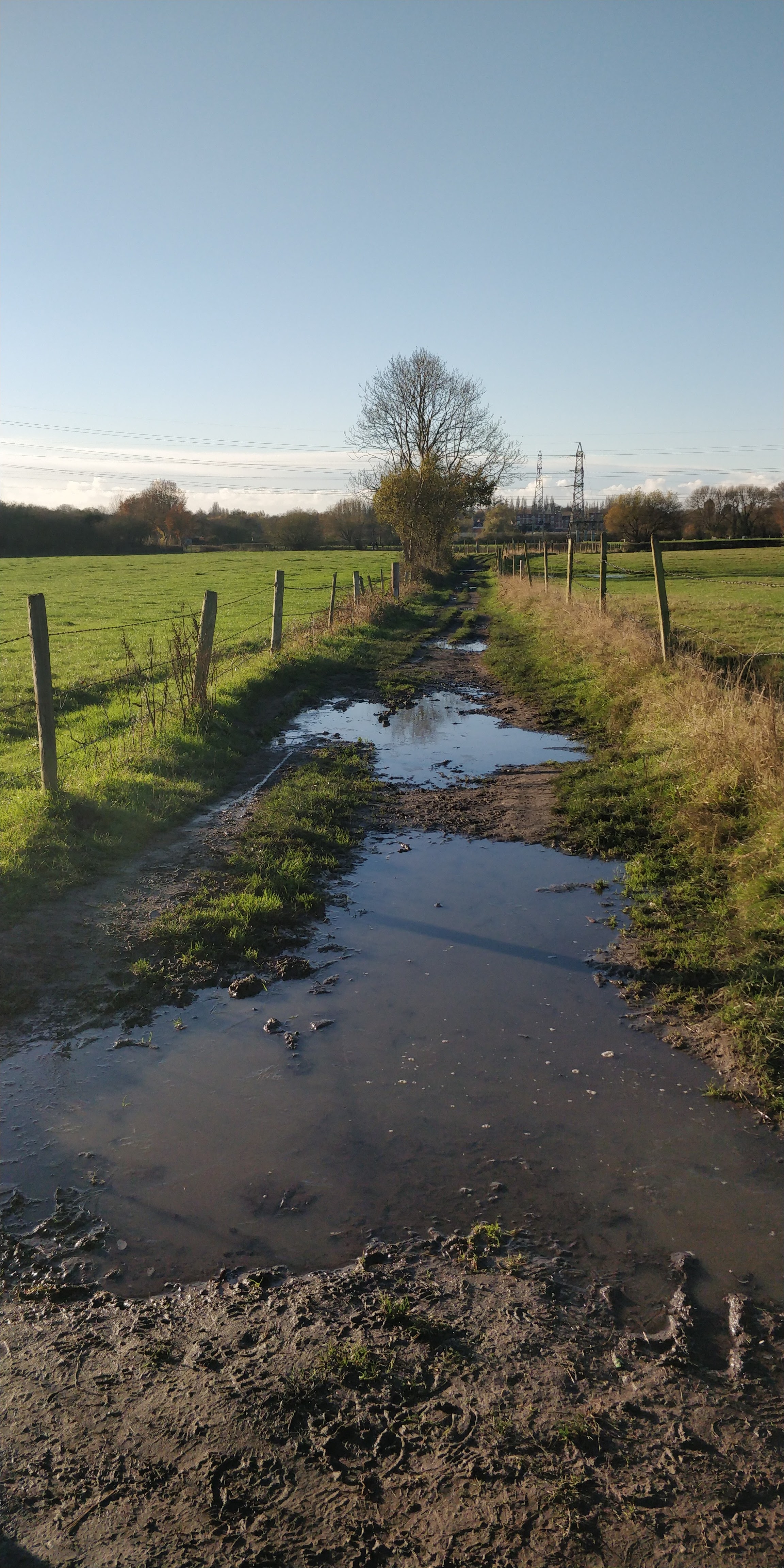
The ground underfoot was wet and muddy but not unusually so, I'd expected worse after the recent weather. 

Stretford Meadows 

I kept my eyes open for a barn owl but had no luck. Having said that the meadows were busier than they have been for ages. There was a constant background noise of magpies, dunnocks and blackbirds calling to each other as they settled down to roost. Three distant ,"blackbirds" flying up into an oak sapling before settling into one of the bramble patches didn't look right somehow, sure enough when I got close enough to hear them they were redwings. Hearing and seeing all this twilight roost activity confirmed my view of the vital importance of bramble patches to our birds. You don't get a dozen assorted thrushes roosting in an open patch of serried ranks of yard-high whips.

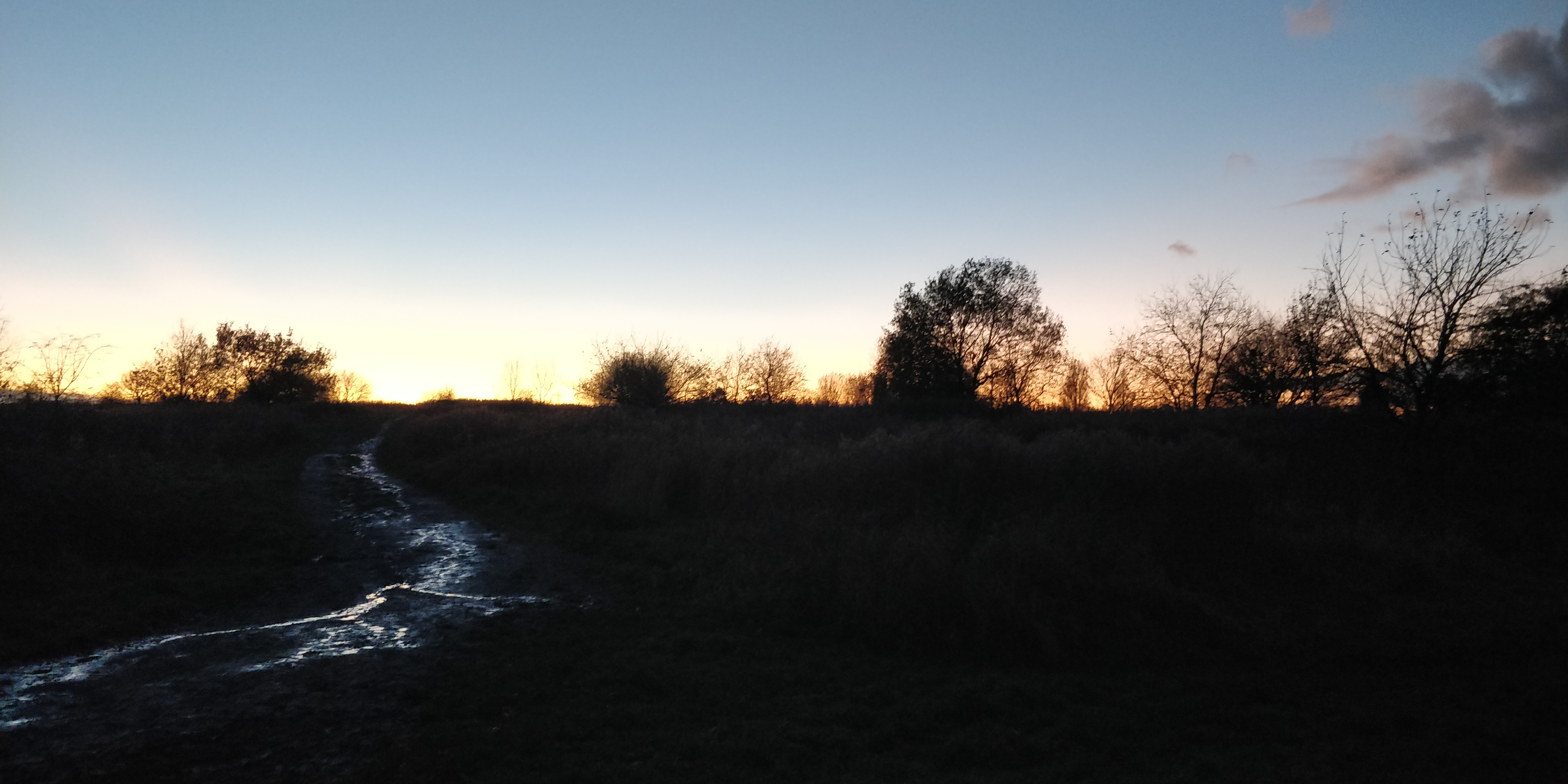
Sunset, Stretford Meadows 

Walking down from the rise

I dropped down from the rise after enjoying the last of the sunset and picked my way back onto Sandy Lane and thence home. The puddles and wet patches on the path down the rise made the navigation easy, they reflected the twilit sky like cats' eyes in the road.

It was the most productive walk I've had on the meadows for months even though I couldn't actually see most of the birds I was finding. 

Home time


Monday, 25 November 2024

St Helens and Pennington Flash

Ring-necked duck, tufted duck and coot, Taylor's Park 

I decided to bob over to Taylor's Park in St Helens to see if the ring-necked duck was still about. I got the train to Warrington, the bus to St Helens then the 10a to Dunriding Road. It was a nice uneventful journey on a bright, sunny and mild day which was a considerable contrast to last week and I worried I may be overdressed. That worry receded when I walked into the biting cut blowing across the lake at Taylor's Park.

Moorhen

Coot

The mallards, moorhens, coots and mute swans hung around the banks of the lake. The tufted ducks were being a bit standoffish out in the middle but were easy enough to see well. As, indeed, was the ring-necked duck. It seems to be the same bird that was here earlier in the year. I'd had my bit of luck so I passed it on by putting a couple of other people on the bird.

Ring-necked duck (left) and tufted ducks

Ring-necked duck (left) and tufted ducks 

Taylor's Park 

I had a — very quiet! — walk round the park then debated where to move on to next seeing as it was still only lunchtime. I decided to play it safe, head back into St Helens and get the 34 to Pennington Flash. I just missed the 34 at the bus station so I got the 320 to Ashton-in-Makerfield and the 610 from there to Pennington Flash.

Pennington Flash 

It had clouded over a little and the wind was getting fresher. The walk in from St Helens Road was fairly quiet, just the rattle of magpies. It took some going to spot the great tits, robins and blackbirds silently rummaging about in the hedgerows, even the squirrels were slinking about like thieves in the night.

Mistletoe 

The brook was slightly higher than usual 

The brook was inundated, even the mute swans drifting backwards downstream were dwarfed by it. The mallards and coots had the sense to stick by the banks.

Mute swans, mallards and Canada geese 

At first sight the flash was deserted, quite unlike the car park. 

Tufted ducks 

A closer look found a couple of large rafts of coots and black-headed gulls bobbing about in the waves. The raft of large gulls over by the sailing club was virtually unidentifiable, I'd no sooner get a distant white shape into focus than it was hidden by the next swell. It was considerably easier when they flew about, roughly two herring gulls for every lesser black-back. All the tufted ducks on the flash herded together in a raft near the café. Not for the first time I missed the sausage butty van and the ice cream van.

From the F.W.Horrocks Hide

The spit in front of the Horrocks Hide was a small crescent shaped island in the mid-distance. A couple of dozen mallards carpeted the near bank, there was enough room for a cormorant, a couple of herring gulls and some coots on the far tip. Beyond that, on the water, half a dozen great crested grebes weaved their way between groups of bathing herring gulls. I'd just managed to convince myself that the darker grey back on one of the hefty herring gulls was a trick of the strong light when that strong light hit its bright yellow legs. The big, blob-ended beak should have told me it was a yellow-legged gull.

Mallards

All the small bird noises but one along the way to the Tom Edmondson Hide were caused by creaking willows and falling leaves. The exception was a chiffchaff doing a very good impersonation of a creaking willow.

From the Tom Edmondson Hide 

The pools at the Tom Edmondson Hide were very high, just one big continuation of Pengy's Pool. The mallards seemed to be paired up, the gadwalls were indulging in a lot of head-bobbing, whistling and nudges, the shovelers and teal cruised around on the margins in small groups. There was just the one heron sat on the usual bank, or the little of it above water.

Gadwalls 

As I walked across to Ramsdales Hide a couple of great tits and a couple of blue tits quietly worked their way along the hedgerow then flew over the path into the drowned dogwoods.

At Ramsdales Hide 

There wasn't a lot to see on the pool at Ramsdales, made harder by the sun shining right through the hide windows. A young dabchick bobbed up and down in the reeds by the hide, a heron sat on one of the few remaining islands.

Dabchick 

Coot and heron

Walking round to the Charlie Owen Hide 

The walk around to the Charlie Owen Hide would have been eerily quiet had it not been for the magpies and carrion crows. I hadn't quite realised how quiet it was until I was negotiating a particularly muddy stretch of path and a goldcrest came over and shouted at me. I looked over at the pair of swimming goosanders and a little egret paddling in the rough and wondered if many golfers were out there today. It decided me not to cut across to get the bus into Leigh from the Sports Village.

Goosanders, a first-Winter drake third-left

No islands were visible at the Charlie Owen Hide, the goosanders had to rough it with the teal, mallards and shovelers and loaf in the shallows in the corner. The dabchicks seemed to be having a productive time of hunting in the submerged reeds.

Absolutely not.

Mallards were swimming on the rough path to the Bunting Hide, I stuck to the metalled paths which were quite damp enough thank you. Nobody was getting to fill the bird feeders at the Bunting Hide without a canoe. Mallards paddled about and a few blue tits and great tits moved their way through the willows.

At the Bunting Hide 

The sun was setting as I walked past the flash and on to St Helens Road but the gull roost wasn't getting much bigger. It was only when my bus got into Leigh I started to see big flocks of lesser black-backs and herring gulls heading over there for the night.

Pennington Flash 

Sunday, 24 November 2024

Lazy day

The day after the storm before and it's suddenly quite mild and I'm overdressed. I decided not to stress myself out by subjecting myself to Sunday standard public transport, especially when everywhere close to hand will still be like a wet sponge.

The usual dozen black-headed gulls were on the school playing field with half a dozen first-Winter herring gulls and an adult lesser black-back. The large gulls vary from day to day and sometimes a few more black-headed gulls will drift in for an hour or two. I wish I could work out whether or not that's the same lesser black-back every day.

The surprise of the day was amongst the group of woodpigeons feeding on the field. Two very young juveniles that still had a lot of squab plumage about them: dull lead grey back and wings, brown rather than plum purple tones to the breast and dull grey heads and scraggy necks. The usual November exodus of woodpigeons hasn't been as marked this year, with odd ones and twos around and about most days, obviously this is what they've been doing to pass the time.

I notice the ring-necked duck is back at the park in St Helens. I wonder if it'll linger over Winter (yes, I'm already worrying about next year's Year List). The long-tailed duck at Marshside has been there a month and seems settled in a cushy billet, it would be nice to get them both in the bag early in January. They'll probably both beggar off overnight now I've said that.


Saturday, 23 November 2024

Bert

Not going out.

It was a dark and blustery start to the day, courtesy of Storm Bert, but milder than it had been. The day started with a crowd of gulls loafing on the school playing field including thirty-odd black-headed gulls, a common gull, eight herring gulls and just the one lesser black-back. 

A couple of goldcrests graced the back garden — a male and a female but I'm not sure they'd be pairing up just yet. Even so, the male was making sure that he was showing plenty of the bright orange streak in the middle of his crown, it was that that first caught my eye when I was scanning the rowan bush.

A dozen spadgers were at the fat feeders, a couple of males were checking the blackcurrant buds for aphids. I'm starting to get to grips with the new dynamic of the sparrow tribes, which is starting to settle into something not unlike the old one, which worked for more than a dozen years so must have some advantage to it. There's been a swap around of birds so if I don't see them coming in I'm still not sure which group is which until I see one of the individuals I can recognise. The counterpart of the old Team Silver has a two- or three-year-old cock sparrow with bright silvery cheeks, two younger cocks with pale yellow-grey underparts and light cheeks (they've moved teams and can be confused with some of their old teammates if the angle of view's not right) and a female with almost white underparts. That of the old Team Tawny has two cocks with dark steel-grey underparts and cheeks not a lot lighter, a couple of cocks with yellow-grey underparts and cheeks and a dark female I keep thinking is a dunnock when I first see her. This morning's breakfast club was the new Team Silver.

I looked out on a day full of possibilities as the rain turned heavier and the wind whirled it round the garden at 45° from the vertical. All the small birds hunkered down in the rambling rose (which I'm really going to have to chop back hard this Winter so the fence panels can be replaced). I went back to bed and got a couple of hours' bonus kip. It's not often me and the cat do hygging but today was one of them.

I'd found one of the missing notebooks the other day when I was "tidying up." (This usually involves moving one pile of paper from its original big pile of paper to another.) Today would have been a good day for inputting the records onto BirdTrack and having a look at the statistical results but the BirdTrack servers are down this weekend for essential maintenance. I could just add the records on the app and dump them wholesale when the servers are back up but I like to check my work as I'm going along, it's too easy to get into autopilot and start making mistakes. It's going to be a hard slog to work through as it covers a few years when I wasn't doing much birdwatching and it's going to take a bit of detective work to get the years right but it'll be worth it to get the gaps filled in.

This is the sort of weather for checking out a gull roost. Somewhere in Greater Manchester there'll be a Caspian gull or two and there'll be half a dozen yellow-legged gulls doing the rounds. The hardy gull-watcher could be in for a jackpot. I wished them luck.


Thursday, 21 November 2024

Leighton Moss

Snipe

It was a cold and sunny morning so I thought I'd push my luck, get myself an old man's explorer ticket and have a look round Leighton Moss.

The train journey up was mercifully uneventful. As the train slowed down for Silverdale I could see that most all the pools at the coastal hides were frozen over but the fields were heavily frosted rather than snow-covered.

By Silverdale Station 

Walking round to Leighton Moss from the station I headed straight for the Hideout to see what was at the feeders. 

Moorhen

Robin
I should have used the macro setting on the camera for this character but it would still have been out of focus because it kept hopping closer.

Female bullfinch 

Blackbird

Chaffinch 

Robin

Mallard

Blackbird 

The chaffinches and goldfinches kept getting barged off the sunflower feeders by bullfinches and robins; dunnocks, coal tits, siskins and greenfinches squeezed in when they could. Underneath the feeders half a dozen mallards, a couple of pheasants and three moorhens jostled for the spillage. A blackbird, a robin and a couple of mallards had taken up residence in the Hideout and mugged shamelessly for scraps. I felt guilty I didn't have anything on me.

From Lilian's Hide 

Snipe

Marsh harrier 

The pool at Lilian's Hide was frozen over, a dozen teal and a few snipe loafing and feeding as best could on the bank by the hide while a heron stalked the reeds on the far bank. A couple of marsh harriers kept floating up from the reeds near the causeway before dropping back down like a stone. I couldn't see that any of the hunting was successful.

Walking to the reedbed hides

The walk down to the reedbed hides was eerily quiet, almost like the morning after a heavy snowfall despite the fact there was no snow to be seen. The small bird noises were mostly falling leaves or the thawing of icy reed stems. A water rail calling by the path came as a shock. Every robin on the path begged for food. I felt awful. Especially when one flew up onto the tree trunk by my face and stared me in the eye. Girding my loins and hardening my heart I carried on walking, bumping into wrens, blue tits and great tits along the way. It was too late in the day to expect bearded tits but I kept an eye and ear peeled on the off-chance.

Reedbeds 

At the Griesdale Hide 

The pools were mostly frozen, a mute swan filling the patch of open water at the Griesdale Hide. Shovelers flew about without landing. A pair of cock pheasants sparred on the field beyond the reserve while a couple of carrion crows stopped by to watch. As I left the Griesdale Hide a cronk heralded the passing by of a low-flying raven.

Walking back into the reedbeds

Walking back to the visitor centre the thawing of the reeds sounded noisier. Upon investigation I found a few blue tits pecking stems open for insects and a pair of reed buntings feeding on seeds. I'd almost arrived at the corner where the reedbeds meet the willow scrub when I heard something else. At first I thought it was the tutting of the wren having a bath at the base of the reeds but it didn't sound right. I heard it again, if the wren wasn't a ventriloquist it must be another bird. Then a bearded tit flew out of the reeds by the first of the drowned willows and disappeared into the depths of the reedbed. I could still, just, hear it but couldn't find it to see again.

There were more robins, wrens, blue tits and water rails and a great spotted woodpecker pecked away at one of the big oak trees. I checked out the goldfinches and siskins feeding on the alder cones just in case any redpolls were in there with them.

The clouds rolled in and the moment they covered the sun there was a sudden drop in the temperature. I'd timed my visit right for taking advantage of the warm snap. I'd reconciled myself to having another visit without seeing a marsh tit so it was nice to meet one by the Hideout as I walked back to the visitor centre.

Leighton Moss 

The plan was to get the Barrow train to Ulverston so I could check out the bird life on the estuaries then get the Manchester train back from there. The plan was. The Manchester train was cancelled. The next train South was an hour later and arrived at Lancaster a few minutes after the train to Manchester left so there was a fifty-seven minute wait for the next Barrow to Manchester train. Earlier in the year I'd have spent that time at Leighton Moss but I wasn't going to rummage about there on the dark on a cold night. I idly looked at what was happening further down the line (I was trying to cobble together some other route home). There'll be a lot of people putting in Delay Repay claims this day.

Wednesday, 20 November 2024

Wellacre Country Park

Redwing

It was a bright and cold and frosty morning. I was just checking the running of the trains to Burscough Bridge when the Met Office issued a yellow warning for ice in the area. I recalled how often I've fallen on my arse or my back on icy walks between Burscough Bridge and Martin Mere and decided I'd postpone the walk until the greyer, milder weather promised next week.

I havered far too long on what to do with the day, the problem being that if you don't get out early enough by the time you've made the connections for the journey there's not a right lot of time left for the walk before the light starts fading. I decided to head out for Pennington Flash, the gull roost making it worth sticking around into twilight. I got to the bus stop with five minutes to wait for the next 25 to the Trafford Centre. Twenty minutes later I double-checked the connections at the Trafford Centre, Eccles, Worsley and Mosley Common and couldn't make any combination work to get me to Pennington Flash more than half an hour before sunset, and that assuming the next 25 turned up at the time it was due. So I got the 256 into Flixton and had a wander round Wellacre Country Park.

Wellacre Wood 

As I squelched my way into Wellacre Wood I wondered if it was such a good idea. I soon changed my mind, it was one of those days when the landscape is green and gold and black. The parakeets were notable by their absence and this made it easier to hear the blackbirds, great tits, blue tits and dunnocks rummaging about in the undergrowth. 

Wellacre Wood 

A great spotted woodpecker saw the female sparrowhawk before I did, I only spotted it as it lurched from its perch low down in a maple tree and went crashing through a bramble hedge. There was a lot of chatter from blackbirds, great tits and house sparrows after her passing.

Business as usual 

The fields were green and largely empty, just a handful of horses were out and had a couple of magpies accompanying them. I heard myself asking the magpies why there weren't any fieldfares about in the trees on the field margins. I negotiated the extremely damp path to Jack Lane and was rewarded by a redwing flying into the tree at the end of the path and a mixed flock of meadow pipits and fieldfares flying by and heading towards the canal.

Jack Lane

Jack Lane Nature Reserve 

Jack Lane Nature Reserve was fairly quiet — a blackbird, a dunnock, a wren and a goldfinch in the trees, woodpigeons and jackdaws flying over. The moorhens and water rails in the reeds were vocal but elusive. Walking past the frozen pools it only felt like yesterday I was watching nesting reed warblers here.

The trees along the railway embankment were very quiet indeed. Not so much as a scolding wren.

Dutton's Pond 

Dutton's Pond looked lovely and had four moorhens and a pair of mallards cruising about. A few black-headed gulls flew over heading for roost. Woodpigeons flew around looking for the next lot of ivy to strip of berries. The squirrels seemed to be already raiding caches of nuts.

Grey squirrel 

Green Hill 

I walked through onto Green Hill where there were a few blue tits and great tits about but they were keeping very low profiles and didn't seem to be organised into mixed flocks. Magpies and woodpigeons were busy in the trees, their bouncing about causing leaves to drop accounted for most of the rustling noises in the background, the woodpigeons' noisily picking ivy berries accounting for the rest. Try as I might I couldn't see where the jays were screaming from.

Green Hill 

As the sun lowered into the clouds just above the horizon the passage of black-headed gulls overhead going to roost were joined by lesser black-backs and herring gulls. Jackdaws and rooks headed for the trees on Carrington Moss. I headed for the bus home.

It was nice to see a pair of dabchicks on the Mersey by Flixton Bridge, they've not been around the last few times I've been past.

Green Hill