Black-tailed godwits, Leighton Moss

Wednesday, 23 April 2025

Martin Mere

Cattle and cattle egret

It had been a night of nice dreams and I was in the market for more of the same but I thought I'd best try and make something of another fine day. I had a day out walking the long way into Martin Mere from New Lane and getting the teatime train home from Burscough Bridge.

A male sparrowhawk was display-soaring high over the house as I left for the station. On the journey out to New Lane I saw a few buzzards and kestrels in the fields by the tracks and a pair of sparrowhawks soared around each other as we chugged through Salford Crescent, and they were the only birds of prey I saw all day. Remarkably, I didn't see any on my walk, which is more unlikely in the circumstances than my claiming to have seen an albatross but there we are.

By New Lane Station 

New Lane Station was a cacophony of bird song. A blackcap sang from a garden with a robin and some house sparrows, a couple of blackbirds, woodpigeons and a chiffchaff from the trees across the line and a wren and a whitethroat from the trackside bushes.

There were no hirundines about despite the clouds of midges I was walking through. A few black-headed gulls and magpies flew about the water treatment works while a pair of oystercatchers called from the filtration pans. On that side of the track whitethroats sang by the trackside one every hundred yards, alternating with Cetti's warblers most of the way. On my side of the track there were a couple more whitethroats and a couple of singing linnets in the hedgerows and a skylark sang high over the fields. Most of the butterflies were large whites with a couple of peacocks.

Stonechat 

Crossing the line I pretended not to notice where the stonechats had their nest and allowed the male to lead me away from it down the path. I took a photo to reassure us both I knew nothing of the nest and the female taking food to it.

The walk around the exterior of the reedbeds was very busy with birds, butterflies and people. I kept bumping into a large walking group, every time I thought they'd gone on well ahead I'd turn a corner and they were there. They were friendly enough, though.

Walking between the reedbeds (left) and the water treatment works (right)

The bases of the hedgerows were bustling with large whites, speckled woods, brimstones and peacocks. The hedgerows themselves were busy with singing blackcaps and chiffchaffs while robins, wrens and titmice mostly went about their business quietly. Unlike the magpies, woodpigeons and the constant traffic of black-headed gulls overhead. The calling of greylags, Canada geese and lapwings from the reedbeds was a constant background noise. The sedge warblers and Cetti's warblers singing in the rank vegetation behind the hedgerow gave way to the reed warblers and Cetti's warblers in the reedbeds proper. Coots, mallards, gadwalls and dabchicks bobbed about in the pools I passed by.

By the reedbeds

The clouds rolled in and the air felt heavy and ready for rain that never came. I headed for the road, marveling at the concrete-like set of the usually vicious mud. (Yes, vicious not viscous, I've walked on it.) A crowd of mallards and a pair of shelducks dawdled on the field as I walked by.

Black-headed gulls 

First stop at Martin Mere was the Discovery Hide and a sit down. The crowds of waterfowl had moved on leaving behind handfuls of mallards, shovelers and teal. The gravel in front of the hide was covered in pigeons and nesting black-headed gulls. Nests were also spaced out fairly evenly across the islands and rafts across the mere leaving space between for partners to land and settle by sitting birds. The odd-looking brown bird at one end of an island turned out to be a gull that had a fine collection of goose feathers lining its nest. It didn't get to keep them all: a neighbouring bird reached over to pinch a feather and in the ensuing squabble a third bird walked over and stole a couple. While it was doing that one of its neighbours relieved its nest of a couple of twigs. I scanned about hoping for my first Mediterranean gull of the year — there's usually a pair somewhere in this colony — but it wasn't my day for it.

Black-headed gulls 

I thought the black-tailed godwits had all left but I found half a dozen over on the far side of the mere with a couple of ruffs and a dozen oystercatchers. Standing away from them, amongst some black-headed gulls, a very slightly larger wader was busy preening and it was a couple of minutes before it straightened itself up and I could see the bent bill confirming it as a whimbrel. Nearly all the lapwings were out on the fields, a couple fossicked about the islands with a few redshanks. A couple of dozen avocets bobbed about in pairs on the open water shrimping as they went. I thought that was the lot for waders then noticed a little ringed plover, dwarfed by the mallards it was skittering about between.

Cuckoo pint

The path down to the Ron Barker Hide was noisy with robins, blackbirds and song thrushes interspersed with chiffchaffs, great tits and goldfinches. The rather lovely soft song with echoes of curlew about it turned out to be a bronze-winged duck in the duckery.

Black-headed gulls 

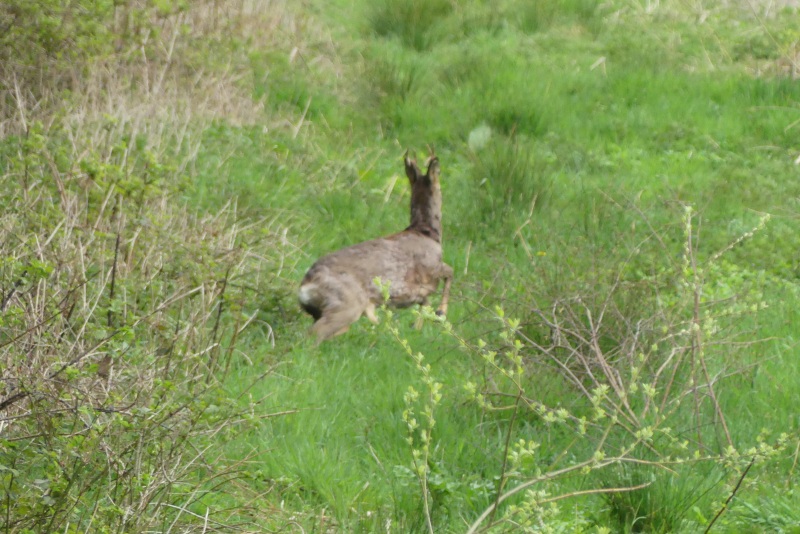
The black-headed gulls on the pools at the Ron Barker Hide were unhappy at the arrival of a great black-back which settled down at the water's edge. A few ruffs and avocets kept their distance from it. The herd of longhorns were lying down in the long grass, the attendant cattle egrets bobbing up and down from view as they walked across them. There were a couple of cows grazing with the Canada geese further out and half a dozen more cattle egrets fussed about their hooves. A pair of roe deer on the bank of the drain leading away from the hide was a nice surprise.

Great black-back and black-headed gull

Heading back I felt unaccountably tired, and not just because the weather had become an headachy, heavy armpit. I limited myself to having a quick look at the mere from the screens, adding a couple of arctic terns to the year list.

Corn bunting 

Walking down to Burscough Bridge I was delighted when a corn bunting jumped up from the hedge by Brandeth Barn to sing from the telephone wires. A swallow twittered from the wires at the corner of Curlew Lane.

Swallow

I got to Crabtree Lane, noticed I had forty minutes for the next train to Manchester so took a detour and walked down the lane. For some reason I've never done this before, whenever I've taken the path across from Marsh Moss Road I've crossed the lane and carried on into Burscough Bridge. So this time I walked down the lane to the railway then followed the path by the line into the station. The rooks that nest at the station were very busy in the fields and took no notice at all as I passed closely by

Rook with plenty in the throat pouch to take back to the nest

I got to the station with ten minutes to spare and was glad of the sit down when the train arrived. I'd made a long day of it and had been more than adequately rewarded for it. When I got home I had a late tea, said hello to the cat and went to bed.

Tuesday, 22 April 2025

Leighton Moss

Greylags and teal

I woke early with ambitious plans I decided I hadn't the energy for so I set off a bit later than planned for to get myself an old man's explorer ticket. A harbinger of the day was the seven very vocal buzzards that floated high overhead as I arrived at Humphrey Park Station.

I got myself my old man's explorer ticket and got the Barrow train, as usual staying on to Ulverston and getting the train back to Silverdale so's I could have a look at the estuaries en route. The coastal pools at Leighton Moss were packed with avocets and black-headed gulls, a male marsh harrier patrolled the trackside reeds, a great white egret posed by the poolside. It was low tide and all the gulls and waders must have been way down the estuary as we crossed the Kent at Arnside. The saltmarsh on the other side was bone dry with just a few carrion crows dotted about. As we crossed the Leven the scores of eiders on the river and its mudbanks ignored the train while the cormorants basking with their wings open watched it go by.

Lesser black-backs, Ulverston Station 

The pairs of lesser black-backs just outnumbered the pairs of herring gulls at Ulverston Station and there was a lot of activity hidden by architectural furniture that looked suspiciously like nest-building. I had quarter of an hour to wait for the train back so I watched them while listening to the blackcap and robins singing in the trackside trees.

On the way back there were a lot of little egrets with yet more eiders on the inland side of the bridge over the Leven. Not for the first time I spotted a coal tit visiting a nest in the station wall at Cark. Oddly, though the saltmarsh between the Kent and Grange-over-sands was bone dry the golf course was still half-flooded. The little egrets on the heronry (egretry?) at Meathop looked a bit busy.

Black-headed gull

At Silverdale the robins, blackbirds and a song thrush were singing and a nuthatch called from the trees on the golf course. The feeders at the Hideout were quiet, even the robins weren't spending much time mugging the visitors. The trees and bushes were far from quiet, the chiffchaffs making the most noise though the wrens and robins were trying their best. As I walked down to Lilian's Hide the first of the many willow warblers and Cetti's warblers of the day sang by the path.

The small black-headed gull colony on Lilian's was in full swing. There's only space for about a dozen nests on the rafts and it was a fractious standing room only. Most of the noise was provided by small groups of squabbling dabchicks over the other side of the pool. A couple of pairs of mallards and gadwalls dabbled in the shallows, a couple of pochards drifted in and out of a loose raft of tufted ducks, greylags sat on nests half-hidden in the reeds, a couple of mute swans drifted about in the reeds and disappeared into the channel beyond. I could just hear a bittern booming over the conversations in the very busy hide.

Dabchicks
Threes a crowd.

Catching a bit of shade in the reedbeds

The path to the reedbeds was almost as busy as the hide. Which didn't stop me hearing my first reed warbler of the year or seeing my first dragonfly of the year, a large red damselfly. The bittern boomed again so I didn't think I was imagining things.

The pool at Tim Jackson's Hide was relatively quiet, there weren't the crowds of teal and shovelers that were features earlier in the year. A pair of shovelers drifted about on one side of the bund, half a dozen teal dozed on the bund with a pair of greylags and a pair of oystercatchers.

At the Griesdale Hide 

I looked in vain for any hirundines over the reedbeds as I walked to the Griesdale Hide. Plenty of black-headed gulls and a couple of buzzards riding the thermals on the distant escarpments but no hirundines. There were plenty of warblers — reed, Cetti's and willow — and a few reed bunting singing in the background. I'd almost reached the hide when an osprey flew overhead, powering its way to the bay to get a bite to eat.

Marsh harrier 

Again, the crowd scenes were in the hide not the pool. It was nice to see a crowd of goslings with a pair of greylags. They were quickly shepherded out of plain sight when a male marsh harrier drifted over. A female made an appearance then drifted over towards the causeway.

Heading back through the reedbeds

The walk back was serenaded by warblers, and the occasional squeal of water rails, and accompanied by mallards and robins which evidently were convinced I was carrying food for them. As I'd forgotten to pick up any for myself we all had a lean time of it. 

Drowned willows 

Any hopes of seeing the marsh tits I hadn't seen on the way out were dashed. The past few visits I've struck lucky at the last minute by bumping into one by the visitor centre or the station but not today. The two British chickadees, marsh and willow tits, are both very secretive this time of year. Not least because there's every prospect that they'll get turfed out of their nest hole by a great tit or blue tit if they're not careful.

I wandered back to the station where the blackbirds, goldfinches and chaffinches competed for attention in the trees and the titmice were almost furtive. It has been a very productive day — I'd seen almost fifty species even before I arrived at Leighton Moss — and I was ready for my tea.


Monday, 21 April 2025

Local patch

Barton Clough

This one day it's early March, the next it's late May and then it's early March again weather is getting me down. It being a bank holiday today of course it was cold, grey and pouring down, it's traditional. Having kitted myself out for early March the sun came out as I was counting greenfinches and it became late May for three-quarters of an hour before clouding over again.

The rain started to ease mid-afternoon so I had a wander round the local patch, hoping for appearances by blackcaps and whitethroats. The good news is that two blackcaps were singing, one in the traditional site in the United Utilities compound, the other singing from a warehouse car park. No whitethroats yet though it's still early days for them. Four chiffchaffs, two of them singing males, may translate into two pairs, we'll see how that goes.

One of the male blackbirds was new to me, a partially leucistic bird with white thighs and a white patch behind the eye.

The usual pair of lesser black-backs were on the roof of the usual industrial unit again. I wonder if they'll breed there this year. I suspect not, there are larger, flatter roofs across by the canal and I don't think they've all been claimed yet. I know this is a colonially nesting species but I haven't knowingly seen more than one pair per roof locally.

  • Blackbird 11, 6 singing 
  • Blackcap 2 singing 
  • Blue tit 1 singing 
  • Carrion crow 1
  • Chiffchaff 4, 2 singing
  • Dunnock 4, 1 singing 
  • Feral pigeon 15 overhead
  • Goldfinch 10, 3 singing 
  • Great tit 4, 3 singing
  • Greenfinch 8, 2 singing 
  • House sparrow 1
  • Lesser black-back 3, 1 overhead
  • Magpie 11
  • Mistle thrush 1
  • Robin 6, 5 singing
  • Song thrush 1 singing
  • Woodpigeon 15, 5 singing
  • Wren 6, 5 singing

Saturday, 19 April 2025

Mosses

Willow warbler, Little Woolden Moss 

It was a cool, dark grey, windy Saturday and I didn't feel like doing much. I got the train into Irlam thinking I might just potter up Astley Road and potter back down again by Roscoe Road and get the buses back home.

Blue tits, Irlam 

Blackbirds and a coal tit sang at Irlam Station. I walked down to Astley Road to the sound of robins, blackcaps and woodpigeons and Astley Road was busy with more of the same and the frantic bustle of the Zinnia Close spadgers in the hedgerows. A blue tit sang from the top of a sapling and a pheasant barked from somebody's back garden.

Kestrel, Irlam Moss 

Goldfinches and greenfinches twittered in the roadside trees of Irlam Moss, chiffchaffs and wrens sang in the hedgerows. The first field to the left of the road has become yet another turf field and was littered with starlings, magpies and a pair of mistle thrushes. On the right the field nearest the road had been ploughed and a flock of woodpigeons fossicked about the disturbed ground with three pigeons (all, remarkably, the "rock dove" type, unlike the usual flock which has a lot of birds with white primaries). Black-headed gulls passed low over the field but didn't settle. A pair of chaffinches bounced about in one corner and in another was a lone grey partridge. This was the first I've seen here this year, last year the covey was almost a fixture. A pale ghost of a female white wagtail flew low over the dark field and disappeared into the rough grass at the side. I waited a while but she wasn't for coming out any time soon.

Over by Prospect Grange a kestrel hovered over the field, sometimes drifting in quite close to the road.

Grey partridge, Irlam Moss 

Just before the motorway I looked back over the field behind Worsley View Farm. Lapwings and pied wagtails were dotted about amongst the woodpigeons and an oystercatcher was busy feeding along a ploughed ridge.

Pied wagtail, Chat Moss 

More robins, chiffchaffs, blackcaps and wrens were joined by great tits in the hedgerows North of the motorway. The turf field by the motorway looked empty save the gang of magpies in the far corner. It took me a while to spot the lapwings sitting in the grass, not as many of them as I'd expected.

A crowd of starlings fed in the paddocks while swallows swooped around the horses' ankles despite the cool weather.

The big expanse of turf fields was busy with birds. A flock of rooks mingled with starlings, lapwings and woodpigeons in the mid-distance. Closer by more swallows swooped about and pied wagtails rummaged in the grass. Three sandy little dots at the back of the field caught my eye. Luckily for me they were moving into the field and eventually I could identify them as wheatears.

Buzzard, Chat Moss 

I walked down Lavender Lane, being churred at by a whitethroat in the brambles by the land drain. A couple of pheasants were sparring in the rough pasture and skylarks sang above the fields. There was a fly-by by the usual kestrel. Way out on the edge of the rough pasture, by the trees on the boundary of the reserve, the pure white underparts of a very contrasty buzzard shone out like a beacon.

The singing chiffchaffs, robins and wrens in the trees of Little Woolden Moss were easily outnumbered and outsung by willow warblers. Out on the pools a handful of black-headed gulls made a lot of noise while Canada geese, lapwings and even carrion crows quietly got on with their business. A curlew called as it flew past and a meadow pipit did its parachute song before disappearing into the long grass. The hares-tail cotton grass was in full bloom across the moss.

Little Woolden Moss 

I had hopes I might find a yellow wagtail on the barley field on Moss Farm. No luck today, "only" lapwings and skylarks. Realistically, I didn't have the legs for the walk into Glazebury. I dawdled back as a flock of sand martins descended on the pools, upsetting a couple of lapwings with their arrival. As I approached the path to the car park I could see it was actually a mixed flock of hirundines: two swallows and a hundred-plus sand martins. A falcon swooped in, for a second I thought: hobby, but it was the kestrel come in to hover over the patch of rough by the willow scrub.

Twelve Yards Road 

I walked back and headed up Twelve Yards Road. Skylarks sang over the fields, woodpigeons and magpies fossicked about. Whitethroats, chiffchaffs and robins sang by the roadside, a willow warbler sang in a willow plantation, a blackcap sang from the trees by the farmhouses.

Yellowhammers, Chat Moss 

The barley was sprouting in the ploughed field by the road. A couple of pheasants, including the black bird with the grey wings, browsed the field margins. Lapwings ignored the artificial giant kite hovering and bobbing about in the wind in an apparently successful attempt to keep the rooks and woodpigeons off the Spring sowing. I was just thinking about some photos of yellowhammers a friend had taken the other day and regretting that they seemed to have disappeared from Chat Moss when a pair flew across the road to feed in the corner of the field. I'm glad it was my lousy fieldcraft and not a lack of yellowhammers that had me not seeing any.

Yellowhammer, Chat Moss 

I turned into Cutnook Lane and came face to face with a roe deer. I stood still as it slowly trotted off into cover. They don't seem all that bothered about people here.

Roe deer, Chat Moss 

A buzzard flew by. A small flock of mallards did a circuit of the fields either side of Twelve Yards Road before settling into the fishery. A cormorant left the fishery for the roost on the Ship Canal. More robins, chiffchaffs, great tits and a blackcap sang in the hedgerows, carrion crows, magpies and woodpigeons fed in the fields. It had been a busy afternoon.

Friday, 18 April 2025

Bank holiday weather (dreich)

They're out there.
Somewhere.

It was bank holiday Good Friday so of course it was cold and heavily overcast. The trains are running but not the buses so I decided to catch up with some of the work needing doing in the back garden — I've only chopped back half the rambling rose and the prunings need chopping into the bin, there's a pile of sycamore seedlings needing getting out and the path in front of the living room window is the fullest border in the garden (a planting of Lysimachia "Firecracker" has gone walkabout). All of which still needs doing as the moment I stepped out it started pouring down.

The birds had been mostly staying undercover anyway, most of them have nests on the go and are too busy collecting insects for hungry mouths to be showing off for elderly birdwatchers. The spadgers are hoovering up aphids from the tops of the sycamores and the bottoms of the blackcurrant bushes. The titmice are in and out at the sunflower seed feeders like a flash, getting a quick bite to eat before fidgeting around in the trees for caterpillars. I had worried we'd lost the coal tits over Winter but a male's been singing by the station platform so I'm hoping all is well. 

The male blackbird spends most of his time singing, the female doesn't stray far from the nest when she's foraging. The dunnocks are around but are hardly ever seen, I still worry about that business when one got itself trapped in the washhouse.

The goldfinches stop by a couple of times a day. For some reason this often coincides with the male robin's patrol of the territory. This time of year the goldfinches are too busy for their habitual fussing about and the robin is too intent on guarding its territory to be fussed with them. Come Midsummer they'll all be so frazzled they'll be pecking at each other whenever they meet. The wren seems only to do a morning patrol.

For all that I know they've all got nests on the go I only know where three are and those by accident, I make a point of not looking for them so I'm not tempted to have a nosy and disturb them. As luck would have it the three I do know are pretty much inaccessible to me with my creaky knees so I'll be leaving well alone.

There are three magpie nests I know for sure are in use and just the one carrion crow nest despite there being two pairs knocking about. I think I've escaped having a jackdaw nest in the chimney this year, unlike some of my neighbours. The collared doves and woodpigeons are favouring conifers this year.

I've kept hearing a mistle thrush and a couple of times one's flown over. It was only last week I found they were nesting near the shops. They've got a huge territory with neighbours having similarly big territories based in Lostock Park and Moss Park.

I'm fretting about the year list. For absolutely no reason, it's roughly where I was this time last year and I haven't had a trip out to a seabird city yet. Every couple of days I have to remind myself that the numbers don't matter, they're only there to prod me into getting out and getting some exercise. And every year I have to remind myself that Spring passage migrants don't tend to linger so there's no point in beating myself up because I'm not haring about hither and thither chasing after them. I'd be a terrible twitcher, I'd have exploded in frustration by the middle of January.


Thursday, 17 April 2025

Elton Reservoir

Great crested grebe 

It was one of those it doesn't matter what clothes you put on, it's going to be wrong days. I've been neglecting Elton Reservoir this year so I thought it was time for a visit.

I got the train to Bolton and the 471 to Bury. For a change I got off at Watling Street and crossed over for the walk through the housing estate to the path that leads to the creek. This goes through a patch of farmland and pasture which I thought might be interesting this time of year. I'm glad I did: as well as the full complement of chiffchaffs, robins, blackbirds, wrens, great tits and blackcaps I heard my first whitethroat of the year. A swallow passing by one of the farm buildings was good to see, too. I must remember to put together a map of this path as an addendum to the Elton Reservoir page.

Walking down to Elton Reservoir 

Walking along the creek to the reservoir 

The sound of willow warblers singing was a sign I was approaching the reservoir. The creek was already invisible at the bridge, a combination of dry weather and young vegetation. Robins and willow warblers vied to see which could provide the most background noise, the wrens, great tits and reed buntings didn't have a chance. A kestrel perched low in a tree by the path looking for anything disturbed by passersby. I saw it hovering above the field on the other side of the reservoir later on.

Kestrel 

Elton Reservoir 

A black tern had been reported so I had a scan round the reservoir. I just missed a pair of great crested grebes doing their penguin dance. Coots and more coots, mallards, a couple of great black-backs… The tern would likely be flying around the raft of black-headed gulls over on the far side, they know the best places for picking emerging midges off the water. No sign of a tern though. I checked all the black-headed gulls — I still haven't seen a Mediterranean gull this year — and was surprised to find a second calendar year common gull in the crowd.

Great crested grebes 

Dry paths — witchcraft!

I walked along a little, frankly astonished at the dry state of the path. All told I encountered a handful of patches of mud and the first-time visitor would have been excused for assuming they were the results of a horse emptying its bladder rather than permanent features. I had to stop once or twice as robins or willow warblers chased each other across the path. The reason why I hadn't seen the black tern flying about was that it had been sitting on one of the buoys in a bay. By the time the path emerged from the trees opening up to this bay it had flown over to the raft of black-headed gulls.

Black tern

There were plenty more coots about, a few pairs of mallards and gadwalls and there was a raft of a dozen tufted ducks that were over by the far bank when I walked into the trees and nowhere to be found when I emerged. All the Canada geese were congregated at the Capsticks end of the reserve.

Lapwing

The lapwings were laid out in regular grid formation amongst the horses on the field by Capsticks. There was at least one nest on the go, the incubating parent dozing off in the warm midday sun. I was glad I hadn't brought my big coat but I was still a bit overdressed. I scanned around for any passage migrants, hoping for a whinchat but settling for a wheatear and getting neither and serve me right for being greedy.

Withins Reservoir 

Withins Reservoir was drained again. I looked in vain for any waders or wagtails on the mud. I tried to remember how long ago it was I didn't see a bee-eater here. (It was two years ago.) I decided against walking down to the canal and into Radcliffe and went back for another look at the black tern.

I walked along the South shore. The black tern was closer and I had the sun behind me so I was getting cracking views of the bird through my binoculars. I was struck particularly at the difference the angle of the bird to the sun made. Flying dead straight it was conspicuous: black body, white rump, ashy grey wings. Whenever it did one of its turn on a sixpence wheels round on the tip of a wing it disappeared into the glare and shadows of the background water only to reappear a few yards further away. I had a go at getting some pictures. 

Black tern
The least worst of a couple of dozen photos. At least it looks like something in this one.

Taking photos of black terns is at least as bad for the ego as sand martins.

Great crested grebes 

I sat and watched the great crested grebes as they spent five minutes waggling their heads at each other as they drifted across the reservoir before going their separate ways. When I had one last look over the reservoir they were in the distance cruising side by side again.

Great crested grebes 

Great crested grebes 

Great crested grebes 

Great crested grebes 

Great crested grebes 

I walked round to the car park, chiffchaffs and reed buntings joining the blackcaps trying to sing over the crowing cockerels. The feeders were busy with greenfinches, goldfinches and bullfinches and a couple of mute swans were mugging for scraps by the bank.

I walked up to the road and got the 471 into Rochdale, hoping to see one of the town centre peregrines. The pair that's been nesting on the Town Hall clock tower seem to have a nest elsewhere but there's been a couple of younger birds seen on the webcam so I had some hopes of seeing at least one peregrine. Not today, though. Never mind, tomorrow is another day.

Rochdale town centre, just to prove I was there