Black-tailed godwits, Leighton Moss

Saturday, 16 December 2023

Crosby

Black-throated diver, Crosby Marine Lake

It was a lovely day for a trip to the seaside so I got the trains to Waterloo and walked down to Crosby Marine Lake where a black-throated diver turned up yesterday. It was reported as showing well from the sailing club so instead of walking down to the boating pond as usual I carried straight on to the lakeside and stared out into the sunshine. Lots of cormorants and black-headed gulls but no diver.

Black-throated diver, Crosby Marine Lake

Luckily there was a small knot of birdwatchers over on the other side of the play area and with the help of a couple of them I eventually got on to it. It had been doing a circuit of this half of the lake and at this point it was furthest away from us. It was tricky to keep track of it: it wasn't on the surface for long, staying underwater for long dives, and it was a fast swimmer so each time it came up for a breather it was a long way from whence it disappeared. Then we had a stroke of luck, its tour of the lake brought it close to this bank and we had some cracking views of a very attractive bird.

Black-throated diver, Crosby Marine Lake

Black-throated diver, Crosby Marine Lake

I'd recently boned up on the identification of black-throated divers after misidentifying one in a friend's photo recently (my excuses for not identifying it as a black-throated diver would convince anybody who didn't read them). It was a high contrast bird, startlingly so in this high contrast light with the sun behind it, and it had a straight, slim dagger of a bill.

Black-throated diver, Crosby Marine Lake

It was a friendly group of birdwatchers, some of whom took pains to make sure that newcomers found the bird. Passersby enquired about the fuss and were told what was going on and when the diver was being cooperative they were shown what we were looking at.

Common gull, Crosby Marine Lake

I took my leave of the diver and walked round the lake. Pied wagtails and small flocks of starlings rummaged round in the grass by the paths. A flock of about fifty herring gulls loafed on the bank of the boating pond with a couple of dozen coots, and more starlings and wagtails. There were more coots and herring gulls on the lake and a few dozen black-headed gulls and handfuls of lesser black-backs and common gulls. Mute swans mugged small children for bread, tufted ducks dozed in the sun and a dozen carrion crows bounced about on the far bank bothering each other more than they were looking for anything to eat.

Cormorant, Crosby Marine Lake

There was a steady stream of cormorants and large gulls overhead going to their high tide roost on Seaforth Nature Reserve. The tide was coming in but there was enough beach for the crows to rummage about on. Black-headed gulls foraged along the timeline while far out in the estuary herring gulls and great black-backs towered in the wind above the waves.

Rabbit, Seaforth Nature Reserve

I walked along the perimeter fence of the nature reserve peering in. There weren't many small birds about, just a couple of linnets and a robin and the rabbits had the grass to themselves.

Shelduck, dunlins, redshanks and black-headed gulls, Seaforth Nature Reserve

A few hundred black-tailed godwits had come in to roost with the crowds of black-headed gulls though it was the redshanks and oystercatchers making all the noise. There were a few curlews and shelduck and small flocks of dunlin weaving about the crowds. scanning round I found the flock of gulls included a dozen or so common gulls and a second-Winter Mediterranean gull and there were at least half a dozen bar-tailed godwits feeding at the margins.

Shelduck, black-tailed godwits, redshanks and black-headed gulls, Seaforth Nature Reserve

Moving along there was a crowd of herring gulls, Canada geese and cormorants on the pool by the hides and a drake goldeneye amongst the raft or coots and tufted ducks.

Black-throated diver, Crosby Marine Lake

I dropped down to the path by the lake hoping to catch sight of the diver with the sun behind me. Eventually I was rewarded as it paraded up and down by the sailing club verandah. The knot of birdwatchers standing there were getting some very close views. In this light I could see that this wasn't an adult bird, pale fringes to the feathers on its back and wings giving it a scaly appearance.

Black-throated diver, Crosby Marine Lake

Eventually I decided to move on. I got the train to Hall Road and walked down to the top of Crosby Beach. The tide was high and the wind very blustery, the black-headed gulls and common gulls hanging in the breeze. A hundred or more starlings worked the car park, trying their best to not let anybody pass by without a donation.

Common gull, Crosby Beach 

I didn't have the legs in me for the coastal walk to Hightown so I stayed and enjoyed some magnificent skies over the estuary.

From Crosby Beach 

From Crosby Beach 
From Crosby Beach 

From Crosby Beach 

North Wales from Crosby Beach

Birkenhead from Crosby Beach

Thursday, 14 December 2023

Pennington Flash

Female goldeneye

The morning was damper than promised, that thin, persistent rain that makes your whole being damp and cold, so I shelved plans A and B which involved spending hours in wide open spaces with no cover. 

I watched the crowd scene in the back garden over a very slow breakfast, a couple of dozen sparrows on the feeders with full supporting cast. In the end I concluded there was just the one goldcrest in the sycamores but there were two coal tits in the garden though they weren't operating as a pair, coming in and out from opposite directions.

A bit of cover and a few hides seemed in order so I got the 126 from the Trafford Centre to Leigh and arrived at Pennington Flash for lunchtime. The sun was threatening to come out when I left home but it turned into an afternoon of eternal twilight, which made bird photography a bit challenging at times.

Damp underfoot 

The pedestrian access via St Helens Road was as bad as ever. I felt the use of high ridges of tarmac and gravel piled across the entrances to the old parking spaces ready to herd the Christmas rush to the pay-as-you-go parking was rather rubbing our noses in it in the circumstances. Robins and woodpigeons sang and great tits bounced about in the hedgerows. 

The brook was running high

I can't remember the brook ever being as high as it was today. A few coots fussed about in the fast moving water near the bridge.
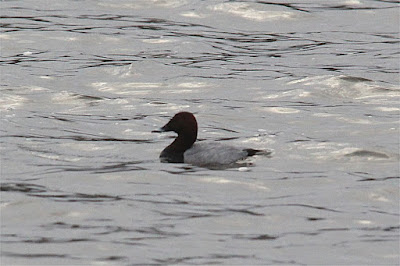
Pochard

There were more coot on the flash by the cat park, together with rafts of pochards, tufted ducks and black-headed gulls. Mallards, mute swans, Canada geese and a couple of Muscovy ducks mooched for food on the car park, the swans checking bags and pockets just in case.

Mute swan

Further out on the flash were scattered groups of gulls, mostly herring gulls and black-headed gulls with a dozen or so lesser black-backs identifiable in the gloom. Half a dozen great black-backs steamed across the flash like a royal yacht review by Ming the Merciless. It took a while to spot the few great crested grebes out on the water and even longer to find the goldeneyes.

Goldeneye

From the Horrocks Hide

The Horrocks spit was underwater save a crescent of high ground at the end. Mallards loafed on the end closest to the hide. It was standing room only at the other end with cormorants, herring gulls and mallards loafing and bathing and thirty-something lapwings jostling for the high ground. There were a couple of lesser black-backs amongst the herring gulls and a first-Winter great black-back dozed amongst the cormorants. I looked in vain for any teal on the spit although I could hear them whistling. I'd find them later on. There were a couple of redhead goosanders loafing on the bank. I couldn't find any waders other than lapwings until the car park oystercatcher walked across my field of view. If I could not notice a big black-and-white wader with a stonking great red beak I could easily not notice all sorts of things so I had another look round and could only find lapwings.

Cormorant, herring gulls, lesser black-backs, great black-back, goosanders and lapwings

Black-headed gulls, herring gulls, cormorants and goldeneye

There was a raft of black-headed gulls and herring gulls over in the mouth of the Ramsdales bight. There were also about fifty tufted ducks and at least a dozen Goldeneye. And yet more cormorants loafing on poles and the flooded breeding rafts.

Cormorants

I turned onto the path to the Tom Edmondson Hide and walked into a flock of a hundred or so finches feeding on the alders. It was roughly equal numbers of goldfinches and siskins with a few blue tits, all very busy and all just silhouette in the gloom as far as the camera was concerned. A few chaffinches were picking up any litter on the ground, I couldn't turn any into bramblings.

Pennington Flash 

The sole occupant of the pool across from the Tom Edmondson Hide was a female GoldenEye, which shows how high the water was today..

Gadwalls, shovelers and mallards dabbled and dozed at the Tom Edmondson Hide. There was only the one teal to be seen.

From Ramsdales Hide 

It turned out that all the teal were on the pool at Ramsdales, though not many could be seen. They were mostly dozing in the reeds and tall grasses of the drowned islands or lurking in the reedbeds on the far side. Long-tailed tits bounced about in the elderberry bushes by the hide and a skein of twenty-six pink-footed geese could be seen in the distance flying towards Plank Lane.

Walking back, a goldcrest and half a dozen blue tits constituted the nearest to a mixed tit flock I saw all afternoon. A pair of bullfinches tweeted mournfully in the hawthorns and the mixed flock of finches twittered in the alders.

Pengy's pool 

Pengy's pool was busy with coots. There were perhaps half as many gadwall and shovelers as on my last visit, all at the far end by the reedbeds.

The view from the Bunting Hide was forlorn. The area's still flooded, the volunteers have had their work cut out catching up after all the disruption of the building works. And we're also in the middle of an avian flu pandemic so they might be leaving the feeding stations be as a precautionary measure. 

Walking to the Charlie Owen Hide 

I only properly realised how gloomy the afternoon had become when I tried photographing the goosanders on the Charlie Owen pool and my camera told me it would be doing one-eighth of a second exposures. And even then the pictures were white flashes in the dark. There were a couple of dozen goosanders with a couple of tufted ducks. The islands the ducks usually loaf on were under four inches of water.

Lesser black-back

All the while there was a steady stream of large gulls flying over to roost on the flash. There were a lot more herring gulls than lesser black-backs amongst the large gulls. Jackdaws were congregating in their hundreds to roost in the trees on the golf course and I made my way home.

Wednesday, 13 December 2023

Hindley

Mute swan, Low Hall

Much to my surprise the clear, sunny day we were promised actually materialised. Rather than waste it in a paroxysm of indecision I headed for the Trafford Centre with the intention of having a walk "over there" [waves vaguely in a Northwest direction]. If the first bus that came was the 100 I'd have a stroll on Chat Moss, the 126 Pennington Flash and the 132 Amberswood. The 132 came first, which in retrospect was fortunate because it was a keening wind accompanying the sunshine and there's plenty of shelter at Amberswood.

The traffic was bad and it seemed to take forever to get to Hindley. I remembered to get off at the church and walk down Liverpool Road this time.

Low Hall

I'd been hearing robins, moorhens and a mistle thrush as I walked down so I decided to have a quick look in Low Hall to see what was about. A pair of mute swans were grazing by the pond and half a dozen teal silently slipped into the reeds by the bank as I walked by. There were coal tits and great tits about but I couldn't see that they were part of a mixed flock.

Amberswood 

I walked back and crossed the road to Amberswood as the low sun reminded me there's not a big window between lunchtime and twilight this time of year. A bullfinch flew from the bush by the gates as I arrived and it joined the mixed tit flock in the alders behind the houses. A couple of pairs of blue tits and great tits bounced about the trees with a family of long-tailed tits and a nuthatch.

Mute cygnet, Amberswood

A couple of cygnets were preening on the bank of the lake with a gang of mallards. Out on the lake there was a very loose raft of a couple of dozen black-headed gulls and a couple of dozing great crested grebes. Half a dozen tufted ducks lurked by the reeds on the far side. 

Amberswood Lake 

I walked clockwise round the Western side of the lake for a change, following the quiet calls of siskins going to roost in the trees. It was remarkably quiet save the mutterings of jackdaws overhead and the occasional black-headed gull letting on to a friend on the lake. Even the dabchicks by the edge of the lake were silent. Which made the blood-curdling cries of a water rail in the reeds all the more surprising when it got going.

Amberswood 

I got round to the bottom of the path to the National Cycle Route (the long straight path to Manchester Road) where I found a bird feeding station at the corner of the lake. I hadn't noticed it until I followed where the great tits and blue tits were going. It was good to see a couple of coal tits and a willow tit tucking in as well.

A great spotted woodpecker calling in the woods defeated my trying to spot it. I had more luck with the jays, dunnocks and blackbirds. As I started on the stretch to Manchester Road the woodpigeons, magpies and carrion crows started settling in the trees by the path. A couple of carrion crows were quietly preening each other's head feathers when they suddenly dropped down from the tree with a shriek as a sparrowhawk shot by. The crows returned and settled for a doze.

Whelley Loop Line 

I got to Manchester Road and noticed I had twenty minutes' wait for the 132 back to the Trafford Centre so I had a bit of an explore of the start of the Whelley Loop Line that curves round to New Springs and thence towards Haigh Country Park (I think it's another of those walks bequeathed to the nation by Marples and Beeching). This late in the afternoon there wasn't a lot of activity besides woodpigeons, magpies and blackbirds and the sound of jackdaws and lesser black-backs passing overhead to roost. I've added this to the ever-lengthening list of places to explore next year.

It was sunset as I caught the bus after finally getting some proper movement walked back into the knees. It's only taken two days, I'll have to make sure not to leave it so long again in future. Which is an excellent excuse for a lot of birdwatching.

Tuesday, 12 December 2023

New Brighton

Carrion crow

Today's challenge was to get out for some decent birdwatching somewhere that didn't involve hillwalking or wading through streams and wasn't so inundated as to be inaccessible without waders or unusable by resting birds. So off to the seaside I toddled. Judging by the state of the Glaze as the train approached Glazebrook it wasn't a bad call, I've never seen it break its banks before. If that's like that God knows what the state of some of the paths are like.

I decided to head for New Brighton to see if any purple sandpipers were about. Usually I get off at New Brighton, have a nosy around Perch Rock and the marine lake then walk down to the end of the prom and go and get the train from Wallasey. It's been a long time but the penny finally dropped today that I could get off the train at Wallasey, walk down to the beach and down the prom to New Brighton and have a cup of tea at the other end. Which is what I did.

Oystercatchers

Oystercatchers and herring gulls

The tide was middling low and starting to think about coming in. The gulls and waders were split between feeding on the beach or loafing on the breakwaters, save a couple of turnstones feeding on the breakwaters. Most of the gulls were herring gulls, the black-headed gulls were mostly feeding on the fields near the golf course. There were also a few lesser black-backs and common gulls. I didn't see a great black-back all day which is unusual, there's usually one or two steaming across the estuary. There were about a hundred oystercatchers scattered about in groups and a couple of dozen each of turnstones and redshanks. A couple of bar-tailed godwits fed at the water line.

Looking towards Leasowe Lighthouse

I walked to the end of the revetment, checking the sand dunes for small birds and finding small giddy dogs on their lunchtime walkies. A robin sang from a gorse bush and a couple of pied wagtails skittered about but it wasn't my day for finding chats or snow buntings.

Oystercatchers

I walked back and carried on down the prom. There were more gulls and oystercatchers. Turnstones, pied wagtails and carrion crows rummaged about on the top of the sea wall. A few little egrets joined the oystercatchers on one of the breakwaters. And the sun sort of came out in that half-hearted December fashion that threatens a hasty retreat if anyone notices.

Redshanks

There was a crowd scene in the bay by the lighthouse. Herring gulls, black-headed gulls and common gulls loafed on the sand, redshanks, turnstones and oystercatchers fed in and around the pools. A couple of dunlins and a sanderling dodged between the redshanks. For some reason I tend to forget that sanderlings are roughly the same size as dunlin, I always think they're bigger.

Redshanks and dunlins
An example of the variation in size of dunlins. I think the bird on the left might be from Greenland .

Although the tide was still low there was a crowd of waders dozing on the pontoon on the lake. Most were redshanks, a sanderling stood out with its white head and a handful of dunlin lurked about the edges. One of them was tiny compared to the others but I couldn't in all conscience turn it into anything but a dunlin. The nominate subspecies alpina from the European Arctic is larger and longer-billed than the Western European schinzii; two large dunlin looked good for alpina but the tiny one didn't look right for a local bird. The bill looked a bit shorter and straighter than I'd expect which got me wondering if it might be one of the Greenland subspecies arctica. (Get him: hasn't the first clue about North American peeps but waxes lyrical about dunlin subspecies.) No purple sandpipers anywhere for me today.

Dunlin

Redshanks, dunlins and sanderling

I got myself a cup of tea and weighed up the options. I was tempted to go over to West Kirby to see if the great Northern diver was about still but decided against: by the time I got over there I'd have less than an hour's light to play with. I have other plans for West Kirby. In the end I decided to call it quits and head off home.

Woodpigeons

Walking up to the station I noticed a bunch of woodpigeons stripping tiny dates from a palm tree in somebody's back garden.

Monday, 11 December 2023

Tameside

Walking to Denton Station

It was another wet and dreary morning but I was desperate for some exercise to try and get some movement back in the joints after a largely inactive week so I thought I'd combine a walk with an exploratory exercise. Audenshaw Reservoir bugs me: access is permit only but permits are like yetis: everybody's heard of them but nobody has seen one or even knows where to look for them. And yet, whenever I pass by on the bus there are people walking round it. I got to wondering whether this was one of those "permit only" sites where it's possible to get child-looking-through-a-sweetshop-window views. Well, no it's not and I spent a couple of hours finding that out.

I got the train to Guide Bridge and the heavens opened. I had a quick look at the canal in the rain, there was nothing on today. Jackdaws and woodpigeons flew about the spire on St Stephens and black-headed gulls flew to and fro overhead. I've already tried and failed to find a way in from the Northern side down Audenshaw Road so I decided to look at the Eastern and Southern approaches (the West side is the M60). 

Audenshaw Ponderosa 

I headed down Guide Lane, dropped down the steps onto Churchfield and followed the road round to the bit of open parkland that Google Maps assures me is The Audenshaw Ponderosa. It's a few acres of grass with a few trees on it. The rain stopped as I walked along the path by the railway line but it stayed rather dark and gloomy. (This is the line between Guide Bridge and Stockport that has one train a week running on it.) There were lots of magpies, woodpigeons and carrion crows about. The flock of bullfinches I accidentally spooked out of the brambles by the line was a nice surprise, at least two males and two females flew into the trees and a couple of other birds darted into the gardens on the other side of the line. A goldcrest bouncing round in one of the trees by the path gave cracking views but wasn't inclined to stay still for any photographs.

I followed the path down to Stamford Road, crossed over and started walking down Corporation Street parallel to the reservoir, the high banks of which rose over the back of the industrial estate on that side of the road. I noticed that there was a footpath at the corner of Mansfield Avenue, one of the side roads, which ran alongside the railway at the side of a field, crossed the line at the Southeast corner of the reservoir then ran down to Denton Station on Hyde Road. This looked promising. The field was flooded but the path, mercifully, wasn't. More crows, magpies and woodpigeons and there was a blackbird fossicking about the side of the path every fifty yards. Overhead there was a steady passage of black-headed gulls, lesser black-backs and cormorants heading out from the reservoir to who knows where. 

Crossing the line and walking down the path there were plenty of gaps in the fence obviously used by kids but nothing that would permit entry by a portly old man who can read "No public access" notices. Halfway down the path became a vigorous little stream about three inches deep, the path only drying out when the stream leapt to one side to pour down the railway embankment at the station. There were dunnocks and robins and blackbirds in the hedgerow and a flock of forty-odd pigeons wheeled about the other side of Hyde Road.

It was evident that the only way to see any of the reservoir was to go in via the waterworks gate and, presumably, present your access permit. I admitted defeat.

I crossed the motorway and headed up the road towards Debdale Park, thinking I would walk through the park over to the Gorton Reservoirs for a nosy round. "Let's not," suggested my knees. The hedges by Denton Golf Course were busy with long-tailed tits, blue tits, magpies and woodpigeons. I got as far as Debdale Park and agreed with my knees, pavement traipsing on cool, wet days starts to take its toll after the three mile mark. I got the 7 to Stockport thence the 23 home to avoid the city centre.

The day wasn't a complete bust: I'd got some exercise, it hadn't been completely birdless and I can now definitely completely ignore the lure of any and all records from Audenshaw Reservoir with an entirely clear conscience.

There was literally just me standing at the entrance to the station.