Black-tailed godwits, Leighton Moss

Friday, 7 June 2024

Mersey Valley

Immature heron, Broad Ees Dole
One of last year's youngsters.

It was one of those walks where you tell yourself: "It's a bit of a drag to the bus stop from here, if I just walk along a bit there's a bus stop that's a bit closer…" and you end up walking home.

I'd renewed my monthly travel card and got the 101 down to Northenden, thinking I could walk along the Mersey into Kenworthy Woods then have a potter about Chorlton Water Park and then decide whether or not to go on any further. I took the path through the woods and under the motorway to the river. Blackbirds, wrens, chiffchaffs and song thrushes sang above the traffic noise, which was no mean feat.

The river on this side of Princess Parkway was fairly quiet, a couple of drake mallards dabbling by the bank, a few woodpigeons feeding on the tops. It was one of those days where the clouds hung dark and heavy but the sun still made a showing and it would have been very nice if the wind hadn't been both strong and cold, a feature of the week. It was okay walking weather, though, so that was all right then.

River Mersey, looking back at Kenworthy Woods 

Passing under the bridge and walking alongside Kenworthy Woods there was a distinct change. There were more mallards on the water, including a duck with half a dozen well-grown ducklings, and a lot more woodpigeons. The squadron of ring-necked parakeets swirling overhead included a couple of youngsters with their shorter, rather blunt tails. Blackcaps and goldfinches joined in the songscape in the trees, it took me an age to find the treecreeper I could hear in the trees by the path. A couple of swifts hawked low over the river and a could see a flock of them wheeling low over the trees by Chorlton Water Park.

River Mersey
Barlow Tip's behind the trees on the right. The flowers are goatsbeards.

A visit to Chorlton Water Park wasn't happening today, the bridge had been closed. Which was a nuisance. So I walked down to Jackson's Boat in the company of a lot more swifts. I quickly gave up on trying to get any photos of them. The greenfinches and reed buntings on the golf courses joined the blackbirds, goldfinches and blackcaps singing in the background. I was most the way down to Jackson's Boat before I saw a grey wagtail foraging at the water side. The water's been quite high lately and it was still too high for their usual nest site to be in use, I'm glad they're still about. There are enough rocky bits of bank protection around here for them to find alternative accomodation.

House martin and swallow, Jackson's Boat

The absence of swallows and martins along the river had been conspicuous. A lot of the swallows, and a house martin, were perched on the tram wires across the bridge. Much to my surprise one of the swallows was a young juvenile, its parents must have been quick off the mark nesting when they arrived. There were more swallows and house martins hawking over the river between the bridges at Jackson's Boat.

Juvenile swallow, Jackson's Boat

I didn't fancy going over and through Hardy Farm and traipsing all the way to Barlow Moor Road for the bus home so took the path along Barrow Brook to Sale Water Park. The hedgerows were busy with singing birds — mostly chiffchaffs, blackbirds and song thrushes — and parakeets screeched in the treetops. A female chaffinch was collecting nesting material on the path in front of me. Most of it seemed to be the fibres from pieces of Himalayan balsam stems that had been trampled underfoot. At the bottom of the brook a Cetti's warbler sang from the flag irises by the path but managed somehow to stay out of sight.

Heron, Barrow Brook

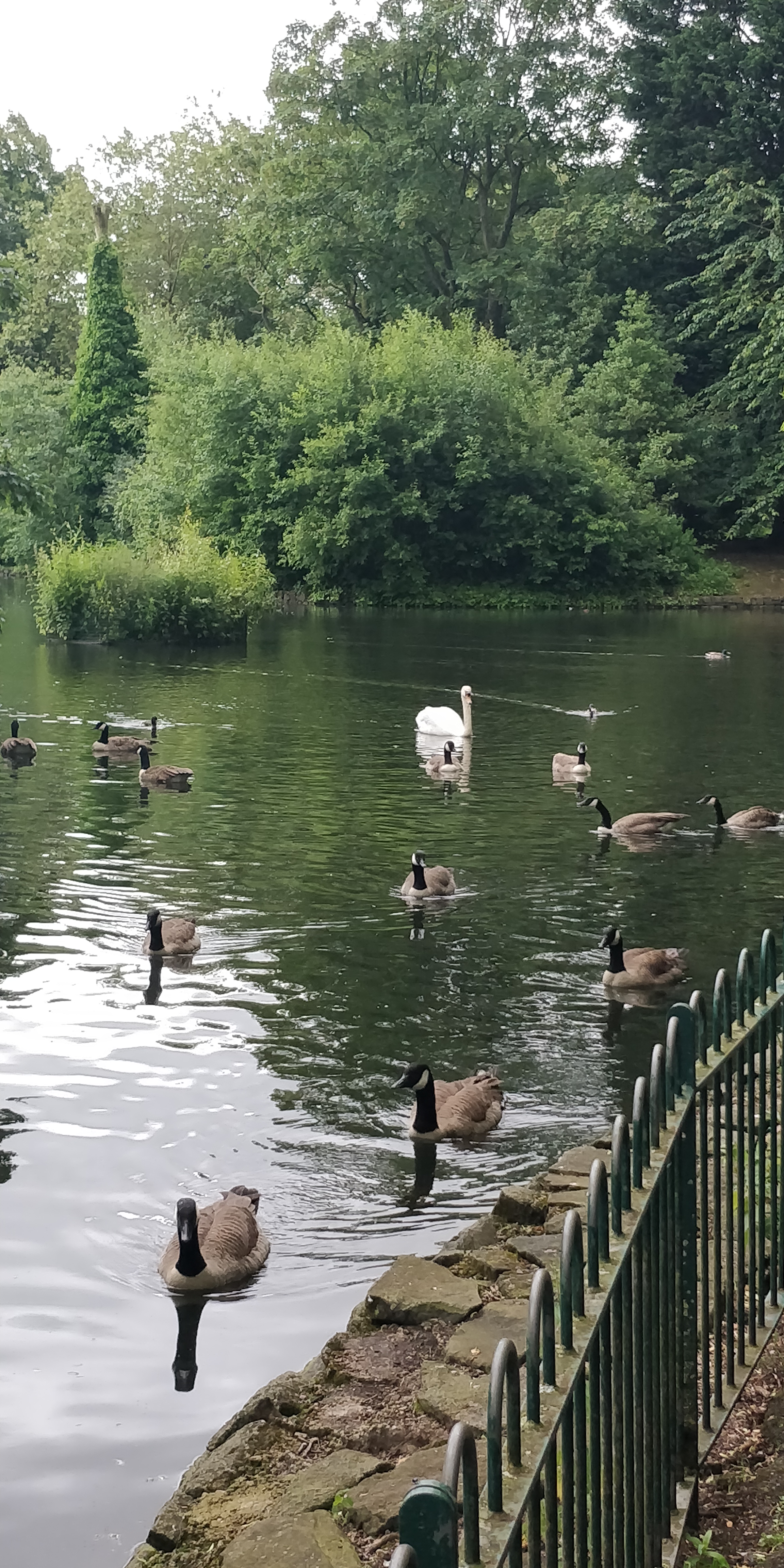
The wooded path to the lake was busy with wrens, blackbirds and robins. Looking across the lake a raft of mute swans cruised by the sailing club while a crowd of mallards and Canada geese haunted the slipway by the car park. Some more Canada geese loafed on the floating platforms near by with a couple of cormorants. A couple of pairs of great crested grebes cruised about midwater. I couldn't see any humbugs with or on them.

Mute swan on the nest, Sale Water Park
One of last year's cygnets.

I took a walk by the lake to Broad Ees Dole. A young swan was asleep on a nest on one of the islands, probably one of the pair of cygnets that were courting a while back. It's only a couple of yards of shallow water away from dogs being walked along the path, the mature adults will have made sure to have the pick of the best places. Fingers crossed anyway. A mallard and her handful of tiny ducklings cruised by as I passed.

Mallard and ducklings, Sale Water Park

Mute swan, Sale Water Park

It's been a shockingly bad year so far for butterflies and today was no exception, not even any large whites to be seen. I wasn't expecting to see any dragonflies in this weather, a few common blue damselflies proved hardier than I'd expected. As I walked into Broad Ees Dole a blue-tailed damselfly fluttered about in the undergrowth by the path before settling into the cover of some brambles.

Coot on the nest, Broad Ees Dole

Another Cetti's warbler sang from somewhere within a tiny patch of reeds by the lake. I had more luck with the reed warblers further along as two singing males decided to settle a dispute over the willows between two patches of reeds by coming to blows before retreating back to their corners. The pool by the hide was high, there was just enough of a ridge of island poking up for half a dozen mallards to sleep in a line. The drakes were already starting to mount into eclipse plumage. A couple of coots fussed about, one sat on its nest and a moorhen swam across the back of the pool. There was neither sight nor sound of any dabchicks, which suggests they're busy in the wooded creeks behind the pool.

Adult (front) and second-calendar-year herons, Broad Ees Dole

A second-calendar-year heron, still with grey on its head and a pale bill, stalked the weeds in the middle of the pool for newts and minnows, striking lucky more often than not. An adult flew in and joined it which gave me an opportunity to get some photos of them together for comparison.

The teal pool 

For once the teal pool was devoid of visible bird life. A passing banded demoiselle added to my damselfly tally for the day, looking all exotic as it caught the sunlight.

Stretford Ees

I bobbed over the river and walked through Stretford Ees. Parakeets made an almighty racket in the treetops, a family of great tits fidgeted about and a bullfinch sang wheezily in an elderflower bush.

Stretford Meadows 

I'd gotten this far, it didn't make sense to walk into the town centre for a bus, the building works and roadworks have closed the bus stop by the shopping mall. I walked along Kickety Brook into Stretford Meadows and walked round the Northeast corner onto Urmston Lane. Along the way I added a garden warbler with a beakful of spiders and the whitethroats singing in the hawthorns to the afternoon's tally of warblers.

As I made my way home I reflected that I've been making a habit of turning quick potters about into five mile walks lately. Which would be great if I wasn't taking itchy eyes and a runny nose home with me. The pollen forecasts are currently "moderate," I'll have to watch myself when they go to "high."

Thursday, 6 June 2024

Stretford Meadows

Northern marsh orchid

It was a bright sunny day, the wind wasn't as strong and cold as it was yesterday so I decided I'd give the antihistamines a workout with a stroll round Stretford Meadows. With a bit of luck I might be able to add lesser whitethroat to the year list.

Stretford Meadows

There's been enough rain lately for there to be a bit of mud under the palettes at the Newcroft Road entrance but not enough to cause the palettes to wobble underfoot. Blackbirds, wrens and robins sang in the trees, a song thrush and a blackcap joined in and it all got fairly noisy especially once a family of great tits started fussing about in the brambles. There were enough insects about for a couple of swallows to be swooping round and a couple of swifts hawked overhead just above the treetops. I'd only taken two steps and was still trying to process all this when an emperor dragonfly zipped by and started hunting over the brambles. It chased bees but caught and ate blowflies.

I hadn't walked very far when the first chiffchaff of the day started singing from the willows by the Transpennine route. Family groups of magpies bounced about in the open ground while blackbirds, robins and goldfinches flitted between the hawthorns. It didn't take long to bump into the first singing whitethroat, there were at least half a dozen of them on the meadows today.

Early spotted orchid

Common twayblade

There were a lot of orchids about, poking through the grass and willowherbs or providing purple splashes in drifts of buttercups. The early purple orchids and early marsh orchids were nearly all gone over, the northern marsh orchids were in full bloom all over the shop wherever the soil had some moisture in it, which is virtually all of the Western half of the meadows. I also bumped into a patch of common twayblade, an orchid I've never noticed before. There was also a fine selection of vetches, vetchlings and the like though it's too early yet for the conspicuous purples of tufted vetch. I had to make do with lots of yellows and soft pinks and some with tiny dove grey flowers that shook too much in the wind to photograph.

Carrion crow

A family party of jackdaws chunnered as they bashed about in the trees by the cricket pitch and got the evil eye from a carrion crow they disturbed in the treetops. I walked through the trees at the Northeastern corner of the meadows, a pair of duelling blackcaps almost drowning out a garden warbler with their singing. It was nice to have the opportunity to do a direct comparison between the songs but it would have been easier with just the one blackcap.

Stretford Meadows

I emerged from the trees and went back whence I came on the open meadow taking a meandering figure of eight path across to try and take in as many bramble patches and stands of great willowherb as I could. There were plenty of whitethroats, dunnocks, wrens and reed buntings but I was having no luck finding any lesser whitethroats. A call from somewhere deep on the other side of a big bramble patch caught my ear but I'd no sooner noticed it than a song thrush flew into the tree by my shoulder and started singing. It is a truth universally acknowledged that any time you're trying to hear an unfamiliar bird call a song thrush will creep up on you and deafen you with its song until you go away. Like as not I'd heard a dunnock doing what dunnocks like to do this time of year.

Stretford Meadows

It had all been very nice but eventually the hay fever kicked in despite all the precautions so I called it quits and walked my impression of the bubbly snot monster back home.

Stretford Meadows


Wednesday, 5 June 2024

Halton

Shelducks, Hale Lighthouse 

I seem to be having a low energy start to June, autumnal weather combining with the pollen count to encourage my lethargy. I was all for going back to bed for a nap but found myself on the lunchtime train to Hough Green, then walking down to Coronation Drive and getting the 82A bus to Hale.

Shelducks and house martins, Hale

I got off at the Wellington and strolled back up Hale Bank Road to look at the marshy fields in the hopes of a stray waders. It was a bright sunny day and I wondered if I'd overdressed for the occasion until I left the shelter of the houses and caught the wind coming in from the estuary. The air was full of swifts and house martins, both flying unusually low due to the wind. It's not often I see house martins fly past at shoulder height.  About forty Canada geese on the marsh on my side of the road craned their necks to see what I was about before deciding I wasn't likely to be able to jump the hedge and run through a hundred yards of reedy bog before they could fly away. Over on the other side of the road shelducks dozed on mudbanks, little egrets and herons stalked the pools and coots and gadwalls made sure to keep their tiny youngsters away from the herons. Linnets, pied wagtails and goldfinches flitted about, noisy squadrons of starlings commuted between the marsh and the gardens in the village, a whitethroat sang in the hedgerow behind me as I looked at the big pool and pairs of cormorants flew to and fro between the river and the trees North of the village.

Poppy, Hale Lighthouse 

I walked back through the village and headed for the lighthouse. The fields along the path were a riot of poppies, ox-eye daisies and corn marigolds. Skylarks, starlings and linnets flitted about in the fields, goldfinches and linnets in the hedgerows along the path. A few skylarks sang, the wind keeping all of them just a few feet above the field. A couple of corn buntings made a cameo appearance on the hedge before disappearing deep into a patch of barley. I watched a robin collecting food at the edge of the path, thinking it must have a nest on the go, when its mate appeared and got fed the meal. A nice bit of pair-bonding.

Hale Lighthouse

Walking from Hale Lighthouse 

Any queries about being overdressed were immediately dispelled as I turned onto the path away from the lighthouse and started walking into a strong, cold wind. Lesser black-backs floated over the river, cormorants and little egrets flew to and fro. The river was high with the tide. A pair of Canada geese loafed on the shore by the lighthouse, a pair of shelducks foraged a little further along and a few crows fossicked about further yet where the brook enters the estuary. I scanned up and down for waders and had no joy until a pair of lapwings flew over the river and disappeared into a field of potatoes by the path. I was looking for them when a grey partridge flew across my line of vision and disappeared into the cornfield.

A few reed buntings had been singing in the cornfield. A couple more were singing in the little patch of reedbeds by the shoreline on the approach to the brook. Appropriately enough, so did a reed warbler. A little further on the reeds got thicker and a sedge warbler took over the singing, just to be awkward.

Heading for Hale Park 

I turned off onto the invisible path that leads to the trees and thence to Hale Park. Chaffinches, blackbirds, robins and song thrushes sang in the trees and more of them joined the woodpigeons, magpies and pied wagtails feeding on the newly mown grass in the park.

Approaching Hale Park

I'd found it hard work walking along the river into the wind, especially following that up by walking through a froth of grass cuttings, and I asked myself if I had the wind to walk down to Pickerings Pasture then across Ditton Marsh to Spike Island as planned. No, of course I didn't. So I got the 82A back and stayed on to Spike Island.

Coot, Spike Island 

There wasn't half as much waterfowl on the canal as usual: a few coots, perhaps a couple of dozen mallards, a couple of pairs of Canada geese and a pair of mute swans asleep on the slipway. 

One of those herring gulls that make you look twice, Spike Island 

The tide was on the ebb and retreating fast. Dozens of black-headed gulls loafed and squabbled on the mudflats by the canal. Shelducks fussed about in the shallows before settling on the mudflats to doze. I looked in vain for any ruddy shelducks, just in case. Dozens of large gulls loafed on the higher banks upstream, mostly lesser black-backs with a few herring gulls including a couple of relatively dark subadult herring gulls I had to look at carefully to make sure I wasn't missing anything.

Shelducks and black-headed gulls, Spike Island

Chiffchaffs, blackcaps and robins sang in the trees on the island. The wind kept the temperature down so there weren't any butterflies or dragonflies about but there were plenty enough smaller insects for the low-flying swallows and house martins hawking over the paths. A family of great tits were being fed in one of the elderflower bushes on the bank.

The Canada geese I hadn't seen on the canal were out on the marsh with a few mallards and an oystercatcher. 

The Mersey Gateway Bridge 

I had one last, lingering look over the river, just in case there might be a ruddy shelduck out there. It's difficult to explain the reserves of wishful thinking involved in scouring a huge expanse of mud for a bird that isn't there but it's surprising how often it works. Not today though, just more gulls, shelducks and a few herons and little egrets.

I didn't have long to wait for the 110 to Warrington and got the train home. I'll get to Pickerings Pasture next time.

Tuesday, 4 June 2024

Whalley Range

Canada geese and mute swan

The weather forecast was decidedly iffy despite the bright, sunny dawn. The planned wander was given up on after the non-appearance of the bus to Buxton so I headed over to Whalley Range on the way home for a shufti round Alexandra Park in between showers.

Coming in from Claremont Road 

I walked in from the corner of Claremont Road in the sunshine and walked down the path that runs parallel to Alexandra Road to the pond. Blackbirds, robins, wrens and a chiffchaff sang in the trees, a mistle thrush fossicked about on the grass with a bunch of young magpies, woodpigeons clattered about and a few ring-necked parakeets screeched about in the treetops.

The path to the pond

Tufted ducks

There were half a dozen tufted ducks with the mallards, coots and Canada geese, just the one mute swan as far as I could see. I wasn't expecting to find a grey wagtail on the island. I hadn't gone far when the clouds rolled in and brought biblical rain. I sloped off for the 85 into Chorlton and thence home.

Alexandra Park pond


Monday, 3 June 2024

Mosses

Juvenile house sparrow, Stretford

A couple of young spadgers spent the morning sitting in one of the rose bushes. Every so often they'd have a go at the fat balls in the nearby feeder but most of the time they just sat about chirping. They looked very young to be out on their own but I couldn't see any adult taking a close watch on them. Usually there'd be one of the cock sparrows supervising them, which I suspect was happening yesterday in the rambling rose. 

Blue tit, Stretford 

Baby spadgers, Stretford 

A new train timetable is usually an invitation for disruption and given Northern's recent performance I thought it advisable to let things bed down for a day or so before going very far. I had my lunch, nipped over to Irlam and went for a stroll on the mosses. It was a grey day, always threatening rain but not delivering, but a cool breeze kept it from being clammy.

Grey partridges, Irlam Moss
Woodpigeons in the background 

I walked down Astley Road, the Zinnia Drive sparrows being very busy indeed. The field behind the houses on that side had been roughly plowed and there was a lot of to-ing and fro-ing between the field and the garden hedges. There were plenty of woodpigeons, blackbirds and magpies on there too, as well as both song thrushes and mistle thrushes and a couple of black-headed gulls. On the other side of the road I puzzled as to how the blackbirds were fully visible in the grass but I could only see the tops of the heads of the couple of pairs of grey partridges.

Even the baby long-tailed tits were camera-shy 

I'd been hearing plenty of song from blackbirds, robins, chaffinches and wrens and a couple of blackcaps and whitethroats. The first chiffchaff of the day was singing at the junction with Roscoe Road. A lot of goldfinches bounced around in the trees with the chaffinches but still no sign of yellowhammers.

Astley Road just after the motorway 

Over the motorway and the turf fields were a sea of woodpigeons and starlings. I couldn't see any young lapwings about, the way the adults were ignoring the carrion crows and magpies I think they've all been predated. Overhead a cloud of swifts, swallows and house martins whirled and swooped at rooftop height, many of the swallows hawking even lower over the fields at knee height. A kestrel landed in one of the trees as I walked by and made it very clear that I should move along please. As soon as she was sure I was safely away she flew over to her nest to a raucous welcome.

Little Woolden Moss 

Little Woolden Moss was in a mood to be generous if I put a bit of work in. Willow warblers, blackcaps, blackbirds, robins and chiffchaffs sang in the trees by the car park. Black-headed gulls and woodpigeons flew overhead, swifts wheeled and shrieked over the birch scrub. At first sight the open Moss looked deserted save great swathes of fluffy white cotton grass. The meadow pipits, linnets and reed buntings soon made themselves known, flitting about or singing from perches in the reeds and birch scrub. A couple of curlews flew in, calling all the while until they disappeared on the other side of the pools. Canada geese, mallards and herring gulls loafed on the bunds and a teal disappeared into a gulley, the first I've seen in weeks, lapwings and oystercatchers called from the banks of pools while moorhens quietly fossicked about the water margins.

Cotton grass, Little Woolden Moss 

Walking along I tried to find where the cuckoo was singing from in the birch scrub and had no luck. The willow warblers were considerably easier. It was too cool for butterflies or dragonflies so it was no surprise to see not a sign of any hobbies. 

I intended walking back into Irlam via Cutnook Lane so I only walked part of the way beyond the path to Moss Road before turning back. I carried on onto the track on the Northern margin of the reserve to have a quick look at the barley fields to see what was about. A few lapwings were easy enough to see but the crop's too high now to be able to see the skylarks, meadow pipits and yellow wagtails I could hear.

I walked back through the trees to the car park entrance serenaded by willow warblers, chiffchaffs, blackcaps and a song thrush as I played peekaboo with another family of long-tailed tits.

Twelve Yards Road 

The whitethroats took over most of the singing as I walked down Twelve Yards Road. Dozens of swallows swooped and hawked low over the road. A female marsh harrier floated by and headed for Little Woolden Moss. I was standing staring at a field and wondering why a dozen Canada geese were sat in a queue in the middle of it when a stoat ran across the road and disappeared into the wayside cow parsley.

Cutnook Lane 

The hedgerows were filled with more robins, blackbirds, whitethroats and chiffchaffs as I walked down the road and turned into Cutnook Lane. It was nice to see so many singing reed buntings about in the fields.

I only had ten minutes to wait for the 100 to the Trafford Centre and I even made the connection with the 25 home, a good ending to a long afternoon's birdwatching.

Sunday, 2 June 2024

Lazy Sunday

Goldfinch 

I was going to do ever such a lot.

Dawn chorus kicked in with the blackbird at 0344, his rival at the station joining the fray about ten minutes after. The wren was a lot earlier than usual, at 0424, joined very quickly by a singing carrion crow on the chimney. A couple of magpies kicked about a bit while the band played on, a woodpigeon joined in at quarter to five. All a bit like the Bonzo Dog Doo Dash Band's Intro And Outro. We had ten minutes' intermission before the woodpigeons, the blackbird and a couple of collared doves started the second movement. A second woodpigeon joined in, the invisible spadgers chirped in the roses, a jackdaw muttered to itself in tongues as it flew by.

I cat-napped awhile then reviewed my options for the day before realising I didn't have the energy for much else besides being sat on by the cat and drinking too much tea. Ah well, it's supposed to be a day of rest.

As is traditional round here one of the baby blue tits has hooked up with one of the gangs of sparrows, I've not seen enough of the cock sparrows to work out which one. The robin didn't start singing until teatime then barely stopped until sundown.

  • Blackbird 2 singing
  • Blue tit 1
  • Carrion crow 2, 1 singing 
  • Collared dove 2 singing 
  • Goldfinch 1
  • Great tit 1
  • House sparrow 6
  • Jackdaw 5
  • Lesser black-back 2 overhead 
  • Magpie 2
  • Robin 1 singing 
  • Starling 5
  • Swift 1
  • Woodpigeon 2 singing 
  • Wren 1 singing 
It looks like we're going to have another week of fits and starts weatherwise, I'll make sure to wear my cap.
The back garden.
The spadgers and woodpigeons have been having rose petal baths.