Black-tailed godwits, Leighton Moss

Wednesday, 12 June 2024

A Pennine stroll

Common sandpiper, Walkerwood Reservoir

The weather forecast offered the unappealing prospect of a cool day with a high pollen count so I decided to head for the hills. The only question was: which hills? I've not been to Stalybridge Country Park and the reservoirs beyond yet this year so I went thataway, courtesy of the train to Stalybridge and the 343 bus to Millbrook.

Robin, Stalybridge Country Park

I walked up Brushes Road and joined the path into the country park where the blackcaps, chiffchaffs and chaffinches were leading the chorus. Blackbirds, woodpigeons, robins and a mistle thrush rummaged about in the undergrowth while song thrushes sang from the treetops. I knew I was approaching Walkerwood Reservoir when the willow warblers joined in the chorus and a grey wagtail flitted from a puddle on the path ahead into a nearby tree.

Walkerwood Reservoir 

I had wondered if I hadn't perhaps overdressed. As I stood on the road across the dam at Walkerwood Reservoir and felt the wind trying to reach my kidneys I was reassured that I hadn't. It was one of those days where the light was bright and the clouds heavy and dark and the scenery looked all the more picturesque for it. A few Canada geese and mallards bobbed about on the reservoir and black-headed gulls floated by in the wind. Blackbirds, song thrushes, chiffchaffs and willow warblers sang in the trees around the reservoir and it was all very pleasant. 

Walkerwood Reservoir 

I'd been looking on the bank by the dam for any wagtails or waders and had no joy until I got to the end and a common sandpiper bobbed up and took noisy exception to me. All that noise didn't stop it from carrying on with its foraging, nor did it seem a lot bothered that it was coming my way and close in. Common sandpipers tend to be frustratingly distant figures in the landscape so it was nice to see one this close to for a change.

Common sandpiper, Walkerwood Reservoir
Nice to see the detailed patterns of the upperparts for once, from a distance this looks plain brown.

I carried on up Brushes Road, the hedgerows busy with goldfinches, greenfinches and great tits, the trees noisy with chiffchaffs, willow warblers and chaffinches. A treecreeper made a cameo appearance on a stunted oak before disappearing in plain sight. A little further on a jay quietly floated by in the trees. 

Walkerwood Reservoir 

As I approached Brushes Farm a kestrel passed low overhead. A mistle thrush that had been with the sheep in the field spotted it and rattled its way into the hawthorns by the path, where it then spotted me and gave me the evil eye until I had walked past.

Brushes Road

A few dunnocks and blackcaps added to the songscape as I took the ascent by Brushes Reservoir. I kept an optimistic ear open for wood warblers or redstarts but it wasn't happening today. You can't see much of the reservoir for trees for most of this stretch, a lot of the trees being stunted oaks with lots of holes in them so I wasn't being entirely unrealistic. 

Looking back along Brushes Road

I'd decided I'd walk up to the open country by the Swineshaw Reservoirs and give both my joints and my wind a bit of a workout. The walking underfoot was easy as it's a metalled road used by reservoir maintenance vehicles but they don't use it very often. As I got higher I started to notice the absence of jackdaws calling in the distance. 

That there Manchester city centre 

I broke out into open country and reached level ground. As I took a breather I took in the views. Looking down the valley Manchester city centre was a hazy blue mound of children's building blocks with clusters of columns sticking up in the middle. Up tops was a rolling green landscape punctuated by millstone grit walls and patches of purple rhododendrons.

By Brushes Road

Linnets and woodpigeons flew across the moors. Meadow pipits, skylarks and reed buntings sang on the open moor, willow warblers and wrens from the bushes and trees in the hollows, and curlews called from the tops. As I walked through the copse by the turnoff to Lower Swineshaw Reservoir I noticed a pair of small finches flitting about the low bushes to the left and took a very long time to recognise them as redpolls. I get to hear redpolls singing perhaps once a year but that's no real excuse for it. A couple of greenfinches twittered in the bushes, a blackcap sang in the trees.

A rather windswept meadow pipit, Upper Swineshaw Reservoir

Upper Swineshaw Reservoir

I reached Upper Swineshaw Reservoir and had a scan round. Linnets fussed about in the waterside vegetation and a grey wagtail fossicked about on the stones in the far corner. Half a dozen drake mallards dozed on the far bank.

Lower Swineshaw Reservoir

Lower Swineshaw Reservoir

Looking down onto Lower Swineshaw Reservoir woodpigeons, magpies and a wren flew about the treetops. I'd walked across to where the road becomes a rough bridleway crossing Swineshaw Brook when the first pair of stonechats of the day took exception to me.

Female stonechat, Upper Swineshaw Reservoir

It was excellent walking weather. I'd got this far and the maps reckoned it was only a couple of miles or so to Tintwistle by the Pennine Bridle Way so I decided to carry on and explore a bit of new territory. I walked through the gate and the path forked. Which was the bridleway? I chose the one going uphill, which turned out to be right. I chose well: the other path did a sharp uphill climb with a browsing bullock blocking the way halfway up.

Meadow pipit at the top of its parachute song, they sing on the way up then slowly spiral down to ground singing all the way.

Juvenile stonechat
The rather fussy background's a field of cotton grass.

Here on in for the next mile or so it was rolling moorland with linnets, mipits, skylarks and curlews with pairs of stonechats scolding from the wings and the occasional passing black-headed gull. A raven cronked its way over the tops.

First sight of the Derbyshire hills

Meadow pipit

Male stonechat

The descent towards the Derbyshire border along Ogden Brook brought a change in the birdlife. Blackbirds, wrens and willow warblers sang from the trees in the hollows and distant plantations. A few swifts flew low over grazing sheep and three oystercatchers flew high overhead. As I got lower I started meeting jackdaws, carrion crows and woodpigeons on the rough pasture.

Heading for Ogden Brook
The valley is the crease in the landscape running left to right across the picture.

Chiffchaff, Ogden Brook

Ogden Brook where the bridleway passes it on a tiny bridge is ridiculously picturesque.

Ogden Brook

Ogden Brook

Looking back at Ogden Brook
Everything left of the brook is Greater Manchester, to the right Derbyshire

The climb up on the other side coincided with the appearance of a mixed flock of crows, jackdaws and rooks feeding amongst the sheep. The curlews on the slopes weren't happy with the passing crows, a couple resorted to distraction displays to head them off from anything valuable. 

Curlew

Curlew

Pennine Bridle Way 

Chiffchaffs, blackbirds and willow warblers sang from a plantation lying like a ribbon on a hill and a buzzard called noisily as it flew in and settled in the treetops. Looking at the rough descent in parts I concluded this walk would be better starting at Tintwistle and concluding with the gentle descent into Millbrook.

Arnfield Reservoir 

I'd been seeing Arnside Reservoir, my target destination, for a while but the paths approach it by going uphill then doing a sharp turn before finally descending by Arnfield Farm then joining Arnfield Lane over the brook to the Northeast of the reservoir then I had to cut down Crossgate Lane to Manchester Road for the bus stops. Pied wagtails flitted about the dry stone walls, mallards dabbled in small pools and lapwings fussed about in damp fields. Family groups of pied wagtails and starlings foraged by Arnfield Brook as swallows hawked low over the water.

Arnfield Brook

Robin, Arnfield Lane
Start the walk with a robin, end the walk with a robin.

Half a dozen Canada geese cruised Arnfield Reservoir as I just missed the bus to Glossop. Luckily I only had five minutes to wait for the bus to Ashton-under-Lyne on the other side and thence home. On paper I'd walked about four miles, it felt slightly longer.

Arnside Lane


Tuesday, 11 June 2024

Wellacre Country Park

Juvenile long-tailed tit

It was a grey, cloudy day and distinctly cool for June. The weather forecast didn't push a pollen count alert at me so I decided to go for a toddle round Wellacre Country Park. I got the 256 down to Town's Gate and the path past Wellacre School into Wellacre Wood. The extremely muddy way was testament to the weekend's heavy rain.

Wellacre Wood 

Blackbirds, robins, chiffchaffs and a blackcap sang in the bushes by the path and house sparrows rummaged about in the brambles. The wood was noisy with song, the blackbirds competing with the song thrushes and the wrens, for once, barely got a look in. There was a lot of furtive movement in the undergrowth, some of it great tits and robins, some of it jays. A family of long-tailed tits passed close overhead before realising I wasn't part of the furniture and filling the soundscape with disgusted tuts as they skipped off all of one tree ahead of me.

Creeping ivy being creepy

The horses were in the fields and were accompanied by magpies and woodpigeons. Hirundines and wagtails were unusually absent though there were swallows hawking over the stables and a few sand martins over the water treatment works over by Irlam Locks.

Walking to Jack Lane, looking back at Wellacre Wood 

The path to Jack Lane was extremely muddy, the first time I've had the tops of my boots wet for over a month. I strolled down to the nature reserve to see what was about, I could already hear there were blackbirds, chiffchaffs, robins and wrens.

I was fated not to get a proper photo of this reed warbler

The reedbeds were relatively quiet though the usual two reed warblers sang at each other across the causeway. Both pairs were extremely active though not so busy they couldn't come over and tell me to go away as I walked by. I accidentally found one of the nests when I was looking to see where a young moorhen was calling from. I actively don't look for nests, that way I'm not tempted to cause any disturbance, so I moved on quickly. (The same applies to all the corvids' nests I see early in the year: once they're covered by leaves I don't go looking for them and wait to see what comes out. It's bad field biology but I'm just an old bloke going for a walk, not a field biologist so I've no excuse for making a nuisance of myself.) Even though I was well away from the nest (or possibly because I was near one I wasn't aware of) one of the reed warblers escorted me out of the reedbed.

Sixth time unlucky

It was far too cold for any butterflies or dragonflies, which is a bit worrying the second week of June. Aside from a few whirligig beetles there wasn't a lot of conspicuous insect life about, not even a cloud of midges. (I can live without midges but a lot of wildlife would struggle.)

Jack Lane Local Nature Reserve 

Walking down the path by the railway embankment there was a lot of activity in the bushes as blue tits and chiffchaffs flitted about in the hawthorns and a large family of great tits bounced about in the willow trees with some blackbirds and a pair of robins.

Wellacre Country Park 

The only swifts of the day passed by but didn't stop as I approached Dutton's Pond. There were a few anglers on the pond but that didn't put off the moorhens and their chicks and they paddled around the open water and padded about on the water lilies.

Green Hill

The hayfever had kicked in, though not yet badly. I decided not to walk up Green Hill for a stroll across the meadow. Instead I took the straight route over to Carrington Road, passing a lot of woodpigeons, some great tits and a coal tit and listening to blackbirds, chiffchaffs, wrens and a song thrush.

There were no birds on the river as I walked by it though there was no shortage of singing blackbirds, chiffchaffs, wrens and goldfinches. I looked at the colour of the clouds and decided I'd had a decent stroll and it would be as well not to push my luck any.

Monday, 10 June 2024

Wirral

Shelduck and ringed plovers

After a weekend getting over the after-effects of overdosing on walking through grassy meadows, newly-mown municipal parks and fields of cereal crops I thought it might be a wise move to have a change of setting for a long walk. So I had a stroll from Hoylake to New Brighton along the Wirral Coastal Path in bright sunshine with a cold Norwester blowing in off the Irish Sea.

I made a start from Manor Road where the chiffchaffs were singing in the trees, the house martins whizzing round the rooftops and a herring gull was sitting on a nest between chimney pots. I got to the lifeboat station and headed for Meols with the wind and the sun mostly on my back — I'd have had both full in the face from different directions walking over from Meols.

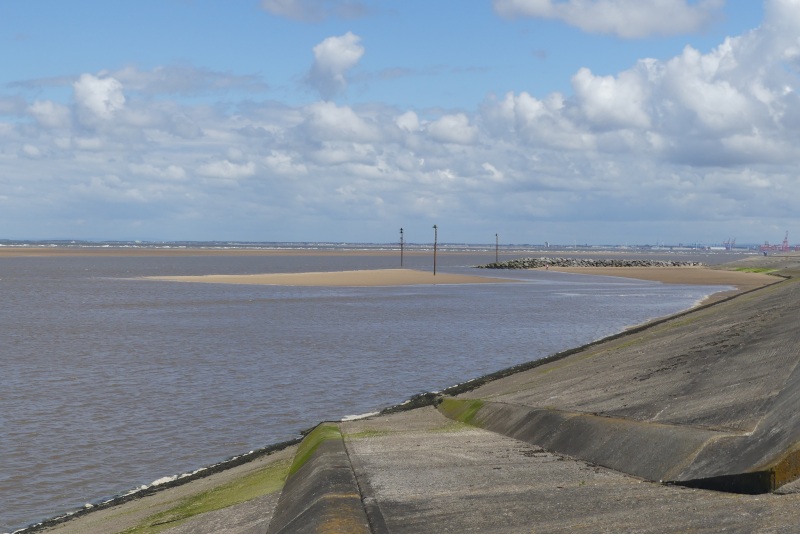
The tide was out but judging by distant white horses that was going to change pretty soon. The beach between Hoylake and Leasowe gets inundated very quickly. There was a line of cormorants and unidentifiable large gulls by the water line half a mile out. A couple of curlews probed the mud slightly further in. Closer to, pairs of shelducks dabbled in muddy puddles and herring gulls loafed about in twos and threes. I almost overlooked a common gull asleep in a hollow out of the wind. A whimbrel flew in and started feeding in the middle distance, it's been a good year for them.

Pied wagtail

Nearby there were bits of movement in the patches of sea grass and plantains as pied wagtails, including a couple of primrose-faced juveniles, went about their business. I'd not walked far when I accidentally broke up a pretty vicious fight between a pair of pied wagtails, the male flying off a few yards leaving a rather dazed female to get her act together before flying off.

Ringed plovers 

Ringed plovers

There had been reports of a couple of little stints here over the weekend, reduced to one by daybreak this morning so I suspected that would have scuttled off by now. Small groups of dunlins and ringed plovers flew to and fro, settling in the shelter of patches of grass. A party of ringed plovers were scuttling about a hundred yards away from the sea wall, the three-quarter-sized youngsters looking unnervingly like Kentish plovers with white faces and sandy rings developing round their necks. A couple of dunlins wandered in from I know not where followed by another, much smaller, wader. Which was also a dunlin because it had a black belly. The size variation in dunlins is one of the major reasons why I have no confidence in identifying "peeps." I watched the plovers for another few minutes before I noticed that one of the littlies skittering about at the far end of a puddle had a scaly brown back and black legs. Which is how I added little stint to the year list.

Ringed plovers and little stint (front)

Grey plover

I'd only walked a few yards ahead when I noticed a grey plover dozing out of the wind behind a tussock of grass. I don't see grey plovers nearly often enough and certainly not in their smart Summer plumage.

Looking back over the Dee Estuary to that Wales

Catamarans at Meols

As I walked along there were fewer waders and shelducks and more herring gulls, lesser black-backs and, once I reached the creeks by the slipway, little egrets. I joined the revetment and walked down to the groyne. It seemed strange not having crowds of knots and redshanks on the mud or turnstones scuttling about in the seaweed. It seemed odder that the only birds on the groyne as the tide came in were a couple of house sparrows.

It's odd looking at the groyne from this view and not having a derelict boat in the corner

The pond on Leasowe Common 

I bobbed over the top and down into Leasowe Common where the goldfinches and linnets were twittering about in the bushes and whitethroats singing from the small trees. A reed warbler sang deep in the reeds by the pool where broad-bodied chasers zipped round the margins. The paddocks that a month ago were hotspots of passage migration were now the playgrounds of swallows and woodpigeons.

Herring gulls and lesser black-backs 

I had a quick look at Kerr's Field which was carpeted with herring gulls and lesser black-backs sitting out the high tide. They were accompanied by a lot of woodpigeons that were trying to pretend their field hadn't been invaded. I had no luck searching for stonechats or sedge warblers in the drain by Lingham Lane, just more linnets, goldfinches and whitethroats.

A melee of starlings

Starling, ready for the post-breeding moult 

I got myself a cup of tea, resisted the temptation to get a bag of chips, and picked my way through the starlings to rejoin the revetment and head towards New Brighton. The scenery for the next couple of miles was lovely but the birdwatching a lot thin on the ground. Most of the action was inland with skylarks singing over the rough and a pair of coots making a natural hazard of the putt on the fifteenth hole of the golf course.

Leasowe Bay 

Leasowe Bay 

Cormorants 

I debated walking inland into the dunes by The Gunsite then remembered the sneezing fit I had walking past the freshly down grass by Leasowe Lighthouse and decided to keep to the coast today. A few herring gulls and parties of cormorants headed out to sea ready for any pickings on the ebb tide. A dark shape caught my eye out to sea. Usually they're buoys or bits of driftwood. The distance between first and second sighting ruled out a buoy and it was moving against the current, it wasn't a cormorant and it was too big for a common scoter. The third time it bobbed up the whole head came out of the water not just the nose and I could see it was a grey seal.

Herring gull

Meadow pipits performed their parachute songs in the dunes, pied wagtails skittered about the paths, herring gulls and lesser black-backs lurked and loafed, carrion crows fossicked about on the beach and starlings fussed about on the grass inland. And so it was all the way past the lifeguard station and down the length of the King's Parade into New Brighton.

Herring gulls by Wallasey Lifeguard Station 

New Brighton 

I decided I didn't have the legs or wind for moving on to someplace else so set off back home. I just missed the train straight home, didn't fancy the wait for the train to Warrington then the wait for the train to Urmston so I got the train to Eccles via St. Helens and got the bus home after a surprisingly good day.

Shelduck and ringed plovers