|
Red-legged partridge and carrion crow
(Me and the camera struggled to not have the partridge bleach out in the bright sun against black soil. While technically inept the result is not wholly unpleasing.)
|
The past few days the dawn chorus has been heralded by the blackbird kicking into song half an hour before dawn and the robin joining in five minutes later. My knowing this might be the reason why after telling myself I'd "just have half an hour" at seven o'clock I woke up at quarter to ten, which put the mockers on today's plans. I wouldn't mind losing the fight against becoming a nocturnal animal if I were truly A Companion To Owls but they've been thin on the ground lately.
The garden and the school playing field would be full of young jackdaws if they ever settled down on the ground for more than half a minute. Their parents have that harassed look you see in people given the job of supervising a coachload of sugar-filled kids at the fairground. The rooks, which have started to drift back from the riverside rookery, have left their youngsters behind now they're able to find their own way to the fields across the way. The adults still go back to the rookery to roost so it won't be long before the youngsters start following them over here.
It was a fine, cloudy day. I bobbed over to the Trafford Centre and played bus station bingo. The 100 to Warrington arrived first so I went for a few hours' walk over the Salford mosses. This time I was prepared with the pollen traps on the upper lip and nostrils and whichever direction I took the barley fields would be at the end of the walk, not the beginning.
 |
| Great tit |
Crossing the motorway bridge on Cutnook Lane the blackbirds, blackcaps, robins and wrens struggled to be heard over the traffic and I struggled to hear and find the families of great tits and blue tits and the great spotted woodpecker moving through the trees. Walking up the lane as the traffic noise decreased there was a crescendo of bird song with song thrushes and chiffchaffs joining in as I passed Raspberry Lane. There were plenty of carrion crows, magpies and woodpigeons in the fields and swifts flying low overhead but a distinct lack of the usual swallows. Black-headed gulls and lesser black-backs passed overhead and a lone buzzard soared very high in the sky. Beside me as I walked common blue damselflies zipped about in the bracken.
 |
| Walking up to Croxden's |
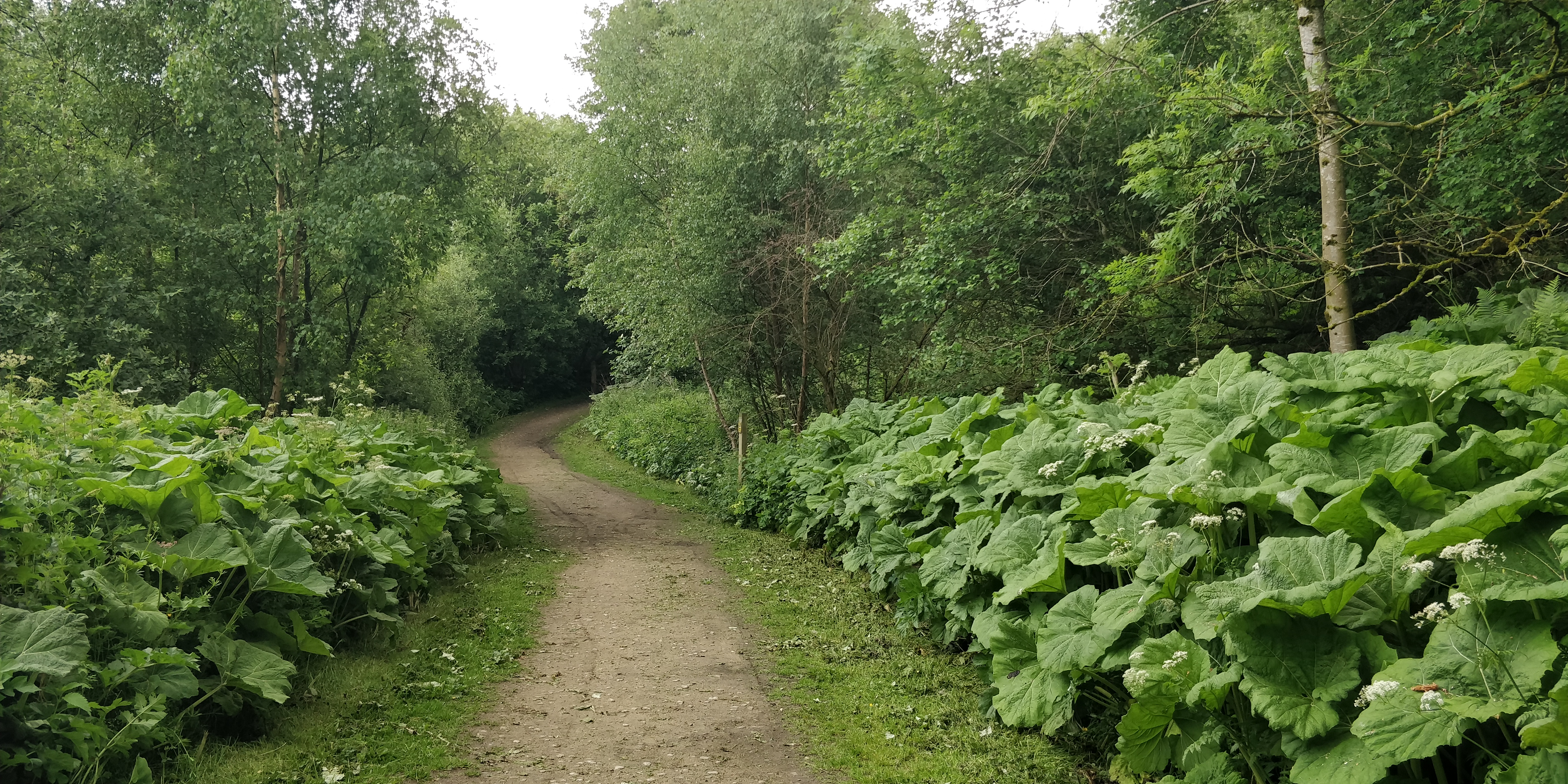
I walked through the woodland up to Croxden's. Willow warblers joined in the songscape almost as soon as I crossed Twelve Yards Road. Mallards could be heard muttering on pools made invisible by the leaves on the birch scrub. If you told me there were gadwall in there, too, I shouldn't disbelieve you. Most of the small birds flitting about in the trees turned out to be robins or chiffchaffs bracing themselves for a song; occasionally they'd be great tits or blue tits and one was a singing coal tit. I hadn't put my cap on so far because it was fine, I dug it out of my pocket sharpish to keep the cleggs out my hair. On paper this part of Chat Moss looks ideal for spotted flycatchers but I only ever see them here in Autumn, and then not every Autumn. I could have done with a squadron of them along this stretch.
 |
| Croxden's Moss |
The wide expanse of Croxden's Moss looked deceptively empty save the rooks, crows and lesser black-backs flying overhead. Blackbirds, woodpigeons, wrens and willow warblers sang from the surrounding trees and more willow warblers held territories in small patches of birch and hawthorn scrub none bigger than a double bed.
 |
| Large red damselfly |
I walked back and joined the path along the woodland fringe. The songscape continued, punctuated by the scolding calls of chaffinches telling me to be off and sharpish. Speckled woods and red admirals flitted about, the common blue damselflies were joined and outnumbered by large red damselflies and the brambles were humming with bumblebees.
 |
I'll bang on a bit more about the diversity of brambles, all from a stretch of path about fifty yards long.
These are like the large-flowered ones on the canal the other day. I don't know which of the big bumblebee species this one is.
|
 |
| The star-shaped brambles are the ones I see most often on these mosses. |
 |
| There were quite a few of these smaller-flowered brambles, common carder bumble bee for scale. |
 |
| These tiny-flowered pink brambles were small plants growing in the thicker undergrowth. |
I've been embarrassed by my inability to identify bumblebees so I took the opportunity to make a bit of an effort. Especially as one of the bramble patches looked like one of those illustrations in books showing an unlikely assortment of species in one place. The tree bumblebees had been my companions since Twelve Yards Road, they were now joined by big white- and buff-tailed bumblebees, smaller garden and — possibly — heath bumblebees, a few cuckoo bees and a lot of little ginger carder bees. I need to make the effort more often. The grass moths I left unidentified, I know when I'm beaten.
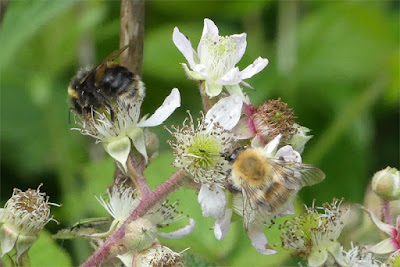 |
| I think the bee on the left is a Southern cuckoo bumblebee, the little ginger one is a common carder bumblebee. |
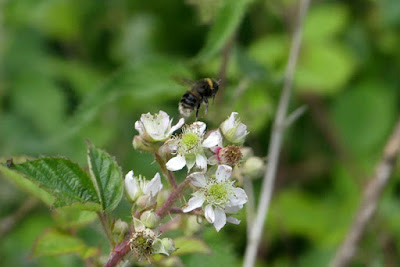 |
| I think this is Barbut's cuckoo bumblebee |
Lapwings and oystercatchers loafed and called from the pools on the open moss though I only saw one of each, the rest being obscured by birch scrub. The moorhens were heard not seen. It occurred to me that if that green-winged teal were still about it would be even more of a beggar to find.
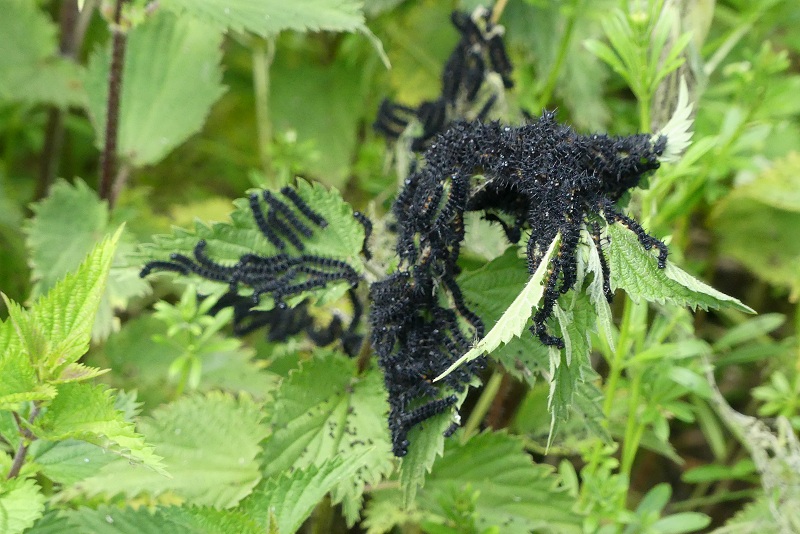
As the landscape opened up whitethroats sang and churred from the bushes and skylarks sang over the fields. Big black patches in the nettles suggested that we'd be okay for peacock butterflies later this Summer. A flock of swifts drifted overhead and lingered over the barley fields as I joined Twelve Yards Road and headed for Four Lanes End.
 |
| Peacock butterfly caterpillars |
I'd seen the usual kestrel hovering over the rough pasture as I approached Four Lanes End but there was no sign of it when I got there, which I hope means it has hungry mouths to feed somewhere. A family of long-tailed tits silently flitted through the hawthorns and willows, whitethroats churred at regular intervals as I passed. I had to look twice at a raptor as it passed overhead, it was an unusually dark buzzard I've not seen here before and with the light behind it it looked like an all-dark bird.
 |
| Twelve Yards Road |
Robins, chiffchaffs, willow warblers and wrens sang in the trees at the entrance to Little Woolden Moss nature reserve. I don't know why the Lancashire Wildlife Trust bothers with the "Ground-nesting birds: keep your dogs on a lead" and "For everybody's safety, cyclists please dismount" signs. Perhaps they need some "Pay attention to these signs or the boggarts will get you" signs.
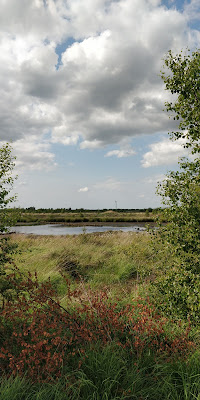 |
| Little Woolden Moss |
It was a quiet sort of afternoon on the pools. A few carrion crows fossicked about to the consternation of the lapwings with chicks. A pair of oystercatchers had an inconspicuous nest. Mallards dabbled about apparently without ducklings. A few black-headed gulls fussed about without lingering long. The songscape was provided by willow warblers, reed buntings and meadow pipits though there weren't many of them singing, most were busily flitting about with insects in their beaks. Again, there was a distinct lack of hirundines. At first there was also a lack of swifts, too, but the flock I'd seen earlier floated low over the peat Moss then moved to the barley fields to the North.
I'd been hoping to see a hobby but it didn't look like it was my day for it. A few broad-bodied chasers shot about the pools and a couple of black-tailed skimmers sunned themselves on the path but there didn't seem to be enough in the way of dragonflies to tempt a hobby. I followed the swifts and walked round to the barley fields in the hopes of seeing a yellow wagtail or two. As I approached the turn into the fields I noticed a falcon flying in from the sun. At first I assumed it was a kestrel but as it got closer it veered slightly and I could safely use my bins on it. It was a hobby. It descended slightly then flew back into the sun, it had seen the swifts and headed that way. It made a desultory pass through the flock which dispersed and moved back over the pools without a hint of panic.
 |
| Pushing my luck quite a lot with the hayfever |
I had no luck with yellow wagtails but the constant distraction of reed buntings, linnets, meadow pipits and skylarks coming and going out of the barley led me to notice a hare hiding in there. Or the tips of its ears anyway.
 |
| Spot the hare |
The ploughed field by the polytunnels had a bumper bundle of lapwings, carrion crows, pied wagtails and a red-legged partridge. A couple of swallows passed by, much to my relief, and collared doves sang by the farmhouse.
 |
| Red-legged partridge |
 |
| By Moss Road |
I walked down Moss Road into Glazebury. More robins, blackbirds and wrens sang in the roadside trees and families of titmice shuffled through the leaves. A yellowhammer sang in the trees near the wind turbine. I bumped into another birdwatcher and we exchanged pleasantries. He'd just managed to get some good photos of a goosander and her ducklings floating down the River Glaze. I wished him luck and hoped the hobby would play nice for him. When I got to the river the goosanders had moved on, three half-sized mallard ducklings were floating downstream with their parents. Downstream of the bridge a juvenile heron was lurking in the shadows by the bank on a hunting trip.
It was a short walk to the bus stop and just ten minutes to wait for the 28 to Leigh and a short wait for the 126 back to the Trafford Centre. The weather had behaved and so had the pollen count and the hobby had kept the year list ticking over.
 |
| Did you find it? |