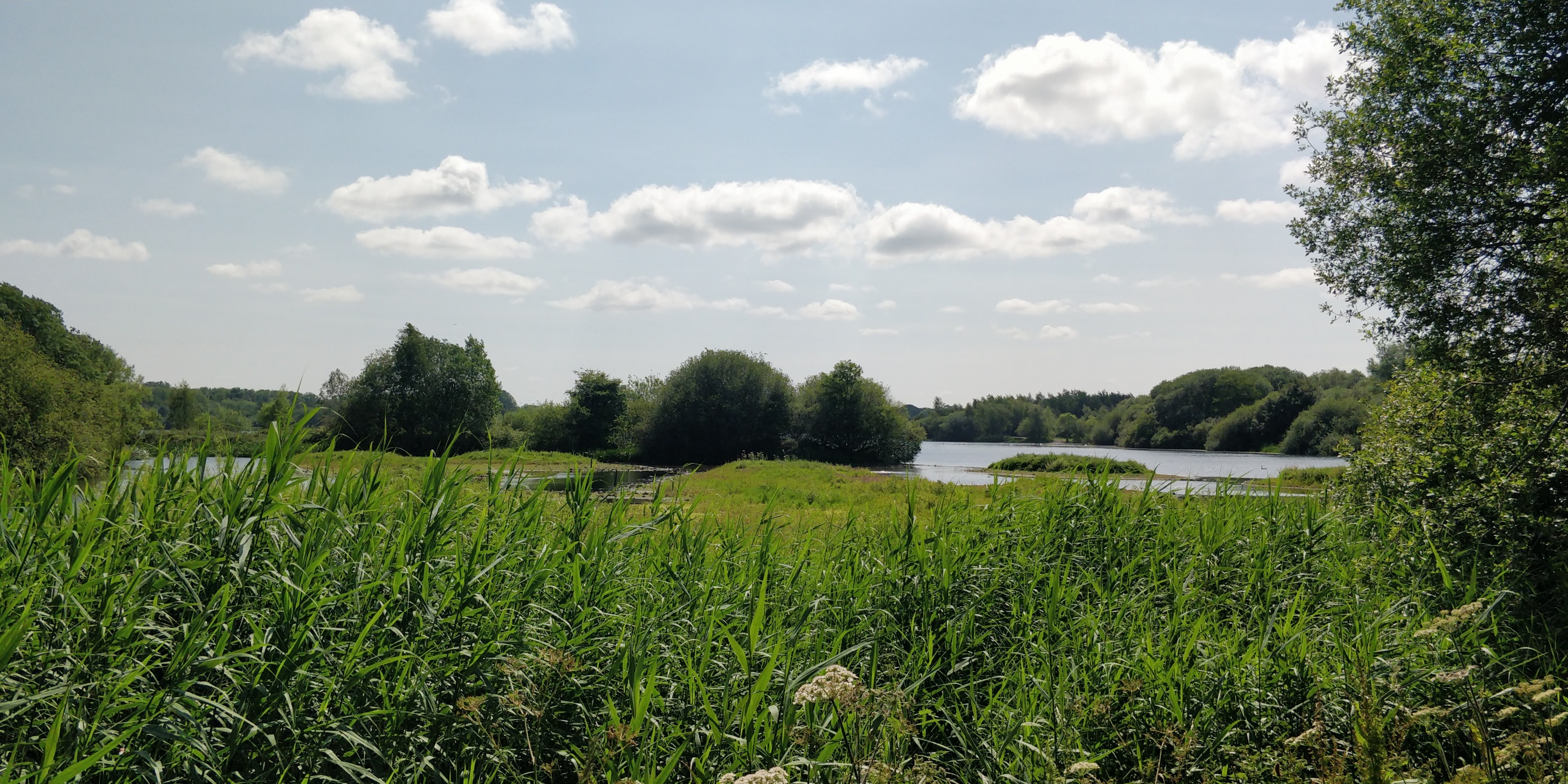
Black-tailed godwits, Leighton Moss

Thursday, 12 June 2025

Reservoir Wednesday

Juvenile pied wagtail, Hollingworth Lake
It's not often you get close enough and they sit still enough to be able to see the yellow gape at the side of the beak.

It was a warm, sunny morning so I thought I'd go for a gentle stroll. A long-tailed duck had been recorded at Hollingworth Lake but had disappeared overnight. No matter, the report reminded me I've not been there in ages and it's a nice, gentle stroll. And if the pollen count's going be high a Pennine reservoir is a fair way of hiding from the worst of it.

I got the train to Smithybridge and walked up to the lake, the slope irritating the knee more than the ankle but the exercise was getting the movement back into the joints. Along the way there was the bonus of a handful of Southern marsh orchids in the grass verge, which was nice to see. Blackbirds, spadgers, starlings and dunnocks rummaged around in front gardens, jackdaws and woodpigeons clattered about the rooftops and swifts screamed about the chimney tops. There were dozens of swifts, showing the advantage of having a huge body of midgey water up the road.

Hollingworth Lake

The lake was, understandably, very busy. Which didn't bother the house sparrows flitting about between the gardens and the bankside. Nor the young pied wagtails overly much though the adults were a lot more skittish. A huge raft of Canada geese cruised the lake in between boatloads of kids learning how to row like Vikings. Most of the gulls on the water were lesser black-backs, there were handfuls of herring gulls and black-headed gulls. The hedgerow songscape was mostly blackbirds with a few blackcaps and chiffchaffs near the houses and gardens, robins and great tits out by the fields. Out in the fields to the South reed buntings, greenfinches and chaffinches sang in the hawthorn bushes.

Looking South from the lake

The path to Shaw Moss, with jackdaw

The crowds were feeling a bit oppressive so I took a time out by taking a walk part of the way along the path to Shaw Moss. It was very quiet of people but noisy with singing woodpigeons and wrens. Magpies and blackbirds rummaged about in the fields and a lot of greenfinches flitted about in the hawthorn bushes. It feels good to be able to write: "A lot of greenfinches." Oddly there weren't any hirundines about, I was expecting to see some swallows at least around the cattle sheds. The non-appearance of swallows where I'm expecting them is getting to be a point of concern.

I wandered back to the lake, got myself a lemon sorbet to give myself an ice cream headache and carried on with my circumlocution.

The nature reserve 

The hide in the nature reserve was busy but there were plenty enough gaps in the trees to see what was about. A few mallards and their ducklings dabbled about in the company of some moorhens and magpies. Out on the beach about forty gulls — two lesser black-backs for every herring gull, plus a couple of black-headed gulls — loafed with a handful of very vocal oystercatchers.

The lake by Rakewood Road

I carried on walking up to Rakewood Road and found out where the hirundines were. A commotion over the houses across the field was house martins chasing off a kestrel. As I walked down the road a flock of swallows descended on the beach across the road and hawked low over the water's edge, keeping out of the way of the gulls while they did so. The balance of things was restored. Further reassurance was the meadow brown butterflies fluttering about the fields on my side of the road.

By Rakewood Road 

The 456 bus was due in ten minutes so I waited and got that into Wardle for a walk up to Watergrove Reservoir to see what was about. It turned out that what was about was a film crew and the Eastern end of the reservoir was off-limits. Which was no great hardship, there's good walking away from there.

Watergrove Reservoir 

Lesser black-backs 

The water was low here, too, and a couple of dozen lesser black-backs loafed on the spit that had emerged. A pair of great crested grebes drifted midwater and dozens of Canada geese congregated on the far bank. Willow warblers and blackbirds sang in the trees down below and a buzzard slowly floated overhead and headed for the hills.

Pied wagtail 

A family of pied wagtails skittered about the base of the reservoir wall. I could see a wader further along and assumed it was a redshank. I eventually caught up with it and was surprised to find it was a greenshank. There's been a passage of waders, mostly sanderlings, over the Pennines recently, this bird might be a part of it.

Greenshank 

I had five minutes' sit down on a bench to check my notes and assess the aches and pains and was surprised to find that the notes were copious and the aches and pains minimal. That being the case I decided not to drop back down into Wardle for the bus, instead I'd have a stroll over the hill into Whitworth. It was just the right weather for it and it's a walk that's easy on the knees with soft ground and climbing not compulsory. As I got up from the bench I noticed a grey wagtail feeding a fledgling at the top of the step bridge overflow.

Grey wagtails

Heading for Slack Gate

It was a very pleasant walk, just what I needed. Blackbirds and robins sang from the trees and skylarks and meadow pipits sang from the moorland. Rooks and jackdaws fossicked about around the sheep, carrion crows flew about the slopes, magpies popped up anywhere. 

There'd evidently been a mass emergence of burnet moths, they littered patches of ragged robin and lady's bedstraw, hardly letting the small tortoiseshells and common blues get a look in at the flowers.

Five-spotted burnet moth on ragged robin 

Common blue 

This path becomes Slack Gate

Slack Gate
It gets posher further along.

I walked along Slack Gate to the radiating confusion of paths near the golf club. Usually I walk down Whitworth Rake into Whitworth for the bus into Rochdale. Today I opted for the bridleway to Syke, just out of curiosity.

The bridleway to Syke

The bridleway follows the route of the feeder stream for Brown House Wham Reservoir (people think I make these names up). Blackbirds, chaffinches and skylarks sang and there was at least one Canada goose on the little reservoir by Springside Farm.

Brown House Wham Reservoir 

Willow warblers, meadow pipits and wrens joined the songscape at Brown House Wham Reservoir, a couple of drake mallards pottered about on the water. 

Fanny Brook 

The bridleway became Dirty Leech, became Limers Gate then became Dewhirst Road and I was heading into Syke for the bus into Rochdale. Of course, I'd forgotten how bad the traffic is on Whitworth Road, I spent most of the next hour sitting on that bus as it crawled down the road. And even that couldn't take the gloss off a very good day's walking.

Tuesday, 10 June 2025

Pennington Flash

Egyptian goose

It had the makings of a very nice day. Last night I put the postponed plan on ice, literally. This morning the tendon was still pulling slightly but by lunchtime I thought I could get a walk in do long as I didn't do anything silly and avoided hill walking or running for buses. I was well past due a visit to Pennington Flash so I got the 126 to Leigh. When I arrived at Leighton Bus Station the 588 to Plank Lane was sitting in the next bay so I got that. It's been a while since I started a wander round Pennington Flash from the North, it would make a change and it would save me having to find a gap in the traffic to cross St Helens Road.

Walking in from Plank Lane 

I got off the bus at the Plank Lane car park and set off walking through the wood. The going was made soft by recent heavy rains but the mud looked worse than it was. A song thrush sang over singing blackbirds, chiffchaffs and blackcaps by the car park. Walking through the woodland there were more blackbirds, chiffchaffs and blackcaps and they were joined by robins, wrens, great tits and willow warblers. Hearing all these was one thing, seeing any of them was a definite challenge. Unlike the family parties of titmice bouncing through the birch trees. As usual the great tits families were more circumspect while the blue tits and long-tailed tits bounced about the pathside. It was pure chance I spotted the family of coal tits in the treetops.

Mute swans and Canada geese 

A meandering course through the trees got me to the Northern edge of the flash. In stark contrast to the scene in Winter the open water was empty though there were herds of mute swans feeding at the banks on either side with mallards, Canada geese and coots. There were no signs of any cygnets about, a lot of the swans were yearling birds. A great crested grebe had a nest at the end of a small spit and a few gadwalls dabbled nearby.

Ramsdales Ruck 

Ramsdales Ruck 

The woodland thinned and I was soon walking through the open grassland of Ramsdales Ruck with the songs of skylarks and reed buntings in my ears. A couple of buzzards passed low overhead and drifted over the flash. A couple of swifts hawked low over the ruck, I wasn't to see any hirundines at Pennington Flash at all today, which came as a surprise.

The Lagoon 

A couple of families of Canada geese had young goslings on the banks of The Lagoon and a couple of mute swans drifted about. The water's surface was sparking with common blue damselflies zipping about feeding on midges, mating, or both.

The Horrocks spit
Black-headed gulls, Canada geese, mute swans and a cormorant

Approaching the canal I was starting to get closer than my usual views of the bight at the end of the Horrocks spit. The nesting black-headed gulls were very busy though I couldn't see any youngsters on the nests. The reactions to any passing large gull were swift and hostile. A couple of dozen herring gulls and lesser black-backs loafed in a raft off the Horrocks spit.

I've had two dry months to do this walk in so I wait until after a deluge

The path round to Ramsdales Hide was noisy with singing blackcaps, blackbirds, robins, wrens and a particularly insistent coal tit.

It was fairly quiet on Ramsdales. The usual Cetti's warbler was back and singing. A family of lapwings pottered about, the parents taking umbrage at anything getting within ten yards of the chicks, which was hard lines on the little egret shrimping at the waterside. A couple of shovelers dozed, moorhens and Canada geese pottered about. 

A young couple in the hide were mesmerised by "a black butterfly thing" fluttering about in the reeds. It took me a while to pick it up, and that only because it was holding a territory and kept coming back to the same leaf, a male banded demoiselle doing a passable imitation of some sort of butterfly. I dug out pictures of male and female banded demoiselles, they were very taken by them and will definitely be on the lookout for them in future. As, indeed, will I.

At Ramsdales Hide 

The Tom Edmondson Hide was very quiet indeed, a pair of gadwalls and a coot. Just as I was putting the camera back in the bag a couple of willow tits flitted between the brambles either side of the hide.

At the F.W.Horrocks Hide

It was a bit busier at the F.W.Horrocks Hide, even not counting the crowd scenes at the end of the spit. Mallards dozed, coots fussed about, a pair of teal slept on the banks of the bight. A little ringed plover must have been pottering about near the teal, it flew up from there and landed at the end of the spit. I'd thought I'd heard terns, there were a pair of common terns wheeling about at the end of the spit. There was an almighty commotion when a great black-back flew in, the black-headed gulls on the nesting raft rose as one and cleared it off, the great black-back affecting nonchalance as it flew off.

Egyptian goose 

There were great rafts of Canada geese cruising round the margins of the flash. At the car park the rafts were smaller, family groups of downy goslings. Also at the car park were a pair of Egyptian geese, a bit early this year. Where on earth are they the rest of the year?


Monday, 9 June 2025

A bit of a wander

Mallards, Brookfield Pond 

The weather for today looked decidedly dodgy so I thought I'd have a bits and pieces sort of a day, getting an old man's explorer ticket and stopping by at places between trains.

For a change I thought I'd head South so I got the train to Buxton with the idea I'd get off at Whaley Bridge and have a nosey at Toddbrook Reservoir which is ten minutes' walk from the station then go down to Buxton and wing it from there.

As I walked up Reservoir Road from the station blackbirds, blackcaps, chiffchaffs and wrens sang in the trees and gardens while swifts and house martins hawked overhead. House sparrows and starlings were visiting nests and a male blackbird was feeding one of its youngsters by a gatepost.

It came as a blow that the reservoir is currently a construction site while they're rebuilding the dam. Still, better safe than sorry. A grey wagtail called as it flew over a construction lorry to give me an idea what I was missing.

Brookfield Pond 

A consolation was the discovery of Brookfield Pond Nature Reserve, which is a fair sized village pond surrounded by trees and very nice, too. A couple of drake mallards mooched about, a moorhen was busy building a nest with unfeasibly large bits of leafy sticks and the songscape was provided by a song thrush and a blackbird. It was too cool for any damselflies or dragonflies to be active, even the pondskaters and midges were a bit lethargic.

The plan was then to get the train to Buxton and have a wander round Pavilion Park. Except that the train was cancelled. I wasn't waiting an hour for the next one so I decided to get the bus. The bus to Macclesfield turned up first so I thought why not? It goes over the moors past the Cat and Fiddle and I could get a train from Macclesfield. So I did.

Google Maps tells you that from Whaley Bridge the 60 goes yomping over the hilltops but in real life it heads for Buxton, veers off just outside the town centre, then onto Macclesfield Main Road and then winds its way through picturesque hill scenery before dropping into Macclesfield. (If you're only ever doing the Buxton to Macclesfield bus journey the once, sit on the right-hand side up to the Cat and Fiddle then, if the bus isn't busy, quietly slip over to the left-hand side, that way you'll get the pick of the views.) 

From Peak View on the bus

There's a bleak beauty to the landscape and the birdwatching can be a bit barren. I thought I'd be making do with a few crows and jackdaws and a skylark, which to be honest isn't a bad haul in this context. Then, near the Peak View Cafe we passed three subadult great black-backs on one of the slopes (before we started to give them prime breeding sites on factory rooves large gulls tended to be moorland breeders the same as many waders, and many still are). Scarcely had that registered than we turned a corner and there was a red kite hovering by the roadside. There is a phenomenal amount of luck involved in birdwatching in any context, it becomes very conspicuous in a setting like this. Thereafter it was the occasional carrion crow and a lapwing until we got near Macclesfield and we started passing rooks and woodpigeons.

Macclesfield is where Plan B came unstuck. We were at the junction across the road from the station and the train to Stoke was due in eight minutes. My thinking was that I'd go to Stoke, have a potter about Manorfields, which is just down from the station, then get the train back into Stockport or Manchester and see how the spirit bade me thereafter. The junction was one of those where you wait three minutes, it lets two cars through then you wait another three minutes. Luckily it's only a minute's walk from the bus stop to the station. Unluckily, I was on the hurry up and I had been sitting on the bus for fifty minutes and the Achilles tendon that's been niggling this past month decided to assert itself quite forcibly. 

I got the train despite it but had to have a rethink. Tomorrow's the only scheduled day of decent weather this week and I've plans for doing something with it, I didn't want to push my luck so I had a lazy afternoon of it, staying on the train to Stoke then coming back to Stockport. I'd prefer to visit Manorfields on a day when it was likely I'd be seeing damselflies and dragonflies as well as catching up with warblers. 

I have to say, while I can be quite disparaging about the lack of birdlife in the fields of Yorkshire, Cheshire wasn't garlanding itself with bounty either today. We got into Staffordshire and it got a bit better, the usual corvids and woodpigeons but in rather better numbers and Etruria was busy with lesser black-backs.

From Stockport I went to Crewe and back just for the ride and to milk a bit of value out of the old man's explorer ticket. The crowd of black-headed gulls, Canada geese and mute swans on the Sandbach flashes reminded me they were due a visit this Summer.

The day didn't go as expected but I'd had a potter about, saw a lot of very agreeable scenery and managed to see a fair number of birds, albeit thinly spread. There's worse things to be doing on a damp Monday.

Saturday, 7 June 2025

Wellacre Country Park

Juvenile blackcap

It had been a cool, damp night and a cool, damp morning and the joints asked if I was really going out in that and I had to admit that I wasn't. Things had calmed down mid-afternoon so I bobbed over to Wellacre Country Park to get a bit of exercise.

Wellacre Wood 

I got off the bus at the school and walked down into Wellacre Wood. Blackbirds, wrens and robins sang incessantly; woodpigeons, magpies and carrion crows clattered about; goldfinches twittered in treetops and a pair of parakeets made noises in a corner of the school yard. Swifts flew high overhead riding the rain fronts.

I emerged from the wood and walked past the fields to Jack Lane. Swallows swooped low over the fields and a crowd of them whizzed about the stables. Over by Irlam Locks the swallows were joined by a flock of sand martins and a crowd of starlings billowed their way between the houses and the water treatment works. Black-headed gulls flew around the locks and lesser black-backs passed high overhead towards the river. I decided not to make the detour round to the locks to see what was on the canal, I'd only be tempted not to traipse all the way back and I'd use the weather as an excuse just to get the bus home.

Walking into Jack Lane Nature Reserve 

So I headed for Jack Lane Nature Reserve instead.

Juvenile long-tailed tit

I'd barely passed by the gate when I was surrounded by a family of long-tailed tits bouncing round the young oak trees by the path. I stayed still and they came and had a look at me before going back about their business. A family of blue tits did similar, the youngsters fresh out of the nest and still making a bad fist of keeping their balance on the branches as they begged for food. The family of great tits couldn't be bothered with me and just passed by.

Jack Lane Nature Reserve 

Two reed warblers sang in the reedbeds, a couple more bustled about and it sounded like there was a nestful of youngsters ready to go out into the world. Chiffchaffs, robins, blackbirds and reed buntings sang. A moorhen called to chicks in the depths, a water rail waited for a lull in the songscape to utter a blood-curdling squeal.

Walking down to Dutton's Pond 

The walk down to Dutton's Pond was fairly quiet, only the chiffchaffs, blackbirds and wrens bothering to sing. I bumped into a birdwatcher who I know has told me his name at least once, he'd managed to get some photos of a bunch of young whitethroats sitting together on Green Hill. It occurred to me to wonder why there weren't any whitethroats on the fields on this side of the railway line and I concluded that the grazing and the magpies would be too much for them. I see them quite often in settings heavily grazed by sheep but the distributed pellets of sheep droppings don't support the crowds of large insects a pile of horse manure will so the magpies are a lot fewer and far between.

Not even nice weather for ducks

I got to Dutton's Pond and it poured down. Everything except the mallards took to cover, the half-grown ducklings sulked in the water lilies.

Juvenile blackcaps

I'd barely passed under the railway bridge when I bumped into the first of many great tit families on Green Hill. A few steps further and there was another, and a blue tit family. Chiffchaffs, blackbirds and robins sang as I walked through the trees and a pair of blackcaps had three hungry mouths demanding food.

Juvenile blackcap

Green Hill 

There were more great tits and blue tits in the hawthorns out in the open. I bumped into the family of whitethroats. They were uncomfortably close to the path, having flown out of a hawthorn to have a look at a large dog. One of their parents was waiting for me to pass so it could do something with a beakful of large green caterpillars so I didn't linger. There were three or four singing whitethroats in the stretch of path I walked along. It wasn't the weather for doing much exploring. Sand martins, swallows and swifts hawked high overhead. There was a steady traffic of woodpigeons, jackdaws and lesser black-backs, each heading their own way. A kestrel hovered high over hillside, seeming to have the most luck near the gorse thickets.

Despite the weather there was nothing on the river except a woodpigeon having a drink. I walked over to Flixton Station and got the train home. The joints in my legs said: "Told you so."

Friday, 6 June 2025

Stretford Meadows

Goldfinch 

It was a morning for errands so I didn't have big plans for the birdwatching day. I might have slept through the opening passage of the dawn chorus as I only heard the bit where the collared dove and the wren were singing a duet. The blackbirds and the robin started singing (again?) mid-morning. Every time I looked out of the living room window there was a bustling about of blue tits and great tits. And by the sound of it the magpies weren't just using the nest in the tree across the road as a roost, at least one juvenile was shouting for its breakfast. Which might be bad news for the very noisy starlings nesting in next door's roof.

Each time I got home there were two dozen large gulls loafing on the school playing field. But not the same two dozen. Sometimes there'd be a couple more herring gulls than lesser black-backs, sometimes vice versa. By lunchtime it was nearly all lesser black-backs. There was always one adult lesser black-back in the same position every time and I began to wonder if it wasn't a decoy of some sort, like the stuffed crow on a roof I see when the bus passes through Moseley Common. It had shifted at teatime and flew off just after, which quashed any further macabre speculation.

The afternoon was mine own so I had a wander over Stretford Meadows. In part to see if any orchids were about, in part to see if the lesser whitethroat was still to be found. But mostly because I needed the exercise.

The spadgers fussed about in the hedgerows of Newcroft Road and wrens, blackcaps, blackbirds and chiffchaffs sang in the trees. For once I didn't have to go searching to see where a pheasant was calling from, there was one by the gate to the field by the garden centre.

Stretford Meadows 

I walked out into the open ground. It was a cool and grey and heavily cloudy afternoon. Carrion crows, woodpigeons and pigeons flew overhead in ones and twos and magpies rattled between trees. It felt like every third hawthorn had a whitethroat and any stand of trees held a whitethroat, a blackbird, a robin and some great tits. In truth there weren't quite that many, they moved about a lot. The chiffchaffs stayed in the wooded fringes, the goldfinches stayed on the tops. The reed buntings were seen but not heard. I didn't consciously see or hear any linnets but somehow had a sense they were about (this doesn't cut it for data recording purposes).

Northern marsh orchid 

Purple spikes of marsh orchids were peppered about liberally amongst the rank grasses, and especially in the emerging stands of great willowherbs. They were rarely in clumps, just the one or occasionally two spikes of flowers. Most were Southern marsh orchids, I found a couple of probably Northern marsh orchids. There were a lot that were variations on a theme of Southern marsh orchids and quite a few that had one or more of the other marsh orchids lurking somewhere in the family tree. Marsh orchids are quite variable to begin with a and hybridise like crazy given half a chance. The few common spotted orchids I identified by the heavy markings on the leaves, I couldn't be confident with the flowers alone. It came as a relief to find a rather bashed-about pyramidal orchid, the three-fingered cartoon glove-shaped lip to the flowers being reassuringly different to the others.

Common spotted orchid

Southern marsh orchid

The purples of the orchids were picked up by the purples of the tufted vetches twining through the grasses, contrasting with the bright yellows of the buttercups and horseshoe vetches. I spent a long while trying to get photos of the grass vetchlings, the tiny carmine-red pea flowers on long, wire-thin stems. It proved impossible, autofocus is not your friend when you're trying to take a picture of a tiny flower against a fussy foreground and background as it bobs about in the breeze and manual focus by mechanical jerks is even worse. There are times when I still miss being able to focus a lens by hand.

Walking away from the cricket pitch 

Heading for the rise

The rise of the heap

My strategy of looking for everything except the lesser whitethroat worked, it started singing from a hawthorn by the psth near the top of the rise. Actually, it was provoked by a magpie but the result was the same. To me the song of a lesser whitethroat has chaffinch tones to it, very different to the other warblers. The magpie moved on as I approached and the lesser whitethroat settled into singing uninterrupted by its sharp tick of an alarm call (like two pieces of flint being banged together). It sang from the depths of the hawthorn, a couple of times I saw its silhouette as if flitted across gaps in the leaf cover.

Goatsbeard

I dropped down to the Transpennine path, dodged a passing cycling club and had a look at the clouds. Prudence dictated that I didn't carry on down and walk into Stretford Ees and Sale Water Park. I headed into the woodland fringe to walk round to Sandy Lane. 

Heading for Sandy Lane

The rain seemed to provoke the birdsong: robins, blackcaps, blackbirds and chiffchaffs sang in the trees, a garden warbler fidgeted in an elderflower bush as it sang, wrens and dunnocks sang from the depths of the undergrowth. I hadn't realised I hadn't seen or heard any parakeets until I heard a couple in the trees on one of the back gardens.