Black-tailed godwits, Leighton Moss

Wednesday, 17 March 2021

Mosses

Female chaffinch, Irlam Moss

Another bad night's sleep and a debate whether to try and catch up with a nap or get some fresh air and some exercise ended up with my deciding on the latter. It was promising to become a nice day so I took the ten minute train ride to Irlam for a walk round Little Woolden Moss and back. It turned out to be a good call: it was just what I needed, the weather was excellent, the birding was good, and the biggest crowd I met was the family of four cyclists who insisted on having the entire width of Astley Road to themselves.

The hedgerows the length of Astley Road from Liverpool Road to Four Lanes End were stiff with chaffinches, goldfinches, blue tits and great tits. I spent a lot of time scanning round in the hopes of a late brambling but I think I'm going to have to wait until next Winter to strike lucky. 

Chaffinches, Irlam Moss

There wasn't a lot going on out in the fields, just the odd carrion crow or magpie, though the usual kestrel was back on its telephone wire. The field next to the motorway, one of the few not given to growing turf, was the exception with large flocks of woodpigeons and chaffinches and half a dozen stock doves. There was just the one yellowhammer, a singing male.

Female pied wagtail, Irlam Moss

Pied wagtails and mistle thrushes joined the crows and magpies on the horse paddock fields, coinciding with an increase in the number of blackbirds in the hedgerows and field margins.

At Four Lanes End I turned onto Twelve Yards Road and headed towards Little Woolden Moss. Pairs of lapwings performed display flights in the field. A pair of buzzards soared high up and I spotted a third behind me, high up over Astley Moss.

Kestrel, Little Woolden Moss

Little Woolden Moss was lively with lapwings, forty-odd of them calling and preening on the bunds until the buzzards started to descend and the whole flock went up. Most of them came back down a way back in the moss, the rest dispersing into the fields. Three mallards, a calling curlew and the only meadow pipits of the day added to the mix and a male kestrel kept a beady eye for anything interesting in the dead bracken. 

Blackbird, Little Woolden Moss

I could hear black-headed gulls but it was only as I was approaching the junction with the path to New Moss Lane that I could see them on the far pools.Today's plan included a wander round New Moss Wood on my way back so I joined that path, passing a group of people doing some work on the water management of the moss (the challenge being to keep it damp during a drought while avoiding its becoming a lake in wet weather).
The path to New Moss Lane

Kestrel, Cadishead Moss

I'd walked down New Moss Lane as far as the motorway when I spotted another pair of buzzards soaring in the distance. Four more birds, distant specks behind them caught my eye. At first I thought they were passing pigeons until they circled and soared and I realised they were yet more buzzards, probably high over Risley Moss. Further down the road a kestrel high in a tree was entirely ignored by the blackbirds and house sparrows fussing round underneath it.

New Moss Wood

Some day I must make a point of starting a walk with a visit to New Moss Wood rather than tagging it on near the end. I found a bench, got my second wind and a late lunch of a Capri-Sun (I'd forgotten to put a packet of mints in my pocket) and had a wander. The titmice were in good voice, as was a mistle thrush singing from the treetops. I've not seen any jays this month so it was nice to see a pair of them quietly going about their business. As I rejoined New Moss Lane a couple of male pheasants made a noisy effort at flying across the fields.

Once over the railway I found a shortcut through the allotments that saved me having to walk through Cadishead onto Liverpool Road. The allotments were busy with dunnocks, robins and goldfinches and I stopped to admire a particularly spectacular bed of rhubarb. I joined Liverpool Road near the station and had barely walked two yards when a couple of sand martins flew low overhead and straight down the road towards Cadishead. Not a bad end to a good walk.

Tuesday, 16 March 2021

Mersey Valley

Ring-necked parakeets, Banky Lane

It was a damp grey morning and it was mostly business as usual in the garden. I generally underestimate the number of sparrows coming in, there's not many I can identify individually so I can never be sure whether most of them are coming in for the first time or returning for seconds. Today was different: both troupes turned up at the same time and the garden was packed with spadgers for ten minutes, including standing room only at the birdbath.

  • Black-headed Gull 1 overhead
  • Blackbird 1
  • Blue Tit 1
  • Carrion Crow 1
  • Collared Dove 2
  • Goldfinch 2
  • House Sparrow 26
  • Jackdaw 3
  • Lesser Black-backed Gull 1 overhead
  • Magpie 2
  • Robin 1
  • Rook 2
  • Starling 4
  • Woodpigeon 2

It had been the second night I was still wide awake when the blackbirds started tuning up for the dawn chorus so I didn't really feel much like going for a walk. After deciding where I didn't want to go I thought I'd have a wander round Cob Kiln Wood because it's not far, it doesn't get busy and it's impossible to ride a bike through it.

Blue tit, Cob Kiln Wood

I'd barely stepped onto the path into the wood when a coal tit started singing nearby, pairs of blue tits and great tits bounced through the trees and a couple of male greenfinches started knocking hell out of each other as they vied for the attentions of a female which didn't seem much interested in either of them. 

Cob Kiln Wood

This pretty much set the scene for the walk, although there were notable absentees — no nuthatches, bullfinches or redwings today — the trees and bushes were full of small birds singing, showing off or snatching a lunch break before resuming singing and showing off. Away from parks, gardens and bird hides small British passerines are hard work to photograph and I had quite a few photos of birdless foliage to prove it. 

Buzzard, Cob Kiln Wood

By the time I'd reached the electricity pylons it had become a bright sunny afternoon and the only downside of the walk was the paths being muddier than ever. As I stood in the clearing a pair of buzzards rose out of the trees and climbed on the thermals, calling to each other all the while and occasionally banking into display flight passes at each other. 

Ring-necked parakeets, Banky Lane

I reached the path to the river and had to decide what to do next: follow the path back into the wood and back home, take the path into Urmston, follow the river round to Kickety Brook or cross the river and either go down Banky Lane or past the golf course into Ashton-on-Mersey. On a whim I crossed the river and went down Banky Lane.

Banky Lane

Overhead the pair of buzzards were mobbed by a third and the three birds soared and climbed and headed over towards Urmston Meadows. The first birds I bumped into along the woodland fringes were a pair of bullfinches and a singing chiffchaff. Blue tits and great tits flitted about with chaffinches and goldfinches and ring-necked parakeets canoodled in the trees. Dabchicks and moorhens could be seen but not heard amongst the drowned willows.

I had a sit down on a bench by the rugby pitch and had a think about where to go next. I still felt tired and though it would be easy enough to carry on towards Carrington I'd be travelling home in the twilight and I wasn't really in the mood for that so I decided to complete the loop around the water treatment works, cross the river and head off for Kickety Brook.

Rookery, Kickety Brook

As I walked down the river I could see the rooks congregating in the rookery by the water treatment works on Bradley Lane, flying in from the fields across the river. I don't know why they leave the fields on Bradley Lane to the carrion crows, perhaps they're too wet for their liking.

Ousel Brook

Armed with a Riverbank coffee I joined the path into the Kickety Brook woodland and walked down past Ousel Brook, over the motorway bridge and into Stretford Meadows in the company of titmice, chaffinches and every ten yards another pair of long-tailed tits. The sun was low and my joints ached at the thought of climbing up muddy paths so I stuck to the bridleway, walking down to the nursery and them home. There was the usual late afternoon passage of woodpigeons, jackdaws, black-headed gulls and lesser black-backs and a cormorant steamed off in the direction of the river.

Stretford Meadows


Monday, 15 March 2021

Stretford

Herring gulls, second-Winter yellow-legged gull and lesser black-back, Salford Quays

 A milder, sunnier, less windy day today. It was quiet in the garden and even quieter on the school playing field so I decided to go for a long wander. The aim was to fill in a few gaps in this month's coverage by hopping from park to park — Moss Park to Victoria Park to Longford Park then through Firswood across to Trafford Park.

I was approaching Moss Park when I saw the first and only raptor of the day, a buzzard soaring slowly overhead and disappearing in the direction of Trafford Park. Moss Park itself held all the regulars: it's got pretty much the same avifauna as my back garden though it gets chaffinches far more regularly. 

Victoria Park had a bit more variety, the highlight being a dozen chaffinches feeding under the trees in the company of half a dozen redwings.

Longford Park

Longford Park was very quiet. I was a bit concerned that I'd wasted my time but then found that Rye Bank Fields were open to walkers again (the paths in and out being very muddy indeed). The trees and bushes were busy with great tits, blue tits, goldfinches and greenfinches. Over towards the Firswood end of the fields there was a flock of a couple of dozen redwings flitting between the sycamores and oaks.

Black-headed gull, Salford Quays

I bobbed over to Wharfside to do a bit of gull-watching. The herd of mute swans was still haunting the basins on the Salford side and pairs of Canada geese were dotted around. There were still over a hundred black-headed gulls with a couple of common gulls. Here and there there were rafts of large gulls, mostly herring gulls of various ages with about half as many lesser black-backs (nearly all adults) and one bird I had to look at twice.

Herring gulls, Salford Quays

Herring gulls, Salford Quays

One raft of gulls included one which I assumed was a third-Winter lesser black-back at first but something didn't feel right about it. I moved down the embankment and looked at the bird again from a different angle and saw that the grey on its back and mantle was slightly darker and bluer than a common gull but significantly paler than a lesser black-back. I was helped by the bird's mingling with herring gulls and lesser black-backs, it gave me a chance to compare and contrast. The bill was less massive than I expect from a yellow-legged gull and the pale tip made me wonder about Caspian gull but the bill didn't look long enough and overall the bird looked chunkier than I'd expect for a Caspian. Having said that, it looks a lot more streamlined in the photos than it did on the ground. I'm settling for its being a yellow-legged gull, though I'll keep it under review.

Herring gulls, lesser black-backs and second-Winter yellow-legged gull, Salford Quays

Herring gulls, lesser black-backs and second-Winter yellow-legged gull, Salford Quays

Herring gulls, lesser black-back and second-Winter yellow-legged gull, Salford Quays

Herring gulls, lesser black-backs and second-Winter yellow-legged gull, Salford Quays

Herring gulls, lesser black-back and second-Winter yellow-legged gull, Salford Quays

Second-Winter yellow-legged gull, Salford Quays


Sunday, 14 March 2021

Home thoughts

Collared dove

I'm getting bored with wet, windy days in lockdown. I've worn the glamour out of going anywhere within walking distance in the pouring rain with the wind whistling up my trousers. It's a bad attitude: there's plenty about out there if you bother to look and quite a bit happening in its quiet, understated way, I'm just very bad at working to any sort of routine and the additional discomfort isn't helping.

Goldfinch

The spadgers are by far the dominant element in the garden at the moment, bursting out of the railway embankment to descend on the feeders mob-handed then going back in out of the rain for ten minutes to have a breather. The goldfinches are having to resort to slipping in to grab a beakful of sunflower seeds to eat in the tree away from the feeders. Even the starlings have barely got a look-in. The blue tits have been too busy chasing each other to get involved.

Collared doves

There are four collared doves in today: the usual pair, one of whom has pale tail feathers which for some reason have become startlingly white; the currently-tailless bird; and another bird which I think is the unpaired one I keep bumping into when I'm walking down towards the allotments.
  • Black-headed Gull 1 overhead
  • Blue Tit 2
  • Carrion Crow 1
  • Collared Dove 4
  • Goldfinch 2
  • Great Tit 1
  • House Sparrow 16
  • Jackdaw 2
  • Long-tailed Tit 2
  • Magpie 1
  • Robin 1
  • Starling 5
  • Woodpigeon 2

Over on the school playing field there's just a couple of dozen gulls, mostly black-headed gulls with three first-Winter herring gulls and an adult lesser black-back. The four common gulls included one very striking second common gull with wholly black primaries and a dark wing band. I don't know what was up with the lesser black-back, it was very flighty and kept chasing other birds, including the young common gull, up into flight.


Saturday, 13 March 2021

Local patch

Barton Clough

Another windy day with quickly alternating sunshine and showers and more business as usual in the garden. The coal tits reappeared yesterday and turned up again today, it's been the pair of blue tits' turn to go missing for a bit. I noticed the great tits investigating one of the nest boxes again, fingers crossed for this year.

  • Blue Tit 1
  • Carrion Crow 1
  • Coal Tit 2
  • Collared Dove 3
  • Great Tit 1
  • House Sparrow 11
  • Jackdaw 1
  • Long-tailed Tit 2
  • Magpie 1
  • Robin 1
  • Starling 2
  • Woodpigeon 2

Over on the school playing field the wind had brought in a fair collection of gulls: 36 black-headed, three common, an adult lesser black-back and a second-Winter herring gull. Yesterday there was only a dozen black-headed gulls but more of the others: five common gulls, a pair of lesser black-backs and six herring gulls (three adults, a third-Winter and two first-Winter birds).

There wasn't a lot to commend the weather for walking so I dragged myself out for a stroll round the local patch. The wind kept most of the small birds under cover though there was plenty of noise from the great tits and a good bit of distant twittering from goldfinches. A pair of greenfinches feeding on bramble pips next to the old railway track was a nice find, as were the flock of twenty-five redwings feeding on the primary school's playing field in the company of a pair of mistle thrushes.

  • Blackbird 6
  • Blue Tit 4
  • Carrion Crow 3
  • Feral Pigeon 21 overhead
  • Goldfinch 6
  • Great Tit 7
  • Greenfinch 2
  • Herring Gull 2 overhead
  • House Sparrow 12
  • Lesser Black-backed Gull 1 overhead
  • Magpie 14
  • Robin 7
  • Starling 7
  • Woodpigeon 7
  • Wren 1

Thursday, 11 March 2021

Mersey Valley

Mute swan (elderly cygnet), Chorlton Water Psrk

After a wild and woolly night's wind and rain the day settled down a little, with the sun even making an occasional appearance. The wind kept most of the garden birds skulking under cover — even the jackdaws perched low down in the trees — and the only birds on the school playing field were two dozen black-headed gulls sat low in the grass with their shoulders hunched and their heads as low as they could manage. 

By lunchtime it had become one of those days where if you don't like the weather you just have to wait ten minutes and something different will come around so I thought I'd chance it with a walk round Chorlton Water Park. There wasn't much out in plain sight on the way there, even the pigeons huddled in the lee of the rooftops in Stretford and Chorlton town centres.

Mute swan, Chorlton Water Park

It was relatively quiet at Chorlton Water Park, much more like a pre-lockdown weekday.  All the small birds were keeping under cover here, too, with a lot of house sparrow noises from the hedges round the car park and a song thrush singing from deep inside one of the hawthorn bushes.

Out on the water most of the Canada geese congregated round the slipway with the coots, as usual. There were a few black-headed gulls here but most were congregated in a raft over on the Barlow Tip end out of the wind. The usual single male pochard was asleep under the usual tree, as usual. The tufted ducks swam in groups near the margins of the lake, as did three goldeneye — a drake and two ducks. 

Tufted duck, Chorlton Water Park

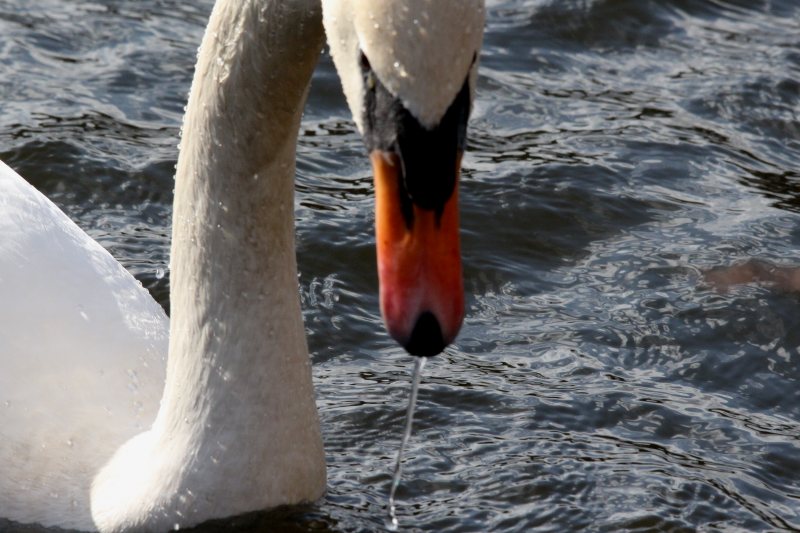
The usual herd of mute swans was dispersed around the lake. Last year's cygnets are now mostly white with rusty patches on their flight feathers, heads and necks and their heads still have that slightly rounded "duckling" shape to them. The grey of their bills has become a salmon pink and it won't be long before their parents make it clear they're no longer welcome.

Mute swan, Chorlton Water Park

It was a bit more sheltered in Barlow Tip, more like Spring, especially in the company of my first singing chiffchaff of the year.

River Mersey, Chorlton

I walked down to Jackson's Boat. The river was high after last night's rain and the wind was strong and blowing in the opposite direction to its flow so any mallards that ventured far from the riverbank soon got fed up of bobbing up and down like a yo-yo and headed straight back. A carrion crow tried to mob a raven over the power station but as the raven was effectively flying backwards and the crow sideways it was a doomed effort.

The grey wagtails were over by Jackson's Boat, their usual haunts on the rocks being underwater. They were joined by the male that's usually on the river near Broad Ees Dole. The parakeets were relatively quiet, chunnering to themselves in the trees by the car park.

Sale Ees

It was still fairly quiet, I'd only had to negotiate half a dozen cyclists on the riverbank, so I thought I'd chance a visit to Sale Water Park. I walked through Sale Ees which was fairly quiet, most of the small bird noises coming from the creaking of willows in the wind. 

Sale Ees

The bird table by the café was busy with great tits and blue tits, a nuthatch and a couple of dunnocks joining in. No joy with willow tits again today: the wind had blown the bird table clean and the willow tits rarely try to use the tube feeders.

Sale Water Park

The lake at Sale Water Park's a bit more exposed than is Chorlton Water Park so all the birds — even the lesser black-backs and cormorants — were hugging the margins. 

Broad Ees Dole

The water was high on Broad Ees Dole with just the trees to show where the island should be. A dozen gadwall fed around the submerged tree roots in the company of a few coots and a Canada goose. Half a dozen dabchicks bobbed around the pool and pairs of teal hugged the margins. There were more Canada geese on the teal pool, together with a pair of rather disconsolate looking herons sheltering in the reedbed.

Stretford Ees

I walked back into Stretford through Stretford Ees, bumping into a great spotted woodpecker in the trees by the electricity pylon. I was approaching Hawthorn Lane when the Heavens opened. I'd been lucky to have avoided rain that long.


Tuesday, 9 March 2021

Mosses

Goosanders, Glaze Brook, Little Woolden Moss

It was business as usual in the garden, the spadgers giving the feeders a bit of hammer all morning. It's interesting watching the male blackbirds having their territorial spats, for such noisy birds they go about it very quietly. The song thrush crept in very quietly and disappeared somewhere in the undergrowth at the blink of an eyelid.

The weather forecast was cloudy but dry so I decided to get a long walk in before the foul weather we're promised for the rest of the week. The schools are staggering their kicking-out times, which is eminently sensible but makes it tricky if you want to avoid bumping into a crowd of kids giddy on escape; I got caught twice yesterday. Getting round any of our local green spaces without coming close to a school is a challenge to say the least so I decided to go a bit further afield. It's much less of a risk to take a ten minute ride on a nearly empty train to Irlam for a long walk away from crowds. In a five and a half mile circuit across the mosses I passed eighteen people (six of them were Lancashire Wildlife Trust volunteers working on Little Woolden Moss) and I missed the crowds at kicking-out time, which is a pretty good bit of social distancing.

Stock doves, Irlam Moss

As I walked down Astley Road onto Irlam Moss the hedgerows were thick with chaffinches and goldfinches (try as I may to turn some of the former into bramblings they were all chaffinches). Pairs of blue tits and great tits fed in the birches and alders and there were plenty of singing robins, dunnocks and wrens. There were a lot of magpies and carrion crows on the fields and just the one cock pheasant. Further on the farmers were already cutting and rolling the turf fields so there weren't many birds out on there. A pair of mallard dabbled in a big puddle next to one of the farm buildings. Strangely there wasn't a sign of any raptors, I could usually rely on a couple of kestrels and at least one buzzard on this stretch.

Yellowhammer, Irlam Moss

I crossed over the motorway and headed towards Four Lanes End. Halfway down a couple of the farmhouses have ponds, one had a couple of moorhens, the other a singing reed bunting. Further along there was a flock of stock doves in one of the fields which seemed to be mixed stubble and grasses. A small flock of yellowhammers fed on the field margins with a few blackbirds and song thrushes.

Little Woolden Moss

Little Woolden Moss was fairly quiet. I could hear oystercatchers but it was a while before I found them, sat on one of the bunds with half a dozen lapwings. A curlew called and was answered by a moorhen. Some LWT volunteers were working over the other side of the reserve, accompanied by a noisy flock of black-headed gulls. A couple of buzzards soared high over the fields onto Chat Moss. 

Oystercatchers and lapwing, Little Woolden Moss

I'm pretty sure this is a foliose lichen but I don't know which one. An example of the the small plants and fungi covering the tree stumps and fallen branches round the moss.

At the far end of the reserve, just before the path turns sharply to the right, a female stonechat hunted in the sedges by the pools. Other than that and a couple of meadow pipits there wasn't anything on at this end. The new path was a delight, last Summer walking along here involved being ankle-deep in peat. A curlew flew low over, wheeled a couple of times and headed North.

Restoring the carbon storage capacity of peatlands

Goosanders, Glaze Brook

I passed Little Woolden Hall and took the path to Holcombe Lane. There was a flock of Canada geese in one of the fields behind the hall, where the cackling goose was in January. A pair of teal whistled from a big puddle in the field with the horses by the hall. A pair of oystercatchers and a mute swan stood on the bank of Glaze Brook North of the bridge. Looking South there was another flock of Canada geese on the bank, two pairs of goosander close to the bridge, and further out there were more teal, a few mallard and a pair of gadwall.

I walked down Holcombe Lane into Glazebrook. Yet again I was surprised by how many collared doves there are down Glazebrook Lane. Thence into Irlam and back home on the train. Five and a half miles and I encountered fewer people than I would have done wandering over Stretford Meadows for an hour, and considerably fewer cyclists. I should have done this before, it's much safer.