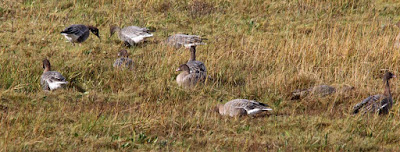
Black-tailed godwits, Leighton Moss

Wednesday, 4 November 2020

A last huzzah

First-Winter drake scaup, Elton Reservoir

I decided to bob over to Elton Reservoir for my last pre-lockdown jaunt. The bar-tailed godwit is still reported to be there but I decided that was the least priority for a walk on a very nice afternoon.

Elton Reservoir looking picturesque

I started along the path on the Northern side of the reservoir, which was very wet underfoot so I only walked as far as the creek then turned back to the car park and walked the Southern margin. If the usually firm bits were that wet I didn't fancy trying my luck in the quagmires. 

Lesser black-back
Possibly a fourth-Winter going by the limited amount of yellow on the bill.

There were a couple of hundred black-headed gulls on the reservoir, accompanied by a dozen lesser black-backs and singles of herring and common gull. One of the lesser black-backs was a puzzler: it was significantly paler on the mantle than usual, almost common gull grey. This, and the limited white on the primaries made me wonder about yellow-legged gull but structurally it wasn't right for one: the wings seemed short even for a lesser black-back and the head and bill were relatively small. The dumpy jizz was all wrong for a Caspian gull and any other options were both extremely unlikely and well beyond my competence to identify so I had to conclude that it was an odd lesser black-back. It was all so much easier back in the days when if it wasn't a lesser black-back or an Iceland gull it could only be a herring gull.

Probably a lesser black-back

Probably a lesser black-back

Another head-scratcher was one of the birds in the raft of tufted ducks at the Western end of the reservoir. In most ways it looked like a tufted duck but the head was more rounded, like a scaup, the black nail at the end of its bill was huge and its eyes were black. I think it was mostly a tufted duck with a pochard somewhere back in the gene pool.

Mostly a tufted duck, I think

There was a definite first-Winter drake scaup at the end of the reservoir closest to Capsticks. A lot of new adult feathers, finely vermiculated grey and white, were showing on its back and wing coverts, giving it a burst mattress look as it bobbed on the surface. I tried to work out what it was eating: at least once it brought up a freshwater mussel.

Diving scaup

I could hear the bar-tailed godwit calling from within the reeds on Capsticks but I was damned if I could see it. Technically it's fourth time lucky but it was very frustrating,

I took the path that goes stratight to Bury Road, for a change and because more buses run that way. I was rewarded with very muddy boots, a couple of goldcrests with a flock of redwings in the hawthorn boundary hedge and all the buses running half an hour late. At least there'll be one thing I won't miss on lockdown!

Tuesday, 3 November 2020

Southport

Bath time for twites, Southport Marine Lake

I decided on a day out to Southport, the train would be quiet off-peak — especially in this weather! — and I'd walk from the station to Marshside. The plan was to see if any twite were around by the marine lake then I'd have a quick nosy round Marshside then back home. The plan was. As it happened I miraculously kept out of the worst of the rain and persuaded myself to walk on down to Crossens.

As I was standing at Humphrey Park Station a couple of skeins of pink-footed geese flew over, a hint of Winter as if the weather wasn't dropping a big enough hint to be getting on with. I wanted to stay in bed. One can only envy them as they move on to the equatorial warmth of Norfolk and the North Sea coast.

There were more Wintery scenes on the rail journey with herds of whooper swans feeding on flooded fields between New Lane and Bescar Lane. So I was already prepared psychologically for arriving in Southport as a strong wind blew in from the sea.

I started off by having a look over the marine lake from the Marine Way Bridge as Silcock's Fun Palace played a selection of Roy Orbison records over the tannoy. A herd of mute swans was the first thing to catch my eye, with a few dozen Canada geese on one of the jetties and a dozen dabchicks peppered around the lake.

I walked down to the Marine Drive just by the pier. It was high tide and the timeline was littered with redshanks and black-headed gulls. A little egret was feeding on the salt marsh, as I watched it I realised there were a couple of dozen pink-footed geese feeding in the long grass. It's a peculiar thing about pink-feet, in dull weather they blend into the dead salt marsh grasses and are tricky to see but as soon as bright sunlight hits them they stand out like new pins. When the sun finally came out it turned out there were hundreds of geese feeding along the salt marsh along Marine Parade.

I crossed back over the road and walked down the little path to the sailing club. There in the club car park, splashing away like a bunch of kids, was a flock of thirty three twites all having a bath in a puddle. I'm fond of twites, they're brown and streaky and quite a lot unspectacular to look at but they're as tough as old boots and have a lot of character about themselves.

Twites, Southport Marine Lake

Twites, Southport Marine Lake

Having added twite to my year list I crossed back over the road and walked down Marine Drive. The sun came out for a while and lit up the geese a treat. It always surprises me how close they feed to the path without making a great fuss when anyone walks or jogs by. The shelduck shuffle away the moment they notice anyone within fifty yards of them, as do the curlews.

Pink-footed goose, Southport

Pink-footed geese, Southport

Shelduck, Southport

First stop on reaching Marshside was Nel's Hide in the rain. As I sat down I noticed a bit of commotion over the far side of the pool as a carrion crow tried to steal a meal away from a great black-back and a jackdaw chased a hare down the bund at the back. The main part of the pool was empty save for a couple of great black-backs drifting around like battle cruisers. There were a lot of ducks in the flooded sedges, mostly pintails and teal with small groups of shoveler and gadwall scattered about. There were plenty of lapwings on the grass over on the far side and further out, towards Marshside Road, there was a huge flock of four or five hundred black-tailed godwits and a few dozen redshanks. A few ruff were flying about but seemed restless.

Pintail, teal and wigeon, Marshside

Adult and third-Winter great black-backs, Marshside

Spindle berries, Nels Hide, Marshside

The spindle bush by Nel's Hide brought a cheerful bit of colour to the day. Walking down the path to the halfway screen I got a much better look at one of the ruffs. The variability of plumage in this species can be baffling: when I first saw the bird I could only see the white face and pinkish-grey line down the side of its neck and I wondered what on earth I was looking at.

Ruff, Marshside

As I came to Marshside Road all the waders and teal over in front of the Sandgrounders Hide were spooked and suddenly rose and wheeled round in the air in a panic. I looked around for the cause, thinking it would be a merlin or possibly a peregrine. It was actually a bloke on a quad bike moving the cattle into the bit of wet pasture nearer the houses.

I had a quick nosy over the salt marsh from the "raptor viewpoint" by the sand works. Lots of mallard, pink-feet and black-headed gulls but no sign of any raptors. The plan was to call it quits at this point but the sun came out again and I thought I shouldn't waste it given we'll be back in lockdown at the end of the week. So I set off for Crossens.

The Southern ends of Crossens Inner and Outer marshes were very quiet. A hundred yards past the boundary fence things picked up on the inner marsh with wigeon, teal and mallard in the ditches and pools and large flocks of lapwings and starlings on the grass. There were a couple of small flocks of golden plover, about forty birds in each. 

Golden plovers, Crossens Inner Marsh

Crossens Outer Marsh was quiet right up to the wildfowlers'pull-in where there was a large flock of lapwings in the flooded grass and a flock of about eighty wigeons sharing a pool with a dozen shelduck. As I was looking at this a few hundred pink-feet came in from over Banks way. Four waves of the birds came over the river and onto the field, half of them going to sleep almost as soon as they landed.

It's a bit boggling checking out all the birds in big flocks like this but it's worth the effort as you've something like a one in three chance of something different joining the flock. I find it easier to spot the odd man out when they're in flight, the differences in structure and aren't confused by birds standing on bumps and hollows on the ground and it's easier to pick out differences in colour. (I'm embarrassed by how often it takes me ages to spot barnacle geese "hiding" in flocks of pink-feet.) Similar with waders, which is how I'd picked up the ruff from Nel's Hide. I'd like to say that patience paid off and I found something unusual today but they were all pink-feet.

On the train home I had my facemask pressed against the window as I stared out into the gloaming in the hopes of seeing an owl or two hunting over the fields of the West Lancashire Plain. There were a lot of cock pheasants but no owls. Consolation came as the train approached the junction at Lostock Station and woke up a buzzard that had been roosting on a fence post by the line.

I'm not sure what I'm doing tomorrow. Part of me wants to have one last hurrah before lockdown but I'll probably just have a walk somewhere within Greater Manchester limits.

Monday, 2 November 2020

Pennington Flash

First-Winter great crested grebe

I had an afternoon wander over to Pennington Flash. In these strange times it's nice to find there are some constants like the kestrel hunting on the field by the RHS Worsley bus stop and the oystercatcher on Pennington Flash car park.

A small mixed tit flock greeted me near the entrance to Pennington Flash, a dozen each of long-tailed tit and blue tit. I got to the bridge over the brook where a couple of dozen mallard were fussing about.

The wind got up as I approached the car park, whipping up fair-sized waves on the flash. Most of the Canada geese were on the car park, clustering round the cars cadging food. There were two hundred or so black-headed gulls, forty of them loafing with the Canada geese, most of the rest of them out on the water on the far side of the flash with thirty-odd lesser black-backs. At first I thought there were no tufted ducks about, they were keeping to the shore near the kiddies' play area. All the great-crested grebes were either on the small pools or congregated in the bight by Ramsdales Hide.

The spit by Horrocks Hide was mostly underwater, there weren't any lapwings about, there were only a few ducks, mostly teal, by the banks and a dozen cormorants loafing on the poles and rafts.

There were a couple more mixed tit flocks about, the one by Ramsdales Hide including a treecreeper. I'd thought I'd heard one earlier but it was hard to be sure amongst the squeaks and creaks of the windblown trees. The water on Ramsdales was so high there was just a pair of shovelers and a dabchick on the pool. The pool by the Tom Edmondson Hide was stiff with coot and gadwall and a couple of herons dozed in the tall grass over to the left.

I wandered down to Pengy's and the Bunting Hide to see if I stood still long enough on the approach paths any small birds might come along (primarily in the hope that one of the willow tits might pass by). As it was the tally was two robins, a blue tit, a blackbird and a squirrel.

I continued down to the Teal Pool which, for once, had a load of teal on it together with a dozen shovelers and a couple of first-Winter goosanders.

Walking back towards the car park a lot of gulls were coming in from over the golf course and joining the roost on the flash. Most were black-headed gulls, coming in in waves of a couple of dozen at a time with a few lesser black-backs in tow, all the latter first-Winter birds. Just as I got to the ice cream van stand (he wasn't on today) a first-Winter Caspian gull flew in, wheeled over the car park for a minute or so then shot over to the full roost like sugar off a shovel, where I lost it in the distant crowd. An interesting bird, I've never knowingly had a worm's eye view of one before. Usually I'm struck by how white the head is, I hadn't appreciated that the white goes from chin to vent. The underwing was surprisingly pale, too; it turns out that's one of the differences between first-Winter Caspian and yellow-legged gulls though I'd imagine the difference in the head and bill shapes would have leapt out at you before you got that far. A first-Winter Caspian gull was reported at the roost most of last week, I'd be surprised if this wasn't the same bird.


The view from Ramsdales Hide


Sunday, 1 November 2020

Home thoughts

Red-throated diver, Dawlish Warren November 2018

Well, we have another lockdown on the near horizon, which comes as no surprise, sadly. I've spent the past few weeks whizzing round trying to fit in as much as I can before the curtain comes back down again while trying to avoid silly risks.

During the first lockdown I became heartily sick of dodging bodies and barbecues along the Mersey Valley. This time it'll be different as people will be still in work or at school (this isn't the place for my views on that). We also know a lot more about the transmission of the virus so I think it should be safe to use the local rail service for the five or ten minute off-peak journey to Flixton or Irlam for an occasional change. So, weather permitting (possibly regardless some days), I should be able to get out for a walk and a bit of birdwatching. Which is good as in the absence of so many other things I've come to depend on it this year as something to hang onto. I'm fortunate that I'm pretty much antisocial so I've not suffered as much as most people this year but it's still been a struggle at times.

So that leaves the next three days. I was thinking about going over to Pennington Flash today but then I started worrying that the Trafford Centre would be heaving with people doing last minute Christmas shopping and I didn't want to get entangled in that en route (a good call: the reports are that it was very busy indeed). In the end I couldn't be bothered going out and tomorrow is another day.

Friday, 30 October 2020

Third time unlucky

Mute swan cygnets and mallard by the Bolton and Bury Canal

I was running an errand that way so I thought I'd bob over to Elton Reservoir to see if the third time would be the charm and I'd get to see the bar-tailed godwit that's been hanging round these past weeks.

Anyway…

I decided to get the Trafford Centre tram home rather than the Altrincham tram. I thought I'd see what there was in the way of gulls and waterfowl on Salford Quays. Roughly a hundred gulls, mostly black-headed with a couple of dozen lesser black-backs and a few herring gulls; ten mute swans and a handful of coots and mallards.

The tram stopped at lights in Trafford Park Village. "There's something odd about that pied wagtail on that roof," I thought to myself. There was nothing odd about it except that it was a female or first Winter black redstart. I've seen reports of them round here over the years but it's the first time I've seen one.

Wednesday, 28 October 2020

Mosses

Kestrel, Hepzibah Farm, Irlam Moss

This being the last day of the week without any rain weather warnings I had a walk over the local mosses, the plan being to walk up from Irlam Station, have a nosy round Little Woolden Moss and walk down for the Urmston train from Glazebrook. The weather forecast was for sun, showers and wind, in the event the showers were short and light and caused no hassle.

Irlam Moss

Walking up Astley Road onto Irlam Moss I was trying to work out who was who in a mixed tit flock in the hedgerow when I accidentally disturbed a female sparrowhawk. She flew off in high dudgeon with half a chaffinch in her claws. Further along a flock of half a dozen fieldfares and a few redwings were finishing off the last of the berries in a couple of hawthorn bushes. 

Fieldfares, Irlam Moss

The fields of mown turf are usually deserts save the usual couple of kestrels. Today was different: one held a flock of seventy-odd pigeons; another had three dozen lapwings, twenty-odd black-headed gulls and a flock of sixty starlings. A stonechat on the fence in one of the paddocks was good to see.

Grey wagtail, Irlam Moss

Pied wagtails had been flitting round between the fields from the first, I was surprised to find a grey wagtail feeding along the path as I approached the motorway bridge. I was impressed by how the colours of a grey wagtail match the wet greys and yellows of leaves on mud.

Kestrel, Irlam Moss

Scanning the field just before Four Lanes End I found a couple of stock doves among the woodpigeons. As I was watching them I noticed a kerfuffle further down on the other side of Twelve Yards Road with woodpigeons, jackdaws and black-headed gulls whirling about in a panic. It took me a while to find the merlin that had put the wind up them as it zoomed off into the distance. I'd expected a peregrine but I wouldn't put it past a merlin to have a go at a larger bird. (Of course, there might have been a peregrine as well but I didn't spot one.)

Little Woolden Moss

Little Woolden Moss was odd. Flocks of fieldfares and starlings flew over, meadow pipits, wood pigeons and carrion crows flew over in ones and twos and a mixed tit flock worked its way along the birches by the path. Halfway down the path a skein of 250+ pink-feet flew overhead, three dozen of them peeling off and flying over towards Glazebury amid much noise, the rest heading off towards Astley. But on the water there was nothing, even on the bunds at the Western end of the reserve. Three ruddy darters hawking round the dead bracken by the path are likely contenders for last dragonflies of the year.

Female stonechat, Little Woolden Moss

First Winter male stonechat, Little Woolden Moss

I'd got to the end of the path and was approaching the nursery beds thinking I'd made a mistake in not turning into Twelve Yards Road and walking down to Barton Moss. Then something orange caught my eye and disappeared just as quickly. This was joined by another something, and another. They moved closer to the path and slowed down a bit, pausing here and there to have a look round before dashing off again, then coming back. A family of stonechats: an adult pair and two first Winters. I watched them awhile as we all moved on, last I saw of them they were making a mockery of the bird scarers on one of the nursery beds.
Stonechats, Little Woolden Moss

Male stonechat, Little Woolden Moss

Five buzzards were feasting on worms on the field opposite Little Woolden Hall while a sixth flew off into the trees. I've never seen that many in one place before. I didn't have to wait long to repeat the experience: as I walked into Glazebury there were another five buzzards sharing a field with a couple of dozen black-headed gulls and rooks.

Little Woolden Moss

I'd missed the train so I walked down into Cadishead to get the bus to Irlam to get the train home from there.

Tuesday, 27 October 2020

Wirral

Snow bunting, Leasowe

All the weather forecasts said wet and windy but not as bad as yesterday so I decided to have a day at the seaside while sensible people stayed at home.

After having a carriage to myself into Liverpool I just missed the West Kirby train at Lime Street Station. The new Merseyrail timetables are running every half hour so I got the next Wirral-bound train, which was the one to New Brighton.

It had been raining all the length of the journey from Manchester, on arrival at New Brighton it was sunny. As it happens, it only lasted half an hour before the wind brought in some filthy weather but the light was brilliant for photography.

Carrion x hooded crow, New Brighton

The tide was in retreat and most of the gulls on the beach were black-headed and lesser black-backs, the herring gulls were loafing by the shoreline. Just singles of great black-back and common gull. As usual there were a few dozen redshanks and just under a hundred oystercatchers. 

One of the crows flying into the beach was interesting. When it landed it looked like it had a scruffily-moulting breast with lots of pale underfeathers showing. When in flight it looked quite different: a grey breast and grey back like a badly defined short tabard. A carrion crow/hooded crow hybrid. I bump into birds like this perhaps once every other Winter.

Redshank, New Brighton

Little egret, New Brighton

I moved on to Leasowe, the idea being to have a nosey round Kerr's Field and Leasowe Lighthouse, have a quick scan of the beach then jack it in before I got too wet.

Walking along the Birkett from Leasowe Station it was certainly wet and windy though the trees provided some cover. (I'm always a bit nervous of willow trees in high winds). No ducks on the river, just a few moorhens, and a juvenile raven high up in one of the willows made it quite clear it didn't like me.

Grey wagtail, Kerr's Field

The weather calmed down a bit as I approached Kerr's Field. A flock of mallards dabbled in the big puddles in one of the horse paddocks. The paddock that's a magnet for yellow wagtails and wheatears in Spring held three lapwings, a small flock of starlings and a dozen pied wagtails. Scanning round the edges of the field I also found a mistlethrush and a nice female grey wagtail.

It had become sunny though the wind was blowing a hooley so I headed straight for the walkway along the sea front to see what was out there. Hundreds of oystercatchers and dozens of redshanks and herring gulls were the most immediately obvious birds. A few minutes' scanning round found a dozen each of little egrets and curlews, a pair of shelduck and half a dozen cormorants far out on the shoreline. I was musing to myself that come the cold weather this would be a good place to find snow buntings when a couple of small birds hopped off the sea defences and onto the path by my feet.

Snow buntings, Leasowe

Snow bunting, Leasowe

Snow bunting, Leasowe

The buntings might have been a pair: one, possibly a male, had a distinctly paler head with a wider white collar. Both were ridiculously tame and accompanied me on my walk for the best part of a mile, only parting company with me just before the groyne. The big problem I had was that they were too close for the autofocus on my camera and my eyesight's none too reliable for focussing manually, still I got some passable photos. The buntings didn't mind people walking past but flitted well out of the reach of any dogs coming along the path. Their alarm call was an odd little trill that reminded me of that of a turnstone though softer and more mellow.

As I approached the groyne there were odd ones and two of knot feeding on the mud and a couple of turnstones feeding on stranded seaweed. It took me an embarrassingly long time to realise the bird fossicking round in a wet hollow was a greenshank, my first for the year. Another surprise was a female goldeneye which suddenly flew up from behind the sea defences.

The other side of the groyne there was less variety but more birds. Between the groyne and the end of Meols Parade there were a couple of hundred knots feeding close by accompanied by a few dozen oystercatchers and redshanks and a couple of little egrets. A small party of dunlin were skittering around the creeks and pools a bit further out and a hundred or so oystercatchers were loafing out in the mid distance. There were a couple of curlews feeding quite close in, with a dozen or so feeding out in the distance.

Knot, Meols

Knot, Meols

Curlews, Meols

Curlews, Meols

Walking along Meols Parade I spotted an oddly dark sandpiper feeding on its own close by the sea wall. As I got closer I realised it was a purple sandpiper. I don't often see them this early and it was nice to see one away from New Brighton for a change. I had the same problem with this bird that I had with the snow buntings; luckily not all of the photographs are out of focus. We kept in pace awhile until it found something particularly interesting in between some rocks and I left it to it.

Purple sandpiper, Meols

Purple sandpiper, Meols

It had turned out to be a very lovely afternoon. I like walking by the sea this time of year: the light's brilliant, the birdwatching's usually good and I don't mind if the wind's fierce so long as it's not raining too hard. As it happens the wind was blowing heavy rain in but always half a mile or so inland of where I was walking.

Shelduck, Meols

I'd only intended walking halfway down the parade then getting the train from Meols Station but I ended up walking on down nearly into Hoylake and got the train from Manor Road. As the sun set slowly in the West and just before I set off for the station I got one last cherry on the cake as a flock of brent geese flew across the horizon towards Hilbre.

A better day's birdwatching that I'd expected. I'd only walked about five miles in total though it felt more as nearly all of it was walking into a strong headwind.

Meols beach