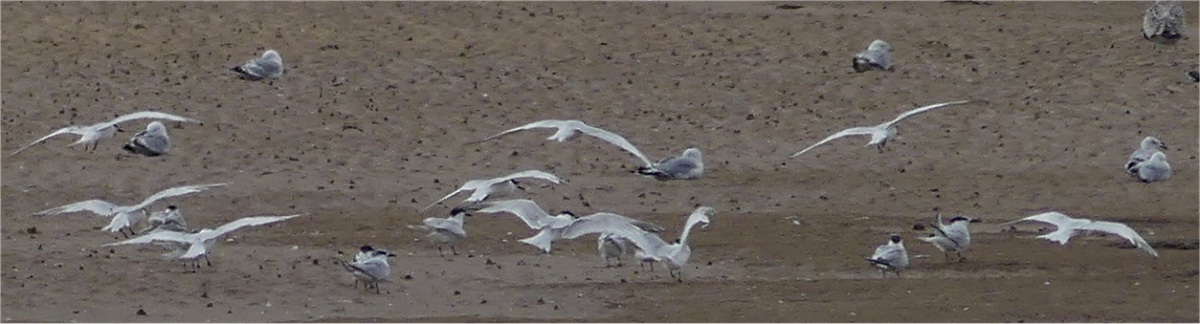
Black-tailed godwits, Leighton Moss

Tuesday, 13 August 2024

Rainy day

Juvenile great tit

I don't know what caused me to glance out of the window but I'm glad I did as the first mixed tit flock of Winter descended on the back garden in silence. I'm not used to large groups of blue tits and great tits keeping schtum, it's quite unnerving. In the end I counted five great tits and seven blue tits together with the four long-tailed tits bouncing about and the coal tit skulking in the ferns. Luckily I'd refilled the feeders over the weekend so they had an incentive to stay, which they did, all day. The eldest of the juvenile robins tagged along, almost indistinguishable from an adult now and surely due to be chased off if its parents are still about.

There was a lot of queueing up for a bath, too. They could have saved themselves the queueing, when the rain came it came down heavy. 

Juvenile blue tit still showing some yellow about the face

Long-tailed tit

The eldest of this year's robins, still with a few juvenile feathers on its wings.

Juvenile long-tailed tit

Long-tailed tit

Juvenile great tit


Monday, 12 August 2024

Seaside Sefton

Common gull, Crosby Beach

The weather forecast bode hot and humid so I headed for the seaside for a walk along the coastal path between Crosby and Hightown.

Joining Crosby Beach at Brighton-le-Sands

It had been a clammy morning when I set out but when I got off the train at Blundellsands and Crosby it was cloudy and cool with a brisk North wind. Good walking weather though I felt slightly underdressed in the wind. 

Common gull, Crosby Beach

Oystercatchers, Crosby Beach

Herring gull, Crosby Beach

The birds on the beach were mostly common gulls and black-headed gulls with a few carrion crows here and there. The herring gulls and lesser black-backs were nearly all passing by. I noticed a couple of curlews with a bar-tailed godwit out on the tideline, I didn't notice the couple of whimbrels until they all took flight, spooked by a passing RNLI jeep. Nearer to hand a few oystercatchers kept an eye on passing dog walkers and family parties of pied wagtails spent more time chasing each other round the seawall than foraging for food.

Crosby Beach
With one of the "Another Place" figures

Starlings, Crosby Beach

I walked up the beach to Burbo Bank where the inevitable gangs of starlings lurked about the parked cars hoping for scraps and I joined the coastal path to Hightown.

By the coastal path 

It was relatively quiet along the path, just a few small flocks of linnets and goldfinches and a family of stonechats. A couple of swifts drifted over from the golf course and every so often a swallow or two would pass by. All the action was on the tideline. It was all very nice to look at and the sun fighting its way through the thinning cloud took the chill off the wind.

Coastal path
With everlasting peas and ragworts 

Ragwort and everlasting pea

Bar-tailed godwits

Bar-tailed godwits

The tide was coming in but wasn't making any sort of rush about it yet, it was a few hours before high tide. The first waders I saw were a handful of bar-tailed godwits. A couple of them looked huge compared to the others and I had to keep looking back at the smaller ones to make sure I wasn't misidentifying greenshanks but no, they were scaled-down barwits. I don't see bar-tailed godwits very often and young juveniles rarely so I'm okay about not feeling confident about them first time.

Burbo Bank wind farm

By the coastal path

Sandwich terns

Oystercatchers, Sandwich terns, black-headed gulls and lesser black-backs

Moving along I noticed the flocks of birds starting to gravitate to the sand banks. Dark lines of oystercatchers and curlews curved around the tops where dozens of herring gulls and lesser black-backs had settled down to loaf while shelducks dabbled by the waterline. As I walked along they were joined by black-headed gulls, cormorants and small but very noisy flocks of Sandwich terns.

By the coastal path looking over towards Formby Point

Nearer to shore little egrets, curlews and redshanks shrimped in the shallows. A handful of turnstones settled down on a pile of rocks on the shore. They were joined by four small ducks. I'm used to sea-going mallards along this stretch of coast but was wrong-footed by these sea-going teal. I guess they must have been on the move and this was as good a place as any to settle down for a rest. They did a good job of disappearing out of sight among the rocks.

Blitz Beach

Redshanks and greenshank (centre left)

Redshanks

Ringed plovers and mallards

A little further on, past Fort Crosby, there were more redshanks on the Blitz Beach. (After the late unpleasantness there was a lot of smashed masonry lying about Merseyside so it was put to use as sea defenses.) A couple of dozen of them flew in to roost on an old jetty and they were joined by dunlins and a greenshank. I'm glad I saw the dunlins fly in because I couldn't see them once they'd landed. The mallards just further along were joined by a dozen or more ringed plovers.

Blitz Beach 

Common blue, Hightown Dunes

As the sun made more of an effort more butterflies started to appear in the grass by the paths. Peacocks and common blues skittered through the grass and wall browns sunned themselves on the dunes. Approaching Hightown the beach became busy with linnets.

Alt Estuary 

Sandwich terns, Alt Estuary

Sandwich terns, Alt Estuary

Sandwich terns, Alt Estuary

I had a sit down by the Alt and scanned the dozens of Sandwich terns lining the sandbanks beyond just in case any had long yellow bills. They didn't but you never know your luck.

Harebells, Hightown Dunes

Sunday, 11 August 2024

Scorchio

The Matto Grosso comes to Stretford

It was a hot day and I didn't feel much like going for a walk in it. Especially as I'd given the back garden a stern looking at yesterday and had concluded that Something Must Be Done before the entire area becomes an impenetrable mass of fruit bushes and rambling rose. I thought I'd have a bash at a start on it today seeing as I wouldn't be feeling guilty about disturbing any birds. The blackbirds come in for the rowan berries first thing then go into hiding, the sparrows are spending the week deep in the brambles on the railway embankment (I know this by occasional chirrups) and I suspect all the other small birds are doing similar. The only birds doing any singing this past week have been the woodpigeons and collared doves. They're not up for a dawn chorus, generally waiting until after they've had their breakfasts. By then the family of carrion crows will have galumphed over the rooftops and chased each other round the field a couple of times.

Although I wasn't disturbing any birds I was encroaching on the territories of the speckled wood butterflies and they tried to chase me off a couple of times. Their problem is that they object to each other even more than they object to me so they lose their advantage in numbers.

Twilight brought a nice surprise in the shape of two pipistrelle bats fluttering about the back garden. No idea if they're common pipistrelles or soprano pipistrelles, both are possibilities round here. Whichever they're nice to see.

Friday, 9 August 2024

Little Woolden Moss

Female ruddy darter

I'd been and gone and got my monthly travel card and seeing as the next train out of Oxford Road was the Liverpool stopping train I got on that and sort of decided on a short walk on the Salford mosses. I wasn't up for a long walk having somehow managed to tweak an Achilles tendon in my sleep the other night so I'm walking at not much more than half speed. I appear to have achieved that combination of old age and male pattern hypochondria that means I can injure myself by looking at an eggcup. Anyway, I wasn't up for a long walk. So I got off at Glazebrook and headed for Little Woolden Moss.

Wood pigeon, Glazebrook 

It was a bright, cloudy afternoon and any threat of getting too warm was negated by a very brisk wind. The birds were quiet, even the collared doves in Glazebrook were being shy. The fields beyond the village were heaving with woodpigeons. Some of the barley had been cut and scores of them rummaged about in the stubble with family parties of crows. A couple of stock doves flew by, there were probably more in the fields.

Glazebrook Lane 

As I passed the junction with Woolden Road a dozen or so house sparrows fussed about in the hedgerow and a few swallows skimmed over the rooftops.

Linnets 

Crossing the motorway I took the path leading over the Glaze and on to Little Woolden Moss. Fifty or more linnets split their time between a field of barley stubble and the telegraph lines stretching over it. I noticed two juveniles still young enough to be being fed by their parents. At one point a couple of corn buntings flew up and perched on the lines, one of them vocally objecting to my dawdling about. Swallows skimmed the fields by Little Woolden Hall and a handful of house martins flew in and joined the ones flying at waist height by the path near the stables. I'd been hearing a buzzard for a while and it finally made an appearance soaring low over the trees of Great Woolden Wood.

River Glaze by Little Woolden Hall 

Another birder drove up. "Very quiet," he said, "But the hobby's about." Not just me finding the mid-July doldrums are a couple of weeks late this year. I walked down to the nature reserve seeing more woodpigeons and swallows and watching the lesser black-backs pass overhead.

Hornet-mimic hoverfly (Volucella zonaria)
One of the very few hoverflies I can identify at all.

The walk by the nature reserve was quiet of birds — for the first five hundred yards if it hadn't been for a chiffchaff squeaking in the trees there would have been nothing — but busy with insects despite the breeze. A few meadow browns flitted about deep in the grass by the path. A rather small "meadow brown" broke cover and fluttered weakly along the path, pausing to hug the ground every so often when the wind got too gusty. It took a while to see enough of it to be able to confirm my suspicions it was a large heath. Good to see the reintroduction scheme's working despite the lousy June weather. Back in the day before it became extinct locally the large heath was known as the Manchester argus.

Little Woolden Moss 

Dragonfly numbers were low at first. I was seeing one or two common darters and my first ruddy darter of the year. As the path got deeper into the shelter of birch scrub there were more darters skittering about in the heather, a couple of Southern hawkers patrolled the birch scrub and a common hawker methodically worked a patch of birch saplings by the path. A male kestrel hovering high up in the air floated down to treetop height before drifting over to the fields.
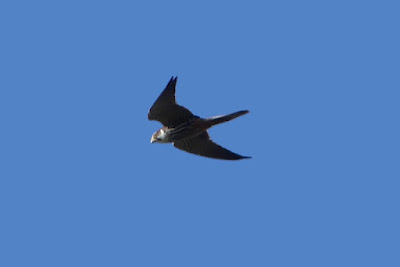
Hobby

I was approaching where the hide used to be when a jay's alarm calls made me look up. A hobby flew in from the fields behind the birches and slowly glided over the reserve with barely a wing beat.

Little Woolden Moss 

The Eastern pools were very quiet, even the usual lapwings and Canada geese were missing. A couple of mallards dabbled, a handful of juvenile pied wagtails mudlarked, a couple of linnets twittered in the cotton grass and a willow warbler deep in some bracken told me to keep moving along. I'd just got to the junction with the path to Astley Road when the usual marsh harrier drifted low over the opposite side of the moss and off towards the river.

Male ruddy dartter

I decided to head into Glazebury for a change, and in the hopes that there might be some yellow wagtails about in the fields. The heather along the path was busy with ruddy darters. As I turned onto the Northern margin of the reserve the path margins the ruddy darters gave way to a profusion of black darters, none of them stopping more than an instant before immediately zipping off again and nearly all of them hugging the tops of the low vegetation. A female kestrel flew in and hovered over this section of the reserve before swooping down and carrying off an unlucky field vole.

Mosslands Farm 

There were plenty of woodpigeons on the barley fields of Mosslands Farm but I couldn't see or hear any larks or wagtails. The field opposite the farmhouse had been recently ploughed and the carrion crows, starlings and pied wagtails rummaging about on there were joined by a couple of woodpigeons and the only lapwing of the day. I couldn't see any yellow wagtails but seeing as I didn't see the hare that got up and lolloped over to the field margins I made myself look three times.

By Moss Road 

The walk down Moss Road to Glazebury was pretty quiet. Small tortoiseshells fluttered by the path margins, blackbirds and collared doves fossicked about on the road, great tits, house sparrows and chaffinches were only contact calls in the trees. The scenery was beautiful. 

By Moss Road 

By Moss Road 

I started to notice that I'd been walking slowly when I started checking the buses. When I decided not to head into Irlam I was forty minutes away from the Warrington bus leaving in forty-three minutes time at Fowley Common Lane and decided to aim for the one due twenty-five minutes later. I got to the bridge over the Glaze just when that was due to depart in five minutes. I'd spent a lot of time looking for birds that weren't there but it was slow progress all the same.

River Glaze

I decided not to rush for it and just miss it and deliberately dawdled round the water treatment works hoping to hear or see more than the great tits and dunnocks in the hedgerows before going to wait ten minutes for the next bus. Being sensible for once as although the tendon was pulling a bit it wasn't hurting and it would be a good idea not to aggravate it. And it worked out in my favour because I got off the bus at Warrington Central and only had to wait twenty minutes for the direct train home. Nice when it works that way.

Wednesday, 7 August 2024

Chat Moss

Pigeons

It was a cool and cloudy sort of day with a brisk wind with a hint of Autumn in it. I'm noticing the countdown to the end of Summer as much by the things I'm not seeing any more as anything else. There are still plenty of young birds about, it's evident that the cold, wet June put back a lot of nesting one way or another. But we seem to have had it with the swifts for one year, and I'm not sure that more have left than had arrived.

Whenever I'm walking up Cutnook Lane into Chat Moss I keep wondering what the walk up Raspberry Lane is like so today I thought I'd try it and see. I wasn't expecting to see much more than a few woodpigeons and carrion crows about anyway in this weather so I wouldn't be losing anything by the diversion.

Walking up Cutnook Lane there were plenty of woodpigeons and magpies about. Family groups of carrion crows with surprisingly young juveniles fussed about in corners of fields. A big flock of pigeons moving as one over a field of turf caused me to look twice at every subsequent passing pair of stock doves that flew by.

Raspberry Lane 

I turned onto Raspberry Lane and headed East with the wind at my back. More woodpigeons, stock doves, carrion crows and magpies and a couple of flocks of about a dozen starlings each. Starlings have been in short supply lately for some reason. Perhaps it's been as bad a year for cranefly larvae as it has been for butterflies. A buzzard made a racket as it flew along Twelve Yards Road and settled into a tree. 

Chat Moss 

Chat Moss — the clouds were quite fun

It was only mid-afternoon but the gloomy weather seemed to be kidding what birds there were into going to roost. Even the usual overhead passage of lesser black-backs was well into swing. The small birds were few and far between: a couple of great tits churring in a hawthorn bush and a wren churring from a field of rough between the lane and the motorway. A couple of swifts flew low overhead just to remind me not to get too cocky about deciding on "last seen" dates. A lone swallow made a fleeting pass over the margins of a field of corn.

Fiddler's Lane 

I carried on to the end of the lane where it meets Fiddler's Lane at the motorway bridge. I weighed up the pros and cons of walking up Fiddler's Lane to Twelve Yards Road and either heading West to Cutnook Lane and beyond or East into Barton Moss. It had been a pretty uninspiring walk as far as the birdwatching was concerned and I wasn't enthused by either option. I decided to walk over the motorway and into Irlam by Fiddler's Lane, just to see what it was like. I don't think I'll bother again, the walks onto the moss via Cutnook Lane and Astley Road are more interesting.

Having said that, there's a lot of scope for using Raspberry Lane as an extension of a walk around Chat Moss so I'm not walking the entire length of Cutnook Lane on both legs of the journey. The fields are farmed differently to those on the other side of the moss so there's scope for this stretch adding a bit more diversity in the birds and butterflies on a sunny day walk.