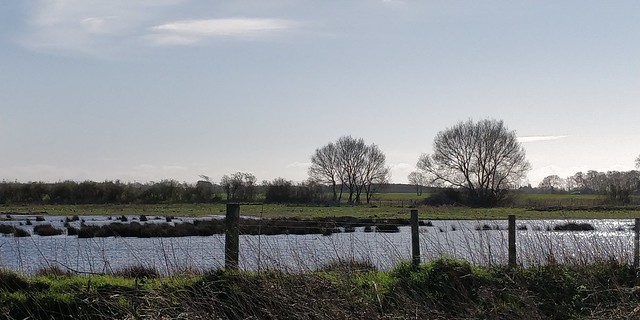
Black-tailed godwits, Leighton Moss

Monday, 16 September 2019

Etherow CP and Keg Woods

Etherow Country Park
The original plan for the day was to bob over to Lunt Meadows to see if the weekend's American golden plover was still about but lousy train services put the block on that so I decided to put my trust in buses and went over to Etherow Country Park and have a wander round Keg Wood.

Probably just as well I did: I hadn't checked my camera battery before I came out and it turned out to be flat. Bad enough missing nice shots of species you see regularly, missing out on something unusual that way would have been heart-breaking. Instead, I can bore people about the lovely photos of mandarin ducks, great spotted woodpeckers, coal tits and nuthatches that got away.

Keg Wood
Walking through the car park I had a surprise when a snipe flew in, tried to find somewhere to land, discovered that the car park was full of pensioners intent on having a nice cup of tea in the café, and flew off again. As always, the mandarin ducks on the little canal were being ridiculously photogenic, especially the juvenile male picking blackberries from a dangling bramble. A sparrowhawk and a buzzard soared high overhead. Walking down to where the river goes over the weir I was hoping there might be a dipper around; no joy but a family of grey wagtails were a good consolation prize.

Keg Wood
Keg Wood was busy with roving mixed flocks of small birds. Nuthatches seem to have had a good year, I counted a dozen all told. A couple of flocks of tits each included over half a dozen coal tits and the flock that came to have a look at me as I sat in one of the bus shelter affairs included a goldcrest, a chiffchaff and a couple of treecreepers. I bumped into three great spotted woodpeckers in different parts of the wood, a male and two females. Jays were very much in evidence, bouncing round the oak trees collecting acorns. 

Despite all the signs of Autumn there were still some signs of lingering Summer, especially a common darter dragonfly quartering the garden of the house in the middle of the wood. 

Sunday, 15 September 2019

Hope Carr

Sketch map: Hope Carr
Hope Carr local nature reserve in Leigh is the remnants of the settling beds used by the local water treatment works. On the South and West it's bound by Pennington Brook, there's an industrial estate to the East and the water treatment works form the Northern boundary. It's largely overgrown these days so it's hard to see the original checker board pattern of the beds.

Hope Carr
The main entrance to the reserve is at the end of Hope Carr Lane, off Warrington Road. The 19 and 28 buses between Leigh and Warrington are roughly every half hour, the bus stops on either side are just to the north of the junction with Hope Carr Lane. Coming up from Warrington, the bus stop is the second after the big roundabout for the East Lancs Road; you know you're coming to this stop when you cross Pennington Brook. Coming down from Leigh the bus stop is the second after you turn into Warrington Road. Once you get to the end of Hope Carr Lane there's a sharp right turn and a rough car park dead ahead. The paths leading from this take you round the reserve.

Hope Carr
The path going to the left passes by a fairly big pool that's largely hidden by a bank and large trees. There's a very rough path that gets you to the water's edge. The other pools in the reserve are much smaller and either very overgrown or well behind fencing. Ducks on the pools include shovelers. gadwall and teal, and green sandpipers are fairly regular passage visitors. The scrub covering most of the reserve attract good numbers of warblers, including Cetti's.

Hope Carr
The path going to the right takes you to the edge of the water treatment works. Keep an eye out for sparrowhawks, kestrels or one of the peregrines that nest in Leigh town centre. The big bramble patch along here hosted a Blyth's reed warbler last Winter.

Blyth's reed warbler

Alternatively, you can come into the reserve from the west, either walking in from Warrington Road (the 10 and 34 are very regular, you want the Mill Bridge stop then walk down Chestnut Avenue) or get the hourly 596 bus from Leigh Bus Station that goes round the houses then goes down Chestnut Avenue, the Wigshaw Close stop is the third one down the road. Just before this bus stop there's a little cut between the houses that leads to a bridge over Pennnington Brook and into the reserve.

High Rid Reservoir

Sketch map: High Rid Reservoir
High Rid Reservoir
High Rid Reservoir is a pocket handkerchief of a Pennine reservoir on the outskirts of Horwich. It's a place I've only recently started exploring.

There are plenty of buses along Chorley New Road, the 575 between Bolton Bus Station to Wigan Bus Station are roughly every ten minutes. The bus from Bolton stops at the Ox Hey Lane stop, the bus from Wigan at the Cambridge Road stop. There's a car wash at the corner of Fall Birch Road which is a short walk up to the reservoir. The trees lining the right-hand side of the round to hide the golf course get progressively thicker as you walk up the road.

Fall Birch Road becomes High Rid Lane at the sign saying the road's unsuitable for vehicles (though I reckon the lads from "Top Gear" could take it at eighty in a Lamborghini). Once past High Rid Farm you get nice views of the fields rising up towards Winter Hill.

The entrance to the reservoir is a little wooden gate at the corner. Once you step down and through the path around the reservoir is pretty good though it gets a bit muddy in wet weather.

Little gull and black-headed gull
Canada geese, mallards, tufted ducks, dabchicks and black-headed gulls are the regulars. Goosander, scaup, common scoters, goldeneyes and black-necked grebes sometimes drop in for a few days. In the Summer large flocks of swifts and hirundines hawk over the water.

Tufted ducks
Common, Arctic and black terns visit on passage. Every so often something different turns up.

Little gull
Don't forget to have a look to see what's going on in the fields around the reservoir. There's the usual compliment of wood pigeons, jackdaws and rooks and plenty of meadow pipits. Where there's Pennine pipits there's always the possibility of a merlin. The trees and bushes by the reservoir attract warblers in the Summer. There's also a small pond in the field near the gate that's worth checking for dragonflies.

Fields north of High Rid Reservoir
Grey and pied wagtails are regulars, you might find yellow or white wagtails on passage.

Grey wagtail

Pied wagtails

High Rid Lane, walking back to the main road
All in all a nice hour-and-a-bit's slow walk round.

Saturday, 14 September 2019

Lunt Meadows

Sketch map: Lunt Meadows and Roundley's Wood
Lunt Meadows is a Lancashire Wildlife Trust site roughly halfway between Maghull and Crosby in Merseyside. It's a stretch of flood meadow next to the River Alt and is particularly noted for its waders, waterfowl and owls. This is another of those places that look like a beggar to get to by public transport but turn out to be straightforward once you know how.

Lunt Meadows
The 133 bus runs between Kirkby Station and the bus stop across the road from Waterloo Station once an hour Mondays to Saturdays. It goes round the houses a bit and takes about forty minutes from Kirkby and twenty-five minutes from Waterloo. The bus stops at Lunt Village are across the road from each other. From Waterloo the bus eventually turns onto the A565 for a short stretch then goes down a long straight road (Long Lane) before taking a right turn onto Lunt Road and past the sign for the car park then into Lunt Village (which is tiny). From Kirkby the bus eventually goes through Sefton Village, then along a long straight road then takes a sharp right then a sharp left into Lunt.

Lunt Meadows, Roughley's Wood to the right
Don't walk down to the car park entrance. Take the little lane on the North side of the road. This takes you past Roughley's Wood (a small Forestry Commission woodland and worth a look round) and then onto Lunt Meadows.

Greylag goose
The paths around the reserve are pretty good. There are a few screen hides with seats dotted about and enough cover to let you see what's on the pools and in the reedbeds without spooking all the birds.

Wren
In Summer black-headed gulls and avocets breed, though large gulls tend to take most of the young avocets. The reedbeds, scrub and woodland attract a good variety of warblers, including Cetti's warblers in the brambles by the reeds. Buzzards, sparrowhawks and kestrels can be seen and marsh harriers seem to be fairly regular visitors. The large numbers of dragonflies and damselflies around the pools give you a chance of striking lucky with a hobby. Ducks include shovelers, gadwall and teal.

Outside the breeding season there are nearly always a few black-tailed godwits, ruff and snipe. Passage migrants include garganeys and wood sandpipers and sometimes something special may turn up.
Fairly poor, heavily-cropped record shot of the stilt sandpiper that visited in July 2019

Garganey
 In Winter Lunt Meadows is famous for the short-eared owls that hunt over the area in daylight.

Lunt Meadows

Friday, 13 September 2019

High Rid Reservoir

High Rid Reservoir
A nice wander round High Rid Reservoir over in Horwich. For an unwooded, rectangular pool of water there was a lot on. Flocks of swallows, house martins and sand martins took their turns hawking for insects over the water. A mixed flock of over forty meadow pipits, thirty-odd pied wagtails (plus one nice female white wagtail) and a dozen grey wagtails chased each other round the edges of the reservoir and there was a flock of nine dabchicks out in the water.

Grey wagtail
Pied wagtail
Pied wagtail, the same bird as above but slightly different light
Pied wagtails
I'd gone in the hope of bumping into the little gull that's been hanging round for the past few days. As I arrived a pair of buzzards flying overhead put the scare into the gulls on the water and my heart sank as they all took off. Then I cheered up as they settled back down and a tiny white figure became obvious: a first-Summer little gull. A lovely bird.

Little gull
Little gull
Little gull
Little gull
Little gull
There was a commotion over in one of the fields by the reservoir. A merlin was desperately trying to concentrate on the business of catching a meadow pipit while being mobbed by a gang of angry jackdaws.
Meadow pipit

High Rid Reservoir


Monday, 9 September 2019

Crossens and Marshside

A visit to Crossens and Marshside in the pouring rain. It seemed to have eased when I arrived at Southport but once I got off the bus at Crossens roundabout the Heavens opened.

Crossens Inner Marsh in the rain
Mostly Canada geese with a few greylags and a domestic white goose
Definitely Autumn, and not just the weather. Crossens Inner Marsh was covered in Canada geese and greylags and the first few golden plovers were included in the flock of black-tailed godwits, starlings and lapwings put up by a kestrel. There were a few dozen pink-footed geese in Crossens Outer Marsh and a few hundred more in Suttons Marsh in Marshside. No sign of the red-breasted goose reported yesterday; I hadn't held out much hope for it, at this time of year the pink-footed geese see the Ribble Estuary as a transport café rather than a destination. Still, you live in hope.

Pink-footed geese, Marshside
At least two ruddy shelducks were still on at Marshside and there were five cattle egrets over at Nels Hide. Two of the egrets were juveniles, they must be breeding somewhere local, surely?

Ruddy shelduck, Marshside
Cattle egrets, Marshside
Cattle egret doing like it says on the tin, Marshside
Huge numbers of swallows passed through and there was a nice male wheatear at the Sandgrounders Hide.

Wheatear, Marshside
Teal and a shoveler, Marshside


Friday, 6 September 2019

New Brighton

New Brighton beach
Four hours' seawatching at New Brighton in a frisky wind in Autumn. I should know better at my age and I loved every minute. The hope was to see some Leach's petrels, which are a local speciality in September.

In the event it was a quiet afternoon and most of the seabirds were cormorants and lesser black-backed gulls. I managed to see one Leach's petrel about two hundred yards out but none in the mouth of the Mersey. A few gannets were caught by a shaft of sunlight about a mile out. About half an hour later a dark Arctic skua passed by about halfway out, flying out towards the Crosby shore.

There were, inevitably, a lot of "I wonder what that was" birds out there. One of them was quite striking but baffling and stuck around long enough for me to take some notes.
? distant, low. smaller than lesser black-back, perhaps common gull length but more stretched out. dark but not uniform. cold and scaly like lesser black-back, no white patches or bands, dark trailing edge to wings. paler (not white) underside and underwings. sharp, long wings. back end not gull-like, more like collared dove shape, lot of tail but blunt.
Having checked my reference books I think this is an immature long-tailed skua.

A handful of sandwich terns came in and dived for fish in the surf.

Sandwich tern, New Brighton
I spent quarter of an hour trying to identify a dark blob bobbing like a cork in the surf. I was sure it was an auk of some type but it was an unidentifiable rear end until it finally came level with me. It was a guillemot having a bit of trouble battling with the tide. Eventually it took a breather on the beach then had another go at it and struck lucky with a back surge and got back out to the sea.

Guillemot, New Brighton

Guillemot, New Brighton

Guillemot, New Brighton
Stopping off for a pizza on the way back to the station I checked out the waders on the deck in the marine lake. Plenty of turnstones and a few redshanks. It's a lot early yet to be expecting any purple sandpipers.

Turnstones, New Brighton