Black-tailed godwits, Leighton Moss

Tuesday, 3 March 2020

Atherton

Just off Miller's Lane
There are times when I wonder why I wash my feet and then go out for a muddy walk.
I thought I should get Iceland gull onto the year list so I went over to Atherton to see if I could have any luck with the individual that's been reported a few times on the flooded fields just South of the town centre over the past week.

It took me a few goes to find out how to get near to the fields in question. In the end I went down Miller's Lane and took the footpath to Howe Bridge and this got me quite close to where the gulls were loafing. I could see the Iceland gull — an adult bird — from a distance but as the path took me closer to the birds it was hidden by a rise in the field. I contemplated leaving the path and walking up the field to try and see over the rise so I could try and get a photo but the state of the field beyond the path was even worse than the muddy mess I was standing in so I decided not to disturb the birds any.

Gulls: mostly black-headed and lesser black-backs with a few herring gulls and a great black-back
The path got less muddy but more wet, in some parts being a fast-flowing stream. I should have taken the hint when I noticed a heron's footprints in the mud earlier on. Once we reached the junction with the path between Leigh and Atherton, which at least was solid underfoot, I abandoned the original plan and cut through the housing estate to get to the bus stop for Leigh. I did contemplate moving on to Pennington Flash for a late afternoon's wander but decided it might be wiser to get the buses home in the hope my feet might dry out a bit en route. (They did but the cat ran away from my socks when I got in.)

Monday, 2 March 2020

Mosses

Moss Lane
Today's plan was to take advantage of the rather better weather than last week to get a bit of walking done across Chat Moss. I thought I'd start from Glazebury for a change, which turned out to be a good move as I had a keen wind behind me.

First stop was the trees by the water treatment works at the end of Hey Shoot Lane. I thought I'd heard a Siberian chiffchaff last time I visited and there had been fairly regular reports of one or even two over the past few weeks so I decided I should have a good look round. Eventually I heard the call a couple of times: a sad bullfinchy sort of tweet with a descending note, soft and easily drowned out by the creaking of the trees in the wind. The second time of hearing I managed to see the bird itself very briefly, a dull brown warbler disappearing into the undergrowth. A third, final call was all I got for the rest of my visit.

The water treatment works had a small flock of pied wagtails flitting about accompanied by a couple of grey wagtails.

The walk down Moss Lane was pleasant but not spectacular for birdwatching. There were plenty of blue tits, house sparrows and chaffinches in the hedgerows and a couple of dozen fieldfares in one of the fields. A curlew was calling from the field nearest the railway line. The first skylarks of the day were singing in the field just before Little Woolden Moss.

Little Woolden Moss
Little Woolden Moss was mostly quiet again. A brown hare shot off into the distance as I went through the gate. Other than that there were just a few meadow pipits and wrens on the moss proper and small numbers of goldfinches and chaffinches in the trees. A buzzard soared overhead towards Astley. It was midday so it wasn't surprising not to see one of the short-eared owls that have been reported here recently.

The fields opposite Four Lanes End were full of fieldfares, stock doves and jackdaws. Walking down Twelve Yards Road there were good numbers of skylarks singing and lapwings display flying in the fields. Although there were plenty of chaffinches and linnets kicking about I drew another blank as far as yellowhammers are concerned. About halfway along to Cutnook Lane pair of grey partridges shot up from the roadside and disappeared into the ploughed furrows of the field further along. Raptors included a couple of kestrels and another buzzard. As I turned into Cutnook Lane a bird rose up slowly from behind the trees then flew off towards Barton Moss, disappearing behind the trees lining that stretch of Twelve Yards Road. Obviously bigger than a kestrel or sparrowhawk, not as chunky as a buzzard and with a long, barred tail — my first Greater Manchester hen harrier!

Cutnook Lane
Down Cutnook Lane and over the motorway bridge for my first singing chiffchaff of the year and the bus back to the Trafford Centre.

Saturday, 29 February 2020

Etherow Country Park

Drake mandarin
I took advantage of the decent weather (once the morning's downpour stopped) for a quick hour's wander round Etherow Country Park to enjoy the mandarin ducks and to see if there were any dippers about. Family commitments meant I had one eye on the clock so I didn't have a wander round Keg Wood.

Mandarin duck
Drake mandarin
Mandarin duck
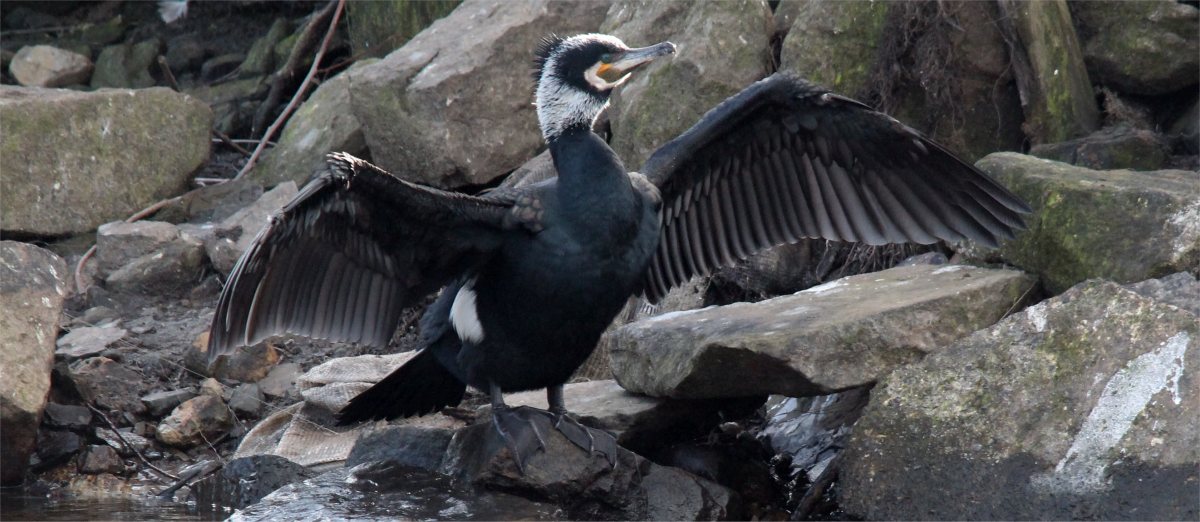
The river was very high after the past few day's rain so not only weren't there any dippers about there wasn't anything at all on the water. Luckily the ponds were teeming with birds. The cormorants loafing on the islands on the big pond included four sinensis.

Sinensis-type cormorant

Wednesday, 26 February 2020

Third time lucky.

Third visit to Ashton's Flash and the first bird I see when I reach the fence on the bund is the Siberian stonechat. A bonny little bird showing its unstreaked apricot-orange rump exceptionally well.


Tuesday, 25 February 2020

Martin Mere

The strong winds brought some funny weather today: it started off sunny with occasional bursts of rain or hail then over lunchtime it turned filthy with occasional bursts of sunshine. I decided to take my chances and go out to Martin Mere for the day.

Along Marsh Moss Lane, just before it started hailing
Walking down from New Lane Station the fields and trees were chock full of fieldfares and woodpigeons. The lack of swans or geese on the fields was made up by the number of little egrets and shelduck on the field between Martin Mere and Marsh Moss Lane.

Whooper swan
The water on the mere was very high. Although there were plenty of whoopers, pintails and wigeon about the most numerous wildfowl by a long chalk were shelduck. On the far side of the mere cormorants, greylags and lapwings loafed at the water's edge. The lapwings were spooked by a flock of lapwings that in turn had been spooked by something in the field beyond, which brought along with them half a dozen black-tailed godwits, a handful of ruff and a single green snadpiper. A flock of twenty-odd avocets flew in but didn't settle.

There weren't many tree sparrows along the path to the Kingfisher Hide, it turned out they were all in the brambles there waiting their turns on the feeders. A buzzard floated in low and looked like it might settle, which upset the woodpigeons that were monopolising the feeders and gave the sparrows the chance to get in there.

Tree sparrows
Shovelers were the most numerous ducks at the Ron Barker Hide. As the weather closed in it became easier to pick out the five avocets feeding far out on the water. It's surprising how easily avocets disappear into choppy water in high contrast light. The wigeon, teal and gadwall were keeping to the water's edges and the ditches. There was a brief flash of pale grey wing with a black panel — a male hen harrier! I've only ever seen ringtails at Martin Mere. That's as much as I saw of it: the sky went black and a torrential hailstorm put paid for any hopes of seeing any raptors flying about.

After a cup of tea I wandered over to the Janet Kear Hide. It was nice to see the willow tit's still there.

Monday, 24 February 2020

Pennington Flash

A bracing couple of hours' stroll about Pennington Flash where both wind and water were very high and the overall impression was that the tide was coming in. The Flash itself was so rough most of the swans and geese were sat in the car park and even the goldeneyes had been driven close to shore.

Male goldeneye
The spit outside the Horrocks Hide was almost completely underwater, with a bunch of mallards and oystercatchers huddled on a tiny island. Further out (and difficult to photograph in the windy conditions) a striking sinensis cormorant stuck out amongst the others with its almost completely white head.

Cormorants
Phalacrocorx carbo carbo on the left, P.c.sinesnsis on the right.
The reeds and  islands in front of the Tom Edmondson Hide were entirely submerged. A small raft of tufted ducks on the water were torn between courtship display and having a nap. Most of the activity here was in the brambles where a large mixed tit flock, including a dozen long-tailed tits and a couple of willow tits, were bouncing round.

Tufted ducks
The ground in front of the Bunting Hide was entirely submerged, which didn't stop the reed buntings and blue tits having a go at the feeders.

Reed bunting

Friday, 21 February 2020

Merseyside

I don't know why I bother planning days out based on the weather forecast according to the Met Office app. When I set off the Merseyside coast was scheduled to be grey, dull and windy, which was better than the pouring rain forecast for Greater Manchester. It was so wet and windy at Crosby Marina that the skylarks were staying firmly on the deck for their singing.

Skylark, Crosby Marine Lake
The wild and woolly weather put everything off the marine lake and even on the boating pond the ducks were generally hugging the sides. Most of the mute swans and all the Canada geese were feeding on the grass accompanied by oystercatchers and a dozen black-tailed godwit. Nice to see three goldeneye — a drake and two ducks — amongst the tufties. A few redshank and a single turnstone flitted also round the pond.

The gulls' favourite loafing pontoon was underwater so they had to make do with lounging round on the grass and keeping an eye out for passing dogs. Mostly black-headed gulls, with a few herring and common gulls, joined by meadow pipits, pied wagtails and eighty-odd starlings.

I used the sand dunes as a wind break for ten minutes' seawatching. A lot of herring and black-headed gulls with a few great black-backs but strangely no cormorants. Dunlin and sanderlings fed along the tideline while a few dozen redshanks were peppered across the beach with a couple of curlews.

After ten minutes I called barleys and sloped off for the train. I decided to have a look see if the purple sandpipers were still at New Brighton. Sadly, no joy there and the only waders on the pontoon on the marine lake were about fifty redshanks and a turnstone.

Redshanks, New Brighton Marine Lake
Lots of black-headed, common and herring gulls about and a first-Winter lesser black-back flew along the beach. A couple of great black-backs were on the lighthouse but strangely there were no cormorants here either. There had been reports of little gulls earlier in the week so I worked my way through all the gulls being blown about in the wind. No little gulls but a kittiwake passing by a hundred yards out was a nice surprise.

Home time and the sad discovery that Northern's new trains are no more reliable than the old Pacers.