Black-tailed godwits, Leighton Moss

Tuesday, 22 November 2022

Banks

Meadow pipit having a bath

The weather bode well but I didn't much want to let Northern have any of my money so I bobbed up to Bolton, got a Stagecoach Lancashire day ranger and headed for Banks Marsh via Preston. I thought I was cutting it fine for catching the 125 to Preston, I needn't have worried: it was twenty minutes late. That meant I missed the number 2 bus at Preston and had to catch the X2 so instead of getting off at the stop on the corner where Marsh Road splits and becomes a rough road up to the marsh I had to get off in the centre of Banks and walk through. It added twenty minutes to the walk but was better than waiting fifty for the next bus.

Whooper swans

It was a lovely day for a walk, I felt a bit over dressed but every so often a cloud would roll over to remind me it was November. The light was astonishing at times, a high contrast modelling light coming from low over my left shoulder. A flock of whooper swans was feeding a couple of fields away. It included a few dusty grey youngsters and a couple of near-adults that were properly white but hadn't yet got yellow on their beaks. I got a bit giddy noticing a difference in heights until I realised how deep some of the ruts were. 

Meadow pipit

Juvenile pied wagtail

It was difficult to pick out any bird noises in the fields as a team of pickers were harvesting cabbages to music. The birds didn't mind the music at all, a mixed dozen of goldfinches and meadow pipits bathed in a puddle in the yard by the field and pied wagtails and grey wagtails foraged in the muddy grass. The stubble fields further along were heaving with skylarks and meadow pipits.

Banks Marsh 

I climbed the muddy bank onto the bund overlooking Banks Marsh and let on to the chap already on there with his telescope. We both marvelled at how mild the weather's been and what means in terms of late arrivals of Winter visitors. There were more than a thousand wigeon out on the marsh, mostly in small groups of a dozen or so. There were plenty of shelducks about, dabbling their ways around groups of wigeon. The mallards were harder to find — they were in the deep drains close to the bund and largely hidden from view until I got alongside them. I almost gave up on teal until I found half a dozen of them snoozing amongst a puddle full of wigeon. I kept getting distracted by the goldfinches and pied wagtails flitting about the bank of the bund.

Wigeon

Thousands of geese were further out on the marsh and nearly all of the small proportion that I could positively identify were pink-feet. There was one group of a couple of dozen Canada geese feeding on grazed grass with some mute swans. I'd seen lapwings billowing about on my approach to the marsh but I really struggled to find them on the ground. It was only when a few of them got skittish that I could pick them out amongst the pink-feet. I could hear but not see curlews and redshanks out there.

Pink-footed geese

I walked down the bund towards Hundred End. A couple of dozen pink-feet fed in the long grass just over the drain separating the marsh from the bund. They grunted their disapproval as I walked past. A few minutes later they were spooked by a low-flying plane pulling a banner. Little egrets fed in the gulleys and drains while a heron loafed by the pool a hundred yards out. (There'd been a lot of herons, a great white egret and a spoonbill here last time I came, today I had to make do with the one heron.) There was a profusion of skylarks, usually calling invisibly from the long grass of the marsh or the stubble in the fields, every so often a few of them would take flight and give me the chance to make sure I got the ID right. No such luck with the snipe calling from the base of the fence. Linnets were thin on the ground today for some reason. Wrens skittered about along the bund and there were a couple of pairs of stonechats chakking at me from vantage points in the dead thistles and nettles. A merlin shot by and headed out into the marsh.

Wren

Stonechat

The clouds rolled in and a chill took the air. The plan had been to walk down towards Hundred End and then, if I was feeling energetic, carry on down to Hesketh Outer Marsh. As I approached the drop down to the path to Hundred End a couple of wildfowlers and their dog were walking out into the marsh. I didn't think I'd be seeing very much with them about so I headed for Hundred End for the bus. Watching the cloud of geese rise up and fly over the river to Warton Bank it looked like a good call.

Starlings, Hundred End

I was nearly at Marsh Road when I realised that the big flock of starlings that came in to roost in the trees along the path included a few dozen fieldfares. They chunnered at me as I walked by and I only had five minutes to wait for the bus back to Preston.

Walking down to Hundred End 


Monday, 21 November 2022

Marple

Brabyns Park 

I like to imagine I'm not a fair-weather birdwatcher but after plans A to E were shot out of the water by cancelled trains I wondered if I shouldn't be staying home in the warm and dry and drinking too much tea. There's a strike day this coming Friday, I wonder if we'll notice any diminution of service.

A refill of the feeders in the back garden was quickly demolished by the attentions of a couple of dozen spadgers, a couple of magpies and a mixed tit flock. The poor squirrels couldn't get a look in. It was nice to see a goldcrest in the rowan tree with the flock of long-tailed tits.

Out on the school playing field the herring gulls have been outnumbering the lesser black-backs 3:1 lately and today was no exception. Just a couple of dozen black-headed gulls on this lunchtime, it was nudging forty yesterday. And still no woodpigeons about.

In the end I beetled over to Marple, thinking I could have a couple of hours toddling round Brabyns Park and Etherow Country Park. I didn't bother taking my big camera lens, the light was so bad I'd just be getting a lot of camera shake with long exposures.

Brabyns Park 

I left Marple Station and walked round the corner to the park entrance on Brabyns Brow. It was raining pretty heavily and promising to rain a lot more. Half a dozen mallards and a moorhen skulked on the water lily pond, glowering at passersby and daring them to make any "nice weather for ducks" quips. Carrion crows and woodpigeons clattered around the treetops and pairs of jackdaws made crowd scene noises as they passed overhead. 

I walked past the car park into the trees, great tits and dunnocks making noises in the undergrowth while a robin and a song thrush tried to outsing each other in an Irish yew. More woodpigeons and crows clattered about and a couple of wrens pottered about by the paths.

River Goyt, Brabyns Park 

The plan had been to cross the iron bridge over the River Goyt and join Compstall Road just below Etherow Country Park but the bridge was fenced off. I walked down the river back to Marple Bridge. The river was in full spate so any hopes of dippers or wagtails were dashed, even the ducks were keeping off it. The weather closed in, it was a good half an hour before sunset but it already lit for twilight.

River Goyt, Brabyns Park 

By the time I got to Marple Bridge I was very wet, didn't fancy the walk up to Etherow Country Park in the encroaching gloom and couldn't justify getting a bus for two stops. So I called it quits. There are times when I am a fair-weather birdwatcher.


Saturday, 19 November 2022

Chat Moss

Chat Moss 

After two very damp days without enough exercise my joints were begging for a walk. It had been a busy Friday and a busier Saturday morning and I really just wanted to go to sleep but I didn't want to waste a splendid Autumn day so I dragged myself out for a walk around Chat Moss. We had a rash of cancelled trains so I had to go over to the Trafford Centre to get the 100 into Irlam and it was gone two o'clock when I set off up Cutnook Lane. I was glad of the walk afterwards, despite my old man's aches and pains.

Cutnook Lane 

It was one of those Autumn afternoons when the scenery comes straight out of a Ladybird picture book. A loosely-knit mixed tit flock made its way along the trees either side of the lane. I noticed the long-tailed tits first, then a couple of goldcrests. The great tits and blue tits were further along and surprisingly hard to see against brightly golden beech leaves. They were joined by a small flock of chaffinches that made sorties onto the roadside looking for beech mast. There were a few stock doves amongst the small flock of woodpigeons and collared doves scattered by a car going down one of the farm drives.

Cutnook Lane 

Chat Moss 

At the crossroads with Twelve Yards Road I decided to carry on North along the rough path beside the pools. Now the birches had shed their leaves I could see how close the pools really are — there's about twelve feet between the path and the bank most of the way along — and how thick the vegetation, with birch saplings just a foot or two apart. Needless to say, now there was a clear view there was nothing on the pools.

Chat Moss looking North to Winter Hill
The line of trees runs parallel to the railway line between Patricroft and Newton-le-Willows

After a chat with a chap walking his dogs and a mad encounter with a giddy whippet pup that had slipped its leash and was giving its owner a run around the moss I turned onto the path running parallel with Twelve Yards Road. Out on the open peat the only birds about were magpies and carrion crows. Goldfinches, chaffinches and great tits fed in the saplings by the path and linnets twittered by between fields. I had a small sense of elation when I found a pair of mallards on one of the small pools. The sun slipped below the low clouds near the horizon and I could see my breath in the air. Squadrons of lesser black-backs passed silently overhead to roost while black-headed gulls squawked and cawed as they skittered by in twos and threes. I don't think black-headed gulls are capable of flying in a straight line.

A whiff of honesty in difficult times 

I reached the end of the path and headed down to Twelve Yards Road. A — literally — steaming mound of political promises provided warmth and a hunting ground for a pied wagtail and a wren. Dunnocks, great tits and blackbirds worked the hawthorns and a buzzard called incessantly from distant trees.

Great black-backs

The sun set as I got to Twelve Yards Road and headed back for Cutnook Lane. I'd missed the finches and buntings going to roost though the occasional movements in the long grass and sedges across the fields suggested where they might be. A couple of pheasants made a closing time racket while a rather vocal kestrel had one last hunting foray before retiring to roost in the poplars a couple of fields away. Three great black-backs steamed past low overhead in the same direction as the lesser black-backs. I was rather hoping to see an owl, barn owls breed here and short-eared owls are occasional Winter visitors. No joy again this time. (Ironically, a short-eared owl was reported over on the other side of Little Woolden Moss about then.) I did get to see a small flock of fieldfares fly off to roost, which was some consolation as it's been a quiet year for them.

Twelve Yards Road 

I headed back down Cutnook Lane, stopping every so often to puzzle over tiny silhouettes going to roost in the rhododendrons. The robins sang their twilight songs and I headed for the motorway bridge and the bus home.

Bracken


Wednesday, 16 November 2022

Southport (with surprise ending)

Merlin, Crossens Outer Marsh

I thought I should take advantage of a fine day for a wander round Marshside and Crossens. It was sunny and cool when I got an early train into Manchester (because the later ones were cancelled) and although it was starting to cloud over when I arrived in Southport the weather behaved itself all day.

I just missed the 44 to Crossens so walked down to Lord Street and by chance got the 40 which meanders through Marshside and has a stop by the little cut which gets you on the bund at the junction between Marshside Inner and Crossens Inner marshes.

Curlew, Crossens Inner Marsh

I was immediately struck by the large numbers of wigeons and teal on the marshes. There were also several family groups of greylags and several hundred each of lapwings and starlings. The lapwings spent most of their time billowing around in a panic as a buzzard moved around the marsh digging for worms. A few ruffs and a dozen or so golden plovers mingled with the lapwings and half a dozen redshanks fed in the pools with the ducks. It was harder work finding the shovelers and mallards and even harder to find the few Canada geese and pink-feet on the ground. It always amazes me how little notice most of the birds take of people walking along the bund, the wigeons get a bit twitchy but nearly everything else pays no attention and some, such as the mistle thrushes and curlews, will get a little closer to make sure you really aren't a threat before getting on with the business of getting something to eat.

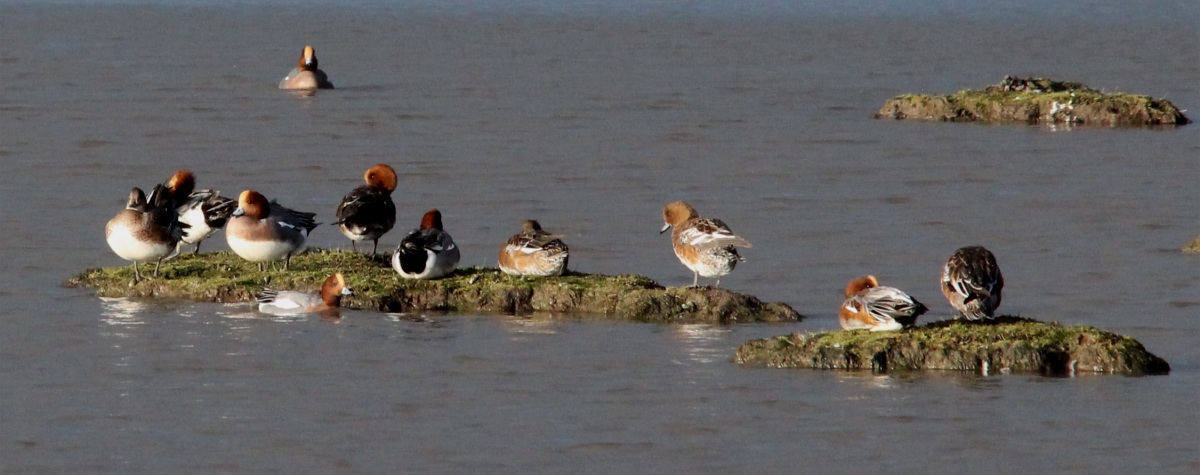
Wigeon, Crossens Inner Marsh
Three drakes in various stages of moult from eclipse (centre) to breeding (right)

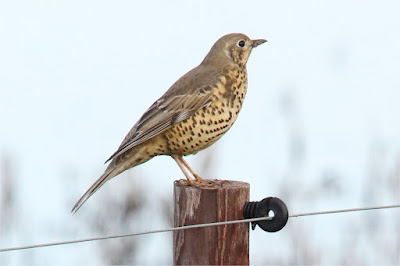
Mistle thrush, Crossens Inner Marsh

The lapwings on Crossens Inner Marsh eventually settled down only to rise up in panic again, this time triggered by an eruption of lapwings and starlings on the Outer Marsh. I tried, and failed, to find the cause and made a mental note to keep an eye out for potential suspects when I got over there. The usual crowd of black-headed gulls loitered round the pools at the end of the marsh by the water treatment works, more of them were making a racket round the settlement beds.

Lapwings, Crossens Inner Marsh

Greylags, Crossens Inner Marsh

Black-headed gulls, Crossens Inner Marsh

Carrion crow and buzzard, Crossens Inner Marsh

I crossed Marine Drive and walked down alongside Crossens Outer Marsh. When the sun was out it was glorious but you felt the chill when a cloud passed over and there was a cool breeze that went straight to the kidneys. There were thousands of birds out there, even if you don't count the hundreds of lapwings, black-tailed godwits and starlings billowing overhead and the skeins of pink-feet passing by. 

Meadow pipit, Crossens Outer Marsh

Nearby the little pools were mostly occupied by teal and shovelers with large groups of wigeon grazing on the banks and surrounding grass. Meadow pipits and pied wagtails bounced around on the turf by the old wildfowlers' pull-in. I was unlucky with the couple of water pipits: I saw them flying off as a chap picking litter accidentally got too close to the fence for their comfort. 

Pink-footed geese, Crossens Outer Marsh

A couple of pink-feet pottered about on the grazed grass by the road. There were dozens more over near the fencing and hundreds in the long grass on the salt marsh. Further out yet the whites of shelducks and little egrets stood out in the sunshine and a few hundred Canada geese grazed in the mid distance. Further out yet on Banks Marsh and beyond were lines and lines of  hundreds, if not thousands, of unidentifiable geese and ducks.

One Canada goose was sitting on its own not far from the pink-feet by the fence over by the salt marsh. On the principle that any social bird sitting on its own is worth a second look I gave it a second look. And a third. It was a compact, dark-looking bird so I got my hopes up on its being the Todd's Canada goose that keeps returning here. The road curves by the pull-in and this was to my advantage as the change of angle let me see that the black of the neck faded into the brown of the back and, crucially, that the black under the chin met the black of the neck. I'd found myself a Todd's and was quite pleased with myself.

The cause of the panics was revealed as I passed a merlin sitting by the roadside utterly indifferent to passersby. I put a bit of distance between us before getting out the camera but it didn't give a monkeys anyway.

The walk down to Marshside was more of the same, with the addition of families of greenfinches feeding in the hawthorns along the road.

Wigeon, Marshside

Marshside was relatively quiet. Polly's Pool was empty save a couple of herring gulls and all the geese and most of the wigeon were over on the side by the bund. Groups of teal, mallards and gadwall loafed and dabbled in the drains, pairs of shovelers dozed by pools and a few dozens of lapwings and black-tailed godwits fed on the grass. Four snipe flew by as I got to the cut with the wooden bench and they disappeared into the mounds of dead grass by the drain.

Gadwall, Marshside

Unusually there were no waterfowl at all on the pond by the entrance to Sandgrounders except for the moorhen picking its way through a crowd of herring gulls and juvenile great black-backs.

The birds on the pools at Sandgrounders were mostly mallards and wigeons with a few teal and gadwalls and a couple of pairs of shovelers. It wasn't my day for seeing any waders other than lapwings here today.

Wigeon and shovelers, Marshside

I didn't hold up much hope of seeing anything on the Junction Pool as there was a hedge-cutting team at work and I was dead wrong. The pool was littered with pintails, shovelers and mallards with dabchicks lurking in secluded corners. Oddly I didn't see a single tufted duck anywhere on Marshside today.

Marshside 

I walked up Marshside Road and sat on the bench overlooking the marsh for a few minutes, scanning the grazing cattle for any cattle egrets without any success. There were plenty of little egrets and starlings taking advantage of anything the cattle might disturb. It seems absurd to be thinking of its being "a bad year for cattle egrets," even if it has been.

The next train home was the one to Stalybridge that doesn't stop at all the halts but still has to take its time so as not to run into the tail of the Alderley Edge train that left Southport a few minutes minutes earlier. (The schedule has you waiting fifty minutes then two leave together.) We'd just left Burscough Bridge and were slowing down to steam through Hoscar when I noticed a large, pale bird in the dark ploughed field ahead. At first I thought it was a large chicken, it was hunched over and had that slow, deliberate plodding walk of a chicken on fallen leaves. Then I realised it was huge — bigger than any chicken — and had long legs. It was entirely wrong for a heron and besides, it was much bigger. I was completely baffled. It would have remained a "What the hell was that?" had it not turned when the train got abreast with it and I saw that it had a long neck and must be a crane of some sort. But I was still baffled, it didn't look like any crane I knew. I've seen one wild common crane and I've seen a few in collections but it didn't look like them. I craned my neck (pun not intended) as I made notes of its appearance. It was sandy grey, slightly paler underneath and at the front of the neck, mottled brown on the wings and dusky on the top of its head. Long neck, big and untidy body, long legs, bill pale and long but not so much as a heron or egret. All of this in the space of about twenty seconds. Over the next ten minutes I found out that juvenile common cranes don't look very much like the adults I've seen. I'd got a sore neck but I'd learned something new and added to the year list.


Monday, 14 November 2022

Wirral

Brent goose, Meols

I thought I'd start the week with a trip to the seaside, doing the usual walk between Leasowe and Hoylake and seeing where I got to after that. The day started cloudy with occasional hints of sunshine but settled into one of those overcast November days where everything that isn't cerulean blue and grey is in shades of rose gold.

The feeders in the back garden were busy with spadgers as I left home and the gulls were slowly drifting onto the school playing field. As I waited for my train at Humphrey Park I was serenaded by the calls of a large skein of pink-footed geese overhead.

The journey over to Liverpool renewed my worries about woodpigeons. For all that huge flocks are being reported migrating at dawn there doesn't to be many hanging round in their usual haunts. On a journey like this records of ones or twos of woodpigeons would join the dots between the places busy with birds. I'll have to have a deep look at my past records to see if this is as unusual as I think it is.

Mistle thrush, Kerr's Field

I got off the train at Moreton and walked down to Kerr's Field. There weren't many gulls on the rooftops of the industrial units today, which is unusual. Kerr's Field was busy with black-headed gulls, starlings and oystercatchers. It would have been busier with starlings had a female sparrowhawk not swooped in and scattered them. She made a couple of unsuccessful sallies then headed off for the fisheries. A pair of mistle thrushes rattled in one of the hawthorn bushes and the hedgerows were busy with robins, chaffinches and blue tits. A chiffchaff silently fly-catched from the top of one of the hawthorns over the Birkett, the first I've seen this month.

Leasowe Common 

I wandered through the trees on Leasowe Common. A couple of loosely-knit mixed tit flocks wandered with me, mostly long-tailed tits and blue tits with a few great tits and a couple of chiffchaffs. Possibly my last red admiral of the year buzzed me as I passed the wrecked hide on the little pond.

Cormorants and oystercatchers, Leasowe 

I joined the revetment and walked down to Meols. It was approaching high tide but the sea was like a mill pond and such waves as there were got as far as the bottom of the revetment and didn't have the energy to bother to lap. It never managed to cover all the sandbars so most of the waders were small figures in the distance. Black lines of oystercatchers delineated the water margins while cormorants crowded together to dry their wings. Most of the gulls were herring gulls but it was the black-headed gulls making the most noise. Far out in the distance I could just make out half a dozen common scoters flying low over the waves. A noisy skein of pink-feet overhead flew North towards the Lancashire mosses.

Dabchick, Meols

I don't know what I was expecting to see on the groyne but I didn't expect to see a dabchick fishing in the water between the rocks. A few redshanks and a little egret loafed at the end away from small dogs. 

Turnstone, Meols

As I walked down into Meols most of the waders were crowded on distant sandbanks. A few redshanks fed in the shallow water near by and little egrets grunted and barked at passersby. A small flock of a dozen turnstones flew in and started feeding at the base of the revetment, nearly all of them at that bare-headed stage of moult that makes them look like smaller birds in fat suits.

Shelducks, Meols

Small flocks of shelducks floated about waiting for the ebb with groups of common gulls that loafed and preened on the still water. The herring gulls and lesser black-backs were out on the sandbanks with the oystercatchers and curlews and black-headed gulls commuted between the fields and sandbanks.

Little egret, Meols

Oystercatcher and redshank

The tide ebbed with even less drama than it came in and by the time I was walking along Meols Promenade in the mizzle increasingly large patches of open mud were being occupied by waders and shelducks. The oystercatchers moved in first and spread themselves across the shallow water, redshanks following and making a racket in the process. Soon there were hundreds of dunlins and redshanks busily feeding by the sea wall. I scanned the dunlins for any exotica that I wouldn't be able to recognise anyway and they were all dunlins. A dozen black-tailed godwits tried to mind their own business and quietly feed in the puddles but two more of their number insisted on picking fights for no apparent reason other than bad temper. At first I thought there were only a couple of knots about, it turned out they were congregating on the patch of mud and samphires halfway down towards the lifeboat station. There were plenty of pied wagtails chasing each other round the place but no ringed plovers. 

Knots, Meols

Brent goose, Meols

The surprise of the day was a light-bellied Brent goose grazing on the sea grass at the foot of the sea wall. I'd hoped to see some today but thought they'd be dark shapes flying by in the distance.

The mizzle had become drizzle and by the time I reached the lifeboat station it had become rain so I decided to call it a day and headed off to Manor Road for the train homewards. I still haven't recalibrated for Greenwich Mean Time so I was making plans for the next port of call when the sun sank slowly in the West.

A couple of hundred dunlins, redshanks and knots, Meols Beach