Black-tailed godwits, Leighton Moss

Monday, 26 August 2024

Southport

Black-tailed godwits

Today has been one of those days that vividly illustrate why so few of us go birdwatching by public transport.

I decided to go over to Southport, I was due a wander round Marshside and the high pollen count would be a bit less fierce at the seaside. I got the quarter to ten train into Manchester so I could catch the Southport train, I could have had another cup of tea and got the twenty past, I'd still would have ten minutes' grace. Anyway, in the end I got to Southport about twenty minutes late, which in the scheme of things is par for the course.

I got the 44 to Marshside and walked down the road to the reserve. It was bank holiday weather, which is to say: grey, cool and windy. House martins swooped over the rooftops nonetheless. The marsh either side of Marshside Road was dry and grazed by greylags and Canada geese while curlews and flocks of starlings prodded for worms and grubs. I was surprised to see a pink-footed goose in the crowd. It's not unusual for one to stay behind for the Summer, injury or illness might have prevented its joining the others, usually I would have expected to see it hanging round before now. House martins and swallows hawked low over the ground so I thought I'd try and get a few action snaps which is how I found that while I'd been fussing about making sure everything else was fully charged I'd forgotten to charge the camera battery. I took this as an omen that I'd get gripping views of some startling rarity (I was dead wrong).

By Marshside Road 

All afternoon any egrets accompanying the cattle were little egrets.

Junction Pool

Mallards, gadwalls, black-tailed godwits and coots dozed on the Junction Pool with a couple of teal and a lapwing. A couple of migrant hawkers zipped around, I'd already bumped into one as I walked up Marshside Road and there was one patrolling the platform when the train called at Meols Cop. The best way to distinguish a migrant hawker from a Southern hawker whatever the sex and age is to look for a yellow mark shaped like a goblet at the top of the abdomen just above the wings. Generally speaking, if the dragonfly is obliging enough to let you look for a goblet mark at the top of the abdomen it's nearly always a Southern hawker.

At the corner of Marshside Road 

I crossed the road and went over to Sandgrounders, cheering myself up along the way with a small handful of dewberries. The pool by Sandgrounders was monopolised by moulting Canada geese. A few mallards tucked themselves under the banks, a couple of dozen herring gulls loafed on the grass behind the far bank and a great black-back tried not to look like it was being crowded out on one of the islands.

By Sandgrounders 

It was quiet at Sandgrounders. A few more Canada geese loafed on the big island, teal and a couple of young shovelers dabbled, a few mallards and gadwall loafed by the waterside. The avocets had all moved on and any other waders would be taking advantage of the low tide. Just as I thought there'd be absolutely nothing doing I found a common sandpiper catching midges in the corner of a bank with a couple of young pied wagtails. A flurry of starlings, woodpigeons and jackdaws in the distance turned out to have been spooked by a low flying marsh harrier which drifted over the road and beyond towards Hesketh Road.

Walking by Marshside Inner Marsh 

I decided to move on, following the path between the inner marshes and Marine Drive. The creeks and drains were eerily quiet, a few black-headed gulls here and there, two or three mallards or gadwalls every so often. Even the very occasional passing linnets, goldfinches or reed buntings were quiet. 

Crossens Inner Marsh 

A buzzard sat on one of the fence posts between Marshside and Crossens Inner Marsh. Woodpigeons sat on some of the others. Crossens Inner Marsh was sparsely populated by mallards, Canada geese and black-headed gulls though the pools over by the bund looked more promising. The linnets and reed buntings were quiet here, too. Unlike the stonechat which objected to my passing its bramble patch but, uncharacteristically, stayed out of sight. They usually like to get a good view of you to make sure you're on your way. The whitethroat which churred at me from the depths of a hawthorn was, amazingly, my first one of the month.

Looking over the road at the Outer Marsh the black-headed gulls dotted about the pools were joined here and there by shelducks and a few more could be seen in the distance. There were a few little egrets about, too, and as I was looking at one of them I noticed there was a female Merlin sitting on a fencepost in the distance, a sign of Autumn if ever there was.

Walking by Crossens Inner Marsh 

I carried on down the path, moorhens and herons joining the mallards and mute swans in the drains while swallows and house martins hawked low over the marsh. A kestrel flew in, hovered over the marsh then moved on. I decided to turn onto the bund and walk down back into Marshside. Chiffchaffs and robins called in the hedgerow by the water treatment works and tufted ducks lurked in the drain between that and the bund. Out on the marsh there were a few dozen black-headed gulls, all of which I scanned just in case a Mediterranean gull was amongst them, and a tightly packed flock of sleeping black-tailed godwits which I checked for any other waders. Most of the godwits were in Winter greys with motley patches of coppery summer reds and golds remaining to be moulted. I could hear a redshank somewhere on the marsh but try as I might I couldn't see it.

Black-tailed godwits 

A flock of spadgers fussed about in the brushes by the fence between Crossens Inner and Marshside. More Canada geese and greylags grazed, little egrets and moorhens fossicked about in creeks and drains, mute swans dozed while curlews called in the open grass.

I'd timed it right and had just a couple of minutes to wait for the 44 back to Southport. 

That's when my luck ran out. 

The train back to Oxford Road was cancelled and I had to wait half an hour for the one to Victoria. Which was a pain but I could change at Bolton for the airport train and get to Oxford Road to get the train home OK. I revised my plans when I noticed that was cancelled. As was the one afterwards. Which was moot anyway as we spent an hour and a half sat at signals by the Miry Lane Industrial Park just outside Wigan because the train that had been cancelled had been sent on ahead of us and broke down at Wigan Wallgate, blocking the line. The guard was very good and kept us informed as best he could but the train crew weren't being best informed by anybody about what was happening at Wigan. Had we but known we could have got off at Gathurst and got the bus into Wigan, it only takes half an hour. In the end our train was shunted back onto the Southport line and we got off at Wallgate on the wrong platform. Nothing was going down the Manchester line until the broken down train was sorted and nothing was coming in from Manchester until our train was out of the way back to Southport. I imagine that's how the trains behind us were decanted later. I don't know because I gave it up as a bad job, walked down to the bus station for the 132 back to the Trafford Centre, just missed the 25 and waited for the next 250, a twilight walk through the park and a "What time do you call this?" from the cat as I got home more than three hours late.

Saturday, 24 August 2024

Home thoughts

I hadn't intended staying at home listening to the cricket. I was still feeling guilty about having spent the fresh, sunny day after the storms listening to the Test Match yesterday but I allowed myself the excuse that I'd spent most of the night listening to the storm, including listening to the crow shouting defiance into the teeth of the worst of the wind just before dawn. I didn't see him again until teatime, he must have been as knackered as I was. Anyway, I wasn't doing that today. Then I looked at the options, bearing in mind that I'd want to avoid any city centres on Bank Holiday Saturday and I didn't fancy the crowds at the Trafford Centre bus station and decided I'd listen to the cricket.

The day started with the local female sparrowhawk visiting the garden. I don't know that she was successful — a blackbird darted out of the rowan as she darted in then she spent a while galumphing round in a hazel bush before disappearing. A couple of magpies were into the rowan almost the moment she left it and within a minute a flock of spadgers had descended on the feeders. 

The juvenile goldfinch that was being fed by its mother earlier in the week has hooked up with the spadgers and seems to be being treated as a junior partner rather like they do the young blue tits. Now they've got the hang of things the juvenile blue tits have joined the adults in the mixed tit flock with the great tits. The long-tailed tits join in every so often but they tend to plough their own furrow even in Winter. The robin's singing, or rather a robin's singing, I suspect it's this year's oldest.

Today's the first day in well over a month I've had double figures of species of birds in the back garden. The twelfth for the day was the ring-necked parakeet that's been flying around all week. It's been a flyover rather than a visitor to the garden so far, I'm still not sure how I'd feel about it becoming a regular. It would give the squirrels a bit of competition for the last of the hazel nuts, all I've managed to get for myself is a few empties. We'll say nothing about the cherries and pears that get eaten when they're only a quarter grown.

As I had a post-match walk down to the shop (England won), a flock of seventeen parakeets flew down the road, screeching all the way. And I counted fifty-seven pigeons roosting under what we used to call "the Quicks for Ford" bridge because that's what was advertised on it for the best part of forty years until the newly-privatised Network Rail realised nobody had paid for the advertising since Johnny Ray was in the Hit Parade.

As the sun sets slowly in the West…


Friday, 23 August 2024

Worsley Woods

Sketch map: Worsley Woods

Worsley Woods is a band of woodland between Roe Green and Worsley that follows the sweep of Kempnough Brook and Worsley Brook meeting at the pool by Old Warke Dam. It's a good hour or so's walk round, longer if you want a good rummage round. The woodland has the usual regulars, grey wagtails breed on Worsley Brook, Old Warke Dam usually has the waterfowl you'd expect round here. Most of the walking is fairly level, the Roe Green Loop to the East is an old railway line, and the long stairways down to Worsley Brook aren't compulsory unless you're looking for wagtails.

Worsley Woods 

The easiest way of getting there is to get the 20 bus that goes between the Trafford Centre and Bolton and get off at Worsley Delph to join the path from the South, at Beesley Green to join the path from the North, or Mabel Avenue to join the Roe Green Loop and wander in from the East. The 35 between Manchester and Leigh or Bryn and the 66 between Eccles and Prestwich stop at Worsley Court House just round the corner from Worsley Delph. 

Kempnough Brook 

The path down from the bus stop in Roe Green is the most immediately obvious one to find. Not long after you go through the gates the path splits, one looping round the edge of the woods to the Roe Green Loop, one following Kempnough Brook and one crossing the brook and looping round to meet the second path at the motorway to follow the brook to Old Warke Dam. There's a maze of other paths you can explore for a good walk round.

Worsley Brook 

At Worsley Delph you've got a choice. Take the road by the Delph Basin and you'll get to the paths around Worsley Brook. These tend to be a bit wild and can be muddy though the wettest stretches have long stretches of boardwalks. 

Walking up from Worsley Brook 

There's the option of taking the steps down to the boardwalk by the brook which is well worth doing if your knees can take it. There's a suite of steps at the other end for the steep rise to Old Warke Dam; there are a few meandering and often muddy paths that will eventually get you to the path at the top that gets round to the dam. It's actually quite hard to appreciate that the dam's there when you look from this direction, it just sort of comes as a logical deduction as you walk over to the pool.

Old Warke Dam 

If, when you get off the bus, you walk past The Delph pub and walk up Mill Brow there's a more sedate walk over to Old Warke Dam.

Worsley Woods can be part of a very pleasant longer walk. You can get here by walking up from Monton along Duke's Drive and joining the Roe Green Loop from that end. The Northern end of the loop is on Walkden Road just south of Walkden Station. A side branch running Northwest from Roe Green becomes the Woodland Trail to Ellenbrook which then runs alongside the guided busway to Leigh.

Old Warke Dam 

Byrom Hall Wood

Sketch map: Byrom Hall Wood and surrounds

Byrom Wood is another of the small patches of woodland scattered round Greater Manchester, bridging a bit of space between Golborne and Pennington Flash. You can treat it as a walk on its own or as an add-on to another local walk.

Looking back at Byrom Hall 

For a first visit it's probably easiest to get the 588 from Leigh and get off at Byrom Lodge. If you miss it on the way down you can get it on the way back — the bus shuttles between Leigh and Lowton. You want to take the path by Byrom Hall, the farmhouse by the roadside. (If you do miss it it's not a long walk up Slag Lane from the next stop at the riding centre). The lane across the road is Byron Lane which takes you to the Southern shore of Pennington Flash.  As you walk past Byrom Hall you go past farm pastures then fairly quickly into the woods.

Walking in from Golborne 

Alternatively you can get the 610 from Wigan or Leigh and get off at Golborne High School or Rothwell Gardens. It's a less obvious route into the woods from this direction, you need to walk down the path between Rothwell Gardens and Rothwell Road, join Farm Croft Drive and then carry on walking straight on as the road curves away to your left. Ignore the gates, keep walking ahead. You'll pass some rough pasture which is the haunt of goldfinches, swallows and butterflies then join a bit of light woodland. 

Looking over towards Abram

If you carry on through you'll get out into some wet pasture and a vista of open farm fields and meadows over to Abram. If you follow the quacks in front of you you'll find a willow-lined pond round the corner of the field. You can't go any further so you'll have to retrace your steps. A path follows the field boundary, enters woodland and eventually joins the metalled path within the wood. It can be very muddy. 

The path can get muddy

Alternatively, before you get to open country you can follow the path that forks to the right, passes a pond and joins the metalled path.

Byrom Wood 

There's a good metalled circular path around the wood which makes for a pleasant walk. There's a mixture of deciduous woodland with all the Red Rose Forest regulars and open glades with small ponds and little brooks.

The birdwatching is what you would expect from light woodland in Northwest England. In Winter expect finch flocks and mixed tit flocks, warblers in Summer, chiffchaffs and blackcaps abundant in the trees, whitethroats in the glades. I haven't bumped into willow tits here but I wouldn't be surprised if there were a pair of two here. If you're coming in from Golborne make sure to check out whichever pond you're passing just in case there's more than just mallards or teal about, especially in late Summer when black-necked grebes are dispersing and can stop for a rest at any stray patch of water. And don't forget to look up every so often for buzzards and kestrels.


Thursday, 22 August 2024

Worsley Woods

Juvenile grey wagtail

It had been a wild and woolly night, the precursor of Storm Saucy Mrs Trusspot, and it occurred to me that a visit to the coast might be in order to see what had been blown in. It then further occurred to me that it might be as well to let the effects of this morning's points failures work their way through the system before setting out anywhere on the trains. I had hoped the mid-morning melee of trains up and down the line was a hopeful sign but that was followed by a series of cancellations so I revised my plans as I watched the new baby goldfinches visiting the sunflower feeders.

Lostock Park 

I drifted over to Lostock Park where it wasn't just the weather that was autumnal. Apple trees and sweet chestnuts were chockablock with fruits and leaf fall was well underway. A few magpies and woodpigeons fed on the field. I was thinking how very, very quiet it was in the trees when a chiffchaff squeaked and a great tit ticked. I looked for either and found a treecreeper working its way up the branch of an ash tree. A couple of great tits broke cover between trees. I stood still and let the mixed flock pass me by, knowing that I was hearing and seeing not half of what the movements of leaves was suggesting and constantly being distracted by the wind in the trees and falling leaves. I heard the long-tailed tits long before I actually saw them. I didn't hear the two juvenile chiffchaffs at all, it was one of their parents doing the squeaking. The juveniles were rich, warm brown above with an orange wash on the olive brown underparts, quite different to the pale brownish grey of the adult.

Barton Clough 

It was a lot quieter in the old cornfields, even the thistles were unmolested by goldfinches. The goldenrod glowed in the dull light, the Pyracantha bushes were smothered in berries and a couple of blackbirds rummaged about in the brambles. I get the distinct impression that our local blackcaps and whitethroats packed it in early this year. I've seen no evidence of youngsters, which is a bit depressing.

Barton Clough 

Feeling a bit underwhelmed I got the 250 and played a half-hearted game of bus station bingo, ending up on the 20 to Bolton. This bus goes through Worsley, Walkden and Logistics North so there are plenty of walks I could choose to do. It seemed to take forever to get as far as Worsley, I bailed at Roe Green.

Kempnough Brook 

I took the path entering Worsley Woods from the North and soon found myself walking beside Kempnough Brook towards the motorway. This is a brisk flowing little brook that meanders through the woods before joining the pool at Old Warke Dam on the other side of the M60. Magpies and jays were suspiciously quiet as they flew between trees, woodpigeons sang and clattered about. It was a nice walk though very quiet for birds, a robin singing in the undergrowth by the motorway bridge being the only small bird I found on this stretch.

Worsley Woods 

The more open woodland on the other side of the motorway was more productive but not by much. Another robin sang, a great tit ticked and a chiffchaff squeaked. A wren quietly hopped about a bramble patch as I passed.

Teal, Old Warke Dam

The mallards and coots on the pool at Old Warke Dam were being spoilt rotten by dog walkers with bags of bread. A family of moorhens kept to the reeds and a lone teal sat and preened away from the crowds. Tufted ducks and gadwalls were notably absent.

Walking down to Worsley Brook

I walked down towards Worsley Brook, a jay and a ring-necked parakeet calling in the trees and squirrels scrabbling about by the path. My knees creaked as I took the flights of steps down to the brook and I tried not to think of the journey back up the steps and into Worsley. I was soon distracted by a family of grey wagtails on the brook with at least two juveniles bobbing about on the stones.

Male grey wagtail

Juvenile grey wagtail

It was a quiet walk along the boardwalk and up the steps to the path into Worsley. I took the route that runs beside the motorway and meets Worsley Road opposite the Court House where I got the 20 back to the Trafford Centre. I was glad of the walk even if it had been very quiet.

Worsley Woods 

Wednesday, 21 August 2024

Flint

Juvenile kestrel

I've been laying covetous eyes on the hudsonian godwit at Burton Mere on the Dee Estuary but I've scoped the logistics of getting there too often to entertain the idea of going there to see it. It then moved over the river to Flint and was still there late on last night. Flint's dead easy to get there from here (it's a quicker journey than getting to Leigh) so off I went.

Flint Castle 

I caught the Llandudno Junction train at Oxford Road and got off at Flint. It was a bright, cloudy day with a fresh breeze. I walked round the corner to Flint Castle. It was high tide and the castle afforded good views of the redshanks roosting on the nearby marsh with a lot of black-headed gulls and mallards. Out on the river dozens of lesser black-backs and herring gulls loafed on the water. A small flock of oystercatchers flew upstream and I found a couple of curlews and a single black-tailed godwit by the water's edge.

Flint Castle 

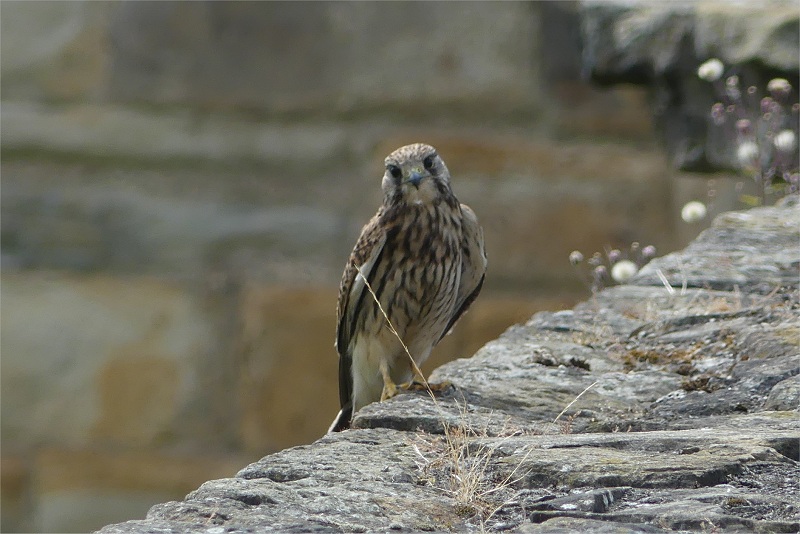
I spent a while having a look round the castle, which is worth the having a look round. As I was crossing over to the Great Tower a juvenile kestrel flew over and sat on the wall to have a look at me. It flew off but didn't go far, it came back and landed pretty much in the same place not long after.

Juvenile kestrel 

Juvenile kestrel 

Leaving the castle I walked round onto the Flint Marsh Walk, a very good path abutting the marsh with the water lapping by its foot at high tide. There was more water and less redshanks but plenty of black-headed gulls and mallards. About a dozen house martins zipped about over the path at head height. More herring gulls and lesser black-backs passed down the river and three common gulls danced for worms on the football pitch by the path. Large whites and speckled woods fluttered about the hedgerow further down the path and robins and chiffchaffs called in the trees.

Black-headed gull 

There was a small knot of birders at the end of the path. It didn't look too promising, they were all scanning in different directions. I couldn't see any waders about until a couple of small flocks of oystercatchers flew upstream. More oystercatchers flew by, as did a flock of about a dozen black-tailed godwits, all of them very definitely black-tailed godwits. I was looking for any of them with black underwings, diagnostic of hudsonian godwit. I wasn't the only person not to have any luck, nobody had seen it today. That flock of a dozen godwits was a one-off, there were no further waves coming in and even the oystercatchers slowed down to a few individuals. There was a lot of river out there for any waders to be roosting in, it was just our bad luck they weren't here.

River Dee, looking upstream towards Connah's Quay 

I was almost the last to go. I checked to see if the hudsonian godwit had been seen today over on the other side of the estuary but there were no reports. There was a report of a juvenile Sabine's gull seen flying down the estuary earlier on, though, so I made sure to be checking all the small gulls passing by (they were all black-headed) the same way I'd been checking all the starlings and redshanks fossicking in the marsh (they were all starlings and redshanks). As I was going another birder was coming along. We both remarked on the sudden clouding over and how fresh the weather had become and I wished him luck.

I had plenty of afternoon to play with so I had a wander round the foreshore downstream of the castle. There's a road going round the industrial estate and part way down a path branches off towards the shore. This in turn divides into two, one path following a high bank, the other following the shoreline. I took the muddy path.

Flint foreshore 

A couple of migrant hawkers patrolled the trees by the little creek at the start of the path. Goldfinches twittered, woodpigeons and collared doves sang, chiffchaffs squeaked. Low overhead a mixed flock of house martins and swallows were joined by a couple of swifts as the clouds got heavier.

Out on the river small groups of herring gulls — none more than half a dozen birds — and a few lesser black-backs and black-headed gulls loafed on the water. A few cormorants flew upstream. The weather was closing in but I was enjoying the walk and the scenery was good, the landscape taking on a grey and brooding air as the clouds darkened. As I turned the corner onto the creek leading to the dock a couple of teal flew in and mingled with the herring gulls that were having a bath.

Flint Castle from the foreshore 

I rejoined the path on the bank and walked down to the end where it meets the end of the road. I walked back to the station, passing a noisy family of great tits near the castle car park. It started raining just as the train arrived.

The godwit was reported again this evening at quarter to seven but was only giving distant views. It would have been a nice lifer to get but I had no complaints, I'd had a nice day out.

Tuesday, 20 August 2024

Pennington Flash

Egyptian goose

Rather to my surprise I got my visit to Pennington Flash though it wasn't straightforward. The 25 arrived on time but we spent ten minutes at the roadworks in Davyhulme and got to the Trafford Centre just in time to wave bye bye to the 132. I checked to see if there were any alternatives to waiting half an hour for the 126, thinking I might be able to get the 22 into Eccles or Monton and pick up the 35 to Leigh. Yep, no problem, get off on one of the stops on Half Edge Lane and wait six or seven minutes for the 35. Luckily Half Edge Lane isn't wide enough for buses to overtake easily so I just managed to flag down the 35 riding on our tail.

And so I got to Pennington Flash.

It had rained a couple of times on the way in and I was glad I'd brought my raincoat. The rest of the afternoon was sunny and very breezy which made me wonder if I shouldn't have taken the risk and left the raincoat at home and worn a jacket. It would have poured down then, mind. I walked in from St Helens Road and decided to take the paths to the sailing club to see what was about in the light woodland by the flash. At first it wasn't a lot despite my bumping into a juvenile blackcap by the old car park. Even the chiffchaffs weren't squeaking.

Pennington Flash 

Pennington Flash 

The water was choppy on the flash, making it tricky to be sure of what you were looking at in the distance before it disappeared behind a wave. Rafts of dozens of coots were scattered around the flash, mostly close to the banks. Great crested grebes were peppered about, with a dozen of them congregating over by Ramsdales. Most of the cormorants were over on the spit drying their wings. There were a few out in midwater and three of them appeared to be fishing cooperatively, diving and rising in synchronisation. The raft of forty-odd large gulls out in the middle were 50:50 herring gulls to lesser black-backs. There might have been a couple of dozen black-headed gulls out there, mostly over by the car park.

Pennington Flash 

On a whim I followed the scrappy path through the woodland that eventually gets you onto Green Lane. It's one of those paths used by kids and dogs. And willow tits, as I learned when my passing  a dense stand of elderberries provoked a lot of angry buzzing from the undergrowth. This eased the floodgates a little and along the way I bumped into a family of great tits, a few chiffchaffs, a nuthatch and a willow warbler, a bumper bounty on the past week's performance. Common blue damselflies zipped about on the path, Southern hawkers patrolled the tree margins, common darters chased each other over the brambles and a migrant hawker passed by just long enough for me to see what it was.

Winter Hill from Pennington Flash 

At the sailing club a young lesser black-back was loudly begging for food on the jetty while what I presume was a parent looked on disdainfully from a lamp standard. The youngster was old enough to be flying strongly, I guess it's also considered to be old enough to feed itself. A lot of movement on the slipway turned out to be a family of pied wagtails, the youngsters — as ever — at least as intent on chasing each other as actually finding anything to eat.

Egyptian goose

I walked back and round to the car park where the mallards and mute swans were assiduously mugging for scraps. One young girl finished throwing bread at ducks and decided she was going to kick one of the swans. I rather hoped it would savage her — they can break your wing with one blow of their nose you know — but the mute swans here are remarkably tolerant of unruly children and dogs. Unlike the Canada geese but they were otherwise engaged cruising up and down the lake like an Atlantic convoy. Seven Egyptian geese are still being reported here but I could only find five.

Lapwings

There were about a hundred lapwings on the spit by the Horrocks Hide though half of the crowd weren't for settling and kept flying off and coming back again five minutes later for no apparent reason.

At the Tom Edmondson Hide 

Dabchick

Cormorant

For once there were more gadwalls on the pool opposite the Tom Edmondson Hide than at it. Most of them were juveniles and needed a careful look to separate them from the three-quarter-sized mallards in the reeds. A cormorant sat and dried its wings in front of the hide while gadwalls and dabchicks drifted about apparently aimlessly. A couple of brown hawkers dashed about the hawthorns and elderberries in the hedgerows.

At Ramsdales Hide

The reeds at Ramsdales made for difficult viewing of the islands. The wind helped a bit, blowing the reeds apart every so often to give clear views of parts of the scene but the overall effect was of a fan dancer being especially coy. I saw a teal and a dozen lapwings and there was a crowd of great crested grebes in the mouth of the bight.

Firs Park

I walked down to the canal, crossed the bridge and walked into Plank Lane for the 588 bus into Leigh. I just missed it so I walked down to Firs Park to see what was on the pond before going back to get the 584. There were plenty of woodpigeons about but only the one coot was out on the water and a lone swift hawked low over the treetops.

It had been fine, if cool and breezy, for the entirety of the walk. It poured down all the way home.