Black-tailed godwits, Leighton Moss

Monday, 14 October 2019

Dawlish Warren

Dawlish Warren
A rough hour's twilight stroll to get the train journey out of my legs. Highlights included a couple of gannets and a great skua pretty far out into the English Channel and fly-bys of a red-throated diver and an arctic skua nearer in.

Plenty of cormorants and shags kicking about, though most of the dark shapes bobbing in the water turned out to be bits of driftwood.

Friday, 11 October 2019

Leasowe

Kestrel, Moreton
A late afternoon stroll round Leasowe Common, timed to avoid the rain. Walking down Pasture Road from Moreton Station I was pleased to find a male kestrel fly up and perch on top of a lamppost. It watched me take a few photos and then walk past with every evidence of not being much fussed about it.

The hedgerows by Kerr's Field were busy with house sparrows and goldfinches and a mixed tit flock which included goldcrests, a chiffchaff and a dozen long-tailed tits. The horse paddocks were quiet, just a few magpies and carrion crows and half a dozen mallards in a big puddle.

Leasowe Common
Leasowe Common was quiet. Plenty of crows, magpies and gulls but just a couple each of robins and wrens to be found amongst the trees. Interesting to see that somebody's built a hide screen overlooking the open bit of the pool amongst the reeds.

Leasowe Common: the view from the screen
It was low tide on the beach so most of the birds were pretty far out. They included herring, black-headed, lesser black-backed and common gulls, with just the one great black-back lumbering out to sea. A couple of large groups of oystercatchers were dotted with redshanks, a couple of little egrets and four curlews. Something interesting must have been out at the tide line as a dozen carrion crows were gathered round it.

Curlew, Leasowe beach
Walking back it was nice to see a couple of buzzards in Kerr's Field. Strangely, it was an overflying heron that spooked the mallards.

Heron

Wednesday, 9 October 2019

High Rid Reservoir

Juvenile grey wagtail
A brief, cold and wet stroll around High Rid this afternoon. I'd no sooner started walking along the most exposed side of the reservoir when it started hailing.

High Rid's a bit exposed for getting caught in a sudden hailstorm.
Luckily the showers and hailstorms passed as quickly as they arrived so there were breathing spaces for a bit of birdwatching. At least eighty pied wagtails were chasing each other around and I counted eight grey wagtails all told. Sixty-odd, or maybe more, meadow pipits split their time between the reservoir and the Winter stubble fields. Three kestrels — a male and a couple of juveniles — were patrolling these fields, much to the disgust of the jackdaws.

I literally lost count of the number of meadow pipits in this field, they disappeared so quickly and completely into the stubble.
Halfway along this stretch of path the wagtails and pipits rose up in a panic and whirled around my head. I was feeling guilty about my lack of field craft then had to take evasive action as a meadow pipit flew straight at me. Followed very quickly by shock as a female sparrowhawk swooshed by so intent on catching that pipit she very nearly had my cap off. It's only after moments like that you realise you should have grabbed your camera…

Twenty swallows and four house martins were feeding closely over the water.

Nice that the little gull was still around, lolling around with black-headed gulls in the murk.

First-Winter scaup
Fourteen dabchicks were dotted about the reservoir, a flock of tufted ducks hung around at the end near the entrance. A first-Winter scaup kept itself aloof from all these, spending more time diving underwater than being up top.

Distance and bad weather precluded any decent shots of either the scaup or the little gull, sadly. After a very damp hour I called it a day and went for the first of my buses home.


Monday, 7 October 2019

Southport

Kentish plover and ringed plover, Southport
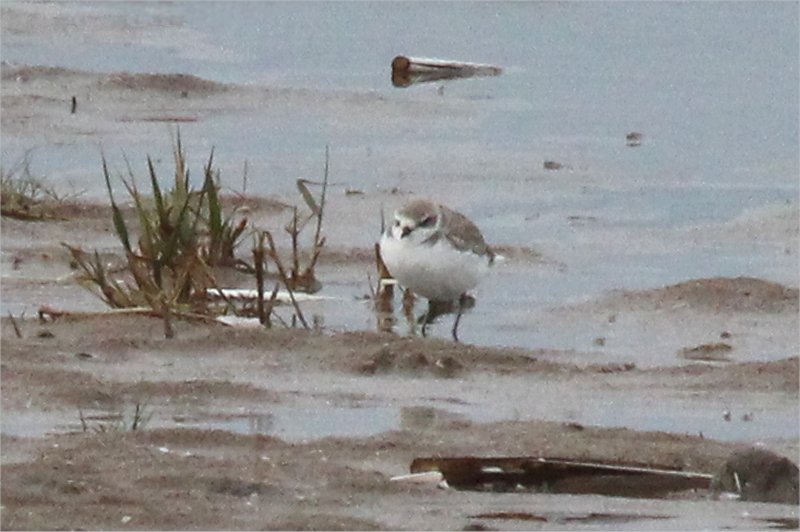
Over to Southport in murky weather to have a look at the very obliging Kentish plover on the beach opposite Pleasureland. A lifer and a bonny little bird at that.

Kentish plover and ringed plover, Southport
It was easy to see where it was by the gaggle of birdwatchers, even more so because an amiable chap called Phil was making sure every passer-by had a look at it through his telescope. It was actually very easy to see just with binoculars once you got your eye into whereabouts roughly it was. A small, pale bird with a very bright white breast.

Kentish plover, Southport
Kentish plover, dunlin and ringed plover, Southport
It looked like this bird was all front and no back end but that was mostly because the white tail disappeared into the background. Even so, a lot more front-heavy than the ringed plovers.

Kentish plover and ringed plover, Southport

Sunday, 6 October 2019

Mersey Valley

Long-tailed tit, Barlow Tip
A break in the weather, and I've kicked most of last week's cold, so I went for a stroll from Hardy Farm this afternoon. Lots of jays being very conspicuous as they quietly collected acorns and a few ring-necked parakeets making themselves almost invisible in the treetops as they screeched to high heaven. It amazes me how something as big, brash and electric green as a ring-necked parakeet can just disappear into a tree but they do it.

A mixed tit flock at Jackson's Boat included a couple of nuthatches, a chiffchaff and a willow tit. There may have been more but they were moving away from the river path towards the golf course.

A very swollen River Mersey at Jackson's Boat
The Mersey was very high indeed, a good three or four feet above the rocks along the bank. A couple of grey wagtails flew up and down trying — and failing — to find anywhere that wasn't either underwater or being walked by dogs. A couple of flocks of mallards were taking advantage of the seeds and vegetation being washed down the river, when they weren't avoiding golden retrievers taking advantage of the big sticks being washed down the river just shouting to be picked up and brought ashore. For a while they were joined by a cormorant which soon got fed up of trying to see through all the silt and moved on. Flying overhead a buzzard and a goosander added to the gaiety.

Barlow Tip away from the metalled path used by the methane inspectors was a quagmire, with fast-running streams running off the land and along this path. A couple more mixed tit flocks and a few blackbirds then the sky turned black and it started pouring down so I took the hint. The dream of finding some rare Sylvia warbler (which I'll struggle to identify) here will have to wait another day.

Tufted ducks, Chorlton Water Park
The rain eased off and Chorlton Water Park was busy with people but relatively quiet with birds. Nearly all the mallards seemed to be on the river, the only other ducks being a small flock of tufted ducks and two pairs of gadwall. The usual great crested grebes were nowhere to be seen. I scanned through a few dozen black-headed gulls on the off-chance but they were all black-headed gulls.

Thursday, 3 October 2019

Garden

It's an odd thing but we don't get many chaffinches this side of the railway line. If I go for a walk round Stretford Meadows or past the local allotments there'll be chaffinches in the trees and bushes all year round, same as most any place else. At home, or if I go for a walk round Lostock Park, they tend to be Winter visitors.

Earlier than usual, but a definite sign the weather's changed.

Chaffinch
Every so often I'm struck by the modestly handsome look of a dunnock in fresh plumage.

Dunnock
Dunnock

Wednesday, 2 October 2019

Local patch

Taking advantage of the sunshine to have a stroll round the local patch and get a bit of fresh air.

Barton Clough
An extremely quiet hour's walk, a dozen woodpigeons, eleven magpies and four goldfinches provided the crowd scenes.

A calling buzzard drifted overhead. I'm not sure it's the return of the old regular buzzard: this individual looks a lot browner underneath and with paler, more contrasting flight feathers to the underwing.

Buzzard
The old "regular" buzzard, February 2019
There's a long line of shrubs and trees along the side of the old freight railway track separating it from the industrial estate. These include hazels, Buddleias, Pyracanthus bushes and a stand of oleasters, providing cover and berries for birds during the Winter. The oleaster flowers are tiny and smell like that old furniture polish that had carnation oil as one of the ingredients, delicious from a distance but cloying en masse close to.

Oleaster berries
The magpies thought I was singing to them so I bought a bottle of Covonia on the way home.