Black-tailed godwits, Leighton Moss

Saturday, 2 November 2019

Home

The blackbirds stripped the last of the berries off the rowan by mid-September. I also have a Himalayan rowan (Sorbus hupehensis) and they usually leave that well alone until the hard times in late December (and often find that one of the local mistle thrushes has taken possession). Today the starlings found the tree.

Starlings
Starlings
Starlings
Starlings
Starlings
Starlings
Starlings
Starlings

Friday, 1 November 2019

Signs of Winter on the local patch

Redwing
Deceptively quiet afternoon stroll round the local patch (almost silent if you don't count the jay feeding at the top of one of the lime trees in the park).  Furtive rustlings deep in the bushes suggested where one of the mixed tit flocks was foraging but it was difficult to see most of the birds. Much more obvious were the finches — twenty two goldfinches, seven greenfinches and a couple of chaffinches — and the thrushes: thirty four blackbirds, a song thrush, the usual pair of mistle thrushes and the first two redwings of Winter.

Barton Clough

Wednesday, 30 October 2019

Local patch

Barton Clough
Today's plan was to take advantage of the good weather and take a walk over Chat Moss but I just didn't have the energy for it. After a lazy day I had a stroll round the local patch.

It was late afternoon so everything was winding down. Good numbers of Winter blackbirds working their way through the Pyracanthus berries and a sparrowhawk whizzed through on its way to Lostock Park.

I'm no good at identifying fungi

Tuesday, 29 October 2019

Leighton Moss

Leighton Moss
A visit to Leighton Moss on a bright sunny day. One of those days when the reserve suffers from its own success. I've written and deleted a long rant about some of the visitors, it was cathartic but not really the sort of things I want in this blog. After a couple of hours I grabbed a sausage butty and called it a day.

Leighton Moss
The recent floods had receded and the paths were passable but their effects could be seen all over. In particular, I've never seen the reedbeds on the way to the Griesdale and Tim Jackson hides looking so open.

Nice to see a great white egret on the Eric Morecambe pool. Duck numbers are starting to build up, particularly at the Lilian's and Griesdale  hides. A couple of Cetti's warblers were singing near the sky tower. They, and marsh tit were my prime targets for the day, I'd hoped for bearded tits but it was a bit late in the morning to connect with them.

Teal, Lilian's Hide

I got the train to Barrow, taking advantage of my Over 55's Explorer ticket. I intended doing a bit of Morecambe Bay watching from the train then do a quick reconnaissance to see how easy or not might be to get to South Walney. Alas, after seeing the afternoon's cancellations to come it became apparent I'd best get the next train back from Barrow to be sure of getting home at a sensible time. Even so, another cancellation at Lancaster nearly had me kicking my heels for a couple of hours.

Monday, 28 October 2019

Banks

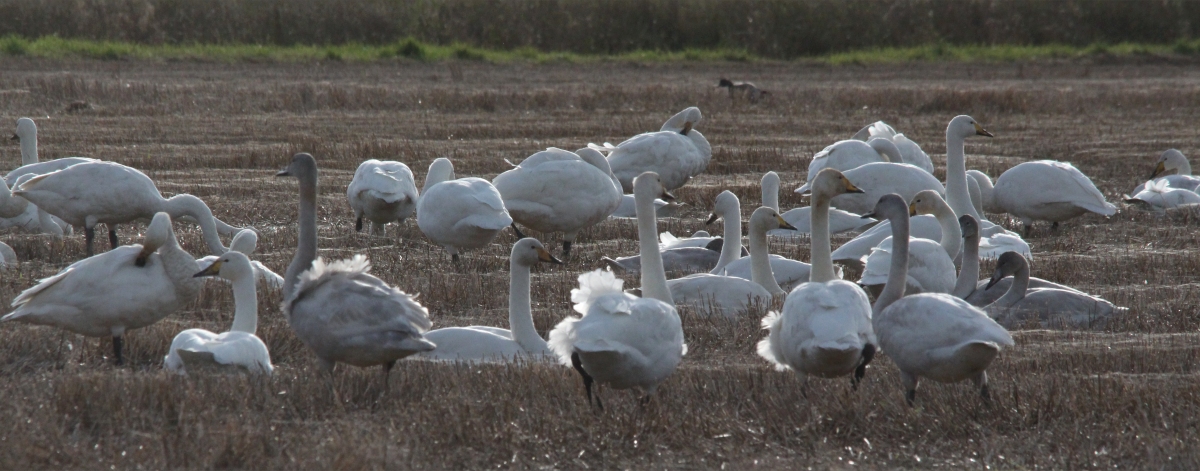
Greenland white-tronted geese, pink-footed geese and whooper swans
A whole bunch of American vagrants, and a few UK regulars I still don't have on the year list, had been reported from Banks over the past few days so I decided it was more than high time I spent the best part of a day there and get to grips with it properly rather than fitting in a quick shufti on a visit to Crossens.

It was Monday so of course Northern Rail had a meltdown. Anyway, I got to Southport and went to get the bus. My mistake here was to get the X2, not the 2. The X2 goes into Banks then turns and heads off towards Mere Brow and Tarleton, whereas the 2 carries on past Banks Marsh thence to Hundred End and Hesketh Bank. Not to worry: it was a nice walk from Mere Brow, I bumped into my first fieldfares of this Winter, four buzzards soared overhead and the bus I should have waited for only passed me a few minutes before I arrived at Banks Marsh.

Ribble Marshes from Banks
The most obvious thing walking down Marsh Lane was a field full of whooper swans. It was only as I got closer that I could see the pink-footed geese further back in the field. Working my way across the field with my binoculars I noticed two dark shapes in the middle of the swans which turned out to be a pair of white-fronted geese. I got a better view of them further down the road and managed to identify them as Greenland white-fronts.

Whooper swans
Whooper swans
Whooper swans
Something was spooking the jackdaws, woodpigeons and starlings feeding in the next field but I couldn't see anything flying about that might account for it.

From the embankment overlooking the Ribble the most obvious birds were the pied wagtails chasing each other about the mud immediately in front. Further out there were plenty of shelduck, wigeon, teal and mallard and little egrets were scattered about the creeks. Waders included lapwings, redshanks and dunlin and a modest flock of golden plover wheeled about the far bank. An Egyptian goose was a surprise. Three birdwatchers with big telescopes were trying to identify a bird which might have been the weekend's white-rumped sandpiper but with no success. It was too far away for me not to have been kidding myself at any identification. After a bit I decided I was jinxing it for the others and left them to it.

There was a lovely bit of cloud iridescence above the field of swans on the way back.

Cloud iridescence
The journey back was horrendous: I should have walked back to Crossens and picked up a bus there. The number 2 bus from Preston to Southport turns out to be horribly unreliable.

On the plus side, Greenland white-fronted goose brings the year list to 200.

Sunday, 27 October 2019

Stretford and Chorlton

Hardy Farm

A combination of Sunday public transport timetables and family commitments limits the options for what you can do with a sunny Sunday so I ended up taking a walk round the local patch (which was considerably quieter than yesterday) then getting a bus and walking down from Hardy Farm back to Stretford.

It was a busy family Sunday so most of the bird life was being heard but not seen. A few mixed tit flocks worked their way through the hedgerows. The ring-necked parakeets were being invisibly shrill. A low-flying buzzard swooped over the path and quickly on over Chorlton Ees. Walking through Chorlton Ees it occurred to me that I've never seen a heron on any of the bits of water or brooks here, it's purely a roosting site for them.

Grey herons
The River Mersey was very high still and both Hardy Farm and Chorlton Ees were very damp underfoot. Just how damp became evident when I got to Turn Moss.

Rain stopped play (for nearly everyone)
A couple of hundred black-headed gulls were playing in the puddles together with a couple of dozen common gulls and a handful of lesser black-backs and herring gulls.

Dawlish Warren

Sketch map of Dawlish Warren Nature Reserve
Dawlish Warren Nature Reserve is a spit of land almost closing the Exe Estuary at its mouth. The combination of location and variety of habitat in a small area make it a birdwatching hot spot. The open sea to the South and the more sheltered estuary with its creeks  and sandbanks to the north provide for a variety of seabirds, waders and wildfowl. At time of writing the official 2019 year list for this site is 175 species.

Most of the reserve is sand dunes, grassed over and covered with light scrub in places. There is a small patch of woodland near the visitor centre and around the Greenland Pool which is next to it. In some points storms have pretty much destroyed most of the dunes and taken old paths with them so you'll need to walk along the beach to get out to the furthest point.

The old sand dune path to the hide. This path was washed away in storms.
I usually walk down past the amusements to do a bit of seawatching from the wall and Langstone Rock. The sea bed is gently sloping here and you'll usually find a couple of shag hunting for dabs and you might strike lucky with a great-crested grebe or red-throated diver. Further out you'll almost certainly see kittiwakes and gannets and perhaps a flyby skua or two. There are some mussel beds at the end of Langstone Rock and these attract eiders and scoters. It's worth checking out any stray individuals, I've seen surf scoter and velvet scoter here.

Langstone Rock
Red-throated diver
Between the amusements and the visitor centre there's a roughly-grassed area crisscrossed with decked paths and a very small wooded patch with rough paths working their way through it. This area's quite good for passage migrants, highlights for me over the years have been black redstart, yellow-browed warbler and Siberian chiffchaff.

Black redstart
Passing through the gates just past to the visitor centre, on your left there's the Greenland Pool surrounded by reeds and a bit of woodland, dead ahead it's sandy heath, and to your right there's some dunes and the beach. There are rough paths (and a couple of less rough ones) starting at this gate splitting off and becoming roughly parallel to each other then converging on another gate a few hundred yards along, where the golf course meets the sand dunes.

Greenland Pool
I generally go clockwise round the pool and follow the paths nearest the golf course. The hawthorn bushes on the boundary are popular with finches, sometimes with large flocks of linnets and goldfinches. Cirl buntings can be found in the nearby farmland so it's worth looking out to see if any are about here.

Linnets
Once you get into the open area you start to see more meadow pipits and there's usually a pair of stonechats about and every bramble thicket has its dunnocks, robins and wrens. There are plenty of rock pipits on the beach and dunes to add to the small brown bird collection.

Stonechat
Rock pipit
The gate at the end brings you onto the dunes. Until recently there was a path here running along the boundary with the golf course then turning and dropping down into the bight and on to the hide. This has been destroyed by storms so you now have to drop down to the beach and walk down to Groyne 18 near the end of the point.

Sanderlings
The beach is good for a bit more seawatching — the river cuts a channel out  to sea and the deeper water brings kittiwakes and sea ducks closer to shore, and sometimes you might find a great northern diver. A Bonaparte's gull was a Winter fixture here for a few years.

Ringed plovers, sanderlings and dunlin can be found on the beach around high tide. Further along these may be joined by grey plovers. Gulls — mostly herring and black-headed — loaf about at the end of the point.

At Groyne 18 the grassy dunes drop down to the beach. There are a few rough paths leading into what is almost a small island of sandy heath. I was once lucky enough to find a Dartford warbler in one of the hawthorn bushes a few years back so I always look twice at any dunnocks lurking about.

One of the paths leads nearly straight to the golf course and down towards the hide. It's a two-story hide facing up the estuary, on a clear day you can see up to Countess Wear. The water's calmer on this side of the Warren and the bird life is different. Wintering brent geese feed and roost here. Wigeon and teal can be seen in the salt marshes on your left. The mound directly in front of the hide is a roosting point for waders at high tide. Sometimes the number of oystercatchers and knots here is huge. Looking out into the deeper channels in the estuary you might see red-necked mergansers and in Winter if you look over to the left towards the railway line you've a good chance of seeing "the usual" Slavonian grebe (I've no idea if it's always the same one every year).

Oystercatchers and cormorants from the hide
Brent geese from the hide
The hide's best at high tide, though you have to time your journey carefully now the only path is via the beach. At low tide it's less productive and most of what's around is pretty distant, but every so often something special will tag along with the linnets, pipits and wagtails feeding on the mud. My best bird from this hide was a Richard's pipit, donkeys years ago, being chased around by pied wagtails here at low tide. More usually it's wheatears.

The way back is the way you came, though there are enough paths around for you not to have to exactly retrace your steps all the way.

Seawatching weather at Dawlish Warren
The excellent Dawlish Warren blog provides latest sightings and past records, as well as useful links to other Devon wildlife blogs.